PUBLISHER: Mordor Intelligence | PRODUCT CODE: 2187172

PUBLISHER: Mordor Intelligence | PRODUCT CODE: 2187172
China Crop Protection Chemicals - Market Share Analysis, Industry Trends & Statistics, Growth Forecasts (2026 - 2031)
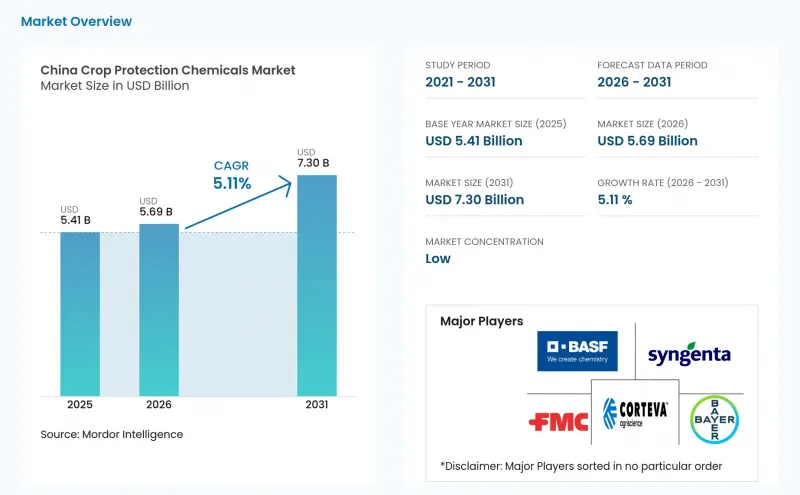
According to Mordor Intelligence, the China crop protection chemicals market size was valued at USD 5.41 billion in 2025 and is forecast to grow from USD 5.69 billion in 2026 to USD 7.30 billion by 2031, at a CAGR of 5.11% from 2026 to 2031.
China Crop Protection Chemicals Market Trends and Insights
Food-Security Grain Self-Sufficiency Programs
China's focus on food security and grain self-sufficiency is supporting sustained demand for crop protection chemicals across major staple-crop production areas. The national crop farming development plan for the 15th Five-Year Plan period (2026-2030) targets comprehensive grain production capacity of about 725 million metric tons by 2030 and calls for more precise and careful use of fertilizers and pesticides, according to the Ministry of Agriculture and Rural Affairs. The policy direction supports continued use of fungicides, insecticides, and herbicides to protect yields during critical crop-development stages, particularly in large-scale grain production. In addition, China's National Food Security Law, effective from June 2024, aims to maintain absolute security in staple grains and basic self-sufficiency in other grains, reinforcing the importance of reliable domestic agricultural production and input availability, according to the United States Department of Agriculture Foreign Agricultural Service (USDA FAS). These priorities make effective crop protection an important component of maintaining stable yields and reducing production risks. Suppliers offering products with strong efficacy, appropriate application rates, and reliable availability are therefore well positioned to benefit from China's long-term food-security agenda.
Labor Scarcity and Mechanized Post-Emergence Weed Control
Rural labor movement toward non-agricultural employment is increasing the need for labor-saving weed-control practices, particularly where manual weeding is difficult to complete within narrow crop-protection windows. Selective post-emergence herbicide programs can reduce manual field operations and the number of field passes, increasing the value of reliable chemical weed-control programs across larger managed farms. China's expanding grain production also provides a substantial application base for herbicides. According to the USDA FAS, China is anticipated to produce a record 301.2 million metric tons of corn in marketing year 2025/26, supported by higher yields. Larger-scale corn production and greater reliance on mechanized farming support the adoption of chemical weed management as an alternative to labor-intensive practices. The China crop protection chemicals market therefore benefits as grain producers increasingly prioritize herbicide programs that provide effective post-emergence control with fewer field operations.
Tightening Registration, Maximum Residue Limits, and Toxic-Active Restrictions
Stricter pesticide registration requirements and restrictions on toxic active ingredients are increasing the regulatory burden for manufacturers and growers in China. Compliance with evolving safety requirements necessitates regular reviews of product portfolios, registered uses, technical documentation, and labeling. These obligations can increase the cost and administrative burden of maintaining older products, particularly for smaller formulators and suppliers with limited regulatory capabilities. Products containing restricted active ingredients or lacking sufficient residue and safety data may require additional testing, revised application instructions, or withdrawal from specific uses, potentially delaying product launches and limiting market access. The market may therefore increasingly favor companies with established registration expertise, comprehensive technical documentation, and portfolios aligned with evolving pesticide safety requirements.
Other drivers and restraints analyzed in the detailed report include:
- Precision Agriculture and Drone Spraying
- Expansion of High-Value Fruits and Vegetables and Export Compliance
- Resistance to Glyphosate, ALS Inhibitors, Pyrethroids, Neonicotinoids, and Triazoles
For complete list of drivers and restraints, kindly check the Table Of Contents.
Segment Analysis
The herbicide segment accounted for 39.0% of the China crop protection chemicals market share in 2025, making it the largest function segment. Its leading position is supported by the expansion of mechanized farming, labor shortages, and the need for efficient weed control across major grain crops such as corn, wheat, and rice. Larger farms increasingly rely on chemical weed management to reduce manual field operations and maintain timely control during critical crop-growth stages. Insecticides remain important across rice, vegetables, and fruits, where recurring pest pressure supports regular applications, while fungicides continue to play an important role in disease management across grain and horticultural crops. The broad application base of herbicides across China's major cropping systems gives suppliers opportunities to serve both large-scale grain producers and smaller farms.
Herbicide is also the fastest-growing function segment, projected to expand at a 5.4% CAGR between 2026 and 2031. Its growth is supported by continued mechanization, increasing adoption of labor-saving weed-control practices, and the need to manage herbicide-resistant weed populations through more effective and diversified treatment programs. Growing demand for selective and post-emergence products is also encouraging suppliers to develop formulations with improved efficacy and crop safety. At the same time, resistance management is increasing the importance of rotating modes of action and integrating chemical and non-chemical weed-control practices. These trends are creating opportunities for players with differentiated herbicide portfolios, while regulatory requirements and resistance concerns are increasing the importance of product stewardship and application guidance.
Complete Report Scope:
- Function
- Fungicide
- Herbicide
- Insecticide
- Molluscicide
- Nematicide
- Application Mode
- Chemigation
- Foliar
- Fumigation
- Seed Treatment
- Soil Treatment
- Crop Type
- Commercial Crops
- Fruits and Vegetables
- Grains and Cereals
- Pulses and Oilseeds
- Turf and Ornamental
List of Companies Covered in this Report:
- Syngenta Group Co., Ltd.
- BASF SE
- Bayer AG
- Corteva, Inc.
- FMC Corporation
- Nufarm Limited
- Sumitomo Chemical Company, Limited
- UPL Limited
- Nutrichem Co., Ltd.
- Shandong Weifang Rainbow Chemical Co., Ltd.
- Zhejiang Xinan Chemical Industrial Group Co., Ltd.
- Nanjing Red Sun Co., Ltd.
Additional Benefits:
- The market estimate (ME) sheet in Excel format
- 3 months of analyst support
TABLE OF CONTENTS
1 INTRODUCTION
- 1.1 Study Assumptions and Market Definition
- 1.2 Scope of the Study
- 1.3 Research Methodology
2 REPORT OFFERS
3 EXECUTIVE SUMMARY AND KEY FINDINGS
4 KEY INDUSTRY TRENDS
- 4.1 Consumption of Pesticide per Hectare
- 4.2 Pricing Analysis for Active Ingredients
- 4.3 Regulatory Framework
- 4.4 Value Chain and Distribution Channel Analysis
- 4.5 Market Drivers
- 4.5.1 Food-Security Grain Self-Sufficiency Programs
- 4.5.2 Labor Scarcity and Mechanized Post-Emergence Weed Control
- 4.5.3 Precision Agriculture and Drone Spraying
- 4.5.4 Expansion of High-Value Fruits and Vegetables and Export Compliance
- 4.5.5 Transgenic Corn and Soybean Commercialization Shifting Herbicide Mix
- 4.5.6 Distributor Consolidation and Agricultural-Input E-Commerce
- 4.6 Market Restraints
- 4.6.1 Tightening Registration, Maximum Residue Limits, and Toxic-Active Restrictions
- 4.6.2 Resistance to Glyphosate, ALS Inhibitors, Pyrethroids, Neonicotinoids, and Triazoles
- 4.6.3 Dual-Control Energy Policies and Environmental Shutdowns Causing Technical-Grade Volatility
- 4.6.4 Regenerative Rice and Reduced-Input Programs Cannibalizing Conventional Pesticide Demand
5 MARKET SIZE AND GROWTH FORECASTS (VALUE AND VOLUME)
- 5.1 Function
- 5.1.1 Fungicide
- 5.1.2 Herbicide
- 5.1.3 Insecticide
- 5.1.4 Molluscicide
- 5.1.5 Nematicide
- 5.2 Application Mode
- 5.2.1 Chemigation
- 5.2.2 Foliar
- 5.2.3 Fumigation
- 5.2.4 Seed Treatment
- 5.2.5 Soil Treatment
- 5.3 Crop Type
- 5.3.1 Commercial Crops
- 5.3.2 Fruits and Vegetables
- 5.3.3 Grains and Cereals
- 5.3.4 Pulses and Oilseeds
- 5.3.5 Turf and Ornamental
6 COMPETITIVE LANDSCAPE
- 6.1 Key Strategic Moves
- 6.2 Market Share Analysis
- 6.3 Company Landscape
- 6.4 Company Profiles (includes Global level Overview, Market level overview, Core Business Segments, Financials, Headcount, Key Information, Market Rank, Market Share, Products and Services, and analysis of Recent Developments)
- 6.4.1 Syngenta Group Co., Ltd.
- 6.4.2 BASF SE
- 6.4.3 Bayer AG
- 6.4.4 Corteva, Inc.
- 6.4.5 FMC Corporation
- 6.4.6 Nufarm Limited
- 6.4.7 Sumitomo Chemical Company, Limited
- 6.4.8 UPL Limited
- 6.4.9 Nutrichem Co., Ltd.
- 6.4.10 Shandong Weifang Rainbow Chemical Co., Ltd.
- 6.4.11 Zhejiang Xinan Chemical Industrial Group Co., Ltd.
- 6.4.12 Nanjing Red Sun Co., Ltd.
7 KEY STRATEGIC QUESTIONS FOR CROP PROTECTION CHEMICALS CEOS

