PUBLISHER: Mordor Intelligence | PRODUCT CODE: 2187199

PUBLISHER: Mordor Intelligence | PRODUCT CODE: 2187199
Large Caliber Ammunition - Market Share Analysis, Industry Trends & Statistics, Growth Forecasts (2027 - 2032)
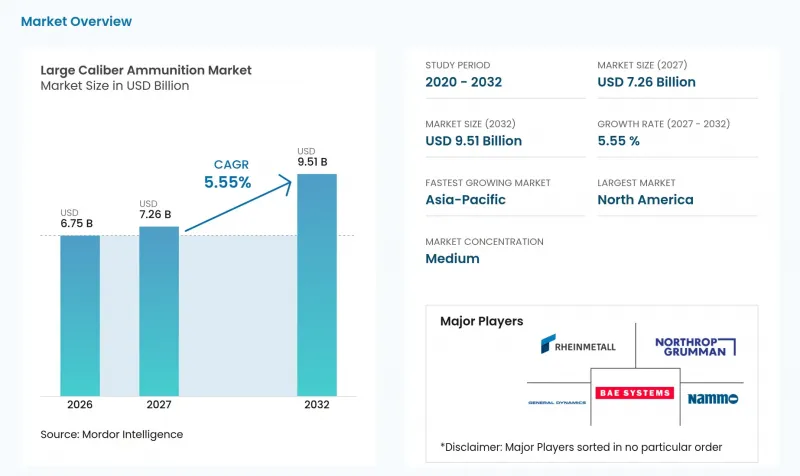
According to Mordor Intelligence, the large caliber ammunition market size was valued at USD 6.75 billion in 2026 and is projected to grow from USD 7.26 billion in 2027 to USD 9.51 billion by 2032, registering a 5.55% CAGR between 2027 and 2032.
Global Large Caliber Ammunition Market Trends and Insights
Defense Stockpile Replenishment and Readiness Procurement
The large caliber ammunition market is supported by efforts to restore reserves after years of procurement based on peacetime consumption. The US Department of Defense (DoD) reported that the Army had spent USD 4.5 billion on 155mm production infrastructure from February 2022 through September 2025. The same assessment recorded 36,000 155mm load, assemble, and pack rounds per month in March 2026, against an Army target of 100,000 rounds per month. This gap links demand to both finished shells and the industrial inputs needed to produce them. Rheinmetall received its first call-off under a NATO Support and Procurement Agency framework in February 2026 for 120mm tank ammunition, with an order value of around EUR 200 million (USD 236.16 million). Long-term call-offs can support steadier production schedules than one-time emergency orders.
Artillery Modernization and Long-Range Fires Investment
Long-range fire programs are increasing the technical demands placed on large-caliber rounds. General Dynamics Ordnance and Tactical Systems received a US Army ERAP contract in June 2026 for its Vulcano 155mm Guided Long Range round. Rheinmetall and General Atomics also agreed in June 2026 to examine co-production of the Vektrex maneuverable 155mm munition. These programs extend demand beyond projectile bodies to guidance, fuzes, and modular propellant systems. Higher-pressure charge requirements for 52-caliber platforms also increase the importance of specialized chemical production. Producers that can validate complete round systems are better placed to serve these programs. The large caliber ammunition market, therefore, benefits from modernization spending even when basic replenishment needs begin to ease.
Explosives, Propellant, and Nitrocellulose Bottlenecks
Propellant and nitrocellulose availability remain a material constraint on the large caliber ammunition market. Rheinmetall acquired Hagedorn-NC GmbH in April 2025 to secure a domestic source of nitrocellulose for military applications. The action shows that control of energetic materials has become a production priority, rather than a routine procurement activity. A shortage at this stage limits the output of otherwise completed shell plants and filling lines. It can also delay delivery against contracts, even where the final assembly capacity exists. Producers with access to secure energy and propellant supplies can reduce this exposure, while companies reliant on external sources face greater delivery risk.
Other drivers and restraints analyzed in the detailed report include:
- Domestic Production Incentives and Supply-Security Policies
- Precision-Guided and Extended-Range Ammunition Adoption
- Qualification and Safety-Certification Lead Times
For complete list of drivers and restraints, kindly check the Table Of Contents.
Segment Analysis
Artillery ammunition accounted for 38.91% of the large caliber ammunition market share in 2026, with 155mm rounds the primary driver of demand. Western replenishment programs and factory expansions remain heavily focused on this caliber. The US Army reported that its 155mm load, assemble, and pack capacity was 36,000 rounds per month in March 2026. Rheinmetall's UnterluB facility is planned to add a substantial 155mm output during 2026 and 2027. Tank ammunition remains a secondary demand center, with Rheinmetall's February 2026 call-off providing direct evidence of continued 120mm requirements.
Mortar ammunition is forecast to record the fastest product-type CAGR at 7.37% through 2032. Its growth is linked to decentralized infantry support, in which lighter crew-served systems can provide shorter response times. Mortar demand complements artillery demand because many forces are refreshing several fire-support categories simultaneously, and flexible lines can serve both high-volume 155mm orders and smaller-caliber requirements. Naval ammunition and rocket artillery remain relevant to platform modernization. The large caliber ammunition market is therefore anchored by artillery output, with mortar rounds contributing the strongest growth rate.
Military procurement accounted for 55.27% of the market share for large-caliber ammunition in 2026. Army orders are central because they include requirements for howitzer, tank, and mortar ammunition. Northrop Grumman's multi-year M1147 contract shows sustained military demand for programmable tank ammunition. Military buyers use multi-year frameworks to protect production capacity and support stockpile planning, as shown by Rheinmetall's NATO procurement framework for 120mm tank ammunition. This customer group continues to set the volume requirements that determine investment in manufacturing capacity.
Law enforcement and homeland security are forecast to be the fastest-growing end-user categories at an 8.43% CAGR through 2032. The segment begins with a smaller base than military procurement. Its expansion reflects the use of heavy-caliber systems by internal security and paramilitary agencies in selected countries, while also adding an alternative source of demand when military budget cycles are uneven. Suppliers must address the separate procurement rules and operational needs of these customers. The large caliber ammunition market depends on military buyers for scale, while this category creates a smaller but faster-growing demand stream.
Complete Report Scope:
- By Product Type
- Artillery Ammunition
- 105mm
- 130mm
- 155mm
- 203mm
- Tank Ammunition
- 105mm
- 120mm
- 125mm
- Mortar Ammunition
- 60mm
- 81mm
- 120mm
- Naval Ammunition
- 57mm
- 76mm
- 127mm
- Rocket Artillery Ammunition
- 70mm
- 122mm
- Artillery Ammunition
- By End-User
- Military
- Air Force
- Army
- Navy
- Law Enforcement/Homeland Security
- Military
- By Guidance
- Guided Ammunition
- Non-Guided Ammunition
- By Component
- Fuzes
- Primers
- Propellants
- Projectiles and Warheads
- Cartridge Case
- Others
- By Geography
- North America
- United States
- Canada
- Mexico
- Europe
- United Kingdom
- France
- Germany
- Russia
- Rest of Europe
- Asia-Pacific
- China
- India
- Japan
- South Korea
- Rest of Asia-Pacific
- South America
- Brazil
- Rest of South America
- Middle East and Africa
- Middle East
- Saudi Arabia
- United Arab Emirates
- Rest of Middle East
- Africa
- South Africa
- Rest of Africa
- Middle East
- North America
Geography Analysis
North America held 46.72% of the large caliber ammunition market share in 2026, supported by the US Army procurement, established industrial infrastructure, and regional manufacturing investment. The US DoD reported a monthly load, assembly, and pack capacity of 36,000 155mm rounds in March 2026. The Army projected 140,000 rounds per month by December 2027, subject to facility ramp-ups, and CSG began work on a Future Artillery Complex in Iowa during 2026. North America remains a key center of demand and production because its procurement base can support long-duration capacity commitments and the qualification of new lines.
Asia-Pacific is forecast to record the fastest regional CAGR at 8.11% through 2032. The region combines domestic capacity initiatives with strategic stockpile investment across South Korea, India, Japan, and Australia. Munitions India Limited's FY2025-2026 revenue of INR 10,954 crore (USD 1.3 billion) points to the scale of domestic procurement activity in India. Regional manufacturers are gaining relevance as governments reduce dependence on overseas supply and seek capacity that can serve both national demand and regional export opportunities. This mix of domestic demand and industrial investment supports the region's leading growth outlook.
Europe remains central to the large caliber ammunition market as it rebuilds stockpiles and expands capacity to meet NATO demand. Rheinmetall's UnterluB facility is scheduled to reach 350,000 155mm shells of annual output in 2027. Germany also supported a new ammunition factory in Lithuania through a November 2025 groundbreaking initiative. The Middle East and Africa remain secondary demand areas. At the same time, South America is more focused on legacy artillery systems.
- General Dynamics Corporation
- BAE Systems plc
- Rheinmetall AG
- Nammo AS
- Elbit Systems Ltd.
- Northrop Grumman Corporation
- KNDS N.V.
- Hanwha Corporation
- Thales Group
- Leonardo S.p.A.
- Saab AB
- Singapore Technologies Engineering Ltd.
- Munitions India Limited
- Poongsan Corporation
- Denel SOC Ltd.
- Diehl Stiftung & Co. KG
Additional Benefits:
- The market estimate (ME) sheet in Excel format
- 3 months of analyst support
TABLE OF CONTENTS
1 INTRODUCTION
- 1.1 Study Assumptions and Market Definition
- 1.2 Scope of the Study
2 RESEARCH METHODOLOGY
3 EXECUTIVE SUMMARY
4 MARKET LANDSCAPE
- 4.1 Market Overview
- 4.2 Market Drivers
- 4.2.1 Defense stockpile replenishment and readiness procurement
- 4.2.2 Artillery modernization and long-range fires investment
- 4.2.3 Domestic production incentives and supply-security policies
- 4.2.4 Precision-guided and extended-range ammunition adoption
- 4.2.5 Production localization around alliance interoperability standards
- 4.2.6 Modular ammunition and platform-life extension programs
- 4.3 Market Restraints
- 4.3.1 Explosives, propellant, and nitrocellulose bottlenecks
- 4.3.2 Qualification and safety-certification lead times
- 4.3.3 Budget volatility and multi-year contract dependence
- 4.3.4 Digital guidance, fuze, and energetics integration complexity
- 4.4 Value Chain Analysis
- 4.5 Regulatory Landscape
- 4.6 Technological Outlook
- 4.7 Porter's Five Forces Analysis
- 4.7.1 Bargaining Power of Buyers
- 4.7.2 Bargaining Power of Suppliers
- 4.7.3 Threat of New Entrants
- 4.7.4 Threat of Substitute Products
- 4.7.5 Intensity of Competitive Rivalry
5 MARKET SIZE AND GROWTH FORECASTS (VALUE)
- 5.1 By Product Type
- 5.1.1 Artillery Ammunition
- 5.1.1.1 105mm
- 5.1.1.2 130mm
- 5.1.1.3 155mm
- 5.1.1.4 203mm
- 5.1.2 Tank Ammunition
- 5.1.2.1 105mm
- 5.1.2.2 120mm
- 5.1.2.3 125mm
- 5.1.3 Mortar Ammunition
- 5.1.3.1 60mm
- 5.1.3.2 81mm
- 5.1.3.3 120mm
- 5.1.4 Naval Ammunition
- 5.1.4.1 57mm
- 5.1.4.2 76mm
- 5.1.4.3 127mm
- 5.1.5 Rocket Artillery Ammunition
- 5.1.5.1 70mm
- 5.1.5.2 122mm
- 5.1.1 Artillery Ammunition
- 5.2 By End-User
- 5.2.1 Military
- 5.2.1.1 Air Force
- 5.2.1.2 Army
- 5.2.1.3 Navy
- 5.2.2 Law Enforcement/Homeland Security
- 5.2.1 Military
- 5.3 By Guidance
- 5.3.1 Guided Ammunition
- 5.3.2 Non-Guided Ammunition
- 5.4 By Component
- 5.4.1 Fuzes
- 5.4.2 Primers
- 5.4.3 Propellants
- 5.4.4 Projectiles and Warheads
- 5.4.5 Cartridge Case
- 5.4.6 Others
- 5.5 By Geography
- 5.5.1 North America
- 5.5.1.1 United States
- 5.5.1.2 Canada
- 5.5.1.3 Mexico
- 5.5.2 Europe
- 5.5.2.1 United Kingdom
- 5.5.2.2 France
- 5.5.2.3 Germany
- 5.5.2.4 Russia
- 5.5.2.5 Rest of Europe
- 5.5.3 Asia-Pacific
- 5.5.3.1 China
- 5.5.3.2 India
- 5.5.3.3 Japan
- 5.5.3.4 South Korea
- 5.5.3.5 Rest of Asia-Pacific
- 5.5.4 South America
- 5.5.4.1 Brazil
- 5.5.4.2 Rest of South America
- 5.5.5 Middle East and Africa
- 5.5.5.1 Middle East
- 5.5.5.1.1 Saudi Arabia
- 5.5.5.1.2 United Arab Emirates
- 5.5.5.1.3 Rest of Middle East
- 5.5.5.2 Africa
- 5.5.5.2.1 South Africa
- 5.5.5.2.2 Rest of Africa
- 5.5.5.1 Middle East
- 5.5.1 North America
6 COMPETITIVE LANDSCAPE
- 6.1 Market Concentration
- 6.2 Strategic Moves
- 6.3 Market Share Analysis
- 6.4 Company Profiles (includes Global Level Overview, Market Level Overview, Core Segments, Financials as available, Strategic Information, Market Rank/Share, Products and Services, and Recent Developments)
- 6.4.1 General Dynamics Corporation
- 6.4.2 BAE Systems plc
- 6.4.3 Rheinmetall AG
- 6.4.4 Nammo AS
- 6.4.5 Elbit Systems Ltd.
- 6.4.6 Northrop Grumman Corporation
- 6.4.7 KNDS N.V.
- 6.4.8 Hanwha Corporation
- 6.4.9 Thales Group
- 6.4.10 Leonardo S.p.A.
- 6.4.11 Saab AB
- 6.4.12 Singapore Technologies Engineering Ltd.
- 6.4.13 Munitions India Limited
- 6.4.14 Poongsan Corporation
- 6.4.15 Denel SOC Ltd.
- 6.4.16 Diehl Stiftung & Co. KG
7 MARKET OPPORTUNITIES AND FUTURE OUTLOOK
- 7.1 White-Space and Unmet-Need Assessment

