PUBLISHER: Mordor Intelligence | PRODUCT CODE: 2187261

PUBLISHER: Mordor Intelligence | PRODUCT CODE: 2187261
Flavor And Fragrance - Market Share Analysis, Industry Trends & Statistics, Growth Forecasts (2027 - 2032)
According to Mordor Intelligence, the flavor and fragrance market size is expected to increase from USD 41.83 billion in 2026 to USD 43.84 billion in 2027 and reach USD 54.97 billion by 2032, growing at a CAGR of 4.63% over 2027-2032.
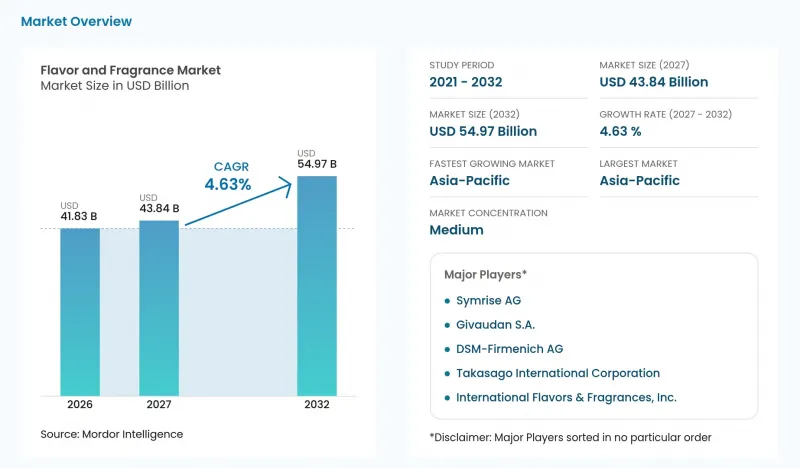
This report is segmented by Product Type (Flavors and Fragrances), Source (Synthetic, Natural, and more), Application (Beverage, Dairy, and more), Form (Liquid, Powder, and more), and Geography (Asia-Pacific, Europe, and more). The market forecasts are provided in terms of value (USD), based on availability.
Global Flavor And Fragrance Market Trends and Insights
Growing Demand for Processed Food Products
Manufacturers adding processed-food output create a potential ingredient requirement tied to the finished product's formulation and intended consumer destinations. Nestle launched a vermicelli production line in Smolyhiv, Ukraine, in July 2025, expanding production to meet stated demand in Ukraine and Europe. The expansion concerned vermicelli sold under the Maggi and Mivina brands. Where flavor is part of the finished-food formulation, additional production can create repeat ingredient requirements from an existing product specification. Because Nestle tied the line to demand in both Ukraine and Europe, ingredient volumes linked to its products would follow consumption in both stated destinations.
Increasing Consumer Demand for Plant-Based Flavors and Fragrances
Plant-based food makers rely on added flavor to give meat and seafood alternatives a distinct taste. Givaudan reported increasing demand for natural, plant-based food ingredients in 2025. In the United States, plant-based meat and seafood products with added Asian, Mexican, and spicy flavors were among the fastest-selling within their category in 2025. That sales pattern points to a flavor-development opportunity in plant-based foods through regional and spicy profiles that differentiate the finished product. For flavor suppliers, the Asian, Mexican, and spicy variants create several formulation assignments within the same plant-based meat or seafood application.
International Quality Standards and Stringent Regulations
Regulatory obligations affect both the introduction of new flavorings and the downstream products that use fragrances. The European Food Safety Authority (EFSA) assesses the safety of new food flavorings before EU market placement, and applications for new flavorings require more information than proposed new uses. Novel ingredients therefore face a different documentation hurdle from extending an already assessed flavoring into another use. A 2025 European Commission report described one medium-sized cosmetics company's estimated one-off allergen-labeling cost of EUR 2 million to 5 million (USD 2.26 million to 5.65 million). The estimate included relabeling and withdrawal of products bearing old, noncompliant labels. Such obligations can make a new sensory proposition commercially difficult even when its flavor or fragrance performs as intended.
Other drivers and restraints analyzed in the detailed report include:
- Product Innovation and New Flavor Launches
- Growing Consumer Interest in Ethnic Flavors
- Fluctuating Raw Material Price
For complete list of drivers and restraints, kindly check the Table Of Contents.
Segment Analysis
Flavors accounted for a 56.05% share of the flavor and fragrance market size in 2026 and are the fastest-growing segment, with a forecast CAGR of 5.42% over 2027-2032. International Flavors & Fragrances, Inc. (IFF) reported Taste segment sales of USD 1.37 billion in the 6 months ended June 30, 2026. The business produces flavor compounds and natural taste solutions and also includes value-added spices and seasoning ingredients. Combining flavor compounds with spices and seasonings lets the Taste business address several components of a manufacturer's taste brief through one supplier.
In Q2 2026, IFF reported 4% comparable currency-neutral growth in Taste sales, primarily driven by volume and price increases in its Flavors business unit. The comparable portfolio excluded Rene Laurent, with approximately USD 4 million in sales impact, while exchange-rate variations had a favorable 1% impact on the reported result. Reported Taste sales growth was 5% for that quarter. Excluding currency effects and Rene Laurent isolates a continuing-business increase that IFF attributed primarily to Flavors volume and pricing, rather than changes in exchange rates or portfolio composition.
Synthetic ingredients represented a 69.21% flavor and fragrance market share in 2026, making them the largest segment. BASF began commercial menthol production at its Ludwigshafen, Germany, aroma-ingredient plant in April 2026. Menthol is a mint ingredient used in flavor compounds for confectionery, as well as in oral and body care and pharmaceutical products. Confectionery flavor makers therefore share this synthetic ingredient supply route with oral care and pharmaceutical applications, so its commercial reach crosses several finished-product categories.
Natural ingredients are the fastest-growing segment, with a forecast CAGR of 5.34% over 2027-2032. On October 23, 2025, BASF launched Isobionics Natural alpha-Farneseen 95, a fermented natural flavor ingredient for lime, beverage, candy, citrus, and fruit formulations. BASF attributed consistent quality and availability independent of weather and harvest conditions to the ingredient's fermentation process. However, Robertet's Raw Materials division, serving fragrance, flavor, and active-ingredient industries, represented 24% of company revenue in H1 2026 and recorded a 5.5% organic revenue decline. Production technology can differentiate a natural ingredient offer through its supply characteristics, while a diversified natural-material business can face a different near-term revenue trajectory.
Complete Report Scope:
- By Product Type
- Flavors
- Fragrances
- By Source
- Natural
- Synthetic
- Nature Identical
- By Application
- Dairy
- Bakery
- Confectionery
- Savory Snack
- Meat
- Beverage
- Other Applications
- By Form
- Powder
- Liquid
- Others
- By Geography
- North America
- United States
- Canada
- Mexico
- Rest of North America
- Europe
- Germany
- United Kingdom
- Italy
- France
- Spain
- Netherlands
- Poland
- Belgium
- Sweden
- Rest of Europe
- Asia-Pacific
- China
- India
- Japan
- Australia
- Indonesia
- South Korea
- Thailand
- Singapore
- Rest of Asia-Pacific
- South America
- Brazil
- Argentina
- Colombia
- Chile
- Peru
- Rest of South America
- Middle East and Africa
- South Africa
- Saudi Arabia
- United Arab Emirates
- Nigeria
- Egypt
- Morocco
- Turkey
- Rest of Middle East and Africa
- North America
Geography Analysis
Asia-Pacific accounted for a 31.66% share of the flavor and fragrance market size in 2026 and is the fastest-growing geography, with a forecast CAGR of 5.36% over 2027-2032. In July 2026, Givaudan inaugurated a production facility in Cikarang, Indonesia, for savory, sweet, and snack flavor powders. The expansion was intended to strengthen its ability to meet rising consumer demand in Southeast Asia, linking additional production capacity to a regional food opportunity. A separate supplier route emerged in Vietnam, where Techvina's new natural aroma-chemical factory, serving flavor, fragrance, cosmetic, and pharmaceutical industries, completed its first export shipment on May 31, 2025.
In North America, Costa Rica published a Central American processed-food and beverage additive-list replacement in May 2026 under a resolution effective from July 15, 2025. In May 2025, the Flavor and Extract Manufacturers Association's Expert Panel published a list of food-flavoring substances it determined to be generally recognized as safe (GRAS) under the 1958 U.S. Food Additives Amendment. Within the EU, flavorings must meet safety and nonmisleading-use conditions, and noncompliant flavorings or foods cannot be marketed. In Ukraine, customs released one importer's piperonal-containing food-flavoring shipment on July 31, 2025, after agencies clarified an amended exemption from precursor restrictions. The Ukrainian clearance case distinguishes import access from the food-use eligibility decisions confronting manufacturers in the United States, Costa Rica, and the EU.
In South America, Uruguay permits food-flavoring additives on its General or Base List, subject to Annexes 5 and 6 and Article 3.3.30 restrictions. Brazil's Anvisa separately evaluates applications to add regional botanical food-flavoring additives and extend their uses. Saudi Arabia brought SFDA.FD GSO 707:2023, covering permitted food flavorings and instructions for their use, into force on January 1, 2025. DSM-Firmenich AG opened an application center in Nairobi, Kenya, on January 29, 2026, for customer collaboration and food and beverage formulation support across East Africa. The Nairobi center offers an entry route through formulation assistance, distinct from the ingredient-eligibility work illustrated by Uruguay, Brazil, and Saudi Arabia.
- DSM-Firmenich AG
- International Flavors & Fragrances, Inc.
- Symrise AG
- Takasago International Corporation
- Givaudan S.A.
- Kerry Group plc
- BASF SE
- Robertet Group
- The Archer-Daniels-Midland Company
- Sensient Technologies Corporation
- Mane Kancor Ingredients Private Limited
- T. Hasegawa Co., Ltd.
- Bell Flavors & Fragrances
- Corbion N.V.
- Flavorchem Corporation
- Carbery Group Limited
- Doehler Group SE
- Syensqo SA
- Huabao Intl. Holdings Ltd.
- Ingredion Inc.
Additional Benefits:
- The market estimate (ME) sheet in Excel format
- 3 months of analyst support
TABLE OF CONTENTS
1 INTRODUCTION
- 1.1 Study Assumptions and Market Definition
- 1.2 Scope of the Study
2 RESEARCH METHODOLOGY
3 EXECUTIVE SUMMARY
4 MARKET LANDSCAPE
- 4.1 Market Overview
- 4.2 Market Drivers
- 4.2.1 Growing Demand for Processed Food Products
- 4.2.2 Increasing Consumer Demand for Plant-Based Flavors and Fragrances
- 4.2.3 Product Innovation and New Flavor Launches
- 4.2.4 Growing Consumer Interest in Ethnic Flavors
- 4.2.5 Expanding Applications in Functional Foods and Beverages
- 4.2.6 Integration of Artificial Intelligence in Flavor Development and Testing
- 4.3 Market Restraints
- 4.3.1 International Quality Standards and Stringent Regulations
- 4.3.2 Fluctuating Raw Material Price
- 4.3.3 Limited Shelf Life of Natural Flavors
- 4.3.4 Cultural and Regional Taste Differences
- 4.4 Industry Value Chain Analysis
- 4.5 Regulatory Landscape
- 4.6 Technological Outlook
- 4.7 Porter's Five Forces Analysis
- 4.7.1 Threat of New Entrants
- 4.7.2 Bargaining Power of Suppliers
- 4.7.3 Bargaining Power of Buyers
- 4.7.4 Threat of Substitutes
- 4.7.5 Competitive Rivalry
5 MARKET SIZE AND GROWTH FORECASTS (VALUE)
- 5.1 By Product Type
- 5.1.1 Flavors
- 5.1.2 Fragrances
- 5.2 By Source
- 5.2.1 Natural
- 5.2.2 Synthetic
- 5.2.3 Nature Identical
- 5.3 By Application
- 5.3.1 Dairy
- 5.3.2 Bakery
- 5.3.3 Confectionery
- 5.3.4 Savory Snack
- 5.3.5 Meat
- 5.3.6 Beverage
- 5.3.7 Other Applications
- 5.4 By Form
- 5.4.1 Powder
- 5.4.2 Liquid
- 5.4.3 Others
- 5.5 By Geography
- 5.5.1 North America
- 5.5.1.1 United States
- 5.5.1.2 Canada
- 5.5.1.3 Mexico
- 5.5.1.4 Rest of North America
- 5.5.2 Europe
- 5.5.2.1 Germany
- 5.5.2.2 United Kingdom
- 5.5.2.3 Italy
- 5.5.2.4 France
- 5.5.2.5 Spain
- 5.5.2.6 Netherlands
- 5.5.2.7 Poland
- 5.5.2.8 Belgium
- 5.5.2.9 Sweden
- 5.5.2.10 Rest of Europe
- 5.5.3 Asia-Pacific
- 5.5.3.1 China
- 5.5.3.2 India
- 5.5.3.3 Japan
- 5.5.3.4 Australia
- 5.5.3.5 Indonesia
- 5.5.3.6 South Korea
- 5.5.3.7 Thailand
- 5.5.3.8 Singapore
- 5.5.3.9 Rest of Asia-Pacific
- 5.5.4 South America
- 5.5.4.1 Brazil
- 5.5.4.2 Argentina
- 5.5.4.3 Colombia
- 5.5.4.4 Chile
- 5.5.4.5 Peru
- 5.5.4.6 Rest of South America
- 5.5.5 Middle East and Africa
- 5.5.5.1 South Africa
- 5.5.5.2 Saudi Arabia
- 5.5.5.3 United Arab Emirates
- 5.5.5.4 Nigeria
- 5.5.5.5 Egypt
- 5.5.5.6 Morocco
- 5.5.5.7 Turkey
- 5.5.5.8 Rest of Middle East and Africa
- 5.5.1 North America
6 COMPETITIVE LANDSCAPE
- 6.1 Market Concentration
- 6.2 Strategic Moves
- 6.3 Market Share Analysis
- 6.4 Company Profiles (includes Global level Overview, Market level overview, Core Segments, Financials as available, Strategic Information, Market Rank/Share for key companies, Products and Services, and Recent Developments)
- 6.4.1 DSM-Firmenich AG
- 6.4.2 International Flavors & Fragrances, Inc.
- 6.4.3 Symrise AG
- 6.4.4 Takasago International Corporation
- 6.4.5 Givaudan S.A.
- 6.4.6 Kerry Group plc
- 6.4.7 BASF SE
- 6.4.8 Robertet Group
- 6.4.9 The Archer-Daniels-Midland Company
- 6.4.10 Sensient Technologies Corporation
- 6.4.11 Mane Kancor Ingredients Private Limited
- 6.4.12 T. Hasegawa Co., Ltd.
- 6.4.13 Bell Flavors & Fragrances
- 6.4.14 Corbion N.V.
- 6.4.15 Flavorchem Corporation
- 6.4.16 Carbery Group Limited
- 6.4.17 Doehler Group SE
- 6.4.18 Syensqo SA
- 6.4.19 Huabao Intl. Holdings Ltd.
- 6.4.20 Ingredion Inc.
7 MARKET OPPORTUNITIES AND FUTURE OUTLOOK
- 7.1 White-Space and Unmet-Need Assessment

