PUBLISHER: Mordor Intelligence | PRODUCT CODE: 2187349

PUBLISHER: Mordor Intelligence | PRODUCT CODE: 2187349
Battery Energy Storage System (BESS) - Market Share Analysis, Industry Trends & Statistics, Growth Forecasts (2027 - 2032)
According to Mordor Intelligence, the battery energy storage system (BESS) market size is expected to grow from USD 89.89 billion in 2026 to USD 105.4 billion in 2027 and is forecast to reach USD 237 billion by 2032 at 17.6% CAGR over 2027-2032.
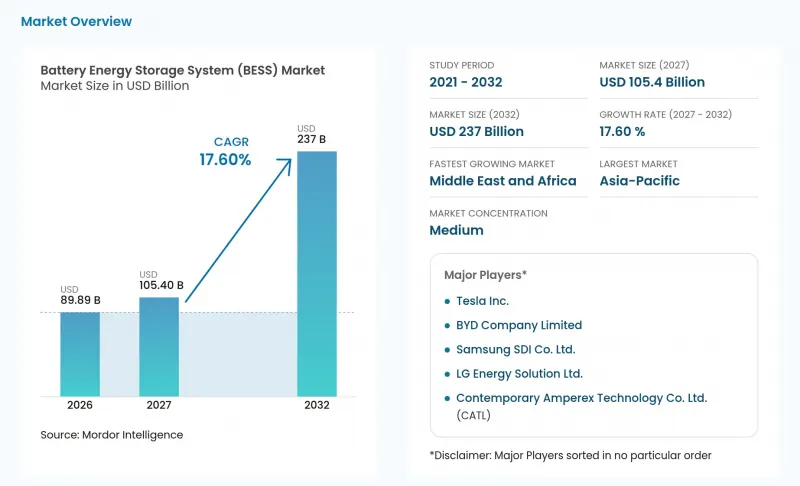
This report is segmented by Battery Type (Lithium-ion and more), Connection Type (On-Grid and more), Component (Battery Pack and Racks and more), Energy Capacity Range (101 to 500 MWh and more), End-user Application (Utility and more), and Geography (Asia-Pacific and more). The market forecasts are provided in terms of value (USD), based on availability.
Global Battery Energy Storage System (BESS) Market Trends and Insights
Utility-Scale Procurement Mandates in U.S. Accelerating Gigawatt-Scale Orders
Recurring public procurement gives storage developers a defined route from a policy objective to a project bid. New York's Public Service Commission directed NYSERDA to conduct at least 3 bulk energy storage procurements, held at least annually, to procure 3 GW. New York issued a request for proposals on July 28, 2025, seeking 1 GW of bulk energy storage toward its statewide 6 GW storage goal for 2030. On September 23, 2026, NYSERDA announced contracts for 8 bulk storage projects totaling 950 MW and 4,360 MWh. In September 2026, NYSERDA planned a second annual solicitation by year-end. A developer can stage its offers across recurring rounds, which gives the mandate value beyond the first solicitation.
Grid-Forming Inverter Requirements Unlocking Co-Location Value Stacks
Contracted system-strength services give storage developers a commercial proposition beyond shifting electricity between hours. In July 2025, Edify Energy reported that Koorangie in Victoria, Australia, was fully operational at 185 MW/370 MWh with grid-forming inverters. Developed by Edify and owned by Sostoneo Infrastructure Partners, the battery secured a 20-year AEMO agreement for 125 MW of system-strength services. A separate 15-year offtake with Shell Energy Australia supported the energy side of the project. For developers, these distinct contracts show how a network service requirement can support purchasing a particular inverter capability alongside storage capacity. Edify said the grid-forming technology lets the battery provide both energy storage and system-strength services in the Murray River region of Victoria, where grid constraints have limited renewable energy exports.
Lithium & Graphite Processing Bottlenecks in Indonesia and Africa
In 2025, the UK government reported that Mozambique and Madagascar produced graphite while all midstream processing was done in China. The same report identified a lack of African lithium refining capacity alongside emerging production in Zimbabwe and the Democratic Republic of the Congo. For cell makers and storage integrators sourcing through these routes, the reported structure puts graphite processing outside the producing countries and leaves lithium chemicals dependent on refining capacity beyond African mine production.
Other drivers and restraints analyzed in the detailed report include:
- PV-Plus-Storage PPA Price Parity in Australia & Chile
- EU & U.S. Battery Supply-Chain Acts Creating Domestic Manufacturing Pull-Through
- Fire-Safety Code Tightening (UL 9540A, NFPA 855) Inflating Balance-of-Plant Costs
For complete list of drivers and restraints, kindly check the Table Of Contents.
Segment Analysis
Lithium-ion was the largest segment, with an 88.12% share of the market in 2026. China's National Energy Administration reported that lithium-ion supplied 96.1% of the country's installed new energy storage capacity at the end of 2025. The NEA grouped compressed-air, flow-battery and flywheel storage within the small remainder of installed new energy storage capacity.
Lithium iron phosphate (LFP) is the fastest-growing segment, with a forecast 19% CAGR over 2027-2032. The 2,000 MWh Tongliao standalone storage project in Inner Mongolia entered operation in November 2025 using CATL's 5 MWh LFP battery energy storage system. The station was developed as a peak-shaving source supporting the large renewable energy base in eastern Inner Mongolia. Here, the LFP choice serves a plant-level peak-shaving duty, with CATL's 5 MWh system as the equipment unit within the station.
On-grid systems represented a 77.19% battery energy storage system (BESS) market share in 2026. The IEA reported that utility-scale batteries accounted for around 80% of global new battery capacity in 2025. Innergex's Hale Kuawehi solar-plus-storage project began commercial operations on March 25, 2025, supplying up to 30 MW of renewable energy to the Hawai'i Island grid with a 120 MWh battery system. Innergex sells the project's energy to Hawaiian Electric under a 25-year power purchase agreement, tying this battery application to a long-term utility supply relationship.
Off-grid (micro-grid, hybrid) storage is the fastest-growing segment, with a forecast 18.4% CAGR over 2027-2032. Saudi Arabia's Red Sea multi-utility project reached full commercial operation in August 2026 with 1,225.4 MWh of battery storage. That milestone completed the wider utility package, while its solar and storage assets had been progressively commissioned since 2023. The project operates independently of the national transmission network to serve a tourism destination and supporting infrastructure. Battery demand in this independent network follows the requirements of the destination's complete utility service.
Complete Report Scope:
- By Battery Type
- Lithium-ion
- Lithium Iron Phosphate (LFP)
- Nickel-Manganese-Cobalt (NMC)
- Lead-acid
- Others [Flow Batteries (Vanadium, Zinc-Br), Sodium-based (NaS, Na-ion)]
- By Connection Type
- On-Grid (Utility Interconnected)
- Off-Grid (Micro-Grid, Hybrid)
- By Component
- Battery Pack and Racks
- Power Conversion System (PCS)
- Energy Management Software (EMS)
- Balance-of-Plant and Services
- By Energy Capacity Range
- Below 100 MWh
- 101 to 500 MWh
- Above 500 MWh
- By End-user Application
- Residential
- Commercial and Industrial
- Utility
- By Geography
- North America
- United States
- Canada
- Mexico
- Europe
- United Kingdom
- Germany
- France
- Spain
- Nordic Countries
- Russia
- Rest of Europe
- Asia-Pacific
- China
- India
- Japan
- South Korea
- Malaysia
- Thailand
- Indonesia
- Vietnam
- Australia
- Rest of Asia-Pacific
- South America
- Brazil
- Argentina
- Colombia
- Rest of South America
- Middle East and Africa
- United Arab Emirates
- Saudi Arabia
- South Africa
- Egypt
- Rest of Middle East and Africa
- North America
Geography Analysis
Asia-Pacific accounted for a 50.09% share of the battery energy storage system (BESS) market size in 2026. China added just over 63 GW of battery capacity in 2025, about one-third more than in 2024. Australia's Cheaper Home Batteries Program had approved 78,000 April 2026 installations representing 2.8 GWh by the end of the second quarter of 2026. Together these examples show demand arriving through 2 channels, large-scale additions in China and an approval-based home-battery program in Australia, so suppliers reach both project developers and household buyers.
Middle East and Africa is the fastest-growing geography, with a forecast 19.45% CAGR over 2027-2032. In July 2026, AMEA Power announced commissioning of the 600 MWh BESS and 500 kV substation at its 1,000 MW solar-plus-storage project in Benban, Egypt. Phased dispatch to the Egyptian Electricity Transmission Company's grid was underway at that announcement, while full commissioning of the overall project remained prospective. The battery and its grid infrastructure form a linked delivery scope, since individual project blocks can begin dispatch before the entire renewable complex is fully commissioned.
North America's operating base included 43.6 GW of utility-scale battery capacity in the United States at the end of 2025. In Europe, European Energy commenced commercial operation of Denmark's Kvosted solar and battery park in December 2025, with 200 MWh of storage. South America's standalone deployment included Atlas Renewable Energy's BESS del Desierto in Chile, inaugurated in April 2025. The Danish and Chilean examples distinguish adding storage within a generation project from developing a separate storage asset, while the U.S. reading establishes a substantial utility fleet.
- BYD Company Limited
- Contemporary Amperex Technology Co. Ltd. (CATL)
- LG Energy Solution Ltd.
- Panasonic Energy Co., Ltd.
- Tesla Inc.
- Samsung SDI Co. Ltd.
- Fluence Energy Inc.
- ABB Ltd.
- Siemens Energy AG
- GE Vernova
- Hitachi Energy Ltd.
- Mitsubishi Power
- Sungrow Power Supply Co.
- Eaton Corporation plc
- Toshiba Corp.
- EVE Energy Co.
- VARTA AG
- Saft SAS (TotalEnergies)
- CellCube Energy Storage GmbH
- Enphase Energy Inc.
Additional Benefits:
- The market estimate (ME) sheet in Excel format
- 3 months of analyst support
TABLE OF CONTENTS
1 INTRODUCTION
- 1.1 Study Assumptions and Market Definition
- 1.2 Scope of the Study
2 RESEARCH METHODOLOGY
3 EXECUTIVE SUMMARY
4 MARKET LANDSCAPE
- 4.1 Market Overview
- 4.2 Market Drivers
- 4.2.1 Utility-Scale Procurement Mandates in U.S. Accelerating Gigawatt-Scale Orders
- 4.2.2 Grid-Forming Inverter Requirements Unlocking Co-Location Value Stacks
- 4.2.3 PV-Plus-Storage PPA Price Parity in Australia & Chile
- 4.2.4 EU & U.S. Battery Supply-Chain Acts Creating Domestic Manufacturing Pull-Through
- 4.2.5 Data-Center & AI Load Growth Driving Storage Demand in North America
- 4.2.6 Second-Life EV Battery Availability Reducing CapEx in Asia
- 4.3 Market Restraints
- 4.3.1 Lithium & Graphite Processing Bottlenecks in Indonesia and Africa
- 4.3.2 Fire-Safety Code Tightening (UL 9540A, NFPA 855) Inflating Balance-of-Plant Costs
- 4.3.3 Long Interconnection Queues in U.S. ISOs Delaying FTM Project Revenues
- 4.3.4 High Interest-Rate Environment Compressing Merchant Revenue Stacks
- 4.4 Industry Value Chain Analysis
- 4.5 Regulatory Landscape
- 4.6 Technological Outlook
- 4.7 Porter's Five Forces Analysis
- 4.7.1 Threat of New Entrants
- 4.7.2 Bargaining Power of Suppliers
- 4.7.3 Bargaining Power of Buyers
- 4.7.4 Threat of Substitutes
- 4.7.5 Competitive Rivalry
- 4.8 Recent Trends & Innovations
5 MARKET SIZE AND GROWTH FORECASTS (VALUE)
- 5.1 By Battery Type
- 5.1.1 Lithium-ion
- 5.1.2 Lithium Iron Phosphate (LFP)
- 5.1.3 Nickel-Manganese-Cobalt (NMC)
- 5.1.4 Lead-acid
- 5.1.5 Others [Flow Batteries (Vanadium, Zinc-Br), Sodium-based (NaS, Na-ion)]
- 5.2 By Connection Type
- 5.2.1 On-Grid (Utility Interconnected)
- 5.2.2 Off-Grid (Micro-Grid, Hybrid)
- 5.3 By Component
- 5.3.1 Battery Pack and Racks
- 5.3.2 Power Conversion System (PCS)
- 5.3.3 Energy Management Software (EMS)
- 5.3.4 Balance-of-Plant and Services
- 5.4 By Energy Capacity Range
- 5.4.1 Below 100 MWh
- 5.4.2 101 to 500 MWh
- 5.4.3 Above 500 MWh
- 5.5 By End-user Application
- 5.5.1 Residential
- 5.5.2 Commercial and Industrial
- 5.5.3 Utility
- 5.6 By Geography
- 5.6.1 North America
- 5.6.1.1 United States
- 5.6.1.2 Canada
- 5.6.1.3 Mexico
- 5.6.2 Europe
- 5.6.2.1 United Kingdom
- 5.6.2.2 Germany
- 5.6.2.3 France
- 5.6.2.4 Spain
- 5.6.2.5 Nordic Countries
- 5.6.2.6 Russia
- 5.6.2.7 Rest of Europe
- 5.6.3 Asia-Pacific
- 5.6.3.1 China
- 5.6.3.2 India
- 5.6.3.3 Japan
- 5.6.3.4 South Korea
- 5.6.3.5 Malaysia
- 5.6.3.6 Thailand
- 5.6.3.7 Indonesia
- 5.6.3.8 Vietnam
- 5.6.3.9 Australia
- 5.6.3.10 Rest of Asia-Pacific
- 5.6.4 South America
- 5.6.4.1 Brazil
- 5.6.4.2 Argentina
- 5.6.4.3 Colombia
- 5.6.4.4 Rest of South America
- 5.6.5 Middle East and Africa
- 5.6.5.1 United Arab Emirates
- 5.6.5.2 Saudi Arabia
- 5.6.5.3 South Africa
- 5.6.5.4 Egypt
- 5.6.5.5 Rest of Middle East and Africa
- 5.6.1 North America
6 COMPETITIVE LANDSCAPE
- 6.1 Market Concentration
- 6.2 Strategic Moves
- 6.3 Market Share Analysis
- 6.4 Company Profiles (includes Global level Overview, Market level overview, Core Segments, Financials as available, Strategic Information, Market Rank/Share for key companies, Products and Services, and Recent Developments)
- 6.4.1 BYD Company Limited
- 6.4.2 Contemporary Amperex Technology Co. Ltd. (CATL)
- 6.4.3 LG Energy Solution Ltd.
- 6.4.4 Panasonic Energy Co., Ltd.
- 6.4.5 Tesla Inc.
- 6.4.6 Samsung SDI Co. Ltd.
- 6.4.7 Fluence Energy Inc.
- 6.4.8 ABB Ltd.
- 6.4.9 Siemens Energy AG
- 6.4.10 GE Vernova
- 6.4.11 Hitachi Energy Ltd.
- 6.4.12 Mitsubishi Power
- 6.4.13 Sungrow Power Supply Co.
- 6.4.14 Eaton Corporation plc
- 6.4.15 Toshiba Corp.
- 6.4.16 EVE Energy Co.
- 6.4.17 VARTA AG
- 6.4.18 Saft SAS (TotalEnergies)
- 6.4.19 CellCube Energy Storage GmbH
- 6.4.20 Enphase Energy Inc.
7 MARKET OPPORTUNITIES AND FUTURE OUTLOOK
- 7.1 White-Space and Unmet-Need Assessment

