PUBLISHER: Mordor Intelligence | PRODUCT CODE: 2187356

PUBLISHER: Mordor Intelligence | PRODUCT CODE: 2187356
India Fintech - Market Share Analysis, Industry Trends & Statistics, Growth Forecasts (2027 - 2032)
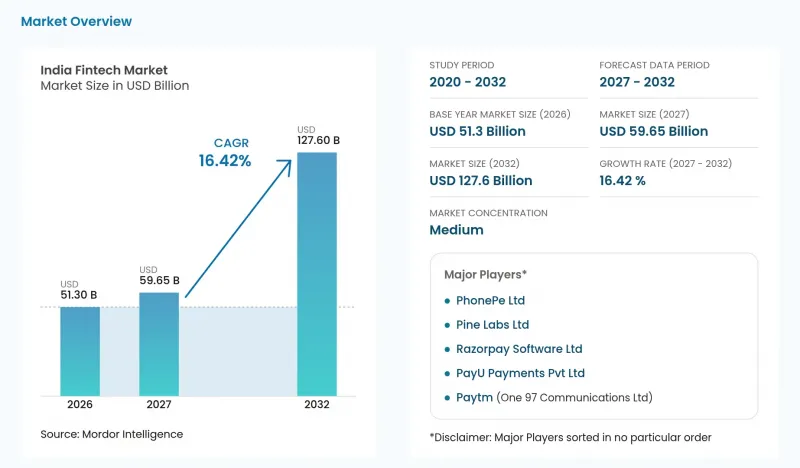
According to Mordor Intelligence, the India fintech market size is expected to increase from USD 51.3 billion in 2026 to USD 59.65 billion in 2027 and reach USD 127.6 billion by 2032, growing at a CAGR of 16.42% over 2027-2032.
This report is segmented by Service Proposition (Digital Payments, Digital Lending and Financing, Digital Investments, Insurtech, and Neobanking), End-User (Retail and Businesses), and User Interface (Mobile Applications, Web / Browser, and POS / IoT Devices). The market forecasts are provided in terms of value (USD), based on availability.
India Fintech Market Trends and Insights
Digital Public Infrastructure (UPI, Aadhaar, OCEN) Accelerating Mass-Market Adoption
Digital identity and transaction-data infrastructure expand the range of financial services that can use a paperless customer journey. The Unique Identification Authority of India (UIDAI) reported 185.6 billion Aadhaar authentication transactions across all sectors in India in FY2025-26. The GST Sahay program of the Small Industries Development Bank of India (SIDBI) combined Open Credit Enablement Network (OCEN) and Account Aggregator frameworks with GST trade data and bank information for paperless invoice-based credit. Its GST Sahay portfolio grew 345% year over year in FY2025-26. SIDBI added 2,261 customers during FY2025-26, taking cumulative sanctioned customers to 3,512 by March 31, 2026. Most of the sanctioned-customer base was added in FY2025-26, indicating that shared rails supported recent credit adoption beyond their role in identity verification.
Account Aggregator Framework Unlocking Data-Driven Credit Underwriting
Account Aggregator (AA) connects permissioned financial data with lenders' underwriting workflows. Sahamati and CRIF estimated that India's Account Aggregator ecosystem facilitated 36.8 million loan disbursals in FY2025-26. Banks accounted for 47.3% of AA-enabled lending by value in H2 FY2025-26, with nonbank finance companies accounting for the remainder. For home loans and loans against property, predominantly AA-using lender cohorts with AA underwriting penetration above 30% recorded an outstanding-portfolio CAGR of 32.9% over June 2024-June 2026, versus 14.3% for non-AA cohorts. That activity places reusable data integration within established credit products, giving technology suppliers a role in underwriting rather than only borrower-facing interfaces.
RBI's Stricter Digital-Lending & FLDG Norms Raising Compliance Cost
Outsourcing digital lending does not remove the regulated lender's responsibility for the service delivered to borrowers. The Reserve Bank of India's NBFC Credit Facilities Directions require applicable nonbank lenders to conduct enhanced due diligence before contracting digital-lending service providers. That review covers technical capabilities, data privacy, storage systems, borrower treatment and regulatory compliance. The lender must also review provider conduct periodically and remains responsible for the provider's acts and omissions. These obligations make partner selection and ongoing oversight part of the cost of expanding digital distribution, particularly when a lender adds providers with different systems. Faster customer acquisition therefore cannot substitute for the continuing expense of supervising each contracted lending relationship.
Other drivers and restraints analyzed in the detailed report include:
- Embedded-Finance Demand from E-commerce & Gig-Economy Platforms
- Formalization of MSMEs post-GST Creating New SME Fintech Demand Pools
- Zero-MDR Policy on RuPay Debit and Most UPI Merchant Payments Compressing Payment-Gateway Profit Pools
For complete list of drivers and restraints, kindly check the Table Of Contents.
Segment Analysis
Digital payments accounted for a 42.69% share of the India fintech market size in 2026. UPI processed 241.6 billion transactions in FY2025-26, according to figures from the National Payments Corporation of India (NPCI) reported by the Ministry of Finance. This transaction scale supports the largest segment's position by making payment execution a recurring service requirement across a substantial flow of financial activity. The competitive task is to deliver dependable payment execution while developing chargeable services around it, because high throughput alone does not secure payment-provider revenue.
Neobanking is the fastest-growing segment, with a forecast CAGR of 19.8% over 2027-2032. Open, an enterprise neobanking platform, reported connections to more than 40 Indian banks in one corporate banking workspace in 2026. For State Bank of India (SBI) business current accounts, Open Money provides real-time balance visibility, automatic statement syncing and payout initiation. SBI transactions on Open Money use non-STP mode, meaning that every payout initiated on Open Money must be authorized on SBI before it executes. A business with accounts at several banks therefore gains one view of balances and payouts, while execution on SBI accounts follows SBI's authorization step.
Complete Report Scope:
- By Service Proposition
- Digital Payments
- Digital Lending and Financing
- Digital Investments
- Insurtech
- Neobanking
- By End-User
- Retail
- Businesses
- By User Interface
- Mobile Applications
- Web / Browser
- POS / IoT Devices
List of Companies Covered in this Report:
- Paytm (One 97 Communications Ltd)
- PhonePe Ltd
- Razorpay Software Ltd
- Pine Labs Ltd
- PayU Payments Pvt Ltd
- BharatPe (Resilient Innovations Pvt Ltd)
- MobiKwik (One MobiKwik Systems Ltd)
- PolicyBazaar (PB Fintech Ltd)
- Zerodha Broking Ltd
- Upstox (RKSV Securities India Pvt Ltd)
- Groww (Groww Invest Tech Pvt Ltd)
- CRED (Dreamplug Technologies Pvt Ltd)
- Slice (slice small finance bank Ltd)
- KreditBee (KrazyBee Services Ltd)
- Lendingkart Finance Ltd
- axio (CapFloat Financial Services Pvt Ltd)
- NeoGrowth Credit Pvt Ltd
- Navi Ltd
- Jupiter (Amica Financial Technologies Pvt Ltd)
- NIYO (Finnew Solutions Pvt Ltd)
Additional Benefits:
- The market estimate (ME) sheet in Excel format
- 3 months of analyst support
TABLE OF CONTENTS
1 INTRODUCTION
- 1.1 Study Assumptions and Market Definition
- 1.2 Scope of the Study
2 RESEARCH METHODOLOGY
3 EXECUTIVE SUMMARY
4 MARKET LANDSCAPE
- 4.1 Market Overview
- 4.2 Market Drivers
- 4.2.1 Digital Public Infrastructure (UPI, Aadhaar, OCEN) Accelerating Mass-Market Adoption
- 4.2.2 Account Aggregator Framework Unlocking Data-Driven Credit Underwriting
- 4.2.3 Embedded-Finance Demand from E-commerce & Gig-Economy Platforms
- 4.2.4 Formalization of MSMEs post-GST Creating New SME Fintech Demand Pools
- 4.2.5 Millennial & Gen-Z Wealth Creation Driving Low-Cost Robo-Advisory Uptake
- 4.2.6 Cross-Border UPI Linkages (e.g., Singapore, UAE) Opening New Remittance Revenues
- 4.3 Market Restraints
- 4.3.1 RBI's Stricter Digital-Lending & FLDG Norms Raising Compliance Cost
- 4.3.2 Zero-MDR Policy on RuPay Debit and Most UPI Merchant Payments Compressing Payment-Gateway Profit Pools
- 4.3.3 Escalating Cyber-Fraud Incidents Undermining Consumer Trust
- 4.3.4 Post-2022 Funding Winter Constraining Scale-Up Capital
- 4.4 Industry Value Chain Analysis
- 4.5 Regulatory Landscape
- 4.6 Technological Outlook
- 4.7 Porter's Five Forces Analysis
- 4.7.1 Threat of New Entrants
- 4.7.2 Bargaining Power of Suppliers
- 4.7.3 Bargaining Power of Buyers
- 4.7.4 Threat of Substitutes
- 4.7.5 Competitive Rivalry
- 4.8 Investment & Funding Trend Analysis
5 MARKET SIZE AND GROWTH FORECASTS (VALUE)
- 5.1 By Service Proposition
- 5.1.1 Digital Payments
- 5.1.2 Digital Lending and Financing
- 5.1.3 Digital Investments
- 5.1.4 Insurtech
- 5.1.5 Neobanking
- 5.2 By End-User
- 5.2.1 Retail
- 5.2.2 Businesses
- 5.3 By User Interface
- 5.3.1 Mobile Applications
- 5.3.2 Web / Browser
- 5.3.3 POS / IoT Devices
6 COMPETITIVE LANDSCAPE
- 6.1 Market Concentration
- 6.2 Strategic Moves
- 6.3 Market Share Analysis
- 6.4 Company Profiles (includes Global level Overview, Market level overview, Core Segments, Financials as available, Strategic Information, Market Rank/Share for key companies, Products and Services, and Recent Developments)
- 6.4.1 Paytm (One 97 Communications Ltd)
- 6.4.2 PhonePe Ltd
- 6.4.3 Razorpay Software Ltd
- 6.4.4 Pine Labs Ltd
- 6.4.5 PayU Payments Pvt Ltd
- 6.4.6 BharatPe (Resilient Innovations Pvt Ltd)
- 6.4.7 MobiKwik (One MobiKwik Systems Ltd)
- 6.4.8 PolicyBazaar (PB Fintech Ltd)
- 6.4.9 Zerodha Broking Ltd
- 6.4.10 Upstox (RKSV Securities India Pvt Ltd)
- 6.4.11 Groww (Groww Invest Tech Pvt Ltd)
- 6.4.12 CRED (Dreamplug Technologies Pvt Ltd)
- 6.4.13 Slice (slice small finance bank Ltd)
- 6.4.14 KreditBee (KrazyBee Services Ltd)
- 6.4.15 Lendingkart Finance Ltd
- 6.4.16 axio (CapFloat Financial Services Pvt Ltd)
- 6.4.17 NeoGrowth Credit Pvt Ltd
- 6.4.18 Navi Ltd
- 6.4.19 Jupiter (Amica Financial Technologies Pvt Ltd)
- 6.4.20 NIYO (Finnew Solutions Pvt Ltd)
7 MARKET OPPORTUNITIES AND FUTURE OUTLOOK
- 7.1 White-Space and Unmet-Need Assessment

