PUBLISHER: Mordor Intelligence | PRODUCT CODE: 2187383

PUBLISHER: Mordor Intelligence | PRODUCT CODE: 2187383
United States Mattress - Market Share Analysis, Industry Trends & Statistics, Growth Forecasts (2027 - 2032)
According to Mordor Intelligence, the United States mattress market size was valued at USD 18.77 billion in 2026 and estimated to grow from USD 19.45 billion in 2027 to reach USD 22.86 billion by 2032, at a CAGR of 3.28% during the forecast period (2027-2032).
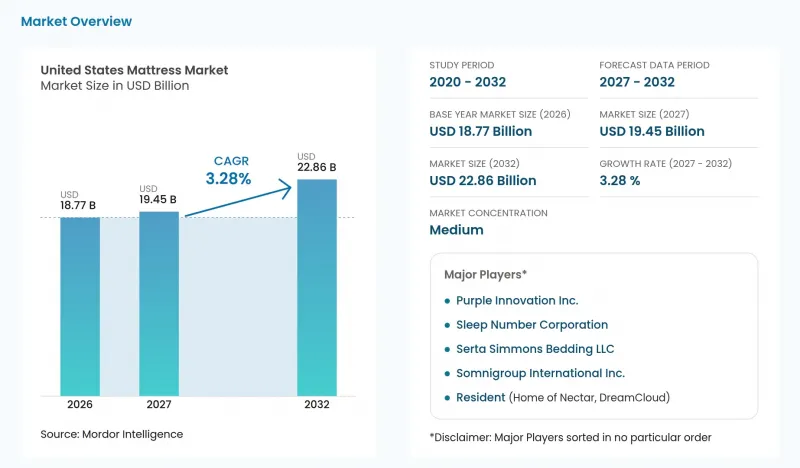
This report is segmented by Product Type (Innerspring / Coil, Foam, and more), Mattress Size (Queen-size Mattress, King-size Mattress, and more), End User (Residential and Commercial), Distribution Channel (B2C/Retail and B2B/Project), and Geography (Southeast, West, and more). The market forecasts are provided in terms of value (USD), based on availability.
United States Mattress Market Trends and Insights
Housing Starts & Home-Furnishing Spend
A newly occupied home creates a mattress-selling occasion around the sleeping spaces that its residents need to furnish. The demand mechanism is strongest when a household needs an additional bed, rather than simply moving an existing mattress between addresses. Housing activity can therefore open a route to incremental units that is distinct from persuading an established household to replace a serviceable product. For manufacturers, the relevant opportunity is an offer suited to furnishing those additional sleeping spaces at the time they become usable. The commercial value of housing-related demand consequently depends on how many mattress needs are newly created, making occupancy a more useful sales trigger than a building announcement alone.
Rapid Proliferation of "Bed-In-A-Box" D2C Model
The demand opportunity in bed-in-a-box selling lies in making a mattress purchase possible without requiring a showroom visit. For a direct seller, shortening the commercial journey can connect a buyer's initial product choice to an order through the same channel. In July 2025, Serta Simmons Bedding launched its Perfect Day mattress-in-a-box collection, with 9 models from twin through California king and suggested queen prices of USD 199 to USD 1,099. The suggested queen range gives boxed sellers several price positions through which to reach households beyond a fixed store footprint. The collection spans 4 comfort tiers, from a firm entry model to a plush pillow top. Boxed delivery can thus support an entry-to-premium price ladder within one collection, widening the spending levels a seller can serve.
Raw-Material (Foam & Steel) Price Volatility
For mattress producers using coil components, raw-material volatility creates a pricing problem before an additional finished mattress reaches a buyer. Leggett & Platt reported that U.S. steel costs rose early in 2025, increased further after April tariffs, and remained significantly higher year over year through year-end. That supplier-side escalation can narrow the room for component manufacturers to offer stable terms without absorbing a greater share of production costs. Passing those costs onward would increase the selling price needed to preserve earnings, making a coil mattress harder to justify for price-sensitive households. Even when sellers absorb the increase to protect affordability, the same input burden leaves lower earnings available from each mattress sold.
Other drivers and restraints analyzed in the detailed report include:
- Growing Incidence of Back-Pain Driving Premium Mattress Demand
- Product Innovation In Memory-Foam & Hybrid Constructions
- Market Saturation & Longer Replacement Cycles
For complete list of drivers and restraints, kindly check the Table Of Contents.
Segment Analysis
Innerspring / coil mattresses accounted for a 44.49% share of the United States mattress market size in 2026, making them the largest segment. In 2025, Leggett & Platt reported that ComfortCore fabric-encased innerspring coils used in hybrid mattresses represented more than 75% of its U.S. innerspring units. This supplier-level mix shows that coil expertise also serves hybrid assembly, giving a component producer access to another finished-mattress construction. For that producer, differentiating the coil system can preserve a role in the mattress even when the finished product is sold under a hybrid label.
Foam (including memory foam) is the fastest-growing segment, with a projected CAGR of 4% during 2027-2032. In Amerisleep's August 2026 survey of 1,006 U.S. adults who had bought a mattress in the prior year or were actively shopping, memory foam represented 37% of reported purchases or planned purchases. This combined measure places memory foam in the choices of both recent buyers and active shoppers, giving sellers an audience at different purchase stages. Converting those planned purchases into orders is therefore the unfinished commercial step for foam sellers.
Queen-size mattresses represented a 44.77% United States mattress market share in 2026 and are the fastest-growing segment, with a projected CAGR of 3.45% during 2027-2032. Domestic mattress shipments shifted toward larger sizes in 2025, with queen and king gaining share while twin and full declined, reflecting a continued move toward higher-priced products. For domestic producers, the mix shift gives queen-specific production capability importance alongside the design of individual mattress models. A producer able to serve multiple comfort specifications within this size can respond through its model range, linking production flexibility to the format's substantial customer base.
The Better Sleep Council's February 2025 survey covered 500 U.S. adults who had recently bought or planned to buy a mattress priced at USD 2,500 or more. Almost 30% had bought or planned to buy a queen-size mattress. Among prospective shoppers in the same survey, more than 60% planned to buy the largest sizes. The queen-size respondents give sellers a defined audience for higher-priced differentiation within that size, though the same survey shows king and California king sizes drawing the larger share of purchases and plans. A premium range built around queen alone would therefore miss the larger-size majority of prospective purchases in this cohort.
Complete Report Scope:
- By Product Type
- Innerspring / Coil
- Foam (including memory foam)
- Latex
- Hybrid
- Other Mattress Types
- By Mattress Size
- Single-size Mattress
- Double-size Mattress
- Queen-size Mattress
- King-size Mattress
- Custom & Specialty Sizes
- By End User
- Residential
- Commercial
- By Distribution Channel
- B2C/Retail
- Mass Merchandisers
- Specialty Mattress Stores (including exclusive brand outlets)
- Online
- Other Distribution Channels
- B2B/Project
- B2C/Retail
- By Geography
- Northeast
- Midwest
- Southeast
- Southwest
- West
List of Companies Covered in this Report:
- Somnigroup International Inc.
- Serta Simmons Bedding LLC
- Sleep Number Corporation
- Purple Innovation Inc.
- Casper Sleep Inc.
- Resident (Home of Nectar, DreamCloud)
- Saatva Inc.
- Helix Sleep LLC
- Brooklyn Bedding LLC
- Avocado Green Brands LLC
- Tuft & Needle (SSB)
- Ashley Furniture Industries LLC
- King Koil Mattress Co.
- Spring Air International
- The Original Mattress Factory
- Leesa Sleep LLC
- GhostBed (Nature's Sleep)
- Bear Mattress
- Cocoon by Sealy
- Zinus Inc.
Additional Benefits:
- The market estimate (ME) sheet in Excel format
- 3 months of analyst support
TABLE OF CONTENTS
1 INTRODUCTION
- 1.1 Study Assumptions and Market Definition
- 1.2 Scope of the Study
2 RESEARCH METHODOLOGY
3 EXECUTIVE SUMMARY
4 MARKET LANDSCAPE
- 4.1 Market Overview
- 4.2 Market Drivers
- 4.2.1 Housing Starts & Home-Furnishing Spend
- 4.2.2 Rapid Proliferation of "Bed-In-A-Box" D2C Model
- 4.2.3 Growing Incidence of Back-Pain Driving Premium Mattress Demand
- 4.2.4 Product Innovation In Memory-Foam & Hybrid Constructions
- 4.2.5 Anti-Dumping Duties Boosting On-Shore Production
- 4.2.6 Integration of Sleep-Data Platforms With Wellness Insurers
- 4.3 Market Restraints
- 4.3.1 Raw-Material (Foam & Steel) Price Volatility
- 4.3.2 Market Saturation & Longer Replacement Cycles
- 4.3.3 FTC Scrutiny of Tempur-Sealy/Mattress Firm Deal (Concluded in 2025)
- 4.3.4 Stricter Mattress Disposal Rules Affecting Polyurethane Foam
- 4.4 Industry Value Chain Analysis
- 4.5 Regulatory Landscape
- 4.6 Technological Outlook
- 4.7 Porter's Five Forces Analysis
- 4.7.1 Threat of New Entrants
- 4.7.2 Bargaining Power of Suppliers
- 4.7.3 Bargaining Power of Buyers
- 4.7.4 Threat of Substitutes
- 4.7.5 Competitive Rivalry
- 4.8 Insights into the Latest Trends and Innovations in the Market
- 4.9 Insights on Recent Developments (New Product Launches, Strategic Initiatives, Investments, Partnerships, JVs, Expansion, M&As, etc.) in the Industry
- 4.10 Insights on Consumer Behavior Analysis and Preferences in the Market (key motivational factors, preferred sales channel, demographics, key influencers and decision-makers)
5 MARKET SIZE AND GROWTH FORECASTS (VALUE)
- 5.1 By Product Type
- 5.1.1 Innerspring / Coil
- 5.1.2 Foam (including memory foam)
- 5.1.3 Latex
- 5.1.4 Hybrid
- 5.1.5 Other Mattress Types
- 5.2 By Mattress Size
- 5.2.1 Single-size Mattress
- 5.2.2 Double-size Mattress
- 5.2.3 Queen-size Mattress
- 5.2.4 King-size Mattress
- 5.2.5 Custom & Specialty Sizes
- 5.3 By End User
- 5.3.1 Residential
- 5.3.2 Commercial
- 5.4 By Distribution Channel
- 5.4.1 B2C/Retail
- 5.4.1.1 Mass Merchandisers
- 5.4.1.2 Specialty Mattress Stores (including exclusive brand outlets)
- 5.4.1.3 Online
- 5.4.1.4 Other Distribution Channels
- 5.4.2 B2B/Project
- 5.4.1 B2C/Retail
- 5.5 By Geography
- 5.5.1 Northeast
- 5.5.2 Midwest
- 5.5.3 Southeast
- 5.5.4 Southwest
- 5.5.5 West
6 COMPETITIVE LANDSCAPE
- 6.1 Market Concentration
- 6.2 Strategic Moves
- 6.3 Market Share Analysis
- 6.4 Company Profiles (includes Global level Overview, Market level overview, Core Segments, Financials as available, Strategic Information, Market Rank/Share for key companies, Products and Services, and Recent Developments)
- 6.4.1 Somnigroup International Inc.
- 6.4.2 Serta Simmons Bedding LLC
- 6.4.3 Sleep Number Corporation
- 6.4.4 Purple Innovation Inc.
- 6.4.5 Casper Sleep Inc.
- 6.4.6 Resident (Home of Nectar, DreamCloud)
- 6.4.7 Saatva Inc.
- 6.4.8 Helix Sleep LLC
- 6.4.9 Brooklyn Bedding LLC
- 6.4.10 Avocado Green Brands LLC
- 6.4.11 Tuft & Needle (SSB)
- 6.4.12 Ashley Furniture Industries LLC
- 6.4.13 King Koil Mattress Co.
- 6.4.14 Spring Air International
- 6.4.15 The Original Mattress Factory
- 6.4.16 Leesa Sleep LLC
- 6.4.17 GhostBed (Nature's Sleep)
- 6.4.18 Bear Mattress
- 6.4.19 Cocoon by Sealy
- 6.4.20 Zinus Inc.
7 MARKET OPPORTUNITIES AND FUTURE OUTLOOK
- 7.1 White-Space and Unmet-Need Assessment

