PUBLISHER: Mordor Intelligence | PRODUCT CODE: 2187663

PUBLISHER: Mordor Intelligence | PRODUCT CODE: 2187663
Indonesia Car Rental - Market Share Analysis, Industry Trends & Statistics, Growth Forecasts (2027 - 2032)
According to Mordor Intelligence, the Indonesia car rental market size is expected to increase from USD 1 billion in 2026 to USD 1.16 billion in 2027 and reach USD 2.41 billion by 2032, growing at a CAGR of 15.72% over 2027-2032.
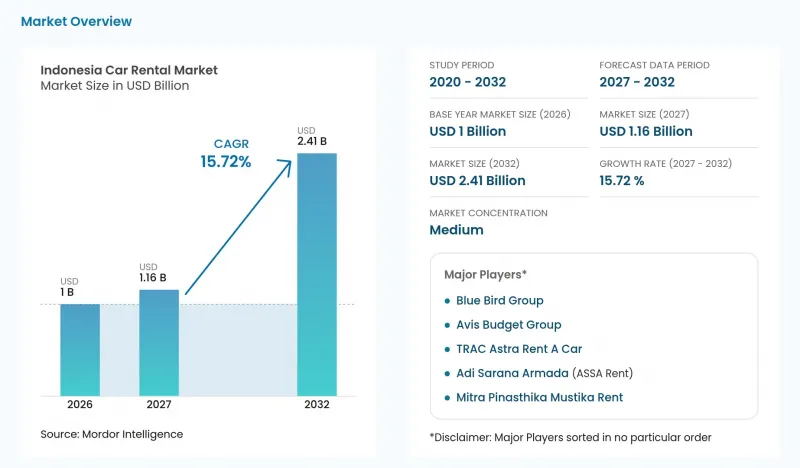
This report is segmented by Booking Type (Online and more), Rental Duration (Short-term and more), Application (Tourism and Leisure and more), Vehicle Type (Economy / Hatchback and more), Fuel Type (ICE - Petrol and more), End-user (Individual and more), Rental Channel (Aggregator Platforms and more), and Geography. The market forecasts are provided in terms of value (USD), based on availability.
Indonesia Car Rental Market Trends and Insights
Rising International and Domestic Tourist Arrivals
Tourist travel creates rental occasions when an itinerary requires temporary access to a locally supplied car. Statistics Indonesia (BPS) recorded 10.58 million foreign tourist visits to Indonesia from January through August 2026, up 5.38% from the same period in 2025. Domestic tourist trips totaled 842.2 million over those months, increasing 4.29% from the comparable 2025 period. Together, these increases widen potential rental occasions across international arrivals and residents traveling within the country. Domestic trips outnumbered foreign visits by roughly 80 to 1, so resident travel offers operators the larger pool of potential rental occasions despite faster foreign-arrival growth.
Surge in Digital-First Booking Platforms
Shorter reservation windows make digital distribution relevant to immediate travel needs as well as advance holiday planning. In February 2026, TRAC released a TRACtoGo feature reducing minimum booking lead time from 12 hours to as little as 2 hours for daily car rentals and airport transfers across its Indonesian network cities. Monthly and yearly rentals were excluded. The change allows an existing daily-rental fleet to enter a customer's decision closer to departure. For the supplying branch, that broader booking window makes near-term vehicle availability part of what the digital channel must deliver.
Ride-Hailing Super-Apps Cannibalizing Short-Term Rentals
Short-term rental operators face substitution when customers need only a single point-to-point journey. Ride-hailing sells access by trip, whereas a rental reserves the vehicle for a period that may exceed that journey. The customer can therefore forgo a rental without reducing travel, shrinking the set of occasions an urban rental operator can address. A rental is easier to justify for an itinerary that needs continuing vehicle availability across several stops. For a provider serving simple journeys, cutting the rental price also cuts the revenue available to cover the vehicle's reserved time.
Other drivers and restraints analyzed in the detailed report include:
- Growing Corporate Demand for Long-Term Operational Leasing
- Government EV Roadmap Accelerating Fleet Electrification
- Intensifying Price-Led Competition Among Incumbents
For complete list of drivers and restraints, kindly check the Table Of Contents.
Segment Analysis
Online booking accounted for a 69.31% share of the Indonesia car rental market size in 2026 and is forecast to be the fastest-growing segment, with a 16.52% CAGR over 2027-2032. In August 2025, TRAC released an updated TRACtoGo app with personal and business accounts and an emergency button, offering car rentals, airport transfers, and bus rentals through one platform. The combined booking environment allows vehicle hire to sit beside related transport services within a single customer interface. An operator's own app can therefore connect digital access with its rental service, giving the customer a route to both reservation and assistance.
Online access has to translate into a locally delivered rental service for the digital booking relationship to retain practical value. Offline booking has a physical access role, illustrated by AgungRent's October 29, 2025, Pekanbaru branch opening for corporate car-rental services in Sumatra. The office represented a local service point for a business rental offer, connecting an operator's geographic presence with its intended corporate customers. Digital reach and physical presence can thus play complementary roles, with online access bringing a customer to an offer and a branch supporting the local operating relationship behind it.
Short-term rentals lasting 30 days or less held 57.59% of the market in 2026, making them the largest duration segment. On December 26, 2025, Adjibon Trans Solo reported its 15-vehicle fleet fully booked for Christmas and New Year holiday transport from December 24, 2025, into early January 2026. Holiday-booking activity can generate work within a contained travel window, when the value of car access is tied to the visitor's trip. Sequential short bookings can reuse a fleet across different travelers, but earning opportunities can cluster around the few days when holiday trips take place.
Long-term rentals above 12 months are forecast to be the fastest-growing segment, with a 16.78% CAGR over 2027-2032. A renter committing beyond a year is choosing sustained vehicle access, so the service must remain useful across an extended operating period. For the supplier, the commitment concentrates the earning relationship in one continuing assignment instead of a succession of separate bookings. Over a contract longer than 12 months, a vehicle that stops matching its assignment becomes a fixed cost to the supplier, so fit matters more than contract length.
Tourism and leisure represented a 63.46% Indonesia car rental market share in 2026. BPS reported 104.3 million domestic tourist trips in Indonesia in August 2026, up 11.47% from August 2025. On July 20, 2026, Rent Car Indonesia's chair said rentals were a primary tourist choice where public transit was limited, with high chauffeur-driven demand from domestic and foreign tourists. Leisure operators can target those transport gaps with driver-supported itineraries, while matching available vehicles to actual bookings to limit idle capacity.
Corporate fleet and business mobility are forecast to be the fastest-growing segment, with a 17.28% CAGR over 2027-2032. In November 2025, QNB Indonesia agreed to a green term loan exclusively for electric-vehicle (EV) procurement in Indorent's broader rental portfolio. Procurement and deployment would turn that financing into a changed vehicle offer for business renters. Airport transfers gained an airline-passenger channel from early March 2025, when Garuda Indonesia passengers could book TRAC airport transfers in 16 major Indonesian cities. These routes involve different commercial relationships, with corporate providers developing a fleet-service offer and airport-transfer partners connecting a rental operator with an airline's passengers.
Complete Report Scope:
- By Booking Type
- Online
- Offline
- By Rental Duration
- Short-term (Less than/Equals 30 days)
- Medium-term (1 to 12 months)
- Long-term (Above 12 months)
- By Application
- Tourism and Leisure
- Daily Commuting
- Corporate Fleet / Business Mobility
- Airport Transfer
- By Vehicle Type
- Economy / Hatchback
- Multi-Purpose Vehicle (MPV)
- Sports Utility Vehicle (SUV)
- Luxury / Executive
- By Fuel Type
- ICE - Petrol
- ICE - Diesel
- Hybrid-Electric
- Battery-Electric (BEV)
- By End-user
- Corporate
- Individual
- By Rental Channel
- Aggregator Platforms
- Direct-to-Consumer (Rental Co.)
- Super-App-Based Bundles
- By Geography
- Java
- Greater Jakarta (Jabodetabek)
- West Java (ex-Jakarta)
- Central and East Java
- Bali and Nusa Tenggara
- Sumatra
- Kalimantan
- Sulawesi
- Papua and Maluku
- Java
List of Companies Covered in this Report:
- Blue Bird Group
- TRAC Astra Rent A Car
- Adi Sarana Armada (ASSA Rent)
- Mitra Pinasthika Mustika Rent
- The Hertz Corporation
- Avis Budget Group
- Europcar Indonesia
- Indorent (PT CSM Corporatama)
- Globe Rent a Car
- Otomo
- Grab Rentals
- GoCar Rental (Gojek)
- DOcar
- Movic
- Easyrent
- Tiket.com Car Rental
- Traveloka Car Rental
Additional Benefits:
- The market estimate (ME) sheet in Excel format
- 3 months of analyst support
TABLE OF CONTENTS
1 INTRODUCTION
- 1.1 Study Assumptions and Market Definition
- 1.2 Scope of the Study
2 RESEARCH METHODOLOGY
3 EXECUTIVE SUMMARY
4 MARKET LANDSCAPE
- 4.1 Market Overview
- 4.2 Market Drivers
- 4.2.1 Rising International and Domestic Tourist Arrivals
- 4.2.2 Surge in Digital-First Booking Platforms
- 4.2.3 Growing Corporate Demand for Long-Term Operational Leasing
- 4.2.4 Government EV Roadmap Accelerating Fleet Electrification
- 4.2.5 Halal-Friendly Tourism Packages Boosting Niche Rentals
- 4.2.6 Rapid Expansion of Secondary-Airport Connectivity
- 4.3 Market Restraints
- 4.3.1 Ride-Hailing Super-Apps Cannibalizing Short-Term Rentals
- 4.3.2 Intensifying Price-Led Competition Among Incumbents
- 4.3.3 Urban Congestion and Parking Scarcity Deterring Self-Drive
- 4.3.4 Fragmented Regional Licensing and Tax Compliance Burden
- 4.4 Industry Value Chain Analysis
- 4.5 Regulatory Landscape
- 4.6 Technological Outlook
- 4.7 Porter's Five Forces Analysis
- 4.7.1 Threat of New Entrants
- 4.7.2 Bargaining Power of Suppliers
- 4.7.3 Bargaining Power of Buyers
- 4.7.4 Threat of Substitutes
- 4.7.5 Competitive Rivalry
5 MARKET SIZE AND GROWTH FORECASTS (VALUE)
- 5.1 By Booking Type
- 5.1.1 Online
- 5.1.2 Offline
- 5.2 By Rental Duration
- 5.2.1 Short-term (Less than/Equals 30 days)
- 5.2.2 Medium-term (1 to 12 months)
- 5.2.3 Long-term (Above 12 months)
- 5.3 By Application
- 5.3.1 Tourism and Leisure
- 5.3.2 Daily Commuting
- 5.3.3 Corporate Fleet / Business Mobility
- 5.3.4 Airport Transfer
- 5.4 By Vehicle Type
- 5.4.1 Economy / Hatchback
- 5.4.2 Multi-Purpose Vehicle (MPV)
- 5.4.3 Sports Utility Vehicle (SUV)
- 5.4.4 Luxury / Executive
- 5.5 By Fuel Type
- 5.5.1 ICE - Petrol
- 5.5.2 ICE - Diesel
- 5.5.3 Hybrid-Electric
- 5.5.4 Battery-Electric (BEV)
- 5.6 By End-user
- 5.6.1 Corporate
- 5.6.2 Individual
- 5.7 By Rental Channel
- 5.7.1 Aggregator Platforms
- 5.7.2 Direct-to-Consumer (Rental Co.)
- 5.7.3 Super-App-Based Bundles
- 5.8 By Geography
- 5.8.1 Java
- 5.8.1.1 Greater Jakarta (Jabodetabek)
- 5.8.1.2 West Java (ex-Jakarta)
- 5.8.1.3 Central and East Java
- 5.8.2 Bali and Nusa Tenggara
- 5.8.3 Sumatra
- 5.8.4 Kalimantan
- 5.8.5 Sulawesi
- 5.8.6 Papua and Maluku
- 5.8.1 Java
6 COMPETITIVE LANDSCAPE
- 6.1 Market Concentration
- 6.2 Strategic Moves
- 6.3 Market Share Analysis
- 6.4 Company Profiles (includes Global level Overview, Market level overview, Core Segments, Financials as available, Strategic Information, Market Rank/Share for key companies, Products and Services, and Recent Developments)
- 6.4.1 Blue Bird Group
- 6.4.2 TRAC Astra Rent A Car
- 6.4.3 Adi Sarana Armada (ASSA Rent)
- 6.4.4 Mitra Pinasthika Mustika Rent
- 6.4.5 The Hertz Corporation
- 6.4.6 Avis Budget Group
- 6.4.7 Europcar Indonesia
- 6.4.8 Indorent (PT CSM Corporatama)
- 6.4.9 Globe Rent a Car
- 6.4.10 Otomo
- 6.4.11 Grab Rentals
- 6.4.12 GoCar Rental (Gojek)
- 6.4.13 DOcar
- 6.4.14 Movic
- 6.4.15 Easyrent
- 6.4.16 Tiket.com Car Rental
- 6.4.17 Traveloka Car Rental
7 MARKET OPPORTUNITIES AND FUTURE OUTLOOK
- 7.1 White-Space and Unmet-Need Assessment

