PUBLISHER: Mordor Intelligence | PRODUCT CODE: 2119682

PUBLISHER: Mordor Intelligence | PRODUCT CODE: 2119682
India Car Rental - Market Share Analysis, Industry Trends & Statistics, Growth Forecasts (2026 - 2031)
According to Mordor Intelligence, the India car rental market size is expected to grow from USD 3.14 billion in 2025 to USD 3.37 billion in 2026 and is forecast to reach USD 4.78 billion by 2031 at 7.27% CAGR over 2026-2031.
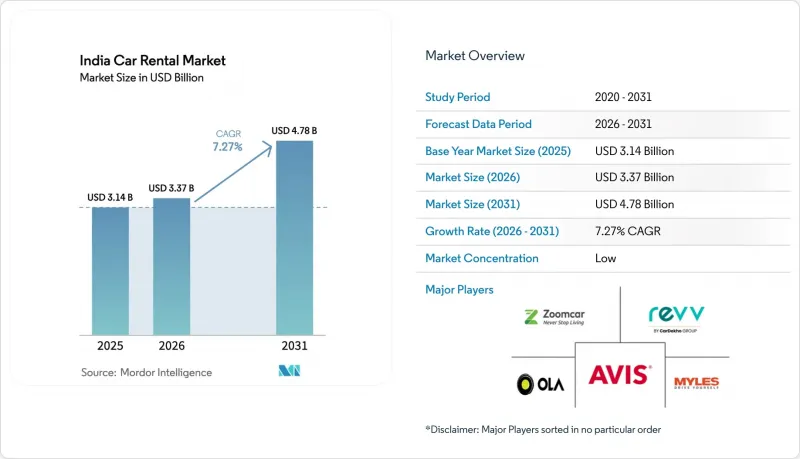
This report is Segmented by Booking Type (Online and Offline), Application Type (Tourism and Commuting/Daily Mobility), Service Model (Self-Drive, Chauffeur-Driven, and More), Vehicle Type (Luxury/Premium Cars and Economy/Budget Cars), Rental Duration (Short-Term, Long-Term), and Rental Channel (Airport and Off-Airport). The Market Forecasts are Provided in Terms of Value (USD).
India Car Rental Market Trends and Insights
Expanding Domestic and Inbound Tourism Flow
Domestic holidaymakers are projected to drive a considerable revenue growth for tourism enterprises in FY25, prompting rental firms to deploy an incremental fleet in spiritual, coastal, and heritage destinations. Flexible short-duration hires appeal to travelers seeking "micro-holiday" itineraries that public transit cannot cover. Hotel occupancy approaching 68% in 2024 resurrects airport-ground transport synergies. Small-and medium-sized events and a steady rise in meetings demand amplify weekday utilization rates, cushioning seasonal volatility. Government investment in roads, rail connectivity, and destination marketing multiplies demand for legally compliant, tech-enabled car rentals.
Growth of Corporate Travel and Gig-Economy Mobility Demand
India's business travel sector is projected to recover to pre-2019 spending levels by 2025. In 2024, business travel spending in India reached an estimated USD 38.3 billion, making it the 8th largest market globally and 4th in the Asia-Pacific (APAC) region, according to the Global Business Travel Association (GBTA). Hybrid work has increased the need for sporadic yet premium door-to-door transport as firms curtail long-term chauffeur contracts. Employee transportation and chauffeur-car rental services currently penetrate only one-fifth of an addressable INR 1 lakh-crore opportunity, leaving wide space for organized entrants. Gig-economy workers favor daily or weekly packages that blend unlimited kilometers with predictable rates, generating a new mid-duration niche within the Indian car rental market. AI-driven routing helps operators hit punctuality targets despite urban congestion.
Limited Presence Beyond Tier-I Cities
Ecos (India) Mobility derives 60% of its turnover from just four metros, highlighting the difficulty of scaling service quality in smaller markets where maintenance vendors and roadside assistance coverage remain thin. Fragmented local taxes, divergent driver-license categories, and gaps in airport connectivity combine to raise the break-even fleet size in Tier-II towns. Yet used-car ownership is rising rapidly in these cities, signaling latent demand that organized rentals could unlock through franchise partnerships and asset-light peer fleets.
Other drivers and restraints analyzed in the detailed report include:
- Rising Penetration of Mobile-App Based Booking Platforms
- EV Adoption in Rental Fleets Fueled by FAME II Incentives
- Ride-Hailing Price Advantage Over Multi-Day Rentals
For complete list of drivers and restraints, kindly check the Table Of Contents.
Segment Analysis
The India car rental market accounts for a 66.85% share in the India Car Rental Market in 2025, as bookings through websites or apps, and that are expected to grow with a 7.60% CAGR during the forecast period (2026-2031). Platform integrations with navigation suites reduce discovery friction and feed data back to fleet-planning algorithms. Offline counters persist at railway hubs where walk-up travelers favor human assistance, but automated kiosks and QR code unlocks are rapidly closing the convenience gap.
Peer-to-peer engines diversify fleet make-up and penetrate housing societies and tech parks where traditional rental storefronts are absent. AI chatbots handle most service queries, significantly reducing the average resolution time. Cashback campaigns tied to e-wallets lure budget travelers, while subscription bundles with smartphone upgrades signal cross-industry alliances.
Tourism still supplied a 57.74% share in the India Car Rental Market in 2025, but weekday commuting packages show the fastest trajectory at an 8.42% CAGR during the forecast period (2026-2031), as city dwellers pivot away from private ownership. The Indian car rental market share for commuting could rise significantly by the decade-end, narrowing the gap with leisure segments. Organized rental agreements tied to corporate travel platforms ensure predictable pricing and duty-of-care compliance.
Spiritual tourism and "micro-holiday" culture elongate peak seasons, smoothing fleet utilization across quarters. Meanwhile, growth in micro, small, and medium enterprises translates into demand for chauffeur-driven shuttles to ferry staff between suburban factories and transit nodes. Daily subscription passes bundle four intra-city trips under a fixed kilometer cap, reflecting operators' creative packaging.
Complete Report Scope:
- By Booking Type
- Online
- Offline
- By Application Type
- Tourism
- Commuting / Daily Mobility
- By Service Model
- Self-Drive
- Chauffeur-Driven
- Corporate Leasing / Subscription
- By Vehicle Type
- Luxury / Premium Cars
- Economy / Budget Cars
- By Rental Duration
- Short-Term (Less than 30 Days)
- Long-Term (Greater than/equals 30 Days)
- By Rental Channel
- Airport
- Off-Airport
List of Companies Covered in this Report:
- Zoomcar
- Revv
- Drivezy
- MyChoize
- Myles
- Vroom Drive
- Eco Rent A Car
- Ola Drive
- Avis India
- Carzonrent
- Savaari Car Rentals
- Hertz India
- Europcar-Eco Mobility
- IndusGo
- FastTrack Tours & Travels
- One Way Cab
Additional Benefits:
- The market estimate (ME) sheet in Excel format
- 3 months of analyst support
TABLE OF CONTENTS
1 Introduction
- 1.1 Study Assumptions & Market Definition
- 1.2 Scope of the Study
2 Research Methodology
3 Executive Summary
4 Market Landscape
- 4.1 Market Overview
- 4.2 Market Drivers
- 4.2.1 Expanding Domestic and Inbound Tourism Flow
- 4.2.2 Growth of Corporate Travel and Gig-Economy Mobility Demand
- 4.2.3 Rising Penetration of Mobile-App Based Booking Platforms
- 4.2.4 EV Adoption in Rental Fleets Fueled by FAME II Incentives
- 4.2.5 GST Rationalization and Seamless Inter-State Permits
- 4.2.6 Integration of Rentals with Multimodal Travel Ecosystems
- 4.3 Market Restraints
- 4.3.1 Limited Presence Beyond Tier-I Cities
- 4.3.2 Ride-Hailing Price Advantage Over Multi-Day Rentals
- 4.3.3 High Insurance and Compliance Burden for Fleet Operators
- 4.3.4 Sparse EV-Charging Network for Rental Operations
- 4.4 Value / Supply-Chain Analysis
- 4.5 Regulatory Landscape
- 4.6 Technological Outlook
- 4.7 Porter's Five Forces
- 4.7.1 Threat of New Entrants
- 4.7.2 Bargaining Power of Buyers
- 4.7.3 Bargaining Power of Suppliers
- 4.7.4 Threat of Substitutes
- 4.7.5 Competitive Rivalry
5 Market Size & Growth Forecasts (Value, USD)
- 5.1 By Booking Type
- 5.1.1 Online
- 5.1.2 Offline
- 5.2 By Application Type
- 5.2.1 Tourism
- 5.2.2 Commuting / Daily Mobility
- 5.3 By Service Model
- 5.3.1 Self-Drive
- 5.3.2 Chauffeur-Driven
- 5.3.3 Corporate Leasing / Subscription
- 5.4 By Vehicle Type
- 5.4.1 Luxury / Premium Cars
- 5.4.2 Economy / Budget Cars
- 5.5 By Rental Duration
- 5.5.1 Short-Term (Less than 30 Days)
- 5.5.2 Long-Term (Greater than/equals 30 Days)
- 5.6 By Rental Channel
- 5.6.1 Airport
- 5.6.2 Off-Airport
6 Competitive Landscape
- 6.1 Market Concentration
- 6.2 Strategic Moves
- 6.3 Market Share Analysis
- 6.4 Company Profiles (includes Global Level Overview, Market Level Overview, Core Segments, Financials as Available, Strategic Information, Market Rank/Share for Key Companies, Products and Services, SWOT Analysis, and Recent Developments)
- 6.4.1 Zoomcar
- 6.4.2 Revv
- 6.4.3 Drivezy
- 6.4.4 MyChoize
- 6.4.5 Myles
- 6.4.6 Vroom Drive
- 6.4.7 Eco Rent A Car
- 6.4.8 Ola Drive
- 6.4.9 Avis India
- 6.4.10 Carzonrent
- 6.4.11 Savaari Car Rentals
- 6.4.12 Hertz India
- 6.4.13 Europcar-Eco Mobility
- 6.4.14 IndusGo
- 6.4.15 FastTrack Tours & Travels
- 6.4.16 One Way Cab
7 Market Opportunities & Future Outlook
- 7.1 White-space & Unmet-Need Assessment
- 7.2 Road-Infrastructure Investment Impact

