PUBLISHER: Mordor Intelligence | PRODUCT CODE: 2117326

PUBLISHER: Mordor Intelligence | PRODUCT CODE: 2117326
Automobile Rental And Leasing - Market Share Analysis, Industry Trends & Statistics, Growth Forecasts (2026 - 2031)
According to Mordor Intelligence, the automobile rental and leasing market size was valued at USD 159.21 billion in 2025 and estimated to grow from USD 171.26 billion in 2026 to reach USD 256.45 billion by 2031, at a CAGR of 8.41% during the forecast period (2026-2031).
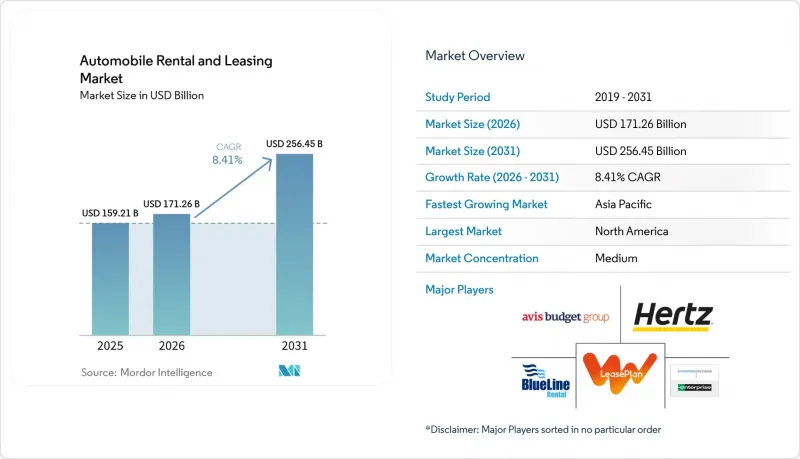
This report is Segmented by Vehicle Type (Passenger Cars and Commercial Vehicles), Service Type (Rental and Leasing), Mode of Booking (Online and Offline), End User (Individual and Corporate), Propulsion Type (Internal Combustion Engine and Electric Vehicles), and Geography. The Market Forecasts are Provided in Terms of Value (USD).
Global Automobile Rental And Leasing Market Trends and Insights
Recovery in Global Business and Leisure Travel
By mid-2025, business trips nearly returned to pre-pandemic levels. In contrast, leisure journeys not only recovered but also exceeded previous benchmarks. This increase in leisure travel has driven corporate daily rates significantly higher than leisure rates . Fleet managers are now leveraging AI forecasting, repositioning vehicles well in advance of major events. A prominent European operator, after integrating predictive rebalancing, reported a notable improvement in asset utilization. Saudi Arabia, with its Vision 2030 initiative, aims to attract a substantial number of visitors by the end of the decade. This ambitious target, combined with relatively low rental penetration compared to more developed markets, indicates strong multi-year demand. While recovery is uneven, China's domestic traffic has fully rebounded, yet international arrivals remain significantly below pre-pandemic levels.
Government Incentives Accelerating Fleet Electrification
The U.S. Inflation Reduction Act provides commercial electric vehicles (EVs) with significant subsidies, leading to a notable reduction in their five-year total cost of ownership . Under Europe's Clean Vehicles Directive, a substantial portion of public procurements must be zero-emission within the next few years. This mandate is pushing private lessors to electrify their fleets to maintain airport concessions. In China, a dual-credit policy is set to effectively prohibit new internal combustion engine (ICE) rentals in major cities in the near future. Meanwhile, California is bolstering the case for electrification by offering competitive peak-hour vehicle-to-grid (V2G) tariffs . As a result, operators are strategically timing their deployments in areas with the most lucrative subsidies, leading to a significantly higher ratio of EVs to ICEs in California compared to rural Midwest regions.
Rising Vehicle Acquisition and Financing Costs
Over the forecast period, fleet prices experienced significant growth, driven by rising interest rates, which reached their peak in mid-2024. Each substantial increase in interest rates added notable annual interest costs per vehicle, exerting pressure on EBITDA margins. Original-equipment makers raised fleet list prices due to inflation in battery material costs, while smaller operators, lacking the advantage of volume leverage, were forced to pay full sticker prices. To manage capital expenditures, fleets have extended their average hold periods. However, this strategy has led to higher maintenance expenses and increased exposure to residual-value risks.
Other drivers and restraints analyzed in the detailed report include:
- E-Commerce-Led Demand for Flexible Truck and Van Leasing
- Mobile/Online Booking Penetration Surge
- EV Residual-Value Volatility and Repair-Cost Uncertainty
For complete list of drivers and restraints, kindly check the Table Of Contents.
Segment Analysis
Passenger cars captured 75.16% of 2025 revenue, whereas commercial vehicles are forecast to advance at an 8.43% CAGR, eclipsing overall automobile rental and leasing market growth. E-commerce giants and regional couriers are driving the surge, opting for flexible leases to navigate seasonal peaks. A significant contract, finalized recently, will deploy thousands of electric vans with last-mile carriers across North America, highlighting the industry's shift towards electrified fleets. In rural tier-3 cities, where volumes fluctuate, shorter leases-averaging a little over two years-are becoming the norm. While passenger cars maintain a dominant market share, they're feeling the pinch from peer-to-peer services that undercut daily rates, especially in dense urban areas where parking costs deter ownership.
Passenger vehicles are reaping the benefits of a travel resurgence, commanding premium daily rates from corporate clients. However, their market dominance belies a growing vulnerability: urban hubs like Manhattan and London have witnessed a noticeable dip in short-term rentals over the past couple of years, a decline somewhat balanced by growth in suburban and leisure markets. On the commercial front, clients are gravitating towards bundled services-maintenance, telematics, and driver training-creating switching barriers that peer-to-peer models struggle to overcome. With stricter environmental regulations complicating compliance, many are turning to specialist lessors for outsourcing.
Rental captured 67.37% of 2025 spend, but leasing expands at an 8.51% CAGR, outperforming the broader automobile rental and leasing market. Enterprises gravitate toward leases that shift rising interest-rate exposure and residual risk to service providers. In recent times, a newly merged European lessor, overseeing a large fleet of vehicles, revealed that a significant portion of its contracts featured early-termination flexibility, marking a notable increase compared to previous years. Meanwhile, in North America, inquiries for electric vehicle (EV) leases experienced substantial growth, driven by tax credits that effectively reduced acquisition costs.
Rentals continue to play a pivotal role for both leisure and short-term business travelers. This trend is bolstered by AI-driven pricing strategies, which significantly boosted one company's revenue per available vehicle. However, the short hold periods of these rentals have led to pronounced shocks from EV depreciation. A testament to this is a major operator's substantial financial write-down following the sale of its used electric sedans. On a different note, subscription models are gaining traction. A prominent pilot program in Germany exemplifies this trend, offering customers the flexibility to swap cars multiple times a month for a flat fee, blending the agility of rentals with the predictability of leasing.
Complete Report Scope:
- By Vehicle Type
- Passenger Cars
- Commercial Vehicles
- By Service Type
- Rental
- Leasing
- By Mode of Booking
- Online
- Offline
- By End User
- Individual
- Corporate
- By Propulsion Type
- Internal Combustion Engine (ICE)
- Electric Vehicles (EVs)
- By Geography
- North America
- United States
- Canada
- Rest of North America
- South America
- Brazil
- Argentina
- Rest of South America
- Europe
- Germany
- United Kingdom
- France
- Italy
- Spain
- Rest of Europe
- Asia Pacific
- China
- India
- Japan
- South Korea
- Rest of Asia Pacific
- Middle East and Africa
- United Arab Emirates
- Saudi Arabia
- South Africa
- Turkey
- Rest of Middle East and Africa
- North America
Geography Analysis
North America produced 32.37% of 2025 revenue and matches the overall CAGR as market maturity limits upside. The Inflation Reduction Act accelerates EV adoption, and California's V2G tariffs reward bidirectional charging. Peer-to-peer penetration reached a minimum of leisure bookings, prompting incumbents to launch counter-platforms. The 2024 ransomware incident that froze 15,000 sites drove a wave of ISO 27001 certifications as corporate buyers harden cybersecurity requirements.
Asia Pacific is the fastest-growing region, advancing at an 8.47% CAGR. China's dual-credit rules will bar fresh ICE rentals in key cities after 2027, while India's corporate leasing grows despite charging-infrastructure gaps. Super-apps such as Grab and WeChat triple booking conversion rates. However, regulatory fragmentation-like India's differential GST-complicates cross-border fleet allocation. Europe shows steady expansion fueled by electrification mandates. Subscription schemes proliferate in Germany and the UK, where customers can swap cars three times a month. Seasonal volatility in Southern Europe inflates idle-fleet costs up to two-fifths off-peak, spurring adoption of dynamic pricing tied to local event calendars. A 200-vehicle V2G project in Spain's Balearic Islands stabilized the grid during tourist surges.
South America remains concentrated, with a Brazilian operator holding the majority of regional share. Currency-hedged leasing shields corporate customers from real and peso volatility. Elevated interest rates- Brazil's Selic at elevated levels in mid-2025- curb fleet financing, though e-commerce drives van leasing. The Middle East and Africa gain structural support from Saudi Arabia's plan to attract 100 million visitors by 2030. Rental duration averages 12 days, triple the global mean. The UAE capitalizes on high-net-worth tourism, expanding luxury and electric catalogs, while South Africa contends with crime-related insurance premiums. Turkey is emerging as a regional hub, blending tourism and cross-border rentals.
- Enterprise Holdings
- The Hertz Corporation
- Avis Budget Group
- Sixt SE
- Europcar Mobility Group
- Localiza
- LeasePlan
- Ryder System
- Penske Truck Leasing
- PACCAR Leasing
- United Rentals
- U-Haul Holding
- Turo
- Getaround
- BlueLine Rental
- Zoomcar
- eHi Car Service
- Grab Rentals
- Uber Technologies (Uber Rent/XL)
- Element Fleet Management
Additional Benefits:
- The market estimate (ME) sheet in Excel format
- 3 months of analyst support
TABLE OF CONTENTS
1 Introduction
- 1.1 Study Assumptions and Market Definition
- 1.2 Scope of the Study
2 Research Methodology
3 Executive Summary
4 Market Landscape
- 4.1 Market Overview
- 4.2 Market Drivers
- 4.2.1 Recovery in Global Business and Leisure Travel
- 4.2.2 Government Incentives Accelerating Fleet Electrification
- 4.2.3 E-Commerce-Led Demand for Flexible Truck and Van Leasing
- 4.2.4 Mobile/Online Booking Penetration Surge
- 4.2.5 AI-Enabled Dynamic Pricing and Predictive Maintenance
- 4.2.6 Vehicle-To-Grid (V2G) Revenue Streams Turn Rental Fleets Into Distributed Energy Assets
- 4.3 Market Restraints
- 4.3.1 Rising Vehicle Acquisition and Financing Costs
- 4.3.2 Intensifying Competition from Ride-Hailing and P2P Car-Sharing
- 4.3.3 EV Residual-Value Volatility and Repair-Cost Uncertainty
- 4.3.4 Heightened Cybersecurity and Data-Privacy Liabilities From Connected/Telematics-Rich Fleets
- 4.4 Value / Supply-Chain Analysis
- 4.5 Regulatory Landscape
- 4.6 Technological Outlook
- 4.7 Porter's Five Forces
- 4.7.1 Threat of New Entrants
- 4.7.2 Bargaining Power of Suppliers
- 4.7.3 Bargaining Power of Buyers
- 4.7.4 Threat of Substitutes
- 4.7.5 Competitive Rivalry
5 Market Size and Growth Forecasts (Value (USD))
- 5.1 By Vehicle Type
- 5.1.1 Passenger Cars
- 5.1.2 Commercial Vehicles
- 5.2 By Service Type
- 5.2.1 Rental
- 5.2.2 Leasing
- 5.3 By Mode of Booking
- 5.3.1 Online
- 5.3.2 Offline
- 5.4 By End User
- 5.4.1 Individual
- 5.4.2 Corporate
- 5.5 By Propulsion Type
- 5.5.1 Internal Combustion Engine (ICE)
- 5.5.2 Electric Vehicles (EVs)
- 5.6 By Geography
- 5.6.1 North America
- 5.6.1.1 United States
- 5.6.1.2 Canada
- 5.6.1.3 Rest of North America
- 5.6.2 South America
- 5.6.2.1 Brazil
- 5.6.2.2 Argentina
- 5.6.2.3 Rest of South America
- 5.6.3 Europe
- 5.6.3.1 Germany
- 5.6.3.2 United Kingdom
- 5.6.3.3 France
- 5.6.3.4 Italy
- 5.6.3.5 Spain
- 5.6.3.6 Rest of Europe
- 5.6.4 Asia Pacific
- 5.6.4.1 China
- 5.6.4.2 India
- 5.6.4.3 Japan
- 5.6.4.4 South Korea
- 5.6.4.5 Rest of Asia Pacific
- 5.6.5 Middle East and Africa
- 5.6.5.1 United Arab Emirates
- 5.6.5.2 Saudi Arabia
- 5.6.5.3 South Africa
- 5.6.5.4 Turkey
- 5.6.5.5 Rest of Middle East and Africa
- 5.6.1 North America
6 Competitive Landscape
- 6.1 Market Concentration
- 6.2 Strategic Moves
- 6.3 Market Share Analysis
- 6.4 Company Profiles (includes Global Level Overview, Market Level Overview, Core Segments, Financials as Available, Strategic Information, Market Rank/Share for Key Companies, Products and Services, SWOT Analysis, and Recent Developments)
- 6.4.1 Enterprise Holdings
- 6.4.2 The Hertz Corporation
- 6.4.3 Avis Budget Group
- 6.4.4 Sixt SE
- 6.4.5 Europcar Mobility Group
- 6.4.6 Localiza
- 6.4.7 LeasePlan
- 6.4.8 Ryder System
- 6.4.9 Penske Truck Leasing
- 6.4.10 PACCAR Leasing
- 6.4.11 United Rentals
- 6.4.12 U-Haul Holding
- 6.4.13 Turo
- 6.4.14 Getaround
- 6.4.15 BlueLine Rental
- 6.4.16 Zoomcar
- 6.4.17 eHi Car Service
- 6.4.18 Grab Rentals
- 6.4.19 Uber Technologies (Uber Rent/XL)
- 6.4.20 Element Fleet Management
7 Market Opportunities & Future Outlook
- 7.1 White-space & Unmet-Need Assessment

