PUBLISHER: Mordor Intelligence | PRODUCT CODE: 2187684

PUBLISHER: Mordor Intelligence | PRODUCT CODE: 2187684
US Telecom MNO - Market Share Analysis, Industry Trends & Statistics, Growth Forecasts (2027 - 2032)
According to Mordor Intelligence, the US telecom MNO market size was valued at USD 357.6 billion in 2026 and estimated to grow from USD 371.2 billion in 2027 to reach USD 441.3 billion by 2032, at a CAGR of 3.52% during the forecast period (2027-2032).
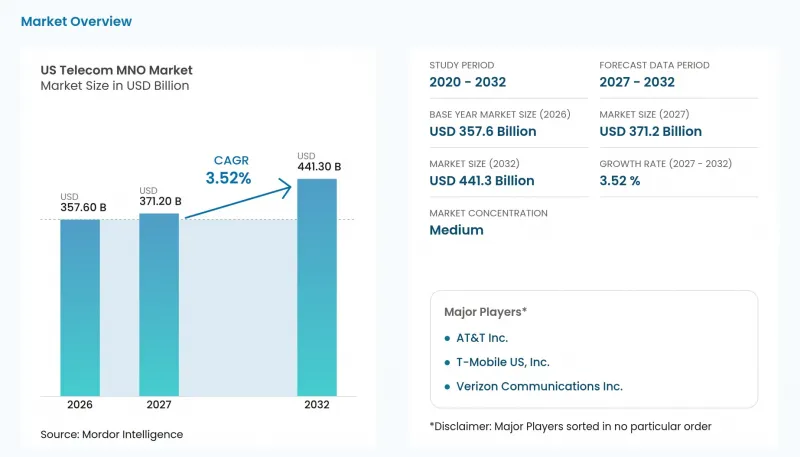
This report is segmented by Service Type (Data and Internet Services, OTT and PayTV Services, Other Services, Voice Services, IoT and M2M Services, and Messaging Services) and End-user (Consumer and Enterprises). The market forecasts are provided in terms of value (USD), based on availability.
US Telecom MNO Market Trends and Insights
5G Stand-Alone Core Roll-outs Accelerating Data-Monetization
Standalone-core investment becomes commercially relevant when it supports a service class that institutional customers can buy. In February 2025, T-Mobile said it was providing US first responders with a dedicated slice of its 5G standalone network through T-Priority. In December 2025, Verizon offered 5G Network Slice - Enhanced Internet, a fixed-wireless business internet service, in select US markets. The offer combined a fixed monthly rate with performance backed by a service-level agreement (SLA). These offerings position connectivity around institutional needs through priority access or a specified business-service commitment. A priced slice with a service-level commitment lets a carrier bill for network performance itself, distinguishing the offer from general connectivity.
Fixed-Wireless Access (FWA) Displacing Legacy Copper
An operator exiting legacy copper needs a replacement service through which it can retain the customer's broadband relationship. AT&T's 2025 copper-exit strategy included migrating customers to fiber and wireless alternatives, alongside work with policymakers on decommissioning. The operator offers fixed wireless access through AT&T Internet Air. AT&T also added 279,000 fixed-wireless internet connections on a net basis in the second quarter of 2026. Verizon added 193,000 fixed wireless access connections on a net basis during the same quarter. An explicit migration strategy and operating FWA additions make wireless a commercially grounded replacement option, alongside the fiber alternative in the incumbent's plan.
Inflation-Induced ARPU Pressure in Pre-paid
Inflation can constrain prepaid service when a customer's next mobile payment competes with other essential spending. In the second quarter of 2026, T-Mobile US reported 9% service-revenue growth primarily from higher postpaid revenue, including following its UScellular and Metronet acquisitions, partly offset by lower prepaid service revenue. An operator could retain the connection while receiving less revenue if the user selects a lower-priced service level. The commercial exposure is therefore to the value of each renewal as well as the continuity of the connection. Maintaining a lower-priced offer may preserve the service relationship. The remaining cost is reduced room to increase revenue per user without making the next service payment harder to justify.
Other drivers and restraints analyzed in the detailed report include:
- eSIM-Only Device Launches Simplifying Churn
- Federal BEAD and Middle-Mile Grants Stimulating Rural Build-outs
- Fiber Over-builds Eroding FWA Economics
For complete list of drivers and restraints, kindly check the Table Of Contents.
Segment Analysis
T-Mobile US reported USD 19 billion in service revenue in the second quarter of 2026, up 9% year over year. Its postpaid average revenue per account (ARPA) was USD 152.91 per month, up 2% over the same period. T-Mobile attributed the ARPA increase primarily to higher fee revenue and more customers per account, including 5G broadband adoption and T-Mobile for Business growth. Fiber and UScellular accounts with fewer customers per account partly offset the rise in customers per account, while increased promotions, including bundled offers, partly offset ARPA growth. The revenue opportunity is to serve more customers within each postpaid account while keeping promotional concessions from absorbing the gains in monthly account value.
AT&T's wireless phone average revenue per user (ARPU) rose to USD 54.16 in the second quarter of 2026 from USD 53.21 a year earlier. Verizon's wireless retail postpaid ARPA fell to USD 168.35 from USD 170.79 over the same period. The figures attach revenue to different units and customer populations, making phone monetization and retail postpaid account value distinct commercial questions. AT&T's rising phone yield supports a case for phone-level monetization, while Verizon's lower account yield puts the competitive weight on revenue depth within each postpaid relationship.
Complete Report Scope:
- By Overall Telecom Revenue and ARPU
- By Service Type
- Voice Services
- Data and Internet Services
- Messaging Services
- IoT and M2M Services
- OTT and PayTV Services
- Other Services (VAS, Roaming and International Services, Enterprise and Wholesale Services, etc.)
- By End-user
- Enterprises
- Consumer
List of Companies Covered in this Report:
- Verizon Communications Inc.
- AT&T Inc.
- T-Mobile US, Inc.
Additional Benefits:
- The market estimate (ME) sheet in Excel format
- 3 months of analyst support
TABLE OF CONTENTS
1 INTRODUCTION
- 1.1 Study Assumptions and Market Definition
- 1.2 Scope of the Study
2 RESEARCH METHODOLOGY
3 EXECUTIVE SUMMARY
4 MARKET LANDSCAPE
- 4.1 Market Overview
- 4.2 Market Drivers
- 4.2.1 5G Stand-Alone Core Roll-outs Accelerating Data-Monetization
- 4.2.2 Fixed-Wireless Access (FWA) Displacing Legacy Copper
- 4.2.3 eSIM-Only Device Launches Simplifying Churn
- 4.2.4 Federal BEAD and Middle-Mile Grants Stimulating Rural Build-outs
- 4.2.5 Private-Cellular Demand from IIoT and Campus Networks
- 4.2.6 AI-Driven RAN Optimization Lowering OPEX
- 4.3 Market Restraints
- 4.3.1 Inflation-Induced ARPU Pressure in Pre-paid
- 4.3.2 Fiber Over-builds Eroding FWA Economics
- 4.3.3 C-Band Aviation Mitigation Costs
- 4.3.4 Heightened FCC Scrutiny on M&A
- 4.4 Industry Value Chain Analysis
- 4.5 Regulatory Landscape
- 4.6 Technological Outlook
- 4.7 Porter's Five Forces Analysis
- 4.7.1 Threat of New Entrants
- 4.7.2 Bargaining Power of Suppliers
- 4.7.3 Bargaining Power of Buyers
- 4.7.4 Threat of Substitutes
- 4.7.5 Competitive Rivalry
- 4.8 Spectrum Landscape and Competitive Holdings
- 4.9 Telecom Industry Ecosystem
- 4.10 Macroeconomic and External Drivers
- 4.11 Key MNO KPIs (2020-2025)
- 4.11.1 Unique Mobile Subscribers and Penetration Rate
- 4.11.2 Mobile Internet Users and Penetration Rate
- 4.11.3 SIM Connections by Access Technology and Penetration
- 4.11.4 Cellular IoT / M2M Connections
- 4.11.5 Broadband Connections (Mobile and Fixed)
- 4.11.6 ARPU (Average Revenue Per User)
- 4.11.7 Average Data Usage per Subscription (GB/month)
- 4.12 Analysis of key business models in Telecom Sector
- 4.13 Analysis of Pricing Models and Pricing
5 MARKET SIZE AND GROWTH FORECASTS (VALUE)
- 5.1 By Overall Telecom Revenue and ARPU
- 5.2 By Service Type
- 5.2.1 Voice Services
- 5.2.2 Data and Internet Services
- 5.2.3 Messaging Services
- 5.2.4 IoT and M2M Services
- 5.2.5 OTT and PayTV Services
- 5.2.6 Other Services (VAS, Roaming and International Services, Enterprise and Wholesale Services, etc.)
- 5.3 By End-user
- 5.3.1 Enterprises
- 5.3.2 Consumer
6 COMPETITIVE LANDSCAPE
- 6.1 Market Concentration
- 6.2 Strategic Moves
- 6.3 Market Share Analysis
- 6.4 Company Profiles (includes Global level Overview, Market level overview, Core Segments, Financials as available, Strategic Information, Market Rank/Share for key companies, Products and Services, and Recent Developments)
- 6.4.1 Verizon Communications Inc.
- 6.4.2 AT&T Inc.
- 6.4.3 T-Mobile US, Inc.
7 MARKET OPPORTUNITIES AND FUTURE OUTLOOK
- 7.1 White-Space and Unmet-Need Assessment

