PUBLISHER: Mordor Intelligence | PRODUCT CODE: 2187691

PUBLISHER: Mordor Intelligence | PRODUCT CODE: 2187691
Philippines Telecom MNO - Market Share Analysis, Industry Trends & Statistics, Growth Forecasts (2027 - 2032)
According to Mordor Intelligence, the Philippines telecom MNO market size is projected to expand from USD 7.81 billion in 2026 and USD 8.13 billion in 2027 to USD 10.07 billion by 2032, registering a CAGR of 4.37% between 2027 and 2032.
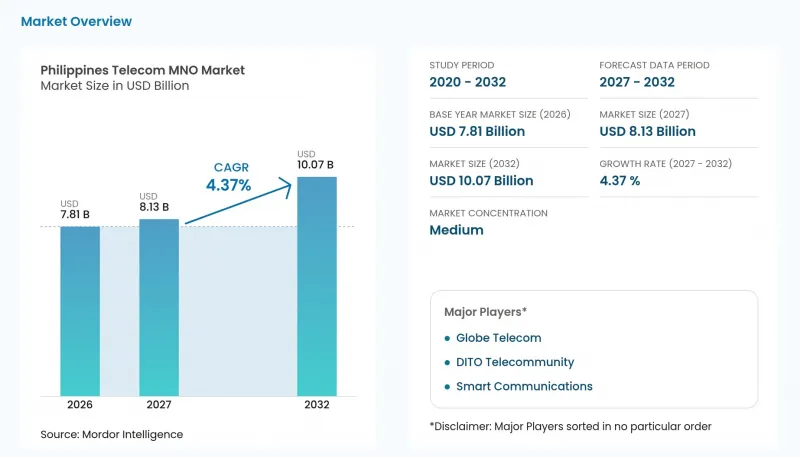
This report is segmented by Service Type (Data and Internet Services, Voice Services, OTT and PayTV Services, Other Services, Messaging Services, and IoT and M2M Services) and End-User (Consumer and Enterprises). The market forecasts are provided in terms of value (USD), based on availability.
Philippines Telecom MNO Market Trends and Insights
Rising mobile-data consumption from video and gaming boom
A growing audience that also uses more data intensifies the capacity required to support mobile entertainment. Globe's mobile-data user base grew 5% year on year to 39.6 million in the first half of 2026. Its mobile-data traffic reached 3,723 petabytes, up from 3,187 petabytes in the first half of 2025. Average monthly usage also rose from 15 GB to 17 GB per subscriber over the same comparison. Globe linked higher consumption to several digital services, including video streaming, gaming, AI applications, e-commerce, digital payments and productivity services. For the operator, broader participation and greater individual use create a recurring data-service opportunity that requires capacity to keep pace with both sources of demand.
Accelerated 5G roll-out and device affordability
Coverage and handset access need to work together for a 5G footprint to become paying demand. The GSMA's February 2026 Philippines roadmap reported commercial 5G coverage at around 80% of the country's population. In its 2025 results release, PLDT linked wider affordable 5G handset availability and Smart's network optimization to the shift toward faster, more reliable connectivity. PLDT reported 12.5 million 5G-capable individual devices at end-June 2026, up 30% year over year and representing 21% of individual devices in its Wireless Consumer business. The same GSMA roadmap reported an Opensignal measure of 5G availability at 46% of the time, a separate measure from population coverage. PLDT's limited 5G device penetration and the separate availability measure point to demand opportunities in handset migration and consistent network access, alongside wider coverage.
Heavy 5G / fiber capex burden on operators
Network expansion must compete for funding even when an operator brings its capital spending under tighter control. PLDT's consolidated capital expenditures equaled 28% of its service revenues in 2025. That ratio makes the cash required to sustain and expand infrastructure commercially significant alongside revenue generation. It also means that demand growth alone cannot settle which capacity additions can be funded or how quickly they can proceed. PLDT said capex discipline and successful vendor negotiations contributed to its lower capital expenditures in 2025. Even with that response, committing capital before the associated services generate returns creates a funding requirement that can limit the pace of additional network deployment.
Other drivers and restraints analyzed in the detailed report include:
- Government common-tower and spectrum-reform programs
- Enterprise digital-transformation and IoT connectivity demand
- Low rural ARPU limiting ROI
For complete list of drivers and restraints, kindly check the Table Of Contents.
Segment Analysis
Overall telecom revenue depends on the value earned from subscriber relationships as well as the amount of connectivity delivered. PLDT reported that Smart Communications maintained stable average revenue per user in 2025, supported by continued 5G adoption and higher data consumption. Stable subscriber monetization alongside greater use means that additional traffic does not necessarily produce a higher average return from each connection. Traffic growth can increase capacity requirements even when average subscriber revenue holds steady, putting the cost of carrying each connection's usage under pressure.
In its 2025 results release, PLDT said Smart's core modernization program, then underway, was strengthening network analytics and targeting capabilities, enabling more personalized offers and better marketing efficiency. Those capabilities connect the network investment decision with the way services are presented to different subscriber needs. More precise targeting can help an operator shape a relevant offer without assuming that all users will respond to the same access package. With ARPU stable while 5G adoption and data use rose, revenue growth would require more paying relationships unless targeted offers also lifted per-user spending.
Complete Report Scope:
- By Overall Telecom Revenue and ARPU
- By Service Type
- Voice Services
- Data and Internet Services
- Messaging Services
- IoT and M2M Services
- OTT and PayTV Services
- Other Services (VAS, Roaming and International Services, Enterprise and Wholesale Services, etc.)
- By End-User
- Enterprises
- Consumer
List of Companies Covered in this Report:
- Globe Telecom
- Smart Communications
- DITO Telecommunity
Additional Benefits:
- The market estimate (ME) sheet in Excel format
- 3 months of analyst support
TABLE OF CONTENTS
1 INTRODUCTION
- 1.1 Study Assumptions and Market Definition
- 1.2 Scope of the Study
2 RESEARCH METHODOLOGY
3 EXECUTIVE SUMMARY
4 MARKET LANDSCAPE
- 4.1 Market Overview
- 4.2 Market Drivers
- 4.2.1 Rising mobile-data consumption from video and gaming boom
- 4.2.2 Accelerated 5G roll-out and device affordability
- 4.2.3 Government common-tower and spectrum-reform programs
- 4.2.4 Enterprise digital-transformation and IoT connectivity demand
- 4.2.5 Fin-tech super-apps (e.g., GCash) lifting stickiness and ARPU
- 4.2.6 Typhoon-resilient network requirements driving densification
- 4.3 Market Restraints
- 4.3.1 Heavy 5G / fiber capex burden on operators
- 4.3.2 Low rural ARPU limiting ROI
- 4.3.3 SIM Registration Act-driven prepaid deactivations
- 4.3.4 Climate-related outages raising opex and churn risk
- 4.4 Industry Value Chain Analysis
- 4.5 Regulatory Landscape
- 4.6 Technological Outlook
- 4.7 Porter's Five Forces Analysis
- 4.7.1 Threat of New Entrants
- 4.7.2 Bargaining Power of Suppliers
- 4.7.3 Bargaining Power of Buyers
- 4.7.4 Threat of Substitutes
- 4.7.5 Competitive Rivalry
- 4.8 Spectrum Landscape and Competitive Holdings
- 4.9 Telecom Industry Ecosystem
- 4.10 Macroeconomic and External Drivers
- 4.11 Key MNO KPIs (2020-2025)
- 4.11.1 Unique Mobile Subscribers and Penetration Rate
- 4.11.2 Mobile Internet Users and Penetration Rate
- 4.11.3 SIM Connections by Access Technology and Penetration
- 4.11.4 Cellular IoT / M2M Connections
- 4.11.5 Broadband Connections (Mobile and Fixed)
- 4.11.6 ARPU (Average Revenue Per User)
- 4.11.7 Average Data Usage per Subscription (GB/month)
- 4.12 Analysis of key business models in Telecom
- 4.13 Analysis of Pricing Models and Pricing
5 MARKET SIZE AND GROWTH FORECASTS (VALUE)
- 5.1 By Overall Telecom Revenue and ARPU
- 5.2 By Service Type
- 5.2.1 Voice Services
- 5.2.2 Data and Internet Services
- 5.2.3 Messaging Services
- 5.2.4 IoT and M2M Services
- 5.2.5 OTT and PayTV Services
- 5.2.6 Other Services (VAS, Roaming and International Services, Enterprise and Wholesale Services, etc.)
- 5.3 By End-User
- 5.3.1 Enterprises
- 5.3.2 Consumer
6 COMPETITIVE LANDSCAPE
- 6.1 Market Concentration
- 6.2 Strategic Moves
- 6.3 Market Share Analysis
- 6.4 Company Profiles (includes Global level Overview, Market level overview, Core Segments, Financials as available, Strategic Information, Market Rank/Share for key companies, Products and Services, and Recent Developments)
- 6.4.1 Globe Telecom
- 6.4.2 Smart Communications
- 6.4.3 DITO Telecommunity
7 MARKET OPPORTUNITIES AND FUTURE OUTLOOK
- 7.1 White-Space and Unmet-Need Assessment

