PUBLISHER: Mordor Intelligence | PRODUCT CODE: 2187759

PUBLISHER: Mordor Intelligence | PRODUCT CODE: 2187759
Indonesia Cold Chain Logistics - Market Share Analysis, Industry Trends & Statistics, Growth Forecasts (2027 - 2032)
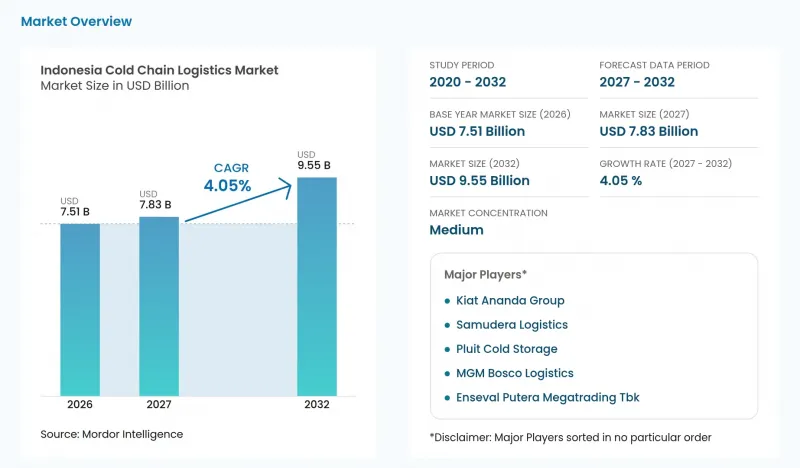
According to Mordor Intelligence, the Indonesia cold chain logistics market size is expected to increase from USD 7.51 billion in 2026 to USD 7.83 billion in 2027 and reach USD 9.55 billion by 2032, growing at a CAGR of 4.05% over 2027-2032.
This report is segmented by Service Type (Refrigerated Storage, Refrigerated Transportation, and more), Temperature Type (Frozen, Chilled, and more), Application (Fish & Seafood, Fruits & Vegetables, and more), and Geography (Java, Sumatra, and more). The market forecasts are provided in terms of value (USD), based on availability.
Indonesia Cold Chain Logistics Market Trends and Insights
Expanding pharmaceutical and vaccine distribution infrastructure
In June 2025, Indonesia's Ministry of Health reported about 20,111 vaccine refrigerators across provincial and local health offices and health centers. In October 2026, the ministry's international procurement for 1,872 vaccine refrigerators, estimated at USD 18.76 million, was at technical evaluation. The distributed equipment base creates a service opportunity in coordinating vaccine movements between storage points, beyond the handling needs of an isolated facility. The procurement could extend that requirement if it progresses into delivered capacity, increasing the importance of connecting new nodes to distribution routes. For logistics providers, the commercial opening is reliable replenishment across the network, so additional equipment can translate into recurring handling demand.
Rapid growth of online grocery and fresh food delivery
Fresh-food delivery promises put commercial emphasis on the interval between order preparation and customer handoff, creating an opening for coordinated temperature-controlled fulfillment. On October 8, 2025, Blibli (PT Global Digital Niaga Tbk) introduced BlibliFresh for selected and curated fresh products, with a commitment to delivery within 1 hour. For products requiring cooling, that service proposition makes dispatch preparation and the delivery handoff part of the same operating requirement. A logistics provider can address it by connecting temperature-controlled holding with order preparation and a scheduled outward movement. Within a promised 1-hour delivery window, late dispatch leaves less time for transit, so preparation and release timing at the cooled holding point become commercially decisive.
High electricity costs and unreliable power supply
A 2026 study reported outages, voltage instability and limited distribution capacity affecting cold-storage facilities in several Indonesian regions. The study connected these conditions with operational disruption, product-quality degradation and economic losses, making continuity a commercial constraint. For a storage operator, adding refrigerated space without dependable power can increase exposed inventory without providing an equally dependable service. The resulting risk can weaken the case for expanding at an otherwise attractive location because usable capacity depends on continuous operation. Dependable site-level power therefore becomes a condition for selling reliable storage, leaving operators exposed to costs that additional floor space cannot resolve.
Other drivers and restraints analyzed in the detailed report include:
- Rising middle-class demand for imported perishables
- Government investment in cold storage hubs and ports
- Fragmented cold chain infrastructure across archipelago
For complete list of drivers and restraints, kindly check the Table Of Contents.
Segment Analysis
Refrigerated storage accounted for a 54.3% share of the Indonesia cold chain logistics market size in 2026. Kiat Ananda Group's companies own, manage and operate 7 mega cold stores and 11 depot warehouses with more than 150,000 pallet positions. The network spans cities including Jakarta, Bekasi, Surabaya, Medan and Makassar. Its warehouses use multiple chambers with temperatures that can be tailored to customer requirements. That configuration gives storage a commercial role in accommodating different product specifications across a network, with the facility offer determined by usable temperature-controlled space as well as its physical location.
Value-added services are forecast to be the fastest-growing segment, at a CAGR of 4.55% over 2027-2032. MGM Bosco Logistics offered warehouse sorting and repacking among its value-added services in May 2026. For a shipper needing smaller dispatch units, preparation within the storage warehouse can avoid arranging a second handling site. The sales proposition becomes the customer's required dispatch format, so the same stored goods can support a broader service relationship.
Complete Report Scope:
- By Service Type
- Refrigerated Storage
- Public Warehousing
- Private Warehousing
- Refrigerated Transportation
- Road
- Rail
- Sea
- Air
- Value-Added Services
- Refrigerated Storage
- By Temperature Type
- Chilled (0-5 °C)
- Frozen (-18-0 °C)
- Ambient
- Deep-Frozen / Ultra-Low (less than -20 °C)
- By Application
- Fruits & Vegetables
- Meat & Poultry
- Fish & Seafood
- Dairy & Frozen Desserts
- Bakery & Confectionery
- Ready-to-Eat Meals
- Pharmaceuticals & Biologics
- Vaccines & Clinical Trial Materials
- Chemicals & Specialty Materials
- Other Perishables
- By Geography
- Java (Jakarta & BOD)
- Sumatra
- Kalimantan
- Sulawesi
- Bali & Nusa Tenggara
- Others
List of Companies Covered in this Report:
- Kiat Ananda Group
- Enseval Putera Megatrading Tbk
- MGM Bosco Logistics
- Samudera Logistics
- Pluit Cold Storage
- PT Nichirei Mega Sejahtera
- PT YCH Indonesia
- PT Wira Logitama Saksama
- DHL Supply Chain Indonesia
- PT BGR Logistik Indonesia
- PT Wahana Cold Storage
- Yusen Logistics
- Ninja Xpress
- Nippon Express
- PT Tira Cipta Logistik (TCL)
- CKL Indonesia Raya (CKL Cargo)
- PT Perishable Logistics Indonesia (PLI)
- PT Mitsubishi Logistics Indonesia
- JAS Worldwide
- Coolkas
Additional Benefits:
- The market estimate (ME) sheet in Excel format
- 3 months of analyst support
TABLE OF CONTENTS
1 INTRODUCTION
- 1.1 Study Assumptions and Market Definition
- 1.2 Scope of the Study
2 RESEARCH METHODOLOGY
3 EXECUTIVE SUMMARY
4 MARKET LANDSCAPE
- 4.1 Market Overview
- 4.2 Market Drivers
- 4.2.1 Expanding pharmaceutical and vaccine distribution infrastructure
- 4.2.2 Rapid growth of online grocery and fresh food delivery
- 4.2.3 Rising middle-class demand for imported perishables
- 4.2.4 Government investment in cold storage hubs and ports
- 4.2.5 Growth of modern retail chains and hypermarkets
- 4.2.6 Increasing aquaculture and seafood export volumes
- 4.3 Market Restraints
- 4.3.1 High electricity costs and unreliable power supply
- 4.3.2 Fragmented cold chain infrastructure across archipelago
- 4.3.3 Limited trained workforce for temperature-controlled operations
- 4.3.4 High capital expenditure for refrigerated fleet and warehouses
- 4.4 Industry Value Chain Analysis
- 4.5 Regulatory Landscape
- 4.6 Technological Outlook
- 4.7 Porter's Five Forces Analysis
- 4.7.1 Threat of New Entrants
- 4.7.2 Bargaining Power of Suppliers
- 4.7.3 Bargaining Power of Buyers
- 4.7.4 Threat of Substitutes
- 4.7.5 Competitive Rivalry
- 4.8 Appendix
- 4.8.1 Annual Statistics on Refrigerated Storage Facilities
- 4.8.2 Import-Export Trade Data of Frozen Food Products
- 4.8.3 Regulatory Framework on Food Transport & Storage
- 4.8.4 Food & Beverage Sector Indicators
5 MARKET SIZE AND GROWTH FORECASTS (VALUE)
- 5.1 By Service Type
- 5.1.1 Refrigerated Storage
- 5.1.1.1 Public Warehousing
- 5.1.1.2 Private Warehousing
- 5.1.2 Refrigerated Transportation
- 5.1.2.1 Road
- 5.1.2.2 Rail
- 5.1.2.3 Sea
- 5.1.2.4 Air
- 5.1.3 Value-Added Services
- 5.1.1 Refrigerated Storage
- 5.2 By Temperature Type
- 5.2.1 Chilled (0-5 °C)
- 5.2.2 Frozen (-18-0 °C)
- 5.2.3 Ambient
- 5.2.4 Deep-Frozen / Ultra-Low (less than -20 °C)
- 5.3 By Application
- 5.3.1 Fruits & Vegetables
- 5.3.2 Meat & Poultry
- 5.3.3 Fish & Seafood
- 5.3.4 Dairy & Frozen Desserts
- 5.3.5 Bakery & Confectionery
- 5.3.6 Ready-to-Eat Meals
- 5.3.7 Pharmaceuticals & Biologics
- 5.3.8 Vaccines & Clinical Trial Materials
- 5.3.9 Chemicals & Specialty Materials
- 5.3.10 Other Perishables
- 5.4 By Geography
- 5.4.1 Java (Jakarta & BOD)
- 5.4.2 Sumatra
- 5.4.3 Kalimantan
- 5.4.4 Sulawesi
- 5.4.5 Bali & Nusa Tenggara
- 5.4.6 Others
6 COMPETITIVE LANDSCAPE
- 6.1 Market Concentration
- 6.2 Strategic Moves
- 6.3 Market Share Analysis
- 6.4 Company Profiles (includes Global level Overview, Market level overview, Core Segments, Financials as available, Strategic Information, Market Rank/Share for key companies, Products and Services, and Recent Developments)
- 6.4.1 Kiat Ananda Group
- 6.4.2 Enseval Putera Megatrading Tbk
- 6.4.3 MGM Bosco Logistics
- 6.4.4 Samudera Logistics
- 6.4.5 Pluit Cold Storage
- 6.4.6 PT Nichirei Mega Sejahtera
- 6.4.7 PT YCH Indonesia
- 6.4.8 PT Wira Logitama Saksama
- 6.4.9 DHL Supply Chain Indonesia
- 6.4.10 PT BGR Logistik Indonesia
- 6.4.11 PT Wahana Cold Storage
- 6.4.12 Yusen Logistics
- 6.4.13 Ninja Xpress
- 6.4.14 Nippon Express
- 6.4.15 PT Tira Cipta Logistik (TCL)
- 6.4.16 CKL Indonesia Raya (CKL Cargo)
- 6.4.17 PT Perishable Logistics Indonesia (PLI)
- 6.4.18 PT Mitsubishi Logistics Indonesia
- 6.4.19 JAS Worldwide
- 6.4.20 Coolkas
7 MARKET OPPORTUNITIES AND FUTURE OUTLOOK
- 7.1 White-Space and Unmet-Need Assessment

