PUBLISHER: Mordor Intelligence | PRODUCT CODE: 2187817

PUBLISHER: Mordor Intelligence | PRODUCT CODE: 2187817
Cold Chain Logistics - Market Share Analysis, Industry Trends & Statistics, Growth Forecasts (2027 - 2032)
According to Mordor Intelligence, the cold chain logistics market size is estimated at USD 384.9 billion in 2026 and is projected to be USD 408.4 billion in 2027, reaching USD 555.4 billion by 2032, growing at a CAGR of 6.34% from 2027 to 2032.
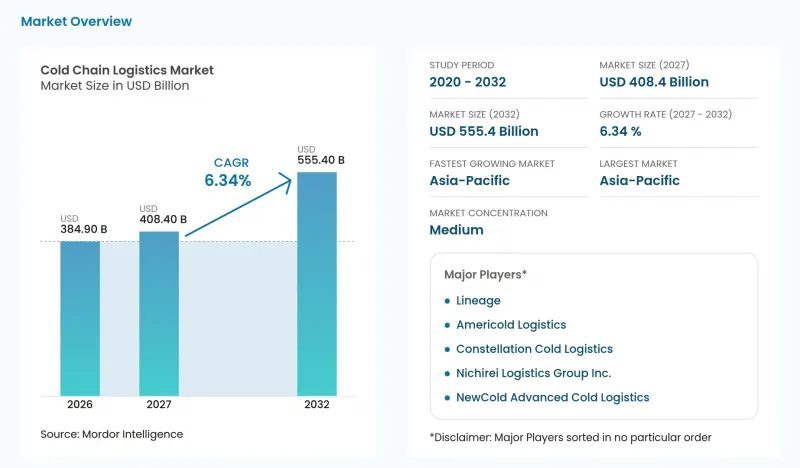
This report is segmented by Service Type (Temperature-Controlled Storage, Temperature-Controlled Transportation, and more), Temperature Type (Chilled / Refrigerated, Frozen, and more), Application (Meat and Poultry, Fruits and Vegetables, and more), and Geography (Asia-Pacific, North America, and more). The market forecasts are provided in terms of value (USD), based on availability.
Global Cold Chain Logistics Market Trends and Insights
Ultra-Low-Temperature mRNA Vaccine Distribution
Frozen COMIRNATY single-dose vials may arrive in dry-ice containers, and the label gives receiving sites a choice between ultra-low-temperature holding and a time-limited refrigerated stage. The World Health Organization's seventh international vaccine-shipping guidance, published in 2025, includes ultra-low-temperature vaccine shipments. Pfizer's 2026-2027 U.S. COMIRNATY label says single-dose vials may arrive frozen in dry-ice thermal containers. It permits storage at -90 °C to -60 °C or transfer to 2 °C to 8 °C refrigeration for up to 10 weeks, and thawed vials should not be refrozen. A provider that can manage both dry-ice delivery and the refrigerated handover can serve either receiving choice, broadening the handling work available around frozen vaccine consignments.
Pharmaceutical Outsourcing to GDP-Compliant 3PLs
In April 2025, EVERSANA, a pharmaceutical third-party logistics operator, announced 30,000 square feet of additional refrigerated and frozen storage to meet growing pharmaceutical needs in biologics and complex therapeutics. Drug makers that outsource distribution need partners able to combine certified pharmaceutical handling with cold capacity for biologics. In August 2026, IAG Cargo added Kuala Lumpur International Airport to its pharmaceutical network, where a good distribution practice (GDP)-certified facility handles active and passive temperature-controlled shipments. Customers could also select priority shipping with enhanced monitoring for urgent temperature-sensitive consignments. Providers that pair certified handling with added biologics capacity can address both the handling standards and the space requirements of outsourcing customers.
CDL-Certified Reefer Driver Shortage in the United States
Driver availability can prevent a temperature-sensitive carrier from fully using equipment already committed to its operations. In its annual filing for 2025, Marten Transport, a U.S. carrier operating temperature-sensitive and dry freight services, reported qualified-driver shortages that had at times caused under-utilization and increased expense. This combination makes the staffing constraint commercially different from a shortage of refrigerated trailers alone. Adding equipment cannot by itself resolve the inability to assign a qualified driver to a movement, so fleet investment may leave the operating bottleneck intact. The resulting service limit can reach refrigerated shippers even when their carrier has suitable vehicles, leaving usable transport capacity dependent on the labor needed to staff it.
Other drivers and restraints analyzed in the detailed report include:
- FSMA 204 Traceability and Real-Time IoT Temperature Monitoring
- Quick-Commerce Grocery and Same-Day Refrigerated Delivery
- Ammonia and CO2 Cascade Retrofit Costs for EU F-Gas Compliance
For complete list of drivers and restraints, kindly check the Table Of Contents.
Segment Analysis
Temperature-controlled storage accounted for a 52.21% share of the cold chain logistics market size in 2026. The Global Cold Chain Alliance's 2026 Global Top 25 ranked Lineage first among its listed temperature-controlled warehousing and logistics providers, with 3.07 billion cubic feet of reported capacity. In the same 2026 table, Lineage's reported capacity rose from 2.98 billion cubic feet for 2025 to 3.07 billion for 2026. For smaller providers competing on storage scale, that expansion raises the capacity benchmark set by the list's leading operator.
Value-added services are forecast to be the fastest-growing segment at a CAGR of 7.9% from 2027 to 2032. Hongxing Coldchain (Hunan) launched frozen-food sorting and dispatch in March 2025, combining sorting, temperature-controlled packaging, and last-mile distribution. It charged by the weight of frozen food handled, with minimal revenue contribution in 2025. This pricing mechanism makes handling activity a distinct source of supplier earnings within the company's frozen-food storage business. Because fees follow handled weight, additional sorting and dispatch work can increase revenue from customers already using frozen-food storage.
Complete Report Scope:
- By Service Type
- Temperature-Controlled Storage
- Public Warehousing
- Private Warehousing
- Temperature-Controlled Transportation
- Road
- Rail
- Sea
- Air
- Value-added Services (Blast Freezing, Labeling, Inventory Management, etc.)
- Temperature-Controlled Storage
- By Temperature Type
- Chilled / Refrigerated (+2 °C to +8 °C)
- Frozen (-25 °C to -15 °C)
- Controlled Ambient / Room Temperature (+15 °C to +25 °C)
- Deep-Frozen / Ultra-Low Temperature (below -40 °C)
- By Application
- Fruits and Vegetables
- Meat and Poultry
- Fish and Seafood
- Dairy and Frozen Desserts
- Bakery and Confectionery
- Pharmaceuticals and Biologics
- Vaccines and Clinical Trial Materials
- Chemicals and Specialty Materials
- Other Applications
- By Geography
- North America
- United States
- Canada
- Mexico
- South America
- Brazil
- Argentina
- Peru
- Chile
- Rest of South America
- Europe
- Germany
- United Kingdom
- France
- Italy
- Spain
- Russia
- Nordics (Denmark, Finland, Iceland, Norway, and Sweden)
- Rest of Europe
- Asia-Pacific
- China
- India
- Japan
- South Korea
- Australia
- Southeast Asia (ASEAN)
- Rest of Asia-Pacific
- Middle East and Africa
- Saudi Arabia
- United Arab Emirates
- Qatar
- South Africa
- Nigeria
- Egypt
- Rest of Middle East and Africa
- North America
Geography Analysis
Asia-Pacific held a 40.62% cold chain logistics market share in 2026 and is forecast to be the fastest-growing geography, with a CAGR of 7.6% from 2027 to 2032. India's Ministry of Food Processing Industries reported 311 completed or operational projects under its Integrated Cold Chain and Value Addition Infrastructure scheme as of June 30, 2026. In September 2026, Yuhu Group's Nanjing trading center in China was under construction as a planned cold-chain food service hub for the Yangtze River Delta. Operators can pursue work around India's completed scheme infrastructure while treating the Nanjing hub as a future distribution opportunity, rather than available handling capacity.
North America and Europe illustrate how import channels can organize cold-chain investment around the transfer from maritime cargo to local distribution. Fresh Del Monte Produce, Freeport Warehouse LLC, and Port Freeport opened an 80,000-square-foot chilled cross-dock in Texas in May 2025 for Fresh Del Monte's banana, pineapple, and plantain imports. Freeport Warehouse LLC is a North American Stevedoring Holding Co. subsidiary. In Europe, Maersk received its first load of fresh grapes from South African exporter Grape Alliance at its Rotterdam, Netherlands, cold store in February 2025. Both locations place refrigerated handling at maritime arrival, so the provider's role for fresh-fruit importers begins at the port interface.
In South America, Fracht Log moved about 87,400 metric tons of dry, refrigerated, and frozen cargo through Brazil's Pecem terminal from September 2025 to August 2026. Its operating flows combined imports, domestic cabotage storage, and exports. Within Middle East and Africa, Commercial Cold Holdings' Greenbushes cold store in Gqeberha, South Africa, serviced Eastern Cape fruit exports and frozen imports in June 2025. The South African example connects outbound produce and inbound frozen goods within the same cold-store service role. Import and export services can share the same facility, so two-way trade offers operators handling work beyond outbound produce alone.
- Lineage
- Americold Logistics
- NewCold Advanced Cold Logistics
- Nichirei Logistics Group Inc.
- Constellation Cold Logistics
- United States Cold Storage, Inc.
- Frigolanda Cold Logistics Group
- Emergent Cold Latin America
- Snowman Logistics Ltd.
- Conestoga Cold Storage
- Interstate Cold Storage, Inc.
- SuperFrio Logistica Frigorificada
- Vertical Cold Storage
- Magnavale Ltd.
- Cube Cold Europe
- Arcadia Cold Storage and Logistics
- Congebec Inc.
- Cold-Link Logistics
- Agile Cold Storage LLC
- Groupe Conhexa
Additional Benefits:
- The market estimate (ME) sheet in Excel format
- 3 months of analyst support
TABLE OF CONTENTS
1 INTRODUCTION
- 1.1 Study Assumptions and Market Definition
- 1.2 Scope of the Study
2 RESEARCH METHODOLOGY
3 EXECUTIVE SUMMARY
4 MARKET LANDSCAPE
- 4.1 Market Overview
- 4.2 Market Drivers
- 4.2.1 Ultra-Low-Temperature mRNA Vaccine Distribution
- 4.2.2 Pharmaceutical Outsourcing to GDP-Compliant 3PLs
- 4.2.3 FSMA 204 Traceability and Real-Time IoT Temperature Monitoring
- 4.2.4 Quick-Commerce Grocery and Same-Day Refrigerated Delivery
- 4.2.5 China Ready-to-Cook Meal Growth and Tier-2 City Storage Leasing
- 4.2.6 Solar-Powered Cold Warehouses to Reduce Post-Harvest Losses
- 4.3 Market Restraints
- 4.3.1 CDL-Certified Reefer Driver Shortage in the United States
- 4.3.2 Ammonia and CO2 Cascade Retrofit Costs for EU F-Gas Compliance
- 4.3.3 Electricity Instability in Sub-Saharan Africa
- 4.3.4 Fragmented Small-Scale Cold-Room Ownership in India
- 4.4 Industry Value Chain Analysis
- 4.5 Regulatory Landscape
- 4.6 Technological Outlook
- 4.7 Porter's Five Forces Analysis
- 4.7.1 Threat of New Entrants
- 4.7.2 Bargaining Power of Suppliers
- 4.7.3 Bargaining Power of Buyers
- 4.7.4 Threat of Substitutes
- 4.7.5 Competitive Rivalry
- 4.8 Impact of Geopolitical Events on the Market
5 MARKET SIZE AND GROWTH FORECASTS (VALUE)
- 5.1 By Service Type
- 5.1.1 Temperature-Controlled Storage
- 5.1.1.1 Public Warehousing
- 5.1.1.2 Private Warehousing
- 5.1.2 Temperature-Controlled Transportation
- 5.1.2.1 Road
- 5.1.2.2 Rail
- 5.1.2.3 Sea
- 5.1.2.4 Air
- 5.1.3 Value-added Services (Blast Freezing, Labeling, Inventory Management, etc.)
- 5.1.1 Temperature-Controlled Storage
- 5.2 By Temperature Type
- 5.2.1 Chilled / Refrigerated (+2 °C to +8 °C)
- 5.2.2 Frozen (-25 °C to -15 °C)
- 5.2.3 Controlled Ambient / Room Temperature (+15 °C to +25 °C)
- 5.2.4 Deep-Frozen / Ultra-Low Temperature (below -40 °C)
- 5.3 By Application
- 5.3.1 Fruits and Vegetables
- 5.3.2 Meat and Poultry
- 5.3.3 Fish and Seafood
- 5.3.4 Dairy and Frozen Desserts
- 5.3.5 Bakery and Confectionery
- 5.3.6 Pharmaceuticals and Biologics
- 5.3.7 Vaccines and Clinical Trial Materials
- 5.3.8 Chemicals and Specialty Materials
- 5.3.9 Other Applications
- 5.4 By Geography
- 5.4.1 North America
- 5.4.1.1 United States
- 5.4.1.2 Canada
- 5.4.1.3 Mexico
- 5.4.2 South America
- 5.4.2.1 Brazil
- 5.4.2.2 Argentina
- 5.4.2.3 Peru
- 5.4.2.4 Chile
- 5.4.2.5 Rest of South America
- 5.4.3 Europe
- 5.4.3.1 Germany
- 5.4.3.2 United Kingdom
- 5.4.3.3 France
- 5.4.3.4 Italy
- 5.4.3.5 Spain
- 5.4.3.6 Russia
- 5.4.3.7 Nordics (Denmark, Finland, Iceland, Norway, and Sweden)
- 5.4.3.8 Rest of Europe
- 5.4.4 Asia-Pacific
- 5.4.4.1 China
- 5.4.4.2 India
- 5.4.4.3 Japan
- 5.4.4.4 South Korea
- 5.4.4.5 Australia
- 5.4.4.6 Southeast Asia (ASEAN)
- 5.4.4.7 Rest of Asia-Pacific
- 5.4.5 Middle East and Africa
- 5.4.5.1 Saudi Arabia
- 5.4.5.2 United Arab Emirates
- 5.4.5.3 Qatar
- 5.4.5.4 South Africa
- 5.4.5.5 Nigeria
- 5.4.5.6 Egypt
- 5.4.5.7 Rest of Middle East and Africa
- 5.4.1 North America
6 COMPETITIVE LANDSCAPE
- 6.1 Market Concentration
- 6.2 Strategic Moves
- 6.3 Market Share Analysis
- 6.4 Company Profiles (includes Global level Overview, Market level overview, Core Segments, Financials as available, Strategic Information, Market Rank/Share for key companies, Products and Services, and Recent Developments)
- 6.4.1 Lineage
- 6.4.2 Americold Logistics
- 6.4.3 NewCold Advanced Cold Logistics
- 6.4.4 Nichirei Logistics Group Inc.
- 6.4.5 Constellation Cold Logistics
- 6.4.6 United States Cold Storage, Inc.
- 6.4.7 Frigolanda Cold Logistics Group
- 6.4.8 Emergent Cold Latin America
- 6.4.9 Snowman Logistics Ltd.
- 6.4.10 Conestoga Cold Storage
- 6.4.11 Interstate Cold Storage, Inc.
- 6.4.12 SuperFrio Logistica Frigorificada
- 6.4.13 Vertical Cold Storage
- 6.4.14 Magnavale Ltd.
- 6.4.15 Cube Cold Europe
- 6.4.16 Arcadia Cold Storage and Logistics
- 6.4.17 Congebec Inc.
- 6.4.18 Cold-Link Logistics
- 6.4.19 Agile Cold Storage LLC
- 6.4.20 Groupe Conhexa
7 MARKET OPPORTUNITIES AND FUTURE OUTLOOK
- 7.1 White-Space and Unmet-Need Assessment

