PUBLISHER: Mordor Intelligence | PRODUCT CODE: 2187801

PUBLISHER: Mordor Intelligence | PRODUCT CODE: 2187801
Luxury Goods - Market Share Analysis, Industry Trends & Statistics, Growth Forecasts (2027 - 2032)
According to Mordor Intelligence, the luxury goods market size is expected to increase from USD 484.2 billion in 2026 to USD 505.1 billion in 2027 and reach USD 610.4 billion by 2032, growing at a CAGR of 3.86% over 2027-2032.
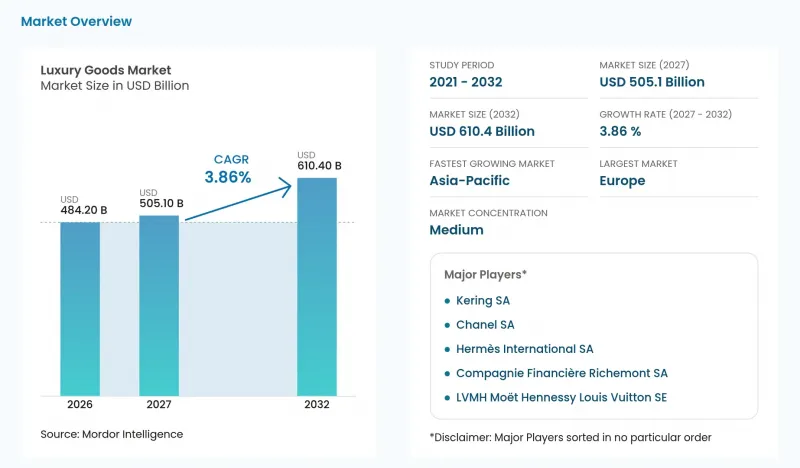
This report is segmented by Product Type (Clothing and Apparel, Handbags and Wallets, and more), End User (Women, Men, and more), Distribution Channel (Single Brand Stores, Multi Brand Stores, and more), and Geography (Europe, Asia-Pacific, and more). The market forecasts are provided in terms of value (USD), based on availability.
Global Luxury Goods Market Trends and Insights
Consumer Shift Toward Sustainable and Eco-Certified Luxury Products
Generational and geographic differences make sustainability a targeted demand proposition for luxury brands. In 2026, 29% of surveyed aspirational luxury clients across 11 markets ranked sustainability among their top purchase influences, down 2 percentage points from 2025. The share was 32% among Gen Z and millennials, compared with 25% among Gen X and baby boomers. Sustainability influenced 40% of surveyed aspirational clients in each of Mainland China and the United Arab Emirates. However, 25% of surveyed aspirational clients expressed skepticism toward brand sustainability claims. For luxury brands, the geographic gap favors country-specific sustainability positioning, while skepticism limits the selling power of an unsupported claim.
Influence of Social Media and Celebrity Endorsement
Social channels can connect product discovery with a transaction, giving them a commercial role beyond visibility alone. In February 2025, 27% of UK fashion and beauty shoppers who followed influencer recommendations reported luxury purchases directly through platforms such as TikTok and Instagram. In EY's 2026 survey across 11 markets, 13% of aspirational luxury clients ranked celebrity, influencer, or social-circle influence among up to 5 factors affecting their most recent luxury purchase. The UK finding establishes a direct selling route, while the broader survey places social influence among several buying considerations. Selling through the recommendation platform can give a brand the transaction itself, in addition to the influence measured in the wider survey.
Proliferation of counterfeit Products
Concealment within legitimate textile shipments makes counterfeit luxury fashion a distribution problem as well as a lost-sale problem. In May 2025, the European Anti-Fraud Office reported that an operation begun with its 2024 inquiries had resulted in national authorities seizing more than 1.8 million counterfeit designer clothing, footwear, and accessory items. Seizures occurred in Austria, Belgium, Germany, Italy, and non-EU countries, and the operation found goods concealed behind legitimately declared textiles. Deceptive goods can enter trade flows alongside authentic textiles and divert potential revenue, a constraint that product differentiation alone cannot remove.
Other drivers and restraints analyzed in the detailed report include:
- Rising Disposable Income and Wealth Accumulation
- Product Innovation in terms of Raw Material and Design
- Lesser demand from price sensitive consumers
For complete list of drivers and restraints, kindly check the Table Of Contents.
Segment Analysis
Clothing and apparel accounted for a 36.93% share of the luxury goods market size in 2026, making it the largest segment. Hermes reported EUR 4.53 billion (USD 5.11 billion) in 2025 revenue from its combined Ready-to-wear and Accessories metier. The combined metier accounted for 28% of Hermes revenue in 2025, down from 29% in 2024, and grew 6% at constant exchange rates in 2025. A leading position in consumer spending can coexist with a declining weight for the combined apparel and accessories business within an individual house's sales.
Watches are the fastest-growing segment, with a projected CAGR of 4.2% over 2027-2032. Richemont's Specialist Watchmakers sales rose 8% at constant exchange rates and 6% at actual rates in April-June 2026 versus April-June 2025. Sales increased across most of its watchmaking maisons, with Vacheron Constantin, Jaeger-LeCoultre, and A. Lange & Sohne standing out. Growth across most maisons and regions, led by the Americas and Japan, gave Richemont's Specialist Watchmakers business a recovery spanning several brands and markets.
Complete Report Scope:
- By Product Type
- Clothing and Apparel
- Footwear
- Eyewear
- Handbags and Wallets
- Jewelry
- Watches
- Beauty and Personal Care
- By End User
- Men
- Women
- Unisex
- By Distribution Channel
- Single Brand Stores
- Multi Brand Stores
- Online Stores
- Other Distribution Channels
- By Geography
- North America
- United States
- Canada
- Rest of North America
- Europe
- United Kingdom
- Germany
- France
- Italy
- Spain
- Rest of Europe
- Asia-Pacific
- China
- Japan
- India
- South Korea
- Australia
- Rest of Asia-Pacific
- South America
- Brazil
- Argentina
- Rest of South America
- Middle East and Africa
- Saudi Arabia
- South Africa
- Rest of Middle East and Africa
- North America
Geography Analysis
Europe held a 51.82% luxury goods market share in 2026, making it the largest geography. Hermes recorded EUR 1.92 billion (USD 2.24 billion) in European destination sales in the first half of 2026, up 6% at constant exchange rates from the first half of 2025. Over that comparison period, its sales grew 1.8% in France and 8.8% in the rest of Europe at constant exchange rates. Faster growth outside France gave the house a European demand base extending beyond its French home market.
Asia-Pacific is the fastest-growing geography, with a projected CAGR of 5.2% over 2027-2032. Prada Group's regional retail sales rose 15% in the first half of 2026 versus the first half of 2025, or 6% organically excluding Versace, both at constant exchange rates. The Prada brand made further progress in the second quarter, while Miu Miu grew throughout the half. The existing portfolio supplied regional retail growth beyond the contribution from adding Versace to the reported business.
In North America, US-native luxury brands grew roughly 10% to 15% year over year in Q1 2026, excluding dollar swings. In South America, Brazilian footprint expansion supported the 2025 Americas outlook, while Dior's largest Brazilian store opened July 24, 2026 in Sao Paulo, combining women's and men's fashion, home goods, jewelry, accessories, footwear, and fragrances. In Middle East and Africa, US-Israeli military operations against Iran began February 28, 2026, and the Gulf luxury consumer base contracted between 15% and 25% in early 2026. Richemont's Middle East and Africa sales fell 3% at constant exchange rates in the quarter ended March 31, 2026 versus the prior year, reflecting slower local demand and reduced tourist flows. US brand growth and Brazil's larger Dior footprint show distinct routes to commercial expansion, while a smaller Gulf buyer base limits the customers available to regional sellers.
- LVMH Moet Hennessy Louis Vuitton SE
- Kering SA
- Compagnie Financiere Richemont SA
- Chanel SA
- Hermes International SA
- Rolex SA
- The Swatch Group Ltd.
- Burberry Group Plc
- Capri Holdings Ltd
- Breitling SA
- Tapestry Inc.
- Moncler SpA
- Giorgio Armani SpA
- PVH Corp.
- Dolce & Gabbana Srl
- Audemars Piguet Holding SA
- Estee Lauder Companies Inc.
- Tod's S.p.A.
- MCM Global AG
- OTB Group
Additional Benefits:
- The market estimate (ME) sheet in Excel format
- 3 months of analyst support
TABLE OF CONTENTS
1 INTRODUCTION
- 1.1 Study Assumptions and Market Definition
- 1.2 Scope of the Study
2 RESEARCH METHODOLOGY
3 EXECUTIVE SUMMARY
4 MARKET LANDSCAPE
- 4.1 Market Overview
- 4.2 Market Drivers
- 4.2.1 Consumer Shift Toward Sustainable and Eco-Certified Luxury Products
- 4.2.2 Influence of Social Media and Celebrity Endorsement
- 4.2.3 Rising Disposable Income and Wealth Accumulation
- 4.2.4 Product Innovation in terms of Raw Material and Design
- 4.2.5 Consumers' Inclination Towards Limited Edition Products
- 4.2.6 Growth of Experience-Based Luxury and Personalization Services
- 4.3 Market Restraints
- 4.3.1 Proliferation of counterfeit Products
- 4.3.2 Lesser demand from price sensitive consumers
- 4.3.3 Stringent Regulatory Environment and Compliance Costs
- 4.3.4 Economic Uncertainty and Inflation Impact on Consumer Spending
- 4.4 Industry Value Chain Analysis
- 4.5 Regulatory Landscape
- 4.6 Technological Outlook
- 4.7 Porter's Five Forces Analysis
- 4.7.1 Threat of New Entrants
- 4.7.2 Bargaining Power of Suppliers
- 4.7.3 Bargaining Power of Buyers
- 4.7.4 Threat of Substitutes
- 4.7.5 Competitive Rivalry
- 4.8 Consumer Behaviour Analysis
5 MARKET SIZE AND GROWTH FORECASTS (VALUE)
- 5.1 By Product Type
- 5.1.1 Clothing and Apparel
- 5.1.2 Footwear
- 5.1.3 Eyewear
- 5.1.4 Handbags and Wallets
- 5.1.5 Jewelry
- 5.1.6 Watches
- 5.1.7 Beauty and Personal Care
- 5.2 By End User
- 5.2.1 Men
- 5.2.2 Women
- 5.2.3 Unisex
- 5.3 By Distribution Channel
- 5.3.1 Single Brand Stores
- 5.3.2 Multi Brand Stores
- 5.3.3 Online Stores
- 5.3.4 Other Distribution Channels
- 5.4 By Geography
- 5.4.1 North America
- 5.4.1.1 United States
- 5.4.1.2 Canada
- 5.4.1.3 Rest of North America
- 5.4.2 Europe
- 5.4.2.1 United Kingdom
- 5.4.2.2 Germany
- 5.4.2.3 France
- 5.4.2.4 Italy
- 5.4.2.5 Spain
- 5.4.2.6 Rest of Europe
- 5.4.3 Asia-Pacific
- 5.4.3.1 China
- 5.4.3.2 Japan
- 5.4.3.3 India
- 5.4.3.4 South Korea
- 5.4.3.5 Australia
- 5.4.3.6 Rest of Asia-Pacific
- 5.4.4 South America
- 5.4.4.1 Brazil
- 5.4.4.2 Argentina
- 5.4.4.3 Rest of South America
- 5.4.5 Middle East and Africa
- 5.4.5.1 Saudi Arabia
- 5.4.5.2 South Africa
- 5.4.5.3 Rest of Middle East and Africa
- 5.4.1 North America
6 COMPETITIVE LANDSCAPE
- 6.1 Market Concentration
- 6.2 Strategic Moves
- 6.3 Market Share Analysis
- 6.4 Company Profiles (includes Global level Overview, Market level overview, Core Segments, Financials as available, Strategic Information, Market Rank/Share for key companies, Products and Services, and Recent Developments)
- 6.4.1 LVMH Moet Hennessy Louis Vuitton SE
- 6.4.2 Kering SA
- 6.4.3 Compagnie Financiere Richemont SA
- 6.4.4 Chanel SA
- 6.4.5 Hermes International SA
- 6.4.6 Rolex SA
- 6.4.7 The Swatch Group Ltd.
- 6.4.8 Burberry Group Plc
- 6.4.9 Capri Holdings Ltd
- 6.4.10 Breitling SA
- 6.4.11 Tapestry Inc.
- 6.4.12 Moncler SpA
- 6.4.13 Giorgio Armani SpA
- 6.4.14 PVH Corp.
- 6.4.15 Dolce & Gabbana Srl
- 6.4.16 Audemars Piguet Holding SA
- 6.4.17 Estee Lauder Companies Inc.
- 6.4.18 Tod's S.p.A.
- 6.4.19 MCM Global AG
- 6.4.20 OTB Group
7 MARKET OPPORTUNITIES AND FUTURE OUTLOOK
- 7.1 White-Space and Unmet-Need Assessment

