PUBLISHER: Mordor Intelligence | PRODUCT CODE: 2116759

PUBLISHER: Mordor Intelligence | PRODUCT CODE: 2116759
Malaysia Luxury Goods - Market Share Analysis, Industry Trends & Statistics, Growth Forecasts (2026 - 2031)
According to Mordor Intelligence, the malaysian luxury goods market size is expected to grow from USD 2.18 billion in 2025 to USD 2.31 billion in 2026 and is forecast to reach USD 3.1 billion by 2031 at 6.05% CAGR over 2026-2031.
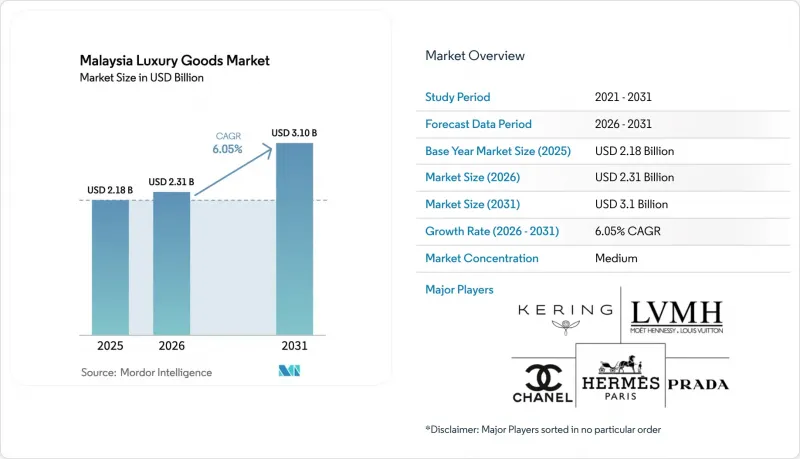
This report is Segmented by Product Type (Clothing and Apparel, Footwear, Eyewear, Leather Goods, Jewelry, Watches, and Beauty and Personal Care), End User (Men, Women, and Unisex), and Distribution Channels (Online Stores, and Offline Stores). The Market Forecasts are Provided in Terms of Value (USD).
Malaysia Luxury Goods Market Trends and Insights
Consumer Emphasis on Sustainability Across Luxury Categories
Sustainability has become a key purchasing factor for Malaysian luxury consumers, especially among younger buyers. This significant change has prompted luxury brands to fundamentally transform their supply chains and product development approaches to meet evolving consumer preferences. In January 2025, Malaysian luxury footwear brand Lewre Bespoke partnered with Weng Meng Greentech to produce sustainable luxury footwear using palm oil trunks. This innovative initiative showcases how local luxury brands are adapting to meet growing consumer demands while addressing critical Malaysian environmental challenges. Brands that authentically weave environmental responsibility into their luxury offerings are reaping significant competitive advantages. This trend is driven by consumers' increasing focus on sustainability, as they actively seek eco-friendly products and practices. Companies that align their strategies with these values are not only meeting consumer expectations but also positioning themselves as leaders in the evolving luxury market.
Influence of Social-Media and Celebrity Endorsement on Malaysian Millennials
Social media and celebrity endorsements have transformed luxury purchasing patterns in Malaysia. Studies of urban Malaysian women show that social media influencers' visual appeal has a stronger impact on luxury cosmetics purchases than their perceived credibility. This shift in consumer behavior demonstrates a significant change in how luxury brands connect with their target audience. The trend is particularly evident in the beauty market, where influencer content has developed small communities of luxury consumers who prioritize peer recommendations over traditional marketing channels. These communities actively share product experiences, reviews, and recommendations, creating a powerful word-of-mouth network. Malaysian celebrities use their social media platforms to strengthen consumer relationships and advocacy, engaging with followers through personalized content and direct interactions. Research confirms that their social media engagement significantly increases luxury purchase intentions, with consumers more likely to trust and act on recommendations from their preferred social media personalities.
Availability of Counterfeit Goods on Grey Market Platforms
Counterfeiting in Malaysia has reached "alarming levels" according to OECD analysis, with counterfeit goods accounting for 2.5% of global trade valued at USD 461 billion, significantly affecting luxury brand integrity and consumer confidence. The proliferation of e-commerce platforms creates new distribution channels for counterfeit luxury goods, complicating enforcement efforts and diluting brand exclusivity. Low penalties and ineffective enforcement of existing regulations contribute to the problem's persistence, while the growth of cross-border e-commerce makes detection and prosecution increasingly difficult. Malaysia's government intensifies efforts to ensure genuine luxury products reach consumers, particularly in the gold and jewelry sectors, but the scale of counterfeiting continues to undermine legitimate luxury sales. The counterfeit issue particularly affects entry-level luxury segments where price sensitivity makes consumers more susceptible to fake alternatives, forcing brands to invest heavily in authentication technologies and consumer education programs.
Other drivers and restraints analyzed in the detailed report include:
- High Demand from Inbound Tourists, Especially from China and GCC
- Product Innovation in Exotic-skins-free Leather and Design Personalization
- Lesser Demand from Price-Sensitive Middle-Income Consumers
For complete list of drivers and restraints, kindly check the Table Of Contents.
Segment Analysis
The product landscape in Malaysia's luxury market reveals a strategic shift toward high-value, investment-oriented purchases. Clothing and apparel command the largest market share at 28.72% in 2025, benefiting from established brand presence and consistent demand for designer fashion. However, jewelry is emerging as the growth leader with a projected CAGR of 6.59% (2026-2031), outpacing all other segments. This acceleration reflects Malaysian consumers' increasing preference for tangible assets with enduring value, particularly in uncertain economic times. The jewelry segment's growth is further amplified by the expanding presence of international brands like Cartier and Bulgari, which are focusing on Malaysia as part of their Southeast Asian expansion strategy.
Moreover, luxury beauty and personal care products are gaining momentum as entry points to luxury consumption, particularly among younger consumers seeking accessible luxury experiences. Watches maintain a strong appeal among male consumers and collectors, with limited editions driving interest. Leather goods benefit from strong brand recognition but face increasing competition from emerging sustainable alternatives. Eyewear serves as an accessible entry point to luxury brands, though it represents a smaller portion of the market.
Complete Report Scope:
- By Product Type
- Clothing and Apparel
- Footwear
- Eyewear
- Leather Goods
- Jewelry
- Watches
- Beauty and Personal Care
- By End User
- Men
- Women
- Unisex
- By Distribution Channel
- Offline Stores
- Online Stores
List of Companies Covered in this Report:
- LVMH Moet Hennessy Louis Vuitton SE
- Kering SA
- Chanel Ltd.
- Richemont SA
- Swatch Group Ltd.
- Prada S.p.A.
- Giorgio Armani S.p.A.
- Hermes International S.A.
- Burberry Group PLC
- Rolex SA
- Patek Philippe SA
- Estee Lauder Companies Inc.
- Coach Malaysia Sdn. Bhd.
- Fossil Group Inc.
- Pandora A/S
- Swarovski International Holding AG
- L'Occitane International SA
- Bonia Corporation Berhad
- Valiram Group
- Aurora Italia International Bhd
Additional Benefits:
- The market estimate (ME) sheet in Excel format
- 3 months of analyst support
TABLE OF CONTENTS
1 INTRODUCTION
- 1.1 Study Assumptions and Market Definition
- 1.2 Scope of the Study
2 RESEARCH METHODOLOGY
3 EXECUTIVE SUMMARY
4 MARKET LANDSCAPE
- 4.1 Market Overview
- 4.2 Market Drivers
- 4.2.1 Consumer Emphasis on Sustainability Across Luxury Categories
- 4.2.2 Influence of Social-Media and Celebrity Endorsement on Malaysian Millennials
- 4.2.3 High Demand from Inbound Tourists, Especially from China and GCC
- 4.2.4 Product Innovation in Exotic-skins-free Leather and Design Personalization
- 4.2.5 Increasing E-commerce Penetration
- 4.2.6 Rising Affluent Muslim Population Seeking Halal-Certified Luxury
- 4.3 Market Restraints
- 4.3.1 Availability of Counterfeit Goods on Grey Market Platforms
- 4.3.2 Lesser Demand from Price-Sensitive Middle-Income Consumers
- 4.3.3 High Import Duties vs. Singapore and Thailand
- 4.3.4 MYR Currency Volatility Compressing Overseas Buying Power
- 4.4 Consumer Behaviour Analysis
- 4.5 Regulatory Outlook
- 4.6 Porter's Five Forces Analysis
- 4.6.1 Bargaining Power of Suppliers
- 4.6.2 Bargaining Power of Buyers
- 4.6.3 Threat of New Entrants
- 4.6.4 Threat of Substitutes
- 4.6.5 Degree of Competition
5 MARKET SIZE AND GROWTH FORECASTS (VALUE)
- 5.1 By Product Type
- 5.1.1 Clothing and Apparel
- 5.1.2 Footwear
- 5.1.3 Eyewear
- 5.1.4 Leather Goods
- 5.1.5 Jewelry
- 5.1.6 Watches
- 5.1.7 Beauty and Personal Care
- 5.2 By End User
- 5.2.1 Men
- 5.2.2 Women
- 5.2.3 Unisex
- 5.3 By Distribution Channel
- 5.3.1 Offline Stores
- 5.3.2 Online Stores
6 COMPETITIVE LANDSCAPE
- 6.1 Market Concentration
- 6.2 Strategic Moves
- 6.3 Market Share Analysis
- 6.4 Company Profiles (includes Global level Overview, Market level overview, Core Segments, Financials as available, Strategic Information, Market Rank/Share for key companies, Products & Services, and Recent Developments)
- 6.4.1 LVMH Moet Hennessy Louis Vuitton SE
- 6.4.2 Kering SA
- 6.4.3 Chanel Ltd.
- 6.4.4 Richemont SA
- 6.4.5 Swatch Group Ltd.
- 6.4.6 Prada S.p.A.
- 6.4.7 Giorgio Armani S.p.A.
- 6.4.8 Hermes International S.A.
- 6.4.9 Burberry Group PLC
- 6.4.10 Rolex SA
- 6.4.11 Patek Philippe SA
- 6.4.12 Estee Lauder Companies Inc.
- 6.4.13 Coach Malaysia Sdn. Bhd.
- 6.4.14 Fossil Group Inc.
- 6.4.15 Pandora A/S
- 6.4.16 Swarovski International Holding AG
- 6.4.17 L'Occitane International SA
- 6.4.18 Bonia Corporation Berhad
- 6.4.19 Valiram Group
- 6.4.20 Aurora Italia International Bhd
7 MARKET OPPORTUNITIES AND FUTURE OUTLOOK

