PUBLISHER: Mordor Intelligence | PRODUCT CODE: 2116758

PUBLISHER: Mordor Intelligence | PRODUCT CODE: 2116758
France Luxury Goods - Market Share Analysis, Industry Trends & Statistics, Growth Forecasts (2026 - 2031)
According to Mordor Intelligence, the France luxury goods market size was valued at USD 24.61 billion in 2025 and estimated to grow from USD 25.81 billion in 2026 to reach USD 32.76 billion by 2031, at a CAGR of 4.89% during the forecast period (2026-2031).
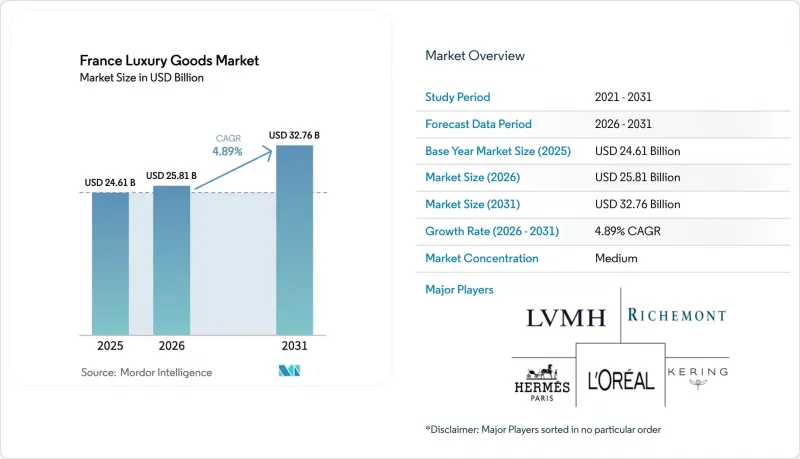
This report is Segmented by Product Type (Clothing and Apparel, Footwear, Eyewear, Leather Goods, Jewelry, Watches, and Beauty and Personal Care), End-User (Men, Women, and Unisex), and Distribution Channel (Single-Brand Stores, Multi-Brand Stores, and Online Stores). The Market Forecasts are Provided in Terms of Value (USD).
France Luxury Goods Market Trends and Insights
Consumer emphasis on sustainability
French luxury consumers increasingly prioritize circularity and traceability, reshaping product development and marketing narratives. Chanel launched its Nevold resale platform in 2024, enabling authenticated pre-owned handbag transactions that extend product lifecycles and capture secondary-market margin previously lost to third-party resellers. LVMH's LIFE 360 initiative, unveiled in 2024, commits the group to 100% renewable energy across European operations by 2026 and mandates that 70% of raw materials meet biodiversity-positive criteria by 2030. Kering's 2025 Environmental Profit and Loss statement quantified the house's EUR 400 million investment in regenerative agriculture for cashmere and leather, a move that signals a willingness to absorb near-term cost for long-term supply security. The EU's Digital Product Passport, effective from 2024, requires every luxury item to carry a scannable record of origin, materials, and repair history, effectively turning sustainability claims into auditable commitments. This regulatory backdrop favors incumbents with vertically integrated supply chains and penalizes brands reliant on opaque third-party sourcing.
Influence of social media and celebrity endorsement
Digital platforms and celebrity partnerships now drive discovery and conversion in ways that traditional advertising cannot replicate. Louis Vuitton's 2025 collaboration with makeup artist Pat McGrath generated over 500 million social media impressions within 72 hours of launch, demonstrating how influencer co-creation amplifies reach beyond paid media budgets. LVMH's 10-year partnership with Formula 1, announced in 2024, integrates TAG Heuer, Louis Vuitton, and Moet Hennessy into race-day activations that target affluent male audiences aged 25-45, a demographic historically underrepresented in luxury marketing. Hermes's entry into haute couture in 2024, led by creative director Nadege Vanhee-Cybulski, leveraged Instagram and TikTok teasers that generated 1.2 billion views before the first collection debuted, illustrating how heritage brands now embrace digital-first storytelling. This shift reflects a broader recognition that authenticity and niche credibility often outperform reach alone, particularly among Gen Z consumers who distrust overt sponsorship.
Availability of counterfeit products
The surge in counterfeiting poses a significant threat to the luxury market. French customs seized more than 20 million counterfeit items in 2023, representing a twofold increase from 2022, with luxury goods being the primary target . The rise of e-commerce has intensified the problem, with counterfeit networks increasingly turning to online platforms for their distribution. The widespread availability of counterfeit products acts as a significant restraint on the market, as it undermines the exclusivity and perceived value of genuine luxury items. Counterfeit goods often attract price-sensitive consumers, diverting demand away from authentic luxury products and impacting the revenue streams of legitimate brands. In response to this escalating challenge, the French government rolled out the 2024-2026 National Anti-Counterfeiting Plan, bolstering enforcement ahead of the 2024 Olympics. Beyond mere economics, counterfeits tarnish brand reputation and diminish consumer trust. In a bid to safeguard their intellectual property, luxury brands are turning to cutting-edge authentication technologies, such as RFID (Radio-Frequency Identification) and NFC (Near Field Communication).
Other drivers and restraints analyzed in the detailed report include:
- High demand from inbound tourist
- Product innovation in raw material and design
- Lesser demand from price-sensitive consumers
For complete list of drivers and restraints, kindly check the Table Of Contents.
Segment Analysis
Clothing and Apparel held 43.03% of the market share in 2025, reflecting France's historical dominance in haute couture and ready-to-wear. However, leather goods are forecast to grow from 2026 to 2031, outpacing apparel's more modest trajectory. Hermes's scarcity-driven model exemplifies this dynamic: the house limits Birkin and Kelly bag production to preserve artisan craftsmanship, sustaining waitlists that span years and reinforcing the perception of unattainable luxury. Louis Vuitton's 2024 launch of the Twist bag in vegan leather, priced at EUR 2,500, tested consumer acceptance of bio-fabricated materials, with initial sell-through rates exceeding expectations. Footwear benefits from the casualization of luxury: Chanel's 2025 introduction of a EUR 1,200 sneaker line, blending heritage tweeds with technical soles, captured younger buyers who prioritize comfort without sacrificing brand signaling.
Eyewear and Watches cater to distinct buyer motivations; eyewear serves as an accessible entry point, while watches function as investment-grade collectibles. Cartier's 2024 launch of the Panthere de Cartier sunglasses, retailing at EUR 800, leveraged the house's jewelry heritage to command premium pricing in a category dominated by EssilorLuxottica's licensed brands. Rolex maintained production discipline in 2025, restricting supply to sustain secondary-market premiums that often exceed retail prices. Jewelry and Beauty and Personal Care segments benefit from gifting occasions and repeat purchase behavior. Chanel's integration of lab-grown diamonds in its 2025 Metiers d'Art collection addressed ethical sourcing concerns while preserving the visual properties of mined stones.
Complete Report Scope:
- Product Type
- Clothing and Apparel
- Footwear
- Eyewear
- Leather Goods
- Jewelry
- Watches
- Beauty and Personal Care
- End-User
- Men
- Women
- Unisex
- Distribution Channel
- Single-Brand Stores
- Multi-Brand Stores
- Online Stores
List of Companies Covered in this Report:
- LVMH Moet Hennessy Louis Vuitton SE
- Kering SA
- Chanel SA
- Hermes International SA
- Compagnie Financiere Richemont SA
- L'Oreal SA
- Moncler SpA
- Burberry Group plc
- Swatch Group AG
- Rolex SA
- Longchamp SAS
- Maison Goyard
- Sisley Paris
- A.P.C. SAS
- Clarins Group
- Puig SA
- Interparfums SA
- Barbara Bui SA
- S.T. Dupont SA
- PVH Corp.
Additional Benefits:
- The market estimate (ME) sheet in Excel format
- 3 months of analyst support
TABLE OF CONTENTS
1 INTRODUCTION
- 1.1 Study Assumptions and Market Definition
- 1.2 Scope of the Study
2 RESEARCH METHODOLOGY
3 EXECUTIVE SUMMARY
4 MARKET LANDSCAPE
- 4.1 Market Overview
- 4.2 Market Drivers
- 4.2.1 Consumer emphasis on sustainability
- 4.2.2 Influence of social media and celebrity endorsement
- 4.2.3 High demand from inbound tourist
- 4.2.4 Product innovation in raw material and design
- 4.2.5 Rising disposable income boosts luxury spending
- 4.2.6 Expansion of e-commerce channels enhances accessibility
- 4.3 Market Restraints
- 4.3.1 Availability of counterfeit products
- 4.3.2 Lesser demand from price-sensitive consumers
- 4.3.3 Stringent government regulations
- 4.3.4 High import duties on luxury goods
- 4.4 Consumer Behaviour Analysis
- 4.5 Regulatory Outlook
- 4.6 Porter's Five Forces
- 4.6.1 Threat of New Entrants
- 4.6.2 Bargaining Power of Buyers
- 4.6.3 Bargaining Power of Suppliers
- 4.6.4 Threat of Substitutes
- 4.6.5 Competitive Rivalry
5 MARKET SIZE AND GROWTH FORECASTS (VALUE)
- 5.1 Product Type
- 5.1.1 Clothing and Apparel
- 5.1.2 Footwear
- 5.1.3 Eyewear
- 5.1.4 Leather Goods
- 5.1.5 Jewelry
- 5.1.6 Watches
- 5.1.7 Beauty and Personal Care
- 5.2 End-User
- 5.2.1 Men
- 5.2.2 Women
- 5.2.3 Unisex
- 5.3 Distribution Channel
- 5.3.1 Single-Brand Stores
- 5.3.2 Multi-Brand Stores
- 5.3.3 Online Stores
6 COMPETITIVE LANDSCAPE
- 6.1 Market Concentration
- 6.2 Strategic Moves
- 6.3 Market Share Analysis
- 6.4 Company Profiles (includes Global level Overview, Market level overview, Core Segments, Financials as available, Strategic Information, Market Rank/Share for key companies, Products and Services, and Recent Developments)
- 6.4.1 LVMH Moet Hennessy Louis Vuitton SE
- 6.4.2 Kering SA
- 6.4.3 Chanel SA
- 6.4.4 Hermes International SA
- 6.4.5 Compagnie Financiere Richemont SA
- 6.4.6 L'Oreal SA
- 6.4.7 Moncler SpA
- 6.4.8 Burberry Group plc
- 6.4.9 Swatch Group AG
- 6.4.10 Rolex SA
- 6.4.11 Longchamp SAS
- 6.4.12 Maison Goyard
- 6.4.13 Sisley Paris
- 6.4.14 A.P.C. SAS
- 6.4.15 Clarins Group
- 6.4.16 Puig SA
- 6.4.17 Interparfums SA
- 6.4.18 Barbara Bui SA
- 6.4.19 S.T. Dupont SA
- 6.4.20 PVH Corp.
7 MARKET OPPORTUNITIES AND FUTURE OUTLOOK

