PUBLISHER: Mordor Intelligence | PRODUCT CODE: 2156989

PUBLISHER: Mordor Intelligence | PRODUCT CODE: 2156989
Italy Premium Goods Logistics - Market Share Analysis, Industry Trends & Statistics, Growth Forecasts (2026 - 2031)
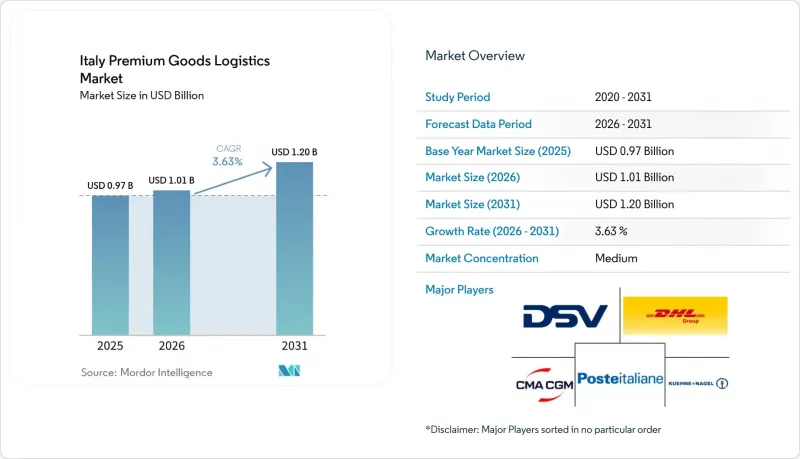
According to Mordor Intelligence, the Italy premium goods logistics market size was valued at USD 0.97 billion in 2025 and is estimated to grow from 1.01 billion in 2026 to reach 1.20 billion by 2031, at a CAGR of 3.63% during the forecast period (2026-2031).
Italy Premium Goods Logistics Market Trends and Insights
Growth of Luxury E-Commerce Fulfillment and Same-Day Delivery Demand
Luxury e-commerce increased the need for faster and more closely managed fulfillment in Italy. Direct-to-consumer orders required accurate stock visibility, secure packing, and reliable delivery windows. GXO Logistics renewed its Versace partnership in January 2025 and continued to manage omnichannel fulfillment from warehouses in Bellinzago Novarese and Novara. The sites handled 2.4 million pieces annually and used RFID, hanging-garment sorters, and 3D sortation systems that could triple peak-season throughput. This level of fixed infrastructure supported long-term capacity near premium brands and raised the operational standard for newer providers. The Italy premium goods logistics market, therefore, rewarded operators that could combine fashion handling with consistent omnichannel fulfillment.
Rising Cross-Border Premium Shopping Flows Through Incheon Gateway
Italian luxury brands served customers through stores, online channels, and travel retail locations across Asia. This pattern created outbound replenishment needs from Italian distribution centers and inbound flows for authenticated returns. Milan Malpensa and Venice Marco Polo provided relevant air cargo connections for these higher-value shipments. Cross-border demand required providers to coordinate time-sensitive transport, customs documentation, and secure transfer procedures. The flow also widened the role of Italian facilities beyond domestic boutique replenishment. The Italy premium goods logistics market gained from this activity, where operators maintained dependable links between Italian production districts and international air gateways.
High Security, Insurance, and Compliance Cost Per Shipment
Cargo theft created a material operating challenge for Italian premium supply chains. Clothing and apparel ranked as the second-most-targeted commodity in Italy in the cargo-theft report prepared by TT Club and BSI. Incidents were concentrated in Lombardy, which also served as a central logistics area for luxury production and distribution. Secure movements often required armored vehicles, GPS geo-fencing, trained personnel, and dedicated high-value cargo procedures. These measures increased the cost per shipment and added complexity for brands with time-sensitive requirements. Smaller brands faced particular pressure because dedicated secure transport did not offer the cost structure of standard parcel delivery.
Other drivers and restraints analyzed in the detailed report include:
- Expansion of Temperature-Controlled and Tamper-Evident Handling Standards
- Brand Demand for End-to-End Chain-of-Custody Visibility
- Limited Scale Economics in Fragmented Premium Brand Networks
For complete list of drivers and restraints, kindly check the Table Of Contents.
Segment Analysis
Transportation accounted for 56.50% of the Italy premium goods logistics market share in 2025. Road freight linked manufacturing areas in Lombardy, Tuscany, and the Veneto with domestic boutiques and European distribution centers. Air freight handled watches, jewelry, and limited-edition fashion where speed and security were especially important. Milan Malpensa handled EUR 60.7 billion (USD 65.6 billion) in import-export trade flows in 2025, and represented 4.9% of Italy's total international trade. Road transport continued to support domestic business-to-business restocking and boutique replenishment. Rail, sea, and inland waterway services held narrower roles for fine art and larger wine movements.
Value-added services and others recorded the fastest projected CAGR at 4.37% from 2026 to 2031. Brands purchased RFID tagging, garment repair, authentication screening, digital product passport support, and white-glove delivery alongside freight services. These activities created recurring per-unit work and were less exposed to standard freight-rate movements. Returns and unsold inventory also required careful sorting, inspection, and rework before resale or other secondary channels. Providers with secure rework capacity could serve these flows without separating handling from documentation. This part of the Italy premium goods logistics market expanded as brands placed more operational steps within specialist logistics contracts. The work covered preparation before shipment, control during storage, and checks after an item returned. It also linked physical handling with records that brands could use for product-level tracking. These requirements made specialist service capabilities relevant across several premium goods categories.
Luxury fashion and accessories held 39.55% of the Italy premium goods logistics market size in 2025. Italy's fashion production and export position supported frequent replenishment, secure transport, and garment-specific storage. Each movement required providers to manage products that varied by collection, retail channel, and delivery timing. This category also linked factory dispatches with wholesale deliveries, boutique replenishment, and direct customer orders. Moncler announced a EUR 80 million (USD 86 million) expansion of the ALS Luxury Logistics hub at Castel San Giovanni in June 2025. The project targeted a capacity of more than 15 million processed pieces annually by 2028. Warehousing for this category used climate controls, continuous monitoring, restricted access, and inventory systems suited to insured goods. These features reflected the need to preserve product condition from receipt through dispatch. Operators also needed to separate inventory while maintaining efficient stock movement. This category continued to provide a broad base of activity for specialist logistics providers.
Watches and jewelry recorded the highest projected CAGR at 4.15% from 2026 to 2031. High unit values made secure custody, authentication, and rapid air transport central to the service design. Malpensa Customs and the Guardia di Finanza intensified joint anti-smuggling activity from January 2026. Their June 2026 operation seized counterfeit watches and accessories valued at more than EUR 2.4 million (USD 2.6 million). Providers needed to protect these shipments during handovers, storage, and transport. fine art and collectibles required controlled crating and provenance documentation. premium spirits and wine required bonded storage and temperature management. Consumer electronics, cosmetics, and fragrances each required dedicated packaging standards. The Italy premium goods logistics market served these categories through tailored procedures rather than a single handling model. This mix widened the operational capabilities expected from specialist providers.
Complete Report Scope:
- By Service
- Transportation
- Road
- Rail
- Air
- Sea and Inland Waterways
- Warehousing and Storage
- Value-added Services
- Transportation
- By Goods Type
- Luxury Fashion and Accessories
- Watches and Jewelry
- Consumer Electronics
- Cosmetics and Fragrances
- Fine Art and Collectibles
- Premium Spirits and Wine
- Other Premium Goods
- By End User
- Luxury Brands and Retailers
- E-commerce Marketplaces
- Art Galleries and Auction Houses
- Airports and Duty-Free Operators
- Corporate Gifting and Concierge Services
- Others
- By Destination
- Domestic
- International
List of Companies Covered in this Report:
- DHL Group
- Kuehne+Nagel
- GXO Logistics, Inc.
- CMA CGM Group (Including CEVA Logistics)
- GEODIS
- DSV A/S
- Rhenus Group
- FedEx
- United Parcel Service of America, Inc. (UPS)
- Fercam
- Arcese Group
- Savino Del Bene
- BRT S.p.A.
- Ferrari Group
- Poste Italiane
- SNATT Logistica
- ALS SpA
- BSB Logistica
- FIEGE
- Fratelli Cosulich Group
Additional Benefits:
- The market estimate (ME) sheet in Excel format
- 3 months of analyst support
TABLE OF CONTENTS
1 INTRODUCTION
- 1.1 Study Assumptions and Market Definition
- 1.2 Scope of the Study
2 RESEARCH METHODOLOGY
3 EXECUTIVE SUMMARY
4 MARKET LANDSCAPE
- 4.1 Market Overview
- 4.2 Market Drivers
- 4.2.1 Growth of Luxury E-Commerce Fulfillment and Same-Day Delivery Demand
- 4.2.2 Rising Cross-Border Premium Shopping Flows Through Incheon Gateway
- 4.2.3 Expansion of Temperature-Controlled and Tamper-Evident Handling Standards
- 4.2.4 Brand Demand for End-to-End Chain-of-Custody Visibility
- 4.2.5 High-Value Reverse Logistics for Returns, Repairs, and Authentication
- 4.2.6 Rising Demand for High-Precision Appointment-Based White-Glove Delivery
- 4.3 Market Restraints
- 4.3.1 High Security, Insurance, and Compliance Cost Per Shipment
- 4.3.2 Limited Scale Economics in Fragmented Premium Brand Networks
- 4.3.3 Sensitivity to Customs Delays and Documentation Complexity
- 4.3.4 Shortage of Specialized High-Value Cargo Handling Talent
- 4.4 Value Chain Analysis/Supply Chain Analysis
- 4.5 Regulatory Landscape
- 4.6 Technological Outlook
- 4.7 Porter's Five Forces Analysis
- 4.7.1 Bargaining Power of Suppliers
- 4.7.2 Bargaining Power of Buyers
- 4.7.3 Threat of New Entrants
- 4.7.4 Threat of Substitutes
- 4.7.5 Intensity of Competitive Rivalry
- 4.8 Impact of Geopolitical Events on the Market
5 MARKET SIZE AND GROWTH FORECASTS
- 5.1 By Service
- 5.1.1 Transportation
- 5.1.1.1 Road
- 5.1.1.2 Rail
- 5.1.1.3 Air
- 5.1.1.4 Sea and Inland Waterways
- 5.1.2 Warehousing and Storage
- 5.1.3 Value-added Services
- 5.1.1 Transportation
- 5.2 By Goods Type
- 5.2.1 Luxury Fashion and Accessories
- 5.2.2 Watches and Jewelry
- 5.2.3 Consumer Electronics
- 5.2.4 Cosmetics and Fragrances
- 5.2.5 Fine Art and Collectibles
- 5.2.6 Premium Spirits and Wine
- 5.2.7 Other Premium Goods
- 5.3 By End User
- 5.3.1 Luxury Brands and Retailers
- 5.3.2 E-commerce Marketplaces
- 5.3.3 Art Galleries and Auction Houses
- 5.3.4 Airports and Duty-Free Operators
- 5.3.5 Corporate Gifting and Concierge Services
- 5.3.6 Others
- 5.4 By Destination
- 5.4.1 Domestic
- 5.4.2 International
6 COMPETITIVE LANDSCAPE
- 6.1 Market Concentration
- 6.2 Strategic Moves
- 6.3 Market Share Analysis
- 6.4 Company Profiles (includes Global Level Overview, Market Level Overview, Core Segments, Financials as available, Strategic Information, Geographic Coverage, Products and Services, Recent Developments)
- 6.4.1 DHL Group
- 6.4.2 Kuehne+Nagel
- 6.4.3 GXO Logistics, Inc.
- 6.4.4 CMA CGM Group (Including CEVA Logistics)
- 6.4.5 GEODIS
- 6.4.6 DSV A/S
- 6.4.7 Rhenus Group
- 6.4.8 FedEx
- 6.4.9 United Parcel Service of America, Inc. (UPS)
- 6.4.10 Fercam
- 6.4.11 Arcese Group
- 6.4.12 Savino Del Bene
- 6.4.13 BRT S.p.A.
- 6.4.14 Ferrari Group
- 6.4.15 Poste Italiane
- 6.4.16 SNATT Logistica
- 6.4.17 ALS SpA
- 6.4.18 BSB Logistica
- 6.4.19 FIEGE
- 6.4.20 Fratelli Cosulich Group
7 MARKET OPPORTUNITIES AND FUTURE OUTLOOK
- 7.1 White-Space and Unmet-Need Assessment

