PUBLISHER: Mordor Intelligence | PRODUCT CODE: 2194822

PUBLISHER: Mordor Intelligence | PRODUCT CODE: 2194822
Europe Inspection Equipment - Market Share Analysis, Industry Trends & Statistics, Growth Forecasts (2027 - 2032)
According to Mordor Intelligence, the Europe inspection equipment market size is projected to expand from USD 5.72 billion in 2026 and USD 6.10 billion in 2027 to USD 8.15 billion by 2032, registering a CAGR of 5.97% between 2027 and 2032.
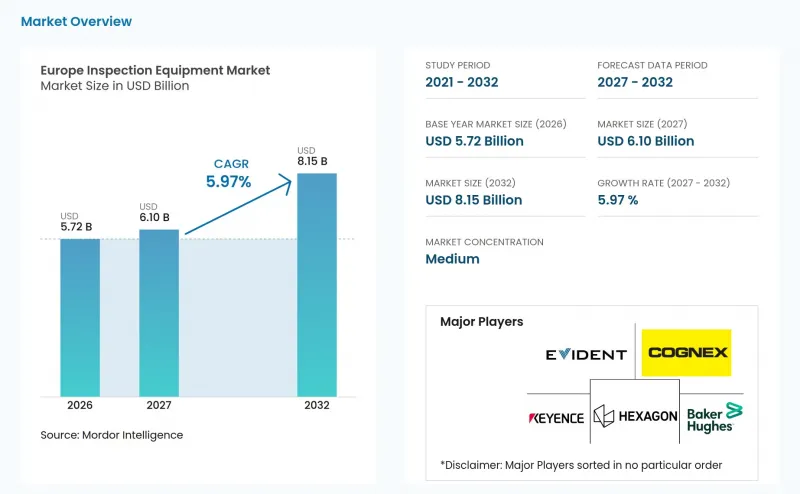
Europe Inspection Equipment Market Trends and Insights
Automation of Quality Inspection Amid European Manufacturing Skills Shortages
The Europe inspection equipment market is benefiting from the difficulty of maintaining manual inspection at the scale planned for European manufacturing. Advanced manufacturing employs more than 30 million workers in the European Union, while 70% of employers report difficulty finding qualified technical talent. A workforce with 25.3% of workers aged 55 or above also faces an estimated loss of 3.8 million workers by 2033. Digital occupations offer better pay in many cases, so training alone does not resolve the shortage of skilled inspection staff. Automated optical and metrology systems reduce dependence on specialist operators, while Hexagon positions its VISIUS optical CMM as requiring limited training in France, Italy, and the United Kingdom. This operating need supports continued investment across factories that must preserve output with smaller technical teams.
Zero-Defect and Traceability Requirements in Regulated Production
The Europe inspection equipment market is also being shaped by rules that make traceability a legal requirement rather than only a quality practice. The Digital Product Passport under Regulation (EU) 2024/1781 requires machine-readable information for batteries, electronics, and textiles from 2027, with wider coverage of goods entering the EU market by 2030. CWA 18230 sets out five maturity levels for zero-defect manufacturing and identifies autonomous quality management, inline inspection, and end-to-end traceability as core elements of its higher levels. The Product Liability Directive, effective from December 2026, extends liability to software-embedded products and AI systems. Manufacturers need reliable records that show how products were inspected and how defects were handled, making inspection data important for compliance, recalls, and customer assurance. This change widens the installed base for equipment that can capture, retain, and connect inspection results with production records.
High Capital Cost and Integration Complexity
Capital cost and integration work remain a material restraint for the Europe inspection equipment market, especially among smaller manufacturers. Inspection projects require spending on hardware, calibration, systems engineering, software validation, and links with manufacturing execution and enterprise resource planning systems. SMEs account for 99% of EU enterprises and generate 53% of industrial value added, making their adoption pace important to the regional outlook. Industrial CT and electron-beam systems can cost EUR 250,000 (USD 294,078) to EUR 2 million (USD 2.4 million) before integration. The Net-Zero Industry Act established EUR 20 billion (USD 23.5 billion) in state-aid corridors for net-zero manufacturing, which reflects the scale of investment needed for strategic industrial projects. This can widen the technology gap in Spain, Italy, Poland, and Romania, where smaller suppliers have less capacity to absorb capital costs.
Other drivers and restraints analyzed in the detailed report include:
- Expansion of Semiconductor, Battery, Aerospace, and Renewable-Energy Manufacturing
- Shift to Inline, AI-Enabled, Multimodal Inspection
- Shortage of Certified NDT, Metrology, and Vision Specialists
For complete list of drivers and restraints, kindly check the Table Of Contents.
Segment Analysis
Radiographic and computed tomography inspection equipment held 27.4% of the Europe inspection equipment market share in 2026. Its position reflects its use in non-destructive verification of complex castings, weld assemblies, and additive-manufactured components. Automotive, aerospace, and energy producers use CT systems to assess internal structures beyond the reach of surface inspection. Battery manufacturers also use industrial CT to assess internal voids, electrode alignment, and electrolyte fill. Optical and visual inspection equipment ranks second by share because it is deployed in high volumes across printed circuit board, semiconductor packaging, and consumer electronics production.
Dimensional and geometric inspection equipment, including coordinate measuring machines and laser scanning systems, has steady aerospace and precision-engineering demand. Electron-beam inspection equipment is projected to register an 8.4% CAGR from 2027 to 2032, making it the fastest-growing equipment type within the Europe inspection equipment market. The expansion is tied to sub-7 nm fabrication ramp-ups at European foundries supported by the Chips Act. KLA expects process diagnostics and control growth of more than 50% in 2026, with advanced packaging revenue approaching USD 1 billion. Phased-array ultrasonic systems support nuclear, oil and gas, and pipeline inspection, while other specialized systems serve food, pharmaceutical, and chemical compliance.
Complete Report Scope:
- By Equipment Type
- Optical and Visual Inspection Equipment
- Machine Vision and Automated Optical Inspection Systems
- Borescopes and Remote Visual Inspection Systems
- Other Optical and Surface Inspection Equipment
- Dimensional and Geometric Inspection Equipment
- Coordinate Measuring Machines
- Laser Scanning and 3D Measurement Systems
- Other Dimensional and Surface Profiling Inspection Systems
- Ultrasonic and Acoustic Inspection Equipment
- Conventional Ultrasonic Inspection Systems
- Phased-Array and Advanced Ultrasonic Inspection Systems
- Acoustic Emission and Acoustic Imaging Systems
- Radiographic and Computed Tomography Inspection Equipment
- Conventional and Digital Radiography Systems
- Industrial Computed Tomography Systems
- Cargo and Consignment X-Ray Inspection Systems
- Electromagnetic and Magnetic Inspection Equipment
- Eddy-Current Inspection Systems
- Magnetic Particle and Magnetic Flux Leakage Inspection Systems
- Ground-Penetrating Radar and Other Electromagnetic Inspection Systems
- Thermal and Infrared Inspection Equipment
- Handheld Thermal Imaging Systems
- Fixed and Integrated Thermal Inspection Systems
- Electron-Beam Inspection Equipment
- Electron-Beam Defect Inspection and Review Systems
- Other Charged-Particle Inspection Systems
- Other Specialized Inspection Equipment
- Leak and Pressure-Integrity Inspection Systems
- Automated Checkweighing and Other Physical Conformity Inspection Systems
- Other Dedicated Inspection Instruments and Systems
- Optical and Visual Inspection Equipment
- By Primary Inspection Application
- Building and Property Inspection
- Civil Infrastructure Inspection
- Industrial Facilities and Fixed Asset Inspection
- Manufactured Product and Production-Process Inspection
- Transportation Vehicle and Mobile Asset Inspection
- Commodity, Cargo and Trade Inspection
- Other Operational Site and Process Inspection
- By End-Use Industry
- Oil and Gas, Including Refining and Petrochemicals
- Power Generation, Renewable Energy and Utilities
- Automotive and Automotive Component Manufacturing
- Aerospace and Defense Manufacturing
- Electronics, Semiconductor and Electrical Equipment Manufacturing
- Other Manufacturing and Industrial Processing
- Construction, Real Estate and Civil Infrastructure
- Transportation and Logistics Operations
- Mining and Quarrying
- Agriculture, Food and Beverage
- Healthcare, Pharmaceuticals and Life Sciences
- Wholesale, Retail and Commodity Trading
- Government, Regulatory and Border Inspection Agencies
- Other End Users
- By Geography
- Germany
- United Kingdom
- France
- Italy
- Spain
- Netherlands
- Poland
- Turkey
- Rest of Europe
List of Companies Covered in this Report:
- Hexagon AB
- Carl Zeiss AG
- Cognex Corporation
- KEYENCE CORPORATION
- Baker Hughes Company
- Waygate Technologies GmbH
- Nikon Corporation
- Evident Corporation
- Renishaw plc
- Mettler-Toledo International Inc.
- Basler AG
- SICK AG
- OMRON Corporation
- Teledyne Technologies Incorporated
- FARO Technologies, Inc.
- KLA Corporation
- ASML Holding N.V.
- Applied Materials, Inc.
- Antares Vision S.p.A.
- Syntegon Technology GmbH
- Viscom SE
- MINEBEA INTEC GmbH
- SESOTEC GmbH
- SGS SA
- Intertek Group plc
Additional Benefits:
- The market estimate (ME) sheet in Excel format
- 3 months of analyst support
TABLE OF CONTENTS
1 Introduction
- 1.1 Study Assumptions and Market Definition
- 1.2 Scope of the Study
2 Research Methodology
3 Executive Summary
4 Market Landscape
- 4.1 Market Overview
- 4.2 Market Drivers
- 4.2.1 Automation of Quality Inspection Amid European Manufacturing Skills Shortages
- 4.2.2 Zero-Defect and Traceability Requirements in Regulated Production
- 4.2.3 Expansion of Semiconductor, Battery, Aerospace, and Renewable-Energy Manufacturing
- 4.2.4 Shift to Inline, AI-Enabled, Multimodal Inspection
- 4.2.5 Inspection Intensity from Aging Infrastructure and Asset-Life Extension
- 4.2.6 Edge-AI Weld-Seam Inspection for High-Mix Production Lines
- 4.3 Market Restraints
- 4.3.1 High Capital Cost and Integration Complexity
- 4.3.2 Shortage of Certified NDT, Metrology, and Vision Specialists
- 4.3.3 Fragmented Standards, Validation, and Cross-Border Acceptance
- 4.3.4 Insufficient Defect Data for High-Mix, Low-Volume AI Inspection
- 4.4 Value and Supply-Chain Analysis
- 4.4.1 Sensors, Detectors and Electronic Component Suppliers
- 4.4.2 Inspection Equipment Manufacturers and System Integrators
- 4.4.3 Software and Inspection Analytics Providers
- 4.4.4 Distributors, Channel Partners and OEM Integrators
- 4.4.5 Equipment Calibration, Maintenance and Aftermarket Service Providers
- 4.4.6 End Users and Independent Inspection Service Providers
- 4.5 Key Market Trends
- 4.5.1 Shift Toward Automated and In-Line Inspection Systems
- 4.5.2 Growing Adoption of AI-Based Defect Detection and Machine Vision
- 4.5.3 Increasing Demand for Portable and Handheld Inspection Equipment
- 4.5.4 Integration of Inspection Systems with Industry 4.0 Platforms
- 4.5.5 Expansion of Robotic and Remote Inspection Technologies
- 4.5.6 Growing Adoption of High-Resolution Imaging and Advanced NDT Systems
- 4.5.7 Development of Multi-Sensor and Integrated Inspection Platforms
- 4.6 Regulatory and Standards Landscape
- 4.7 Technological Outlook
- 4.7.1 Machine Vision and Automated Optical Inspection
- 4.7.2 Precision Metrology and 3D Scanning Technologies
- 4.7.3 Ultrasonic, Acoustic and Electromagnetic Inspection Technologies
- 4.7.4 Digital Radiography and Industrial Computed Tomography
- 4.7.5 Thermal Imaging and Infrared Inspection
- 4.7.6 Electron-Beam and Advanced Semiconductor Inspection
- 4.7.7 Drone-Based, Robotic and Remote Inspection Platforms
- 4.7.8 AI-Enabled Inspection Analytics and Edge Computing
- 4.7.9 Multi-Sensor Inspection and Digital Twin Integration
- 4.8 Equipment Procurement and Commercial Models
- 4.8.1 Capital Equipment Procurement and Leasing Models
- 4.8.2 Standalone Equipment versus Integrated Inspection Systems
- 4.8.3 Equipment Pricing and Total Cost of Ownership
- 4.9 Macroeconomic and Capital Investment Cycle Impact
- 4.9.1 Impact of Industrial Capital Expenditure and Manufacturing Activity
- 4.9.2 Impact of Infrastructure Development and Energy Investments
- 4.9.3 Impact of Semiconductor and Electronics Investment Cycles
- 4.9.4 Impact of Supply-Chain Localization and Trade Restrictions
5 Market Size and Growth Forecasts
- 5.1 By Equipment Type
- 5.1.1 Optical and Visual Inspection Equipment
- 5.1.1.1 Machine Vision and Automated Optical Inspection Systems
- 5.1.1.2 Borescopes and Remote Visual Inspection Systems
- 5.1.1.3 Other Optical and Surface Inspection Equipment
- 5.1.2 Dimensional and Geometric Inspection Equipment
- 5.1.2.1 Coordinate Measuring Machines
- 5.1.2.2 Laser Scanning and 3D Measurement Systems
- 5.1.2.3 Other Dimensional and Surface Profiling Inspection Systems
- 5.1.3 Ultrasonic and Acoustic Inspection Equipment
- 5.1.3.1 Conventional Ultrasonic Inspection Systems
- 5.1.3.2 Phased-Array and Advanced Ultrasonic Inspection Systems
- 5.1.3.3 Acoustic Emission and Acoustic Imaging Systems
- 5.1.4 Radiographic and Computed Tomography Inspection Equipment
- 5.1.4.1 Conventional and Digital Radiography Systems
- 5.1.4.2 Industrial Computed Tomography Systems
- 5.1.4.3 Cargo and Consignment X-Ray Inspection Systems
- 5.1.5 Electromagnetic and Magnetic Inspection Equipment
- 5.1.5.1 Eddy-Current Inspection Systems
- 5.1.5.2 Magnetic Particle and Magnetic Flux Leakage Inspection Systems
- 5.1.5.3 Ground-Penetrating Radar and Other Electromagnetic Inspection Systems
- 5.1.6 Thermal and Infrared Inspection Equipment
- 5.1.6.1 Handheld Thermal Imaging Systems
- 5.1.6.2 Fixed and Integrated Thermal Inspection Systems
- 5.1.7 Electron-Beam Inspection Equipment
- 5.1.7.1 Electron-Beam Defect Inspection and Review Systems
- 5.1.7.2 Other Charged-Particle Inspection Systems
- 5.1.8 Other Specialized Inspection Equipment
- 5.1.8.1 Leak and Pressure-Integrity Inspection Systems
- 5.1.8.2 Automated Checkweighing and Other Physical Conformity Inspection Systems
- 5.1.8.3 Other Dedicated Inspection Instruments and Systems
- 5.1.1 Optical and Visual Inspection Equipment
- 5.2 By Primary Inspection Application
- 5.2.1 Building and Property Inspection
- 5.2.2 Civil Infrastructure Inspection
- 5.2.3 Industrial Facilities and Fixed Asset Inspection
- 5.2.4 Manufactured Product and Production-Process Inspection
- 5.2.5 Transportation Vehicle and Mobile Asset Inspection
- 5.2.6 Commodity, Cargo and Trade Inspection
- 5.2.7 Other Operational Site and Process Inspection
- 5.3 By End-Use Industry
- 5.3.1 Oil and Gas, Including Refining and Petrochemicals
- 5.3.2 Power Generation, Renewable Energy and Utilities
- 5.3.3 Automotive and Automotive Component Manufacturing
- 5.3.4 Aerospace and Defense Manufacturing
- 5.3.5 Electronics, Semiconductor and Electrical Equipment Manufacturing
- 5.3.6 Other Manufacturing and Industrial Processing
- 5.3.7 Construction, Real Estate and Civil Infrastructure
- 5.3.8 Transportation and Logistics Operations
- 5.3.9 Mining and Quarrying
- 5.3.10 Agriculture, Food and Beverage
- 5.3.11 Healthcare, Pharmaceuticals and Life Sciences
- 5.3.12 Wholesale, Retail and Commodity Trading
- 5.3.13 Government, Regulatory and Border Inspection Agencies
- 5.3.14 Other End Users
- 5.4 By Geography
- 5.4.1 Germany
- 5.4.2 United Kingdom
- 5.4.3 France
- 5.4.4 Italy
- 5.4.5 Spain
- 5.4.6 Netherlands
- 5.4.7 Poland
- 5.4.8 Turkey
- 5.4.9 Rest of Europe
6 Competitive Landscape
- 6.1 Market Concentration
- 6.2 Strategic Moves
- 6.3 Market Share Analysis
- 6.4 Company Profiles (Includes Global Level Overview, Market Level Overview, Core Segments, Financials as available, Strategic Information, Market Rank/Share, Products and Services, Recent Developments)
- 6.4.1 Hexagon AB
- 6.4.2 Carl Zeiss AG
- 6.4.3 Cognex Corporation
- 6.4.4 KEYENCE CORPORATION
- 6.4.5 Baker Hughes Company
- 6.4.6 Waygate Technologies GmbH
- 6.4.7 Nikon Corporation
- 6.4.8 Evident Corporation
- 6.4.9 Renishaw plc
- 6.4.10 Mettler-Toledo International Inc.
- 6.4.11 Basler AG
- 6.4.12 SICK AG
- 6.4.13 OMRON Corporation
- 6.4.14 Teledyne Technologies Incorporated
- 6.4.15 FARO Technologies, Inc.
- 6.4.16 KLA Corporation
- 6.4.17 ASML Holding N.V.
- 6.4.18 Applied Materials, Inc.
- 6.4.19 Antares Vision S.p.A.
- 6.4.20 Syntegon Technology GmbH
- 6.4.21 Viscom SE
- 6.4.22 MINEBEA INTEC GmbH
- 6.4.23 SESOTEC GmbH
- 6.4.24 SGS SA
- 6.4.25 Intertek Group plc
7 Market Opportunities and Future Outlook
- 7.1 White-Space and Unmet-Need Assessment
- 7.1.1 AI-Validated Inspection for High-Mix, Low-Volume SMEs
- 7.1.2 Multimodal Inspection Platforms for Battery and Semiconductor Production
- 7.1.3 Cross-Border Compliance Data Interoperability
- 7.1.4 Inspection-as-a-Service and Equipment Leasing

