PUBLISHER: Mordor Intelligence | PRODUCT CODE: 2194823

PUBLISHER: Mordor Intelligence | PRODUCT CODE: 2194823
North America Inspection Equipment - Market Share Analysis, Industry Trends & Statistics, Growth Forecasts (2027 - 2032)
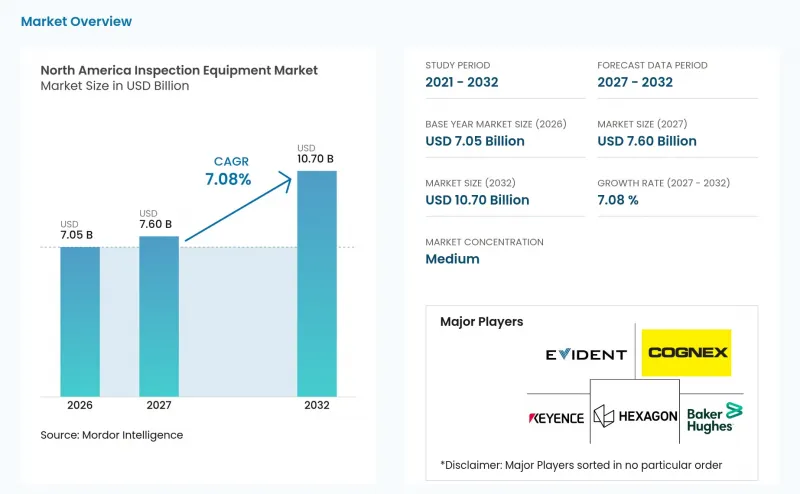
According to Mordor Intelligence, the North America inspection equipment market size is projected to expand from USD 7.05 billion in 2026 and USD 7.60 billion in 2027 to USD 10.70 billion by 2032, registering a CAGR of 7.08% between 2027 and 2032.
North America Inspection Equipment Market Trends and Insights
AI-Enabled Defect Detection and Closed-Loop Quality Control
Automated inspection is increasingly valued for its ability to feed defect information back into upstream production settings without interrupting line throughput, helping manufacturers reduce scrap and shorten process-development cycles. Cognex made its OneVision platform generally available in May 2026, following a beta phase that involved more than 100 manufacturing customers since June 2025. The platform is designed to extend AI-based inspection across multiple production sites through a centralized development environment. KLA reported a USD 12.57 billion process-control and inspection order backlog as of June 30, 2026, compared with USD 7.86 billion a year earlier. These developments support recurring demand in the North America inspection equipment market from upgrades at operating facilities and the construction of new manufacturing plants. The growing integration of inspection data into production control allows manufacturers to identify recurring defect patterns and adjust equipment settings and material-handling processes earlier in the production cycle, rather than relying exclusively on final quality checks. Semiconductor manufacturers have a particularly strong need for these capabilities as advanced process nodes and increasingly complex memory structures require additional inspection stages. Automotive and electronics manufacturers also deploy machine vision systems where inspection repeatability and production-line speed influence automation efficiency.
Reshoring and Semiconductor Fab Expansion
Semiconductor construction is driving inspection demand that will likely extend beyond the initial building phase, as fab development schedules typically span several years from chip-design decisions to production readiness. TSMC accelerated mass production at its second Phoenix facility from 2028 to 2027, while Intel continued construction at its New Albany facility after securing an AI production partnership with Nvidia in September 2025. These projects require inspection equipment before production ramps up because process control is essential for equipment qualification and manufacturing consistency. New fabs increasingly design around in-line optical inspection, electron-beam systems, and metrology tools rather than relying primarily on end-of-line sampling, supporting sustained orders in North America's inspection equipment market. The impact extends beyond wafer fabrication plants, as equipment suppliers, component manufacturers, and service providers must meet stringent traceability and quality requirements when supplying domestic semiconductor projects. Inspection intensity also increases at advanced logic nodes because conventional optical methods may not adequately resolve the smallest structures. KLA highlighted strong adoption of single-beam and multi-beam electron-beam systems alongside improvements in AI-based optical inspection in its fiscal 2026 materials.
High Capital Cost and Integration Complexity
Advanced inspection cells can involve substantial costs beyond the initial equipment quotation, including installation, programmable logic controller (PLC) connections, factory-network configuration, custom interfaces, validation protocols, and commissioning labor. The National Institute of Standards and Technology's Manufacturing Extension Partnership identifies total cost of ownership as an important consideration in manufacturing technology decisions, while the Pipeline and Hazardous Materials Safety Administration (PHMSA), in its May 2025 proposal, sought feedback on whether inspection technology requirements could impose costs disproportionate to their safety benefits. These factors create an adoption barrier for smaller users in the North America inspection equipment market. Integration complexity adds to the challenge because manufacturers often need new inspection systems to communicate with legacy manufacturing execution systems, enterprise resource planning platforms, and quality-management software. Configuring these connections can extend implementation timelines by several months and require specialized engineering resources that may not be available internally.
Other drivers and restraints analyzed in the detailed report include:
- Aging Industrial Infrastructure and Mandatory Integrity Inspection
- Regulatory Compliance Across Energy, Aviation, and Nuclear
- Shortage of Qualified Inspection and Metrology Personnel
For complete list of drivers and restraints, kindly check the Table Of Contents.
Segment Analysis
Optical and visual inspection equipment held 29.7% of the North America inspection equipment market share in 2026, making it the largest equipment category. Machine vision and automated optical inspection are widely used in electronics assembly, automotive production, and consumer goods manufacturing. Borescopes for jet-engine work and surface scanners for composite aerospace structures add to demand. The North America inspection equipment market size for this category is supported by use across high-volume lines and specialized maintenance activities. The installed base allows optical suppliers to add AI tools, centralized data management, and repeatable automated checks.
Electron-beam inspection equipment is forecast to grow at a 9.5% CAGR from 2027 to 2032 because advanced semiconductor process control at sub-3nm nodes can exceed optical-resolution limits. KLA has described adoption of single-beam and multi-beam electron-beam systems alongside AI-based optical improvements. Dimensional and geometric systems, including coordinate measuring machines, laser scanners, and 3D platforms, remain process-critical for automotive and aerospace manufacturing. Ultrasonic and acoustic equipment serve buried, subsurface, and hard-to-access energy and civil assets. Radiographic and computed tomography systems are gaining relevance in battery-cell qualification and additive-manufactured-part verification without damaging the component.
Complete Report Scope:
- By Equipment Type
- Optical and Visual Inspection Equipment
- Machine Vision and Automated Optical Inspection Systems
- Borescopes and Remote Visual Inspection Systems
- Other Optical and Surface Inspection Equipment
- Dimensional and Geometric Inspection Equipment
- Coordinate Measuring Machines
- Laser Scanning and 3D Measurement Systems
- Other Dimensional and Surface Profiling Inspection Systems
- Ultrasonic and Acoustic Inspection Equipment
- Conventional Ultrasonic Inspection Systems
- Phased-Array and Advanced Ultrasonic Inspection Systems
- Acoustic Emission and Acoustic Imaging Systems
- Radiographic and Computed Tomography Inspection Equipment
- Conventional and Digital Radiography Systems
- Industrial Computed Tomography Systems
- Cargo and Consignment X-Ray Inspection Systems
- Electromagnetic and Magnetic Inspection Equipment
- Eddy-Current Inspection Systems
- Magnetic Particle and Magnetic Flux Leakage Inspection Systems
- Ground-Penetrating Radar and Other Electromagnetic Inspection Systems
- Thermal and Infrared Inspection Equipment
- Handheld Thermal Imaging Systems
- Fixed and Integrated Thermal Inspection Systems
- Electron-Beam Inspection Equipment
- Electron-Beam Defect Inspection and Review Systems
- Other Charged-Particle Inspection Systems
- Other Specialized Inspection Equipment
- Leak and Pressure-Integrity Inspection Systems
- Automated Checkweighing and Other Physical Conformity Inspection Systems
- Other Dedicated Inspection Instruments and Systems
- Optical and Visual Inspection Equipment
- By Primary Inspection Application
- Building and Property Inspection
- Civil Infrastructure Inspection
- Industrial Facilities and Fixed Asset Inspection
- Manufactured Product and Production-Process Inspection
- Transportation Vehicle and Mobile Asset Inspection
- Commodity, Cargo and Trade Inspection
- Other Operational Site and Process Inspection
- By End-Use Industry
- Oil and Gas, Including Refining and Petrochemicals
- Power Generation, Renewable Energy and Utilities
- Automotive and Automotive Component Manufacturing
- Aerospace and Defense Manufacturing
- Electronics, Semiconductor and Electrical Equipment Manufacturing
- Other Manufacturing and Industrial Processing
- Construction, Real Estate and Civil Infrastructure
- Transportation and Logistics Operations
- Mining and Quarrying
- Agriculture, Food and Beverage
- Healthcare, Pharmaceuticals and Life Sciences
- Wholesale, Retail and Commodity Trading
- Government, Regulatory and Border Inspection Agencies
- Other End Users
- By Geography
- United States
- Canada
- Mexico
List of Companies Covered in this Report:
- Baker Hughes Company (Waygate Technologies)
- Evident Corporation
- Hexagon AB
- Cognex Corporation
- KEYENCE CORPORATION
- FARO Technologies, Inc.
- KLA Corporation
- Applied Materials, Inc.
- MISTRAS Group, Inc.
- SGS Societe Generale de Surveillance SA
- Bureau Veritas
- Nikon Corporation (Nikon Metrology)
- Carl Zeiss AG (ZEISS Industrial Quality Solutions)
- Mitutoyo Corporation
- Eddyfi Technologies Inc.
- Fujifilm Holdings Corporation (FUJIFILM NDT Systems)
- Magnaflux (Illinois Tool Works Inc.)
- SICK AG
- OMRON Corporation
- Teledyne Technologies Incorporated
- Sonatest Ltd.
- Applus Services, S.A.
Additional Benefits:
- The market estimate (ME) sheet in Excel format
- 3 months of analyst support
TABLE OF CONTENTS
1 Introduction
- 1.1 Study Assumptions and Market Definition
- 1.2 Scope of the Study
2 Research Methodology
3 Executive Summary
4 Market Landscape
- 4.1 Market Overview
- 4.2 Market Drivers
- 4.2.1 AI-Enabled Defect Detection and Closed-Loop Quality Control
- 4.2.2 Reshoring and Semiconductor Fab Expansion
- 4.2.3 Aging Industrial Infrastructure and Mandatory Integrity Inspection
- 4.2.4 Regulatory Compliance Across Energy, Aviation, and Nuclear
- 4.2.5 Inspection Demand from Battery and Additive-Manufacturing Qualification
- 4.2.6 Inspection Data Interoperability as a Production Bottleneck
- 4.3 Market Restraints
- 4.3.1 High Capital Cost and Integration Complexity
- 4.3.2 Shortage of Qualified Inspection and Metrology Personnel
- 4.3.3 Cybersecurity and Data-Sovereignty Requirements for Connected Inspection
- 4.3.4 Unstandardized AI Defect Libraries and Model Validation
- 4.4 Value and Supply-Chain Analysis
- 4.4.1 Component and Sensor Suppliers
- 4.4.2 Inspection Equipment Manufacturers
- 4.4.3 System Integrators and Automation Partners
- 4.4.4 Distributors, Calibration Providers, and Service Companies
- 4.4.5 End-User Manufacturing Sites
- 4.5 Regulatory Landscape
- 4.5.1 ASME, API, ASTM, and Code-Driven Inspection Requirements
- 4.5.2 FAA, NRC, PHMSA, FDA, and OSHA Requirements
- 4.5.3 NIST Cybersecurity and Connected-Factory Controls
- 4.5.4 USMCA and North American Manufacturing Localization
- 4.6 Key Market Trends
- 4.6.1 Shift Toward Automated and In-Line Inspection Systems
- 4.6.2 Growing Adoption of AI-Based Defect Detection and Machine Vision
- 4.6.3 Increasing Demand for Portable and Handheld Inspection Equipment
- 4.6.4 Integration of Inspection Systems with Industry 4.0 Platforms
- 4.6.5 Expansion of Robotic and Remote Inspection Technologies
- 4.6.6 Growing Adoption of High-Resolution Imaging and Advanced NDT Systems
- 4.6.7 Development of Multi-Sensor and Integrated Inspection Platforms
- 4.7 Technological Outlook
- 4.7.1 Machine Vision and Automated Optical Inspection
- 4.7.2 Precision Metrology and 3D Scanning Technologies
- 4.7.3 Ultrasonic, Acoustic and Electromagnetic Inspection Technologies
- 4.7.4 Digital Radiography and Industrial Computed Tomography
- 4.7.5 Thermal Imaging and Infrared Inspection
- 4.7.6 Electron-Beam and Advanced Semiconductor Inspection
- 4.7.7 Drone-Based, Robotic and Remote Inspection Platforms
- 4.7.8 AI-Enabled Inspection Analytics and Edge Computing
- 4.7.9 Multi-Sensor Inspection and Digital Twin Integration
- 4.8 Equipment Procurement and Commercial Models
- 4.8.1 Capital Equipment Procurement and Leasing Models
- 4.8.2 Standalone Equipment versus Integrated Inspection Systems
- 4.8.3 Equipment Pricing and Total Cost of Ownership
- 4.9 Macroeconomic and Capital Investment Cycle Impact
- 4.9.1 Impact of Industrial Capital Expenditure and Manufacturing Activity
- 4.9.2 Impact of Infrastructure Development and Energy Investments
- 4.9.3 Impact of Semiconductor and Electronics Investment Cycles
- 4.9.4 Impact of Supply-Chain Localization and Trade Restrictions
5 Market Size And Growth Forecasts
- 5.1 By Equipment Type
- 5.1.1 Optical and Visual Inspection Equipment
- 5.1.1.1 Machine Vision and Automated Optical Inspection Systems
- 5.1.1.2 Borescopes and Remote Visual Inspection Systems
- 5.1.1.3 Other Optical and Surface Inspection Equipment
- 5.1.2 Dimensional and Geometric Inspection Equipment
- 5.1.2.1 Coordinate Measuring Machines
- 5.1.2.2 Laser Scanning and 3D Measurement Systems
- 5.1.2.3 Other Dimensional and Surface Profiling Inspection Systems
- 5.1.3 Ultrasonic and Acoustic Inspection Equipment
- 5.1.3.1 Conventional Ultrasonic Inspection Systems
- 5.1.3.2 Phased-Array and Advanced Ultrasonic Inspection Systems
- 5.1.3.3 Acoustic Emission and Acoustic Imaging Systems
- 5.1.4 Radiographic and Computed Tomography Inspection Equipment
- 5.1.4.1 Conventional and Digital Radiography Systems
- 5.1.4.2 Industrial Computed Tomography Systems
- 5.1.4.3 Cargo and Consignment X-Ray Inspection Systems
- 5.1.5 Electromagnetic and Magnetic Inspection Equipment
- 5.1.5.1 Eddy-Current Inspection Systems
- 5.1.5.2 Magnetic Particle and Magnetic Flux Leakage Inspection Systems
- 5.1.5.3 Ground-Penetrating Radar and Other Electromagnetic Inspection Systems
- 5.1.6 Thermal and Infrared Inspection Equipment
- 5.1.6.1 Handheld Thermal Imaging Systems
- 5.1.6.2 Fixed and Integrated Thermal Inspection Systems
- 5.1.7 Electron-Beam Inspection Equipment
- 5.1.7.1 Electron-Beam Defect Inspection and Review Systems
- 5.1.7.2 Other Charged-Particle Inspection Systems
- 5.1.8 Other Specialized Inspection Equipment
- 5.1.8.1 Leak and Pressure-Integrity Inspection Systems
- 5.1.8.2 Automated Checkweighing and Other Physical Conformity Inspection Systems
- 5.1.8.3 Other Dedicated Inspection Instruments and Systems
- 5.1.1 Optical and Visual Inspection Equipment
- 5.2 By Primary Inspection Application
- 5.2.1 Building and Property Inspection
- 5.2.2 Civil Infrastructure Inspection
- 5.2.3 Industrial Facilities and Fixed Asset Inspection
- 5.2.4 Manufactured Product and Production-Process Inspection
- 5.2.5 Transportation Vehicle and Mobile Asset Inspection
- 5.2.6 Commodity, Cargo and Trade Inspection
- 5.2.7 Other Operational Site and Process Inspection
- 5.3 By End-Use Industry
- 5.3.1 Oil and Gas, Including Refining and Petrochemicals
- 5.3.2 Power Generation, Renewable Energy and Utilities
- 5.3.3 Automotive and Automotive Component Manufacturing
- 5.3.4 Aerospace and Defense Manufacturing
- 5.3.5 Electronics, Semiconductor and Electrical Equipment Manufacturing
- 5.3.6 Other Manufacturing and Industrial Processing
- 5.3.7 Construction, Real Estate and Civil Infrastructure
- 5.3.8 Transportation and Logistics Operations
- 5.3.9 Mining and Quarrying
- 5.3.10 Agriculture, Food and Beverage
- 5.3.11 Healthcare, Pharmaceuticals and Life Sciences
- 5.3.12 Wholesale, Retail and Commodity Trading
- 5.3.13 Government, Regulatory and Border Inspection Agencies
- 5.3.14 Other End Users
- 5.4 By Geography
- 5.4.1 United States
- 5.4.2 Canada
- 5.4.3 Mexico
6 Competitive Landscape
- 6.1 Market Concentration
- 6.2 Strategic Moves
- 6.3 Market Share Analysis
- 6.4 Company Profiles (Includes Global Level Overview, Market Level Overview, Core Segments, Financials as available, Strategic Information, Market Rank/Share, Products and Services, Recent Developments)
- 6.4.1 Baker Hughes Company (Waygate Technologies)
- 6.4.2 Evident Corporation
- 6.4.3 Hexagon AB
- 6.4.4 Cognex Corporation
- 6.4.5 KEYENCE CORPORATION
- 6.4.6 FARO Technologies, Inc.
- 6.4.7 KLA Corporation
- 6.4.8 Applied Materials, Inc.
- 6.4.9 MISTRAS Group, Inc.
- 6.4.10 SGS Societe Generale de Surveillance SA
- 6.4.11 Bureau Veritas
- 6.4.12 Nikon Corporation (Nikon Metrology)
- 6.4.13 Carl Zeiss AG (ZEISS Industrial Quality Solutions)
- 6.4.14 Mitutoyo Corporation
- 6.4.15 Eddyfi Technologies Inc.
- 6.4.16 Fujifilm Holdings Corporation (FUJIFILM NDT Systems)
- 6.4.17 Magnaflux (Illinois Tool Works Inc.)
- 6.4.18 SICK AG
- 6.4.19 OMRON Corporation
- 6.4.20 Teledyne Technologies Incorporated
- 6.4.21 Sonatest Ltd.
- 6.4.22 Applus Services, S.A.
7 Market Opportunities And Future Outlook
- 7.1 White-Space and Unmet-Need Assessment
- 7.1.1 Inspection-as-a-Service for Small and Mid-Sized Manufacturers
- 7.1.2 Validated AI Defect Libraries for Regulated Production
- 7.1.3 Interoperable Inspection Data for Multi-Plant Quality Networks
- 7.1.4 Low-Access Inspection for Aging Infrastructure
- 7.1.5 North American Aftermarket and Calibration Capacity

