PUBLISHER: Mordor Intelligence | PRODUCT CODE: 2195007

PUBLISHER: Mordor Intelligence | PRODUCT CODE: 2195007
Vietnam Less-than-Container Load (LCL) - Market Share Analysis, Industry Trends & Statistics, Growth Forecasts (2027 - 2032)
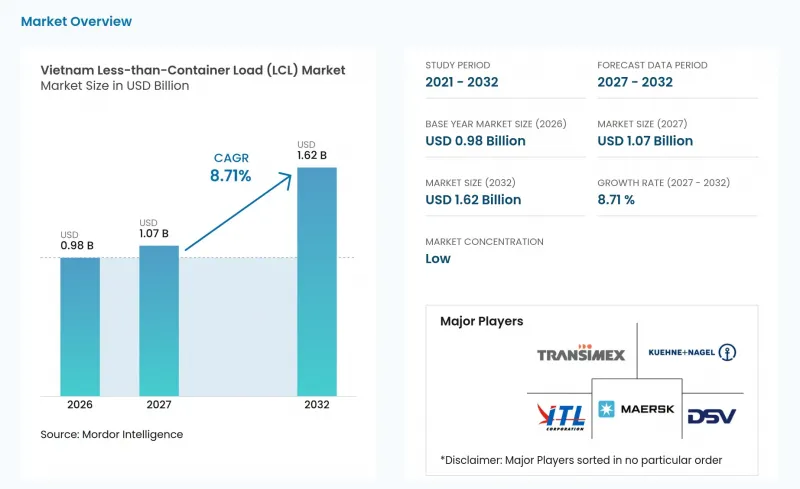
According to Mordor Intelligence, the Vietnam less-than-container load (LCL) market size is valued at USD 0.98 billion in 2026 and is estimated to grow from USD 1.07 billion in 2027 to reach USD 1.62 billion by 2032, at a CAGR of 8.71% during the forecast period (2027-2032).
Vietnam Less-than-Container Load (LCL) Market Trends and Insights
Manufacturing Diversification Increasing Export-Oriented Consolidation Demand
Vietnam's manufacturing base supports demand for shared-container shipping as suppliers serve multiple buyers with differing order sizes and shipment schedules. Electronics, footwear, apparel, furniture, and consumer goods generate cargo volumes that may not fill a full container individually. LCL services allow these businesses to combine smaller consignments with compatible shipments, helping them access international markets without committing to full-container volumes. Consolidators can differentiate themselves through efficient cargo collection, documentation, warehouse handling, and reliable vessel bookings. The commercial opportunity is particularly relevant near industrial parks and export gateways in Northern and Southern Vietnam, where manufacturers and supporting suppliers generate recurring freight flows.
Cross-Border E-Commerce Expanding Small-Batch Shipment Volumes
Cross-border e-commerce supports demand for smaller, more frequent shipments that may be unsuitable for full-container bookings. Retailers and online sellers need coordinated collection, labeling, customs documentation, tracking, and destination delivery. LCL services can help combine consignments from multiple exporters and provide access to international routes without requiring each seller to book an entire container. Digital booking and shipment visibility can further improve the customer experience by making rates, schedules, and cargo status easier to manage. Providers that combine consolidation with customs support and destination distribution are better positioned to serve smaller merchants, although shipment economics depend on cargo density, handling charges, and delivery requirements.
Equipment Imbalances Increasing Container Repositioning Costs
Equipment imbalances can increase costs and create scheduling uncertainty when consolidators cannot secure suitable container space at the required time. Smaller exporters often have less negotiating power than large shippers when equipment is scarce or carrier allocations are constrained. A missed sailing can delay several consignments within the same shared container and generate additional handling, storage, or rebooking requirements. These risks are particularly relevant around major export gateways, where cargo demand can be concentrated within particular shipping windows. LCL operators can reduce exposure through carrier diversification, accurate booking forecasts, flexible routing, and coordination between cargo-receiving facilities and vessel schedules. However, their ability to maintain service reliability remains influenced by carrier capacity and wider trade conditions.
Other drivers and restraints analyzed in the detailed report include:
- RCEP Integration Supporting Regional Customs and Trade
- Deep-Sea Port Expansion Strengthening Consolidation Network Connectivity
- Port Congestion Disrupting Schedule Reliability During Peak Periods
For complete list of drivers and restraints, kindly check the Table Of Contents.
Segment Analysis
Consolidation services account for 66.78% of the Vietnam less-than-container load (LCL) market size in 2026. These services combine cargo from multiple shippers into shared containers, allowing exporters with smaller consignments to access international shipping routes. Vietnam's manufacturing base generates demand from apparel, electronics, furniture, footwear, and consumer goods suppliers whose order volumes vary by customer and destination. Effective consolidation requires coordinated cargo collection, receiving, documentation, loading, and vessel booking. Container freight stations near industrial areas can support these activities by providing facilities for cargo inspection, staging, and container preparation. Operators with established carrier relationships and efficient warehouse processes can improve shipment reliability and container utilization.
CAGR for de-consolidation and distribution is projected at 10.38% from 2027 to 2032. This service category supports the separation of consolidated cargo after arrival and its distribution to individual importers or delivery locations. Growth opportunities arise when importers, retailers, and manufacturers require smaller consignments to be sorted and delivered across multiple destinations. Providers need suitable warehouse capacity, accurate cargo identification, customs coordination, and domestic transport arrangements. Forwarders that integrate these functions can reduce handoffs and improve shipment visibility. Growth will depend on import activity, the development of distribution networks, and the availability of facilities capable of handling different cargo categories.
International shipments account for 61.38% of the Vietnam less-than-container load (LCL) market share in 2026. The segment benefits from Vietnam's manufacturing exports and its participation in regional and global supply chains. Exporters can use shared-container services when order volumes do not justify a full container, while importers can consolidate smaller quantities of components, machinery, packaging, and finished goods. Service performance depends on carrier access, destination-agent coverage, customs documentation, and predictable transshipment arrangements. Providers with international networks can coordinate shipments across multiple countries and offer consistent service standards. International LCL therefore remains closely linked to the country's trade flows and manufacturing activity.
CAGR for domestic LCL is projected at 9.37% from 2027 to 2032. Domestic consolidation supports the movement of smaller shipments between manufacturing centres, warehouses, and distribution markets in Northern, Central, and Southern Vietnam. In February 2025, NX Vietnam announced a consolidation service using the North-South Railway between Hanoi and Ho Chi Minh City. Rail can provide an alternative to road transport for suitable cargo, particularly when shipments can be grouped into regular movements. The commercial benefits depend on terminal access, handling requirements, transit schedules, and the coordination of first- and last-mile delivery. Providers that combine rail, road, and warehouse operations can offer shippers additional routing choices.
Complete Report Scope:
- By Service Type
- Consolidation Services
- De-consolidation and Distribution
- By Destination
- Domestic
- International
- By Nature of Business
- Freight Forwarding
- NVOCCs
- By End User
- Manufacturing and Automotive
- Retail and E-commerce
- Healthcare and Pharmaceuticals
- Agriculture and Forestry
- Other End Users
- By Cargo Type
- General Cargo
- Temperature-Controlled Cargo
- Hazardous Cargo
- High-Value and Sensitive Cargo
- Other End Users
- By Region
- Northern Vietnam
- Central Vietnam
- Southern Vietnam
List of Companies Covered in this Report:
- A.P. Moller - Maersk
- DHL Global Forwarding
- DSV
- Kuehne+Nagel
- CEVA Logistics
- Expeditors International
- Nippon Express
- Rhenus Logistics
- Sinotrans
- SEKO Logistics
- Yusen Logistics
- CJ Logistics
- Indo Trans Logistics Corporation (ITL)
- Bee Logistics Corporation
- Transimex Corporation
- Gemadept Corporation
- U&I Logistics Corporation
- VINATRANS
- Dolphin Sea Air Services Corporation
- ASL Logistics
- Vinafreight
- Vietfracht
Additional Benefits:
- The market estimate (ME) sheet in Excel format
- 3 months of analyst support
TABLE OF CONTENTS
1 INTRODUCTION
- 1.1 Study Assumptions and Market Definition
- 1.2 Scope of the Study
2 RESEARCH METHODOLOGY
3 EXECUTIVE SUMMARY
- 3.1 Market Size, Growth, and Forecast Outlook
- 3.2 Key Demand Drivers and LCL Shipping Trends
- 3.3 Major LCL Gateways and Cargo Concentration
- 3.4 Competitive Landscape and Leading LCL Providers
4 MARKET LANDSCAPE
- 4.1 Market Overview and Importance of Less Than Container Load Market
- 4.2 Market Drivers
- 4.2.1 Manufacturing Diversification Increasing Export-Oriented Consolidation Demand
- 4.2.2 Cross-Border E-Commerce Expanding Small-Batch Shipment Volumes
- 4.2.3 RCEP Integration Simplifying Regional Customs and Trade
- 4.2.4 Deep-Sea Port Expansion Strengthening Consolidation Network Connectivity
- 4.2.5 Factory Clustering Increasing Origin-Side Cargo Consolidation Demand
- 4.2.6 Apparel and Electronics Exports Supporting Frequent Shipments
- 4.3 Market Restraints
- 4.3.1 Equipment Imbalances Increasing Container Repositioning and Costs
- 4.3.2 Port Congestion Disrupting Schedule Reliability During Peaks
- 4.3.3 Fragmented Pickup Networks Reducing End-to-End Service Efficiency
- 4.3.4 Inland Connectivity Gaps Increasing Origin-Destination Handling Complexity
- 4.4 Value Chain Structure and LCL Cargo Flow Analysis
- 4.5 Regulatory Framework and LCL Shipping Compliance Analysis
- 4.6 Technology Adoption and LCL Digitalization Trend Analysis
- 4.7 Major Port and LCL Gateway Concentration Analysis
- 4.8 LCL Freight Rate and Surcharge Trend Analysis
- 4.9 Inter-Island LCL Connectivity and Backhaul Analysis
- 4.10 Porter's Five Forces Analysis
- 4.10.1 Threat of New Entrants
- 4.10.2 Bargaining Power of Buyers
- 4.10.3 Bargaining Power of Suppliers
- 4.10.4 Threat of Substitute Services
- 4.10.5 Intensity of Competitive Rivalry
- 4.11 Impact of Geo-Political Events on Supply Chain Shifts
5 MARKET SIZE AND GROWTH FORECASTS
- 5.1 By Service Type
- 5.1.1 Consolidation Services
- 5.1.2 De-consolidation and Distribution
- 5.2 By Destination
- 5.2.1 Domestic
- 5.2.2 International
- 5.3 By Nature of Business
- 5.3.1 Freight Forwarding
- 5.3.2 NVOCCs
- 5.4 By End User
- 5.4.1 Manufacturing and Automotive
- 5.4.2 Retail and E-commerce
- 5.4.3 Healthcare and Pharmaceuticals
- 5.4.4 Agriculture and Forestry
- 5.4.5 Other End Users
- 5.5 By Cargo Type
- 5.5.1 General Cargo
- 5.5.2 Temperature-Controlled Cargo
- 5.5.3 Hazardous Cargo
- 5.5.4 High-Value and Sensitive Cargo
- 5.5.5 Other End Users
- 5.6 By Region
- 5.6.1 Northern Vietnam
- 5.6.2 Central Vietnam
- 5.6.3 Southern Vietnam
6 COMPETITIVE LANDSCAPE
- 6.1 Market Concentration
- 6.2 Strategic Moves
- 6.3 Market Share Analysis
- 6.4 Company Profiles (includes Global Level Overview, Market Level Overview, Core Segments, Financials as available, Strategic Information, Geographic Coverage, Products and Services, Recent Developments)
- 6.4.1 A.P. Moller - Maersk
- 6.4.2 DHL Global Forwarding
- 6.4.3 DSV
- 6.4.4 Kuehne+Nagel
- 6.4.5 CEVA Logistics
- 6.4.6 Expeditors International
- 6.4.7 Nippon Express
- 6.4.8 Rhenus Logistics
- 6.4.9 Sinotrans
- 6.4.10 SEKO Logistics
- 6.4.11 Yusen Logistics
- 6.4.12 CJ Logistics
- 6.4.13 Indo Trans Logistics Corporation (ITL)
- 6.4.14 Bee Logistics Corporation
- 6.4.15 Transimex Corporation
- 6.4.16 Gemadept Corporation
- 6.4.17 U&I Logistics Corporation
- 6.4.18 VINATRANS
- 6.4.19 Dolphin Sea Air Services Corporation
- 6.4.20 ASL Logistics
- 6.4.21 Vinafreight
- 6.4.22 Vietfracht
7 MARKET OPPORTUNITIES AND FUTURE OUTLOOK
- 7.1 White-Space Opportunities and Unmet LCL Service Needs
- 7.2 High-Potential End-User Segments and Trade Opportunities
- 7.3 Strategic Growth Priorities Across LCL Shipping Ecosystem
- 7.4 Future Market Outlook and Emerging LCL Demand Pockets
8 APPENDIX

