PUBLISHER: Mordor Intelligence | PRODUCT CODE: 2197077

PUBLISHER: Mordor Intelligence | PRODUCT CODE: 2197077
India Coffee - Market Share Analysis, Industry Trends & Statistics, Growth Forecasts (2027 - 2032)
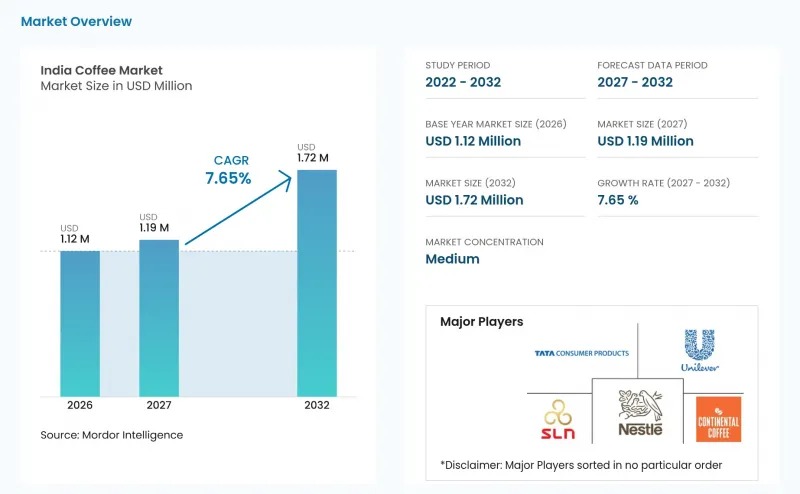
According to Mordor Intelligence, the Indian coffee market is projected to grow from USD 1.12 billion in 2026 and USD 1.20 billion in 2027 to USD 1.72 billion by 2032, registering a CAGR of 7.65% during the forecast period (2027-2032).
India Coffee Market Trends and Insights
Rising Urban Coffee Adoption and Cafe Culture
India's expanding cafe culture is driving coffee consumption beyond traditional morning occasions. Branded cafes serve as venues for meetings, studying, and socializing, giving younger consumers more reasons to consume coffee throughout the day. This shift also familiarizes consumers with formats such as cold brew and single-origin coffee, which may subsequently translate into retail purchases. The Indian coffee market benefits as cafe chains expand into Tier-2 cities, allowing local consumers to experience premium coffee formats before purchasing them for at-home consumption. Organized chains are increasing their physical presence, including Third Wave Coffee's planned expansion into nine new cities following its anticipated Series D funding round in August 2026. This expansion connects on-trade consumption with the growth of packaged coffee and ready-to-drink products sold through other distribution channels.
Premiumization of Instant, Specialty, and Origin-Led Coffee
Premium demand is growing across flavored instant coffee, specialty blends, capsules, and estate-specific offerings. For instance, Nestle is expected to open its first Nespresso boutique in New Delhi in early 2025 and partner with Thakral Innovation to expand distribution in India. Tata Starbucks is also expected to introduce three estate-exclusive whole-bean coffees from Kodagu in October 2025, sourced from the Nullore, Margolly, and Karadibetta estates. These launches are expected to increase consumer visibility into coffee origin, growing area, and processing methods. Higher green coffee prices are likely to narrow the price gap between specialty and standard coffee in 2025, increasing the importance of traceability and product differentiation. Consequently, the Indian coffee market is developing premium products through both international distribution systems and Indian estate-led offerings.
Volatility in Arabica and Robusta Prices
Coffee bean prices are expected to remain highly volatile in 2025 and continue affecting costs in 2026. According to the USDA Foreign Agricultural Service's India Coffee Annual 2026, domestic farmgate prices for Arabica parchment and Robusta cherry are projected to decline by 16% and 11%, respectively, from October 2025 levels. This decline reflects expectations of higher coffee output in major producing countries and elevated domestic inventories. However, price corrections may not immediately reduce retail costs, as brands may continue selling inventory purchased when bean prices were higher. Blue Tokai is expected to increase packet prices by 10% to 20% in July 2026 due to its higher-cost harvest-season inventory. International supply conditions, weather-related risks, and uncertainty surrounding U.S. tariffs on Brazilian coffee are also expected to contribute to price pressures. The Indian coffee market may face margin pressure when brands cannot pass these costs on to price-sensitive consumers.
Other drivers and restraints analyzed in the detailed report include:
- Convenience Demand for Soluble, Single-Serve, and Ready-to-Drink Formats
- Expansion of E-Commerce and Quick-Commerce Distribution Channels
- Climate Change Affecting Coffee Production
For complete list of drivers and restraints, kindly check the Table Of Contents.
Segment Analysis
Ground coffee accounted for a 33.14% share in 2026, supported by established filter-coffee consumption routines in South Indian households and broader availability across modern retail channels. Ready-to-drink coffee is projected to grow at an 8.61% CAGR through 2032, driven by demand for cold, single-serve beverages that require no home preparation. Instant coffee remains a major volume contributor due to its affordability and widespread availability across urban and smaller-city retail outlets. Soluble formats also introduce coffee to first-time consumers, who may subsequently trade up to ground, whole-bean, or specialty coffee products.
Whole-bean coffee is gaining visibility among urban consumers seeking to replicate cafe-style brewing at home. The Nespresso boutique in New Delhi provides capsule systems with a higher-profile entry point into the country. Coffee pods and capsules can drive demand among professionals who value consistent portions and minimal preparation time. In August 2025, the Food Safety and Standards Authority of India (FSSAI) amended labeling requirements for coffee-chicory products, with the requirements taking effect in July 2026. The amendment requires manufacturers to clearly disclose coffee and chicory percentages on the front of packs. This requirement can help consumers compare blended and pure-coffee formats more easily.
Arabica is projected to hold a 59.42% share in 2026, supported by its use in specialty cafes, capsule systems, and origin-led retail ranges. Robusta is forecast to grow at a CAGR of 8.30% through 2032, driven by its suitability for instant coffee and ready-to-drink blends that require consistent flavor, cost efficiency, and high soluble yield. This trend indicates that Robusta demand is closely linked to the adoption of mass-market formats rather than solely to premium coffee consumption. The coffee industry uses both species to address distinct consumer requirements.
Karnataka and Kerala are key cultivation regions for both Arabica and Robusta. Arabica is expected to face additional pressure during 2025-26 as the crop enters its biennial off-year cycle. Weather-related disruptions may affect the availability and quality of both species. Tata Starbucks' planned launch of Kodagu estate coffees in October 2025 is expected to increase the focus on Arabica provenance and regional identity. Robusta continues to support a broader range of accessible packaged coffee formats. Consequently, brands can use Arabica to strengthen premium positioning while leveraging Robusta to meet widespread household demand.
Complete Report Scope:
- By Product Type
- Whole-bean
- Ground Coffee
- Instant Coffee
- Ready-to-Drink (RTD)
- Coffee Pod and Capsules
- By Coffee Species
- Arabica
- Robusta
- Other Coffee Species
- By Price Tier
- Mass
- Premium
- By Distribution Channel
- On-Trade
- Off-Trade
- Supermarkets/Hypermarkets
- Convenience Stores
- Specialty Stores
- Online Retail Stores
- Other Distribution Channels
List of Companies Covered in this Report:
- Nestle India Limited
- Hindustan Unilever Limited
- Tata Consumer Products Limited
- CCL Products (India) Limited
- SLN Coffee Private Limited
- Cothas Coffee Co.
- Sri Narasu's Coffee Company Private Limited
- Bayar's Coffee
- Blue Tokai Coffee Roasters
- Sleepy Owl Coffee
- Rage Coffee
- Levista Coffee
- Starbucks Coffee Company
- Cafe Coffee Day
- Third Wave Coffee
- Costa Coffee
- Tim Hortons
- Araku Coffee
- Country Bean Coffee
- Lavazza
Additional Benefits:
- The market estimate (ME) sheet in Excel format
- 3 months of analyst support
TABLE OF CONTENTS
1 INTRODUCTION
- 1.1 Study Assumptions and Market Definition
- 1.2 Scope of the Study
2 RESEARCH METHODOLOGY
3 EXECUTIVE SUMMARY
4 MARKET LANDSCAPE
- 4.1 Market Overview
- 4.2 Market Drivers
- 4.2.1 Rising Urban Coffee Adoption and Cafe Culture
- 4.2.2 Premiumization of Instant, Specialty, and Origin-Led Coffee
- 4.2.3 Convenience Demand for Soluble, Single-Serve, and Ready-to-Drink Formats
- 4.2.4 Expansion of Organised Coffee Shop Chains
- 4.2.5 Growing Preference for Specialty Coffee Varieties
- 4.2.6 Expansion of E-Commerce and Quick-Commerce Distribution Channels
- 4.3 Market Restraints
- 4.3.1 Volatility in Arabica and Robusta Prices
- 4.3.2 Climate Change Affecting Coffee Production
- 4.3.3 Tea Preference and Low Per-Capita Coffee Consumption
- 4.3.4 High Dependence on Southern Producing Regions
- 4.4 Consumer Demand Analysis
- 4.5 Value Chain Analysis
- 4.6 Regulatory Landscape
- 4.7 Technological Outlook
- 4.8 Porter's Five Forces Analysis
- 4.8.1 Bargaining Power of Suppliers
- 4.8.2 Bargaining Power of Buyers
- 4.8.3 Threat of New Entrants
- 4.8.4 Threat of Substitutes
- 4.8.5 Intensity of Competitive Rivalry
5 MARKET SIZE & GROWTH FORECASTS (VALUE AND VOLUME)
- 5.1 By Product Type
- 5.1.1 Whole-bean
- 5.1.2 Ground Coffee
- 5.1.3 Instant Coffee
- 5.1.4 Ready-to-Drink (RTD)
- 5.1.5 Coffee Pod and Capsules
- 5.2 By Coffee Species
- 5.2.1 Arabica
- 5.2.2 Robusta
- 5.2.3 Other Coffee Species
- 5.3 By Price Tier
- 5.3.1 Mass
- 5.3.2 Premium
- 5.4 By Distribution Channel
- 5.4.1 On-Trade
- 5.4.2 Off-Trade
- 5.4.2.1 Supermarkets/Hypermarkets
- 5.4.2.2 Convenience Stores
- 5.4.2.3 Specialty Stores
- 5.4.2.4 Online Retail Stores
- 5.4.2.5 Other Distribution Channels
6 COMPETITIVE LANDSCAPE
- 6.1 Market Concentration
- 6.2 Strategic Moves
- 6.3 Market Share Analysis
- 6.4 Company Profiles (Includes Company Highlights, Strategic Information, Core Segments, Financials, Products & Services, Recent Developments)
- 6.4.1 Nestle India Limited
- 6.4.2 Hindustan Unilever Limited
- 6.4.3 Tata Consumer Products Limited
- 6.4.4 CCL Products (India) Limited
- 6.4.5 SLN Coffee Private Limited
- 6.4.6 Cothas Coffee Co.
- 6.4.7 Sri Narasu's Coffee Company Private Limited
- 6.4.8 Bayar's Coffee
- 6.4.9 Blue Tokai Coffee Roasters
- 6.4.10 Sleepy Owl Coffee
- 6.4.11 Rage Coffee
- 6.4.12 Levista Coffee
- 6.4.13 Starbucks Coffee Company
- 6.4.14 Cafe Coffee Day
- 6.4.15 Third Wave Coffee
- 6.4.16 Costa Coffee
- 6.4.17 Tim Hortons
- 6.4.18 Araku Coffee
- 6.4.19 Country Bean Coffee
- 6.4.20 Lavazza
7 MARKET OPPORTUNITIES AND FUTURE OUTLOOK

