
PUBLISHER: Global Market Insights Inc. | PRODUCT CODE: 1982378

PUBLISHER: Global Market Insights Inc. | PRODUCT CODE: 1982378
North America Cooling Meters Market Opportunity, Growth Drivers, Industry Trend Analysis, and Forecast 2026 - 2035
North America Cooling Meters Market was valued at USD 525.6 million in 2025 and is estimated to grow at a CAGR of 5.3% to reach USD 839.8 million by 2035.
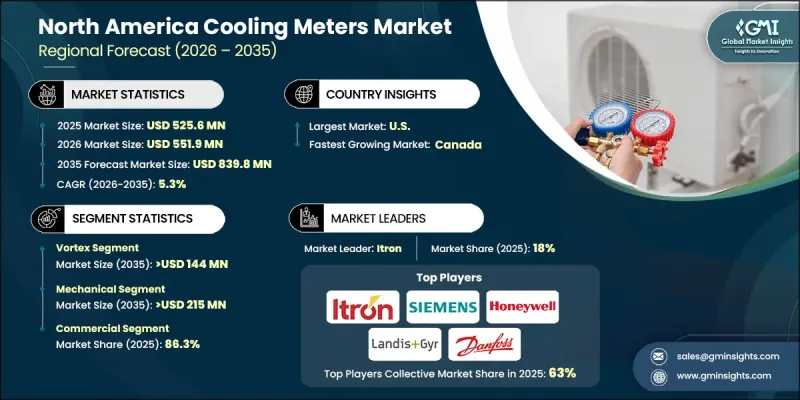
Cooling meters are designed to measure thermal energy in HVAC systems by calculating the temperature difference between supply and return flows along with the volume of fluid passing through the system. These devices enable accurate energy billing in multi-tenant buildings, promote efficient energy usage, and minimize waste. Integration with IoT platforms and advanced building automation systems provides real-time analytics, fault detection, and performance optimization. Growing urbanization and the expansion of district cooling networks in metropolitan areas are fueling HVAC deployment, while smart grid initiatives and energy efficiency incentives are further driving demand. The industry is also witnessing a shift toward sustainability, with key market players emphasizing reduced carbon footprints and green energy practices, strengthening the adoption of cooling meters across residential, commercial, and industrial facilities. Ongoing investment in monitoring-enabled systems enhances cost savings and operational efficiency, reinforcing market growth prospects.
| Market Scope | |
|---|---|
| Start Year | 2025 |
| Forecast Year | 2026-2035 |
| Start Value | $525.6 Million |
| Forecast Value | $839.8 Million |
| CAGR | 5.3% |
The vortex cooling meters segment is projected to reach USD 144 million by 2035 due to their advantages, including eliminating the need for an external power supply. These meters are widely used for switch cabinet cooling, convective cooling of high-speed equipment, and air conditioning for specialized protective gear. The growing preference for advanced cooling devices offering real-time data monitoring is expected to further boost sales in the coming years.
The mechanical cooling meters segment is expected to generate USD 215 million by 2035, primarily in cost-sensitive sectors such as residential and small commercial projects. Their ease of integration into older buildings and legacy systems that require lower accuracy or less frequent data collection supports ongoing adoption. Increasing regulatory compliance with energy efficiency standards is also projected to strengthen market penetration and overall demand.
U.S. Cooling Meters Market will capture USD 710 million by 2035, driven by regulatory mandates, technological innovations, and rising adoption of energy-efficient practices. Companies and building owners are increasingly implementing sustainability measures to meet energy efficiency requirements set by authorities such as the U.S. Department of Energy. Access to low-cost electricity, growing industrial and commercial infrastructure, and strategic collaborations further contribute to market expansion. HVAC systems in large commercial and industrial facilities account for a significant portion of energy usage, creating strong demand for monitoring solutions that optimize cooling efficiency and reduce costs.
Prominent companies operating in the North America Cooling Meters Market include Siemens AG, Honeywell International Inc., Schneider Electric SE, Danfoss A/S, Itron, Inc., Xylem, Inc., Kamstrup A/S, RB Flowmeter, B METERS s.r.l., Integra Metering, Landis+Gyr AG, Apator SA, Secure Meters Ltd., Sontex SA, ista Energy Solutions Limited, QMC Metering Solutions, Axioma Metering, Diehl Stiftung & Co. KG, and Badger Meter, Inc. Key strategies adopted by companies in the North America Cooling Meters Market focus on technological innovation, product diversification, and market expansion. Firms are investing in IoT-enabled and smart metering solutions to provide real-time data analytics, improve operational efficiency, and reduce energy consumption for end-users. Partnerships with HVAC system integrators and building management solution providers enhance product deployment and service networks. Sustainability initiatives, including energy-efficient and low-power meters, strengthen brand positioning among environmentally conscious consumers.
Table of Contents
Chapter 1 Methodology & Scope
- 1.1 Research design
- 1.1.1 Research approach
- 1.1.2 Data collection methods
- 1.2 Base estimates and calculations
- 1.2.1 Base year calculation
- 1.2.2 Key trends for market estimates
- 1.3 Forecast model
- 1.3.1 Key trends for market estimates
- 1.3.1.1 Quantified market impact analysis
- 1.3.1.2 Mathematical impact of growth parameters on forecast
- 1.3.2 Scenario analysis framework
- 1.3.1 Key trends for market estimates
- 1.4 Primary research and validation
- 1.4.1 Some of the primary sources (but not limited to)
- 1.5 Data mining sources
- 1.5.1 Paid Sources
- 1.5.2 Sources, by region
- 1.6 Research trail & scoring components
- 1.6.1 Research trail components
- 1.6.2 Scoring components
- 1.7 Research transparency addendum
- 1.7.1 Source attribution framework
- 1.7.2 Quality assurance metrics
- 1.8 Our commitment to trust
- 1.9 Market definitions
Chapter 2 Executive Summary
- 2.1 Industry 360-degree synopsis, 2022 - 2035
- 2.2 Business trends
- 2.3 Product trends
- 2.4 Technology trends
- 2.5 Application trends
- 2.6 Country trends
Chapter 3 Industry Insights
- 3.1 Industry ecosystem
- 3.1.1 Raw material availability & sourcing analysis
- 3.1.2 Manufacturing capacity assessment
- 3.1.3 Supply chain resilience & risk factors
- 3.1.4 Distribution network analysis
- 3.2 Regulatory landscape
- 3.3 Industry impact forces
- 3.3.1 Growth drivers
- 3.3.2 Industry pitfalls & challenges
- 3.4 Growth potential analysis
- 3.5 Price trend analysis
- 3.5.1 By product
- 3.6 Porter's analysis
- 3.6.1 Bargaining power of suppliers
- 3.6.2 Bargaining power of buyers
- 3.6.3 Threat of new entrants
- 3.6.4 Threat of substitutes
- 3.7 PESTEL analysis
- 3.8 Emerging opportunities & trends
- 3.8.1 Digitalization & IoT integration
- 3.8.2 Emerging market penetration
- 3.9 Investment analysis and future outlook
Chapter 4 Competitive landscape, 2026
- 4.1 Introduction
- 4.2 Company market share analysis, 2025
- 4.2.1 U.S.
- 4.2.2 Canada
- 4.3 Strategic dashboard
- 4.4 Strategic initiatives
- 4.5 Innovation & technology landscape
Chapter 5 Market Size and Forecast, By Product, 2022 - 2035 (USD Million & '000 Units)
- 5.1 Key trends
- 5.2 Ultrasonic
- 5.3 Vortex
- 5.4 Others
Chapter 6 Market Size and Forecast, By Technology, 2022 - 2035 (USD Million & '000 Units)
- 6.1 Key trends
- 6.2 Mechanical
- 6.3 Static
Chapter 7 Market Size and Forecast, By Application, 2022 - 2035 (USD Million & '000 Units)
- 7.1 Key trends
- 7.2 Residential
- 7.3 Commercial
- 7.4 Industrial
Chapter 8 Market Size and Forecast, By Country, 2022 - 2035 (USD Million & '000 Units)
- 8.1 Key trends
- 8.2 U.S.
- 8.3 Canada
Chapter 9 Company Profiles
- 9.1 Apator SA
- 9.2 Axioma Metering
- 9.3 Badger Meter, Inc.
- 9.4 B METERS s.r.l.
- 9.5 Danfoss A/S
- 9.6 Diehl Stiftung & Co. KG
- 9.7 Honeywell International Inc.
- 9.8 Itron, Inc.
- 9.9 Integra Metering
- 9.10 Kamstrup A/S
- 9.11 Landis+Gyr AG
- 9.12 QMC Metering Solutions
- 9.13 RB Flowmeter
- 9.14 Schneider Electric SE
- 9.15 Secure Meters Ltd.
- 9.16 Siemens AG
- 9.17 Sontex SA
- 9.18 Xylem, Inc.
- 9.19 ZENNER International GmbH & Co. KG
- 9.20 ista Energy Solutions Limited

