PUBLISHER: Global Market Insights Inc. | PRODUCT CODE: 1998724

PUBLISHER: Global Market Insights Inc. | PRODUCT CODE: 1998724
Europe Commercial Cooling Meters Market Opportunity, Growth Drivers, Industry Trend Analysis, and Forecast 2026 - 2035
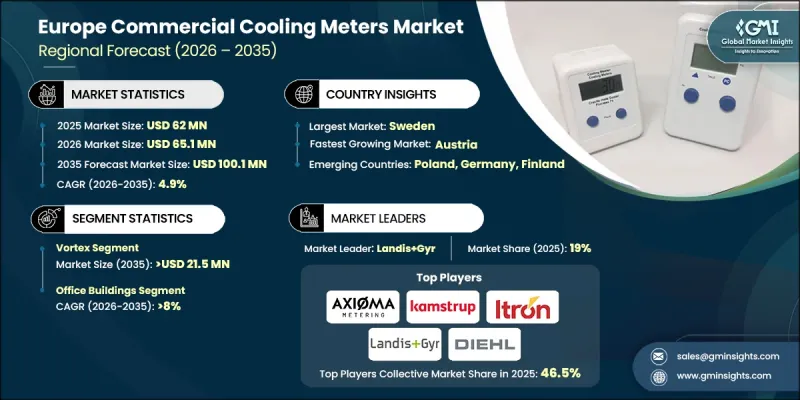
Europe Commercial Cooling Meters Market was valued at USD 62 million in 2025 and is estimated to grow at a CAGR of 4.9% to reach USD 100.1 million by 2035.
The market expansion is driven by the rising adoption of energy-efficient HVAC systems in commercial facilities and the increasing demand for accurate cooling energy measurement. Cooling meters monitor thermal energy by calculating the temperature difference between supply and return flows and the fluid volume circulating through the system. They enable fair billing in multi-tenant buildings by ensuring tenants pay for actual energy consumption. Integration with IoT platforms and building automation systems allows real-time analytics, predictive maintenance, and energy optimization. Compliance with international energy management standards like ISO 50001 also fuels market growth, as organizations upgrade cooling systems to enhance efficiency and track energy usage more effectively. The shift toward smart building technologies and digitized energy management is further strengthening demand for commercial cooling meters across offices, hotels, and retail facilities.
| Market Scope | |
|---|---|
| Start Year | 2025 |
| Forecast Year | 2026-2035 |
| Start Value | $62 Million |
| Forecast Value | $100.1 Million |
| CAGR | 4.9% |
The vortex meters segment is expected to reach USD 21.5 million by 2035 due to their reliability, precision, and ability to measure liquids, gases, and steam. These meters are increasingly adopted in commercial HVAC systems to monitor chilled water efficiency. Integration with smart energy systems reduces operational costs while improving performance, making vortex meters a preferred choice.
The office buildings segment is projected to grow at a CAGR of 8% through 2035, driven by high-precision meters that operate without moving parts, lowering maintenance costs while enabling better energy management. IoT-enabled meters and smart building deployment allow remote monitoring, real-time data access, and optimized energy consumption, boosting product penetration across commercial offices.
Germany Commercial Cooling Meters Market is projected to garner USD 5.2 million by 2035, supported by energy efficiency initiatives, regulatory mandates, and demand for smart building solutions. Implementation of the EU Energy Efficiency Directive (EED) encourages accurate and regular energy monitoring. New energy regulations push the adoption of energy-saving technologies, prompting facilities to replace traditional mechanical meters with ultrasonic solutions in large-scale energy management programs, further strengthening the market outlook.
Leading players operating in the Europe Commercial Cooling Meters Market include Schneider Electric, Siemens, Kamstrup, Apator S.A., Axioma Metering, BMETERS, Danfoss, Diehl Stiftung & Co. KG, ista Energy Solutions, Landis+Gyr, Meters UK Ltd., Micronics Ltd., Nordstrom Metering, Premier Control Technologies Ltd., QUNDIS GmbH, RB Flowmeter, Smartdhome Srl, Sontex, Vital Energi, and ZENNER International GmbH & Co. KG. Companies in the Europe Commercial Cooling Meters Market are employing multiple strategies to enhance their market presence and competitiveness. They are investing in research and development to improve meter accuracy, reliability, and integration with IoT platforms. Firms are expanding their presence in smart building and commercial energy management projects through partnerships and strategic collaborations. Adoption of advanced ultrasonic and vortex meter technologies, coupled with predictive maintenance capabilities, ensures higher operational efficiency for clients. Companies are also focusing on regulatory compliance, energy-saving certifications, and sustainable product innovations to differentiate themselves. Expanding service networks, enhancing customer support, and offering customized solutions for multi-tenant and commercial facilities further strengthen market foothold and long-term growth prospects.
Table of Contents
Chapter 1 Methodology & Scope
- 1.1 Research design
- 1.1.1 Research approach
- 1.1.2 Data collection methods
- 1.2 Base estimates and calculations
- 1.2.1 Base year calculation
- 1.2.2 Key trends for market estimates
- 1.3 Forecast model
- 1.3.1 Key trends for market estimates
- 1.3.1.1 Quantified market impact analysis
- 1.3.1.2 Mathematical impact of growth parameters on forecast
- 1.3.2 Scenario analysis framework
- 1.3.1 Key trends for market estimates
- 1.4 Primary research and validation
- 1.4.1 Some of the primary sources (but not limited to)
- 1.5 Data mining sources
- 1.5.1 Paid Sources
- 1.5.2 Sources, by region
- 1.6 Research trail & scoring components
- 1.6.1 Research trail components
- 1.6.2 Scoring components
- 1.7 Research transparency addendum
- 1.7.1 Source attribution framework
- 1.7.2 Quality assurance metrics
- 1.7.3 Our commitment to trust
- 1.8 Market definitions
Chapter 2 Executive Summary
- 2.1 Industry 360-degree synopsis, 2022 - 2035
- 2.2 Business trends
- 2.3 Product trends
- 2.4 Technology trends
- 2.5 Application trends
- 2.6 Country trends
Chapter 3 Industry Insights
- 3.1 Industry ecosystem
- 3.1.1 Raw material availability & sourcing analysis
- 3.1.2 Manufacturing capacity assessment
- 3.1.3 Supply chain resilience & risk factors
- 3.1.4 Distribution network analysis
- 3.2 Regulatory landscape
- 3.3 Industry impact forces
- 3.3.1 Growth drivers
- 3.3.2 Industry pitfalls & challenges
- 3.4 Growth potential analysis
- 3.5 Price trend analysis
- 3.6 Porter's analysis
- 3.6.1 Bargaining power of suppliers
- 3.6.2 Bargaining power of buyers
- 3.6.3 Threat of new entrants
- 3.6.4 Threat of substitutes
- 3.7 PESTEL analysis
- 3.7.1 Political factors
- 3.7.2 Economic factors
- 3.7.3 Social factors
- 3.7.4 Technological factors
- 3.7.5 Legal factors
- 3.7.6 Environmental factors
- 3.8 Emerging opportunities & trends
- 3.8.1 Digitalization & IoT integration
- 3.8.2 Emerging market penetration
- 3.9 Investment analysis and future outlook
Chapter 4 Competitive landscape, 2026
- 4.1 Introduction
- 4.2 Company market share, by country, 2025
- 4.2.1 Germany
- 4.2.2 Poland
- 4.2.3 Sweden
- 4.2.4 Italy
- 4.2.5 France
- 4.2.6 Finland
- 4.2.7 Austria
- 4.2.8 Norway
- 4.3 Strategic dashboard
- 4.4 Strategic initiatives
- 4.5 Innovation & technology landscape
Chapter 5 Market Size and Forecast, By Product, 2022 - 2035 (USD Million & ‘000 Units)
- 5.1 Key trends
- 5.2 Ultrasonic
- 5.3 Vortex
- 5.4 Others
Chapter 6 Market Size and Forecast, By Technology, 2022 - 2035 (USD Million & ‘000 Units)
- 6.1 Key trends
- 6.2 Mechanical
- 6.3 Static
Chapter 7 Market Size and Forecast, By Application, 2022 - 2035 (USD Million & ‘000 Units)
- 7.1 Key trends
- 7.2 College/University
- 7.3 Office Building
- 7.4 Government Building
- 7.5 Others
Chapter 8 Market Size and Forecast, By Country, 2022 - 2035 (USD Million & ‘000 Units)
- 8.1 Key trends
- 8.2 Germany
- 8.3 Poland
- 8.4 Sweden
- 8.5 Italy
- 8.6 France
- 8.7 Finland
- 8.8 Austria
- 8.9 Norway
Chapter 9 Company Profiles
- 9.1 Apator S.A.
- 9.2 Axioma Metering
- 9.3 BMETERS
- 9.4 Danfoss
- 9.5 Diehl Stiftung & Co. KG
- 9.6 ista Energy Solutions
- 9.7 Kamstrup
- 9.8 Landis+Gyr
- 9.9 Meters UK Ltd.
- 9.10 Micronics Ltd
- 9.11 Norstrom Metering
- 9.12 Premier Control Technologies Ltd.
- 9.13 QUNDIS GmbH
- 9.14 RB Flowmeter
- 9.15 Schneider Electric
- 9.16 Siemens
- 9.17 Smartdhome Srl
- 9.18 Sontex
- 9.19 Vital Energi
- 9.20 ZENNER International GmbH & Co. KG

