PUBLISHER: Global Market Insights Inc. | PRODUCT CODE: 1998754

PUBLISHER: Global Market Insights Inc. | PRODUCT CODE: 1998754
Cooling Meters Market Opportunity, Growth Drivers, Industry Trend Analysis, and Forecast 2026 - 2035
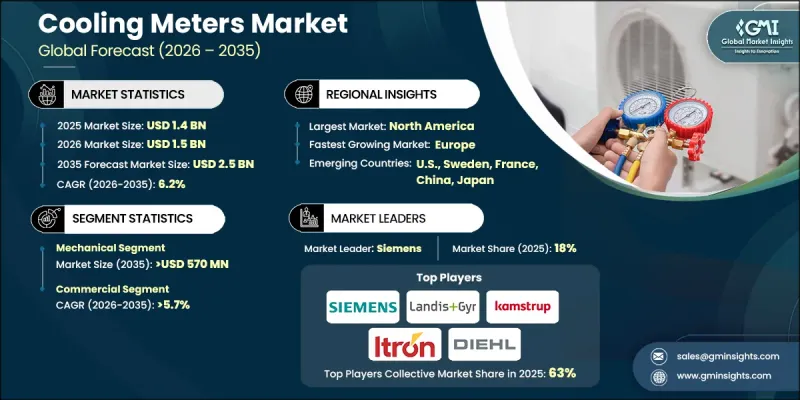
The Global Cooling Meters Market was valued at USD 1.4 billion in 2025 and is estimated to grow at a CAGR of 6.2% to reach USD 2.5 billion by 2035.
The market growth is driven by the increasing adoption of sustainable cooling solutions, rising environmental standards, and stricter regulatory mandates, encouraging the deployment of smart metering technologies that provide precise measurement of chilled water usage and transparent billing. Growing attention to operational efficiency is boosting adoption across commercial complexes, industrial facilities, and upgraded residential projects. Modernization of buildings and industries, along with the expansion of district cooling networks, has intensified the need for accurate metering solutions, further propelling market growth. Manufacturers are now focusing on reliable, low-maintenance, digitally enabled meters offering real-time monitoring, integration with building management systems, and data-driven analytics. These solutions help optimize system performance, reduce wastage, ensure fair cost allocation, and maintain consistent cooling delivery, making cooling meters a critical component in energy-efficient infrastructure worldwide.
| Market Scope | |
|---|---|
| Start Year | 2025 |
| Forecast Year | 2026-2035 |
| Start Value | $1.4 Billion |
| Forecast Value | $2.5 Billion |
| CAGR | 6.2% |
The mechanical cooling meters segment is projected to reach USD 570 million by 2035, supported by their cost-effectiveness, simple design, and precise measurement capabilities. These meters operate using direct mechanical technology to measure flow and temperature differentials, making them suitable for environments where high-end smart meters are less necessary. Mechanical meters are particularly favored in commercial and residential buildings targeting green certifications, including LEED compliance, thereby reinforcing market expansion.
The commercial segment is expected to grow at a CAGR of 5.7% through 2035, fueled by demand for energy management in office buildings, shopping centers, and hotels. Cooling meters deliver real-time energy data, enabling facility managers to perform regular audits, improve system efficiency, prevent overcooling, and identify operational improvements, strengthening the sector's adoption.
U.S. Cooling Meters Market is anticipated to reach USD 0.71 billion by 2035, driven by supportive government policies promoting sustainable building infrastructure. Incentives for energy-efficient solutions and programs supporting high-performance cooling technologies for commercial and industrial applications are accelerating adoption and innovation.
Prominent players in the Global Cooling Meters Market include Apator S.A., Axioma Metering, B Meters, Danfoss, Diehl Stiftung & Co. KG, Honeywell International Inc., Integra Metering, Itron Inc., ista Energy Solutions Limited, Kamstrup, Landis+Gyr, QUNDIS, RB Flowmeter, Schneider Electric, Secure Meters Ltd., Siemens, Smartdhome Srl, Sontex SA, Xylem, and ZENNER International GmbH & Co. KG. Companies in the Global Cooling Meters Market are focusing on strategies such as launching smart, IoT-enabled meters with real-time monitoring, integrating AI-driven analytics for predictive maintenance, expanding district cooling partnerships, offering low-maintenance and cost-effective mechanical meters, localizing production to strengthen supply chains, and investing in R&D to improve energy efficiency and accuracy. Additionally, collaborations with building management system providers and retrofitting solutions for existing infrastructures help establish long-term contracts and enhance market footprint in both mature and emerging regions, ensuring sustained growth and competitive advantage.
Table of Contents
Chapter 1 Methodology & Scope
- 1.1 Research Design
- 1.1.1 Research approach
- 1.1.2 Data collection methods
- 1.2 Base estimates and calculations
- 1.2.1 Base year calculation
- 1.2.2 Key trends for market estimates
- 1.3 Forecast model
- 1.3.1 Key trends for market estimates
- 1.3.1.1 Quantified market impact analysis
- 1.3.1.2 Mathematical impact of growth parameters on forecast
- 1.3.2 Scenario analysis framework
- 1.3.1 Key trends for market estimates
- 1.4 Primary research and validation
- 1.4.1 Some of the primary sources (but not limited to)
- 1.5 Data mining sources
- 1.5.1 Paid Sources
- 1.5.2 Sources, by region
- 1.6 Research trail & scoring components
- 1.6.1 Research trail components
- 1.6.2 Scoring components
- 1.7 Research transparency addendum
- 1.7.1 Source attribution framework
- 1.7.2 Quality assurance metrics
- 1.7.3 Our commitment to trust
- 1.8 Market definitions
Chapter 2 Executive Summary
- 2.1 Industry 360-degree synopsis, 2022 - 2035
- 2.2 Business trends
- 2.3 Product trends
- 2.4 Technology trends
- 2.5 Application trends
- 2.6 Regional trends
Chapter 3 Industry Insights
- 3.1 Industry ecosystem
- 3.1.1 Raw material availability & sourcing analysis
- 3.1.2 Manufacturing capacity assessment
- 3.1.3 Supply chain resilience & risk factors
- 3.1.4 Distribution network analysis
- 3.2 Regulatory landscape
- 3.3 Industry impact forces
- 3.3.1 Growth drivers
- 3.3.2 Industry pitfalls & challenges
- 3.4 Growth potential analysis
- 3.5 Porter's analysis
- 3.5.1 Bargaining power of suppliers
- 3.5.2 Bargaining power of buyers
- 3.5.3 Threat of new entrants
- 3.5.4 Threat of substitutes
- 3.6 PESTEL analysis
- 3.6.1 Political factors
- 3.6.2 Economic factors
- 3.6.3 Social factors
- 3.6.4 Technological factors
- 3.6.5 Legal factors
- 3.6.6 Environmental factors
- 3.7 Emerging opportunities & trends
- 3.7.1 Digitalization & IoT integration
- 3.7.2 Emerging market penetration
- 3.8 Investment analysis and future outlook
Chapter 4 Competitive landscape, 2026
- 4.1 Introduction
- 4.2 Company market share analysis, 2025
- 4.2.1 North America
- 4.2.2 Europe
- 4.2.3 Asia Pacific
- 4.2.4 Middle East
- 4.3 Strategic dashboard
- 4.4 Strategic initiatives
- 4.5 Innovation & technology landscape
Chapter 5 Market Size and Forecast, By Product, 2022 - 2035 (USD Million & ‘000 Units)
- 5.1 Key trends
- 5.2 Ultrasonic
- 5.3 Vortex
- 5.4 Others
Chapter 6 Market Size and Forecast, By Technology, 2022 - 2035 (USD Million & ‘000 Units)
- 6.1 Key trends
- 6.2 Mechanical
- 6.3 Static
Chapter 7 Market Size and Forecast, By Application, 2022 - 2035 (USD Million & ‘000 Units)
- 7.1 Key trends
- 7.2 Residential
- 7.3 Commercial
- 7.3.1 College/University
- 7.3.2 Office Building
- 7.3.3 Government Building
- 7.3.4 Others
- 7.4 Industrial
Chapter 8 Market Size and Forecast, By Region, 2022 - 2035 (USD Million & ‘000 Units)
- 8.1 Key trends
- 8.2 North America
- 8.2.1 U.S.
- 8.2.2 Canada
- 8.3 Europe
- 8.3.1 Germany
- 8.3.2 Poland
- 8.3.3 Sweden
- 8.3.4 Italy
- 8.3.5 France
- 8.4 Asia Pacific
- 8.4.1 China
- 8.4.2 Japan
- 8.4.3 South Korea
- 8.4.4 Singapore
- 8.4.5 India
- 8.5 Middle East
- 8.5.1 Saudi Arabia
- 8.5.2 UAE
- 8.5.3 Qatar
- 8.5.4 Oman
- 8.5.5 Kuwait
- 8.6 Rest of World
Chapter 9 Company Profiles
- 9.1 Apator S.A.
- 9.2 Axioma Metering
- 9.3 B Meters
- 9.4 Danfoss
- 9.5 Diehl Stiftung & Co. KG
- 9.6 Honeywell International Inc.
- 9.7 Integra Metering
- 9.8 Itron Inc.
- 9.9 ista Energy Solutions Limited
- 9.10 Kamstrup
- 9.11 Landis+Gyr
- 9.12 QUNDIS
- 9.13 RB Flowmeter
- 9.14 Schneider Electric
- 9.15 Secure Meters Ltd.
- 9.16 Siemens
- 9.17 Smartdhome Srl
- 9.18 Sontex SA
- 9.19 Xylem
- 9.20 ZENNER International GmbH & Co. KG

