PUBLISHER: Global Market Insights Inc. | PRODUCT CODE: 1998762

PUBLISHER: Global Market Insights Inc. | PRODUCT CODE: 1998762
Road Freight Services Market Opportunity, Growth Drivers, Industry Trend Analysis, and Forecast 2026 - 2035
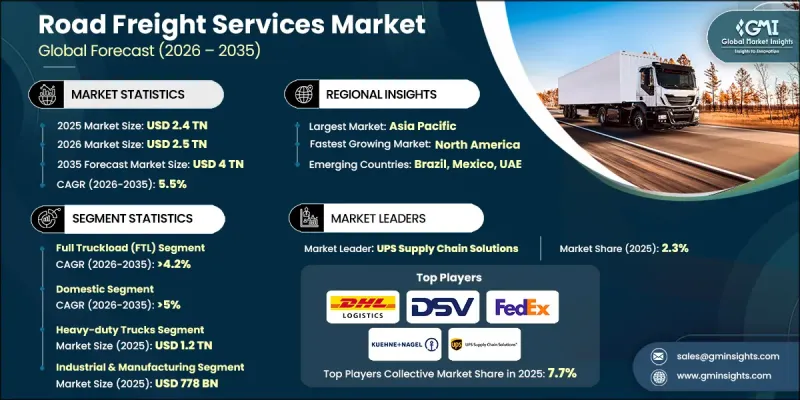
The Global Road Freight Services Market was valued at USD 2.4 trillion in 2025 and is estimated to grow at a CAGR of 5.5% to reach USD 4 trillion by 2035.
Road freight remains one of the most critical logistics modes for transporting goods across domestic and regional supply chains due to its flexibility, accessibility, and ability to support last-mile distribution. Expanding e-commerce penetration and the continuous development of urban centers are creating significant demand for reliable delivery solutions capable of handling high shipment volumes with faster turnaround times. Logistics companies and shippers are therefore investing heavily in advanced technologies, fleet modernization initiatives, and integrated transportation networks to improve service efficiency and reliability. Digital freight platforms, intelligent logistics management tools, and real-time tracking capabilities are helping companies optimize routes, reduce transit delays, and enhance operational visibility. In addition, the expansion of modern retail supply chains, manufacturing networks, and temperature-controlled logistics systems is strengthening demand for scalable road freight services that can support complex global distribution networks.
| Market Scope | |
|---|---|
| Start Year | 2025 |
| Forecast Year | 2026-2035 |
| Start Value | $2.4 Trillion |
| Forecast Value | $4 Trillion |
| CAGR | 5.5% |
Growing pressure on logistics providers to lower operational costs while meeting strict environmental and regulatory requirements is also transforming the road freight services market. Transportation companies are accelerating investments in digital logistics infrastructure, including AI-enabled route optimization systems and advanced fleet monitoring technologies. Sustainability initiatives are encouraging carriers to adopt cleaner vehicle technologies and energy-efficient operational practices. The freight ecosystem is evolving as digitalization, automation, and global supply chain restructuring reshape industry priorities. Companies are increasingly adopting flexible operating models that reduce asset ownership while improving operational agility. At the same time, dynamic pricing systems, multimodal logistics integration, and customer-focused service offerings are helping organizations respond quickly to changing market conditions. These developments are improving network efficiency, increasing transparency in freight operations, and supporting long-term value creation for industries such as retail distribution, manufacturing, healthcare logistics, infrastructure development, and automotive supply chains across global markets.
The full truckload segment accounted for 36% share and is expected to grow at a CAGR of 4.2% between 2026 and 2035. Full truckload transportation plays an essential role in large-volume cargo movement because it allows businesses to utilize an entire vehicle for a single shipment, ensuring faster transit and improved cargo security. As global trade volumes and e-commerce distribution networks continue to expand, businesses increasingly rely on dedicated freight capacity to move goods efficiently between distribution centers, manufacturing facilities, and retail networks. FTL solutions also help logistics providers maximize fleet utilization while supporting seamless integration with digital freight platforms and modern logistics management systems. The growing need for reliable high-capacity transportation across domestic and cross-border corridors is therefore expected to sustain strong demand for full truckload freight services worldwide.
The domestic transportation segment held 76% share, and is projected to grow at a CAGR of 5% from 2026 to 2035. Domestic freight movements remain a fundamental component of logistics networks because they support large volumes of intra-regional and inter-state shipments that connect production centers, warehouses, and consumer markets. The increasing demand for quick delivery services and efficient distribution networks is driving the adoption of advanced technologies such as AI-assisted route planning, telematics-based fleet management, and digital freight marketplaces. Domestic road freight operations benefit from well-established transportation infrastructure, shorter travel distances, and fewer regulatory complexities compared with international shipping routes. These advantages allow logistics companies to maintain predictable transit schedules and optimize fleet productivity, reinforcing the dominant role of domestic freight transportation in the overall road freight services market.
China Road Freight Services Market accounted 55% share, generating USD 507 billion in 2025. The country's leadership in the regional logistics sector is supported by its extensive manufacturing base, large domestic consumer market, and advanced supply chain infrastructure. High industrial output and large-scale vehicle production continue to generate strong demand for road transportation services across various industries. Logistics operators across major economic corridors are increasingly adopting advanced fleet management technologies and intelligent transportation systems to improve freight efficiency and operational performance. The rapid adoption of digital logistics platforms and connected vehicle technologies is enabling transportation companies to manage large freight networks more effectively. These technological advancements are supporting scalable logistics operations while improving real-time visibility, shipment tracking, and operational coordination across large distribution networks.
Major companies operating in the Global Road Freight Services Market include C.H. Robinson, DB Schenker, DHL Logistics, DSV, FedEx, Kuehne + Nagel, Nippon Express, Sinotrans, UPS Supply Chain Solutions, and XPO Logistics. Companies competing in the Global Road Freight Services Market are implementing multiple strategic initiatives to strengthen their competitive positions and expand their global logistics capabilities. Many organizations are investing heavily in digital freight platforms, advanced analytics systems, and AI-driven route optimization technologies to improve operational efficiency and reduce transportation costs. Strategic partnerships with e-commerce companies, manufacturers, and supply chain operators are helping logistics providers expand service networks and secure long-term shipping contracts. Firms are also modernizing vehicle fleets by introducing energy-efficient trucks and environmentally sustainable transport solutions to comply with regulatory standards. Additionally, companies are expanding cross-border logistics networks, strengthening warehouse and distribution infrastructure, and adopting flexible asset-light business models to improve scalability and responsiveness within the rapidly evolving global road freight services market.
Table of Contents
Chapter 1 Methodology & Scope
- 1.1 Research approach
- 1.2 Quality Commitments
- 1.2.1 GMI AI policy & data integrity commitment
- 1.3 Research Trail & Confidence Scoring
- 1.3.1 Research Trail Components
- 1.3.2 Scoring Components
- 1.4 Data Collection
- 1.4.1 Partial list of primary sources
- 1.5 Data mining sources
- 1.5.1 Paid sources
- 1.6 Base estimates and calculations
- 1.6.1 Base year calculation
- 1.7 Forecast model
- 1.8 Research transparency addendum
Chapter 2 Executive Summary
- 2.1 Industry 360° synopsis, 2022 - 2035
- 2.2 Key market trends
- 2.2.1 Regional
- 2.2.2 Service
- 2.2.3 Vehicle
- 2.2.4 Destination
- 2.2.5 End Use
- 2.3 TAM Analysis, 2026-2035
- 2.4 CXO perspectives: Strategic imperatives
- 2.4.1 Executive decision points
- 2.4.2 Critical success factors
- 2.5 Future outlook and strategic recommendations
Chapter 3 Industry Insights
- 3.1 Industry ecosystem analysis
- 3.1.1 Supplier Landscape
- 3.1.2 Profit Margin
- 3.1.3 Cost structure
- 3.1.4 Value addition at each stage
- 3.1.5 Factor affecting the value chain
- 3.1.6 Disruptions
- 3.2 Industry impact forces
- 3.2.1 Growth drivers
- 3.2.1.1 Electrification of Vehicles
- 3.2.1.2 Software-Defined Vehicle (SDV) Integration
- 3.2.1.3 Autonomous and ADAS-Enabled Fleets
- 3.2.1.4 Connectivity & High-Speed Networks
- 3.2.2 Industry pitfalls and challenges
- 3.2.2.1 High Implementation Costs
- 3.2.2.2 Regulatory & Cybersecurity Challenges
- 3.2.3 Market opportunities
- 3.2.3.1 Expansion of Intermodal & Express Freight Services
- 3.2.3.2 Emerging Markets’ Growth
- 3.2.3.3 Predictive & AI-Driven Fleet Management
- 3.2.3.4 Partnerships with OEMs & Technology Providers
- 3.2.1 Growth drivers
- 3.3 Growth potential analysis
- 3.4 Regulatory landscape
- 3.4.1 North America
- 3.4.1.1 U.S.: EPA, CARB, NHTSA Standards
- 3.4.1.2 Canada: Transport Canada, CMVSS Regulation
- 3.4.2 Europe
- 3.4.2.1 Germany: BMDV, Euro 6/7
- 3.4.2.2 France: Ministry of Transport, Euro 6/7
- 3.4.2.3 UK: Department for Transport, Euro 6/7
- 3.4.2.4 Italy: Ministry of Infrastructure & Transport
- 3.4.3 Asia Pacific
- 3.4.3.1 China: MIIT, China 6/7 Standards
- 3.4.3.2 Japan: MLIT, JIS Regulations
- 3.4.3.3 South Korea: MOLIT, KS Standards
- 3.4.3.4 India: MoRTH, BS6 Norms
- 3.4.4 Latin America
- 3.4.4.1 Brazil: DENATRAN, CONAMA Standards
- 3.4.4.2 Mexico: Ministry of Communications & Transport
- 3.4.5 Middle East and Africa
- 3.4.5.1 UAE: RTA, ESMA Regulations
- 3.4.5.2 Saudi Arabia: Ministry of Transport, SASO
- 3.4.1 North America
- 3.5 Porter's analysis
- 3.6 PESTEL analysis
- 3.7 Technology and Innovation Landscape
- 3.7.1 Current technological trends
- 3.7.2 Emerging technologies
- 3.8 Pricing Analysis (Driven by Primary Research)
- 3.8.1 Historical Price Trend Analysis
- 3.8.2 Pricing Strategy by Player Type
- 3.9 Cost breakdown analysis
- 3.10 Patent analysis (Driven by Primary Research)
- 3.11 Impact of Artificial Intelligence (AI)
- 3.11.1 AI-driven disruption of existing road freight services business models
- 3.11.2 Predictive maintenance & fleet vehicle system management AI
- 3.11.3 Automated road freight services route and load optimization
- 3.11.4 Supply chain AI for components, vehicle, and platform demand forecasting
- 3.11.5 GenAI use cases & adoption roadmap by segment
- 3.11.5.1 Centralized and zonal computing platform design generation
- 3.11.5.2 Vehicle performance, energy efficiency, and fleet utilization optimization
- 3.11.5.3 Customer service chatbots & technical support
- 3.11.5.4 Marketing and operational content creation
- 3.12 Sustainability and Environmental Aspects
- 3.12.1 Sustainable practices
- 3.12.2 Waste reduction strategies
- 3.12.3 Energy efficiency in production
- 3.12.4 Eco-friendly initiatives
- 3.12.5 Carbon footprint considerations
- 3.13 Use case scenarios
- 3.14 Forecast assumptions & scenario analysis (Driven by Primary Research)
- 3.14.1 Base Case - key macro & industry variables driving CAGR
- 3.14.2 Optimistic Scenarios - Favorable Macro and Industry Tailwinds
- 3.14.3 Pessimistic Scenario - Macroeconomic slowdown or industry headwinds
Chapter 4 Competitive Landscape, 2025
- 4.1 Introduction
- 4.2 Company market share analysis
- 4.2.1 North America
- 4.2.2 Europe
- 4.2.3 Asia Pacific
- 4.2.4 Latin America
- 4.2.5 Middle East & Africa
- 4.3 Competitive analysis of major market players
- 4.4 Competitive positioning matrix
- 4.5 Strategic outlook matrix
- 4.6 Key developments
- 4.6.1 Mergers & acquisitions
- 4.6.2 Partnerships & collaborations
- 4.6.3 New product launches
- 4.6.4 Expansion plans and funding
Chapter 5 Market Estimates & Forecast, By Service, 2022 - 2035 ($Bn)
- 5.1 Key trends
- 5.2 Full truckload (FTL)
- 5.2.1 Dedicated Full Truckload
- 5.2.2 Spot Market Full Truckload
- 5.3 Less-than-truckload (LTL)
- 5.3.1 Regional LTL
- 5.3.2 Long-Haul LTL
- 5.4 Express & parcel services
- 5.4.1 Same-Day Delivery
- 5.4.2 Next-Day Delivery
- 5.4.3 Standard Express
- 5.5 Dedicated contract carriage (DCC)
- 5.5.1 Long-Term Contract (3+ Years)
- 5.5.2 Short-Term Contract (Under 3 Years)
- 5.6 Intermodal transport
- 5.6.1 Road-Rail Intermodal
- 5.6.2 Road-Sea Intermodal
Chapter 6 Market Estimates & Forecast, By Vehicle, 2022 - 2035 ($Bn)
- 6.1 Key trends
- 6.2 Light commercial vehicles (LCVs)
- 6.2.1 Under 3.5 Tons GVW
- 6.3 Medium-duty trucks
- 6.3.1 3.5-7 Tons GVW
- 6.3.2 7-15 Tons GVW
- 6.4 Heavy-duty trucks
- 6.4.1 15-25 Tons GVW
- 6.4.2 Above 25 Tons GVW
Chapter 7 Market Estimates & Forecast, By Destination, 2022 - 2035 ($Bn)
- 7.1 Key trends
- 7.2 Domestic
- 7.3 International
Chapter 8 Market Estimates & Forecast, By End Use, 2022 - 2035 ($Bn)
- 8.1 Key trends
- 8.2 Industrial & manufacturing
- 8.3 Retail & E-commerce
- 8.4 Food & beverage
- 8.5 Automotive
- 8.6 Chemicals & hazardous materials
- 8.7 Pharmaceuticals & healthcare
Chapter 9 Market Estimates & Forecast, By Region, 2022 - 2035 ($Bn)
- 9.1 Key trends
- 9.2 North America
- 9.2.1 US
- 9.2.2 Canada
- 9.3 Europe
- 9.3.1 UK
- 9.3.2 Germany
- 9.3.3 France
- 9.3.4 Italy
- 9.3.5 Spain
- 9.3.6 Belgium
- 9.3.7 Netherlands
- 9.3.8 Sweden
- 9.4 Asia Pacific
- 9.4.1 China
- 9.4.2 India
- 9.4.3 Japan
- 9.4.4 Australia
- 9.4.5 Singapore
- 9.4.6 South Korea
- 9.4.7 Vietnam
- 9.4.8 Indonesia
- 9.5 Latin America
- 9.5.1 Brazil
- 9.5.2 Mexico
- 9.5.3 Argentina
- 9.6 MEA
- 9.6.1 UAE
- 9.6.2 South Africa
- 9.6.3 Saudi Arabia
Chapter 10 Company Profiles
- 10.1 Global Player
- 10.1.1 C.H. Robinson
- 10.1.2 DB Schenker
- 10.1.3 DHL Logistics
- 10.1.4 DSV
- 10.1.5 FedEx
- 10.1.6 Kuehne + Nagel
- 10.1.7 Nippon Express
- 10.1.8 Sinotrans
- 10.1.9 UPS Supply Chain Solutions
- 10.1.10 XPO Logistics
- 10.2 Regional Player
- 10.2.1 Agility Logistics
- 10.2.2 CEVA Logistics
- 10.2.3 Expeditors International
- 10.2.4 Geodis
- 10.2.5 Kintetsu World Express
- 10.2.6 Panther Logistics
- 10.2.7 Rhenus Logistics
- 10.2.8 Southeastern Freight Lines (SEFL)
- 10.2.9 Toll
- 10.2.10 Yusen Logistics

