
PUBLISHER: Global Market Insights Inc. | PRODUCT CODE: 1998837

PUBLISHER: Global Market Insights Inc. | PRODUCT CODE: 1998837
Insulin Market Opportunity, Growth Drivers, Industry Trend Analysis, and Forecast 2026 - 2035
The Global Insulin Market was valued at USD 29.2 billion in 2025 and is estimated to grow at a CAGR of 3.4% to reach USD 41.4 billion by 2035.
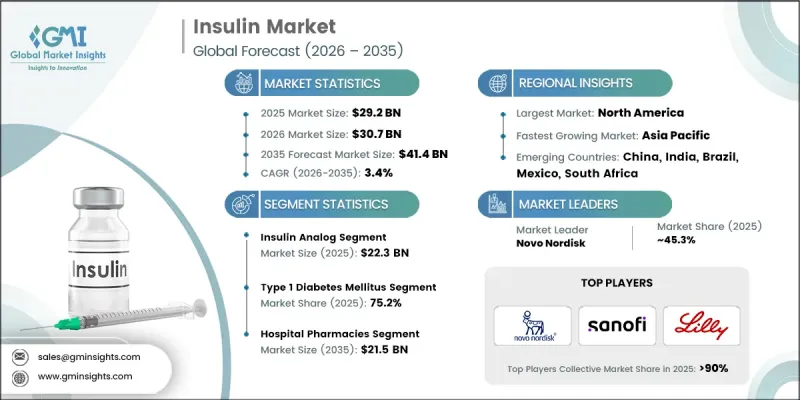
Growth across the insulin market is driven by the rising prevalence of diabetes worldwide, particularly type 2 diabetes, which is increasingly associated with sedentary lifestyles, increasing obesity levels, and an aging population. Additional factors such as poor dietary habits, higher caloric intake, genetic susceptibility, and lifestyle-related stress are also contributing to the growing incidence of the disease. Insulin is a naturally occurring hormone responsible for regulating glucose levels in the bloodstream. It is produced by specialized cells in the pancreas and released when blood sugar levels increase, enabling glucose to move into body cells where it is utilized for energy or stored for later use. When the body either fails to produce adequate insulin or cannot effectively respond to it, blood glucose levels rise, leading to diabetes. The insulin market includes multiple product categories such as rapid-acting, short-acting, intermediate-acting, long-acting, premixed insulin formulations, and biosimilar insulin products. The global market remains highly consolidated, with a limited number of multinational pharmaceutical companies accounting for a significant portion of production and technological development.
| Market Scope | |
|---|---|
| Start Year | 2025 |
| Forecast Year | 2026-2035 |
| Start Value | $29.2 Billion |
| Forecast Value | $41.4 Billion |
| CAGR | 3.4% |
The insulin analog segment reached USD 22.3 billion in 2025. Insulin analog products maintain a strong position in the market because they offer improved clinical outcomes, enhanced safety profiles, and greater treatment convenience compared with conventional human insulin formulations. These therapies are widely recognized for reducing the risk of severe blood sugar fluctuations and improving overall treatment adherence. Insulin analogs also provide greater dosing flexibility, allowing patients to manage therapy more conveniently. Their ease of administration and improved patient satisfaction contribute to their widespread adoption. In addition, certain long-acting analog formulations are associated with more stable treatment outcomes and reduced treatment-related complications, which further supports their demand.
The long-acting insulin segment held a 45.3% share in 2025. Long-acting insulin formulations are designed to release insulin gradually, maintaining a consistent baseline level in the bloodstream over an extended duration. Their slow activity is achieved through formulation mechanisms that allow gradual absorption after subcutaneous injection. Some long-acting insulin products can remain effective for extended periods, which reduces the frequency of injections required for patients. This extended action helps maintain stable glucose control while lowering the risk of sudden fluctuations in blood sugar levels. As a result, long-acting insulin therapies are widely adopted because they improve treatment adherence and provide more predictable blood glucose management.
North America Insulin Market generated 40.1% share in 2025. The region's leadership within the insulin industry is strongly supported by the significant prevalence of diabetes and the high demand for insulin therapy across the population. Many patients rely on insulin to manage their condition, resulting in strong and consistent product utilization across healthcare systems. The presence of advanced medical infrastructure, strong diagnostic capabilities, and broad access to modern insulin formulations and delivery technologies further reinforces North America's leading market position.
Key companies operating in the Global Insulin Market include Novo Nordisk, Sanofi, Eli Lilly and Company, Pfizer, Biocon, Boehringer Ingelheim International, Adocia, Gan & Lee Pharmaceuticals, MannKind Corporation, Shanghai Fosun Pharmaceutical, Tonghua Dongbao Pharmaceutical, United Laboratories International, Julphar, Gland Pharma, and Wockhardt. Companies participating in the Global Insulin Market are implementing a range of strategic initiatives to strengthen their market position and maintain a competitive advantage. Major pharmaceutical firms are investing heavily in research and development to introduce advanced insulin formulations that offer improved efficacy, longer duration of action, and enhanced patient convenience. Strategic partnerships and licensing agreements with biotechnology firms are also helping companies accelerate innovation and expand product pipelines. Many manufacturers are focusing on the development of biosimilar insulin products to improve affordability and increase market penetration across emerging economies. In addition, firms are strengthening global distribution networks and expanding manufacturing capabilities to meet growing demand.
Table of Contents
Chapter 1 Methodology and Scope
- 1.1 Market scope and definition
- 1.2 Research approach
- 1.3 Quality commitments
- 1.3.1 GMI AI policy and data integrity commitment
- 1.3.1.1 Source consistency protocol
- 1.3.1 GMI AI policy and data integrity commitment
- 1.4 Research trail and confidence scoring
- 1.4.1 Research trail components
- 1.4.2 Scoring components
- 1.5 Data collection
- 1.5.1 Partial list of primary sources
- 1.6 Data mining sources
- 1.6.1 Paid sources
- 1.6.1.1 Sources, by region
- 1.6.1 Paid sources
- 1.7 Base estimates and calculations
- 1.7.1 Revenue share analysis
- 1.7.2 Base year calculation
- 1.8 Forecast model
- 1.9 Research transparency addendum
- 1.9.1 Source attribution framework
- 1.9.2 Quality assurance metrics
- 1.9.3 Our commitment to trust
Chapter 2 Executive Summary
- 2.1 Industry 360° synopsis
- 2.2 Key market trends
- 2.2.1 Regional trends
- 2.2.2 Type trends
- 2.2.3 Product type trends
- 2.2.4 Application trends
- 2.2.5 Distribution channel trends
- 2.3 CXO perspectives: Strategic imperatives
Chapter 3 Industry Insights
- 3.1 Industry ecosystem analysis
- 3.2 Industry impact forces
- 3.2.1 Growth drivers
- 3.2.1.1 Increasing prevalence of diabetes
- 3.2.1.2 Advancements in insulin delivery systems
- 3.2.1.3 Government initiatives and policies
- 3.2.2 Industry pitfalls and challenges
- 3.2.2.1 High cost of insulin
- 3.2.2.2 Availability of alternative therapies
- 3.2.3 Market opportunities
- 3.2.3.1 Focus on pediatric diabetes
- 3.2.3.2 Expansion of biosimilar insulin products
- 3.2.1 Growth drivers
- 3.3 Growth potential analysis
- 3.4 Regulatory landscape (Driven by primary research)
- 3.4.1 North America
- 3.4.1.1 U.S.
- 3.4.1.2 Canada
- 3.4.2 Europe
- 3.4.3 Asia Pacific
- 3.4.1 North America
- 3.5 Pricing analysis (Driven by primary research)
- 3.6 Pipeline analysis (Driven by primary research)
- 3.7 Diabetes landscape
- 3.7.1 Number of diabetics worldwide, by region
- 3.7.2 Countries with the highest number of diabetics worldwide in 2024
- 3.7.3 Countries with the highest prevalence of diabetes worldwide in 2024
- 3.7.4 Estimated number of diabetics worldwide in 2024 and a forecast for 2050
- 3.7.5 Countries with the highest projected number of diabetics worldwide in 2050
- 3.7.6 Top 10 countries based on diabetes health expenditure
- 3.7.7 Global undiagnosed diabetes cases, by region
- 3.7.8 Percentage of diabetics undiagnosed, by regions
- 3.8 Impact of AI and generative AI on the market
- 3.9 Porter's analysis
- 3.10 PESTEL analysis
Chapter 4 Competitive Landscape, 2025
- 4.1 Introduction
- 4.2 Company market share analysis
- 4.2.1 North America
- 4.2.2 Europe
- 4.2.3 Asia Pacific
- 4.3 Company matrix analysis
- 4.4 Competitive analysis of major market players
- 4.5 Competitive positioning matrix
- 4.6 Key developments
- 4.6.1 Merger and acquisition
- 4.6.2 Partnership and collaboration
- 4.6.3 New product launches
- 4.6.4 Expansion plans
Chapter 5 Market Estimates and Forecast, By Type, 2022 - 2035 ($ Mn)
- 5.1 Key trends
- 5.2 Human insulin
- 5.3 Insulin analog
Chapter 6 Market Estimates and Forecast, By Product, 2022 - 2035 ($ Mn)
- 6.1 Key trends
- 6.2 Rapid-acting insulin
- 6.3 Long-acting insulin
- 6.4 Combination insulin
- 6.5 Biosimilar
- 6.6 Other products
Chapter 7 Market Estimates and Forecast, By Application, 2022 - 2035 ($ Mn)
- 7.1 Key trends
- 7.2 Type 1 diabetes mellitus
- 7.3 Type 2 diabetes mellitus
- 7.4 Gestational diabetes
Chapter 8 Market Estimates and Forecast, By Distribution Channel, 2022 - 2035 ($ Mn)
- 8.1 Key trends
- 8.2 Hospital pharmacies
- 8.3 Retail pharmacies
- 8.4 Online pharmacies
Chapter 9 Market Estimates and Forecast, By Region, 2022 - 2035 ($ Mn)
- 9.1 Key trends
- 9.2 North America
- 9.2.1 U.S.
- 9.2.2 Canada
- 9.3 Europe
- 9.3.1 Germany
- 9.3.2 UK
- 9.3.3 France
- 9.3.4 Italy
- 9.3.5 Spain
- 9.3.6 Netherlands
- 9.4 Asia Pacific
- 9.4.1 China
- 9.4.2 Japan
- 9.4.3 India
- 9.4.4 Australia
- 9.4.5 South Korea
- 9.5 Latin America
- 9.5.1 Brazil
- 9.5.2 Mexico
- 9.5.3 Argentina
- 9.6 Middle East and Africa
- 9.6.1 South Africa
- 9.6.2 Saudi Arabia
- 9.6.3 UAE
Chapter 10 Company Profiles
- 10.1 Adocia
- 10.2 Biocon
- 10.3 Boehringer Ingelheim International
- 10.4 Eli Lilly and Company
- 10.5 Gan & Lee Pharmaceuticals
- 10.6 Gland Pharma
- 10.7 Julphar
- 10.8 MannKind Corporation
- 10.9 Novo Nordisk
- 10.10 Pfizer
- 10.11 Sanofi
- 10.12 Shanghai Fosun Pharmaceutical
- 10.13 Tonghua Dongbao Pharmaceutical
- 10.14 United Laboratories International
- 10.15 Wockhardt

