PUBLISHER: Global Market Insights Inc. | PRODUCT CODE: 2038782

PUBLISHER: Global Market Insights Inc. | PRODUCT CODE: 2038782
Baby Doll Market Opportunity, Growth Drivers, Industry Trend Analysis, and Forecast 2026 - 2035
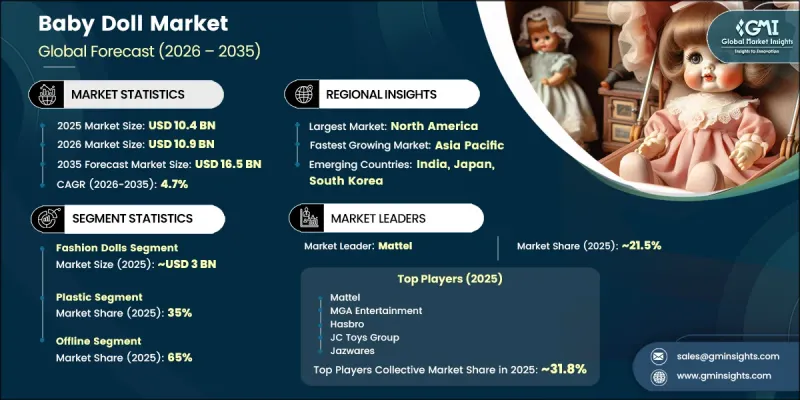
The Global Baby Doll Market was valued at USD 10.4 billion in 2025 and is estimated to grow at a CAGR of 4.7% to reach USD 16.5 billion by 2035.
The baby doll industry continues to evolve as rising disposable income levels encourage higher spending on children's products that support emotional growth and creative play. Increasing urbanization and the expansion of dual-income households are driving demand for high-quality and branded toys, as consumers prioritize value, safety, and developmental benefits. Baby dolls remain a preferred choice for encouraging nurturing behavior and social interaction among children, sustaining their long-term relevance in the global toy market. At the same time, manufacturers are continuously enhancing product offerings by integrating advanced features that improve engagement and realism. The growing availability of diverse product ranges across retail and online platforms is further supporting accessibility and consumer reach. Technological enhancements, combined with evolving consumer expectations for interactive and educational toys, are accelerating innovation and strengthening the overall growth trajectory of the baby doll market.
| Market Scope | |
|---|---|
| Start Year | 2025 |
| Forecast Year | 2026-2035 |
| Start Value | $10.4 Billion |
| Forecast Value | $16.5 Billion |
| CAGR | 4.7% |
The fashion dolls segment generated USD 3 billion in 2025 and is expected to grow at a CAGR of 3.3% from 2026 to 2035. This segment maintains a strong market position due to its visual appeal, creativity-driven play value, and consistent product refresh cycles. Continuous introduction of new designs and themed variations encourages repeat purchases and sustained consumer interest.
The plastic segment accounted for 35% share in 2025 and is projected to grow at a CAGR of 2.5% during 2026-2035. Its dominance is supported by durability, cost-effectiveness, and versatility in design. Plastic enables manufacturers to produce detailed and lightweight products that withstand frequent use while offering a wide range of aesthetic options across multiple price segments.
U.S. Baby Doll Market was valued at USD 3 billion in 2025 and is anticipated to grow at a CAGR of 3.2% between 2026 and 2035. Market expansion is supported by increasing demand for toys that combine engagement with developmental value. Consumer preferences are shifting toward products that encourage interactive learning and emotional connection, further strengthening adoption across households.
Key companies operating in the Global Baby Doll Industry include Adora Dolls, Ashton-Drake Galleries, Battat (Our Generation/Lullababy), Bayer Design Fritz Bayer, Corolle, Gotz Puppenmanufaktur, Hasbro, Jazwares, JC Toys Group, Kathe Kruse, Madame Alexander, Mattel, Melissa & Doug, MGA Entertainment, and Paradise Galleries. Companies in the Global Baby Doll Market are reinforcing their market position by focusing on continuous product innovation, enhanced interactivity, and improved design realism. Many manufacturers are incorporating advanced features to increase engagement and deliver greater play value. Strategic expansion across digital retail channels is helping companies reach broader consumer bases and improve accessibility. Firms are also investing in product diversification to cater to varying price segments and evolving consumer preferences. Strengthening brand identity through creative product lines and consistent launches is supporting repeat purchases.
Table of Contents
Chapter 1 Methodology & Scope
- 1.1 Market scope and definition
- 1.2 Research design
- 1.2.1 Research approach
- 1.2.2 Data collection methods
- 1.3 Data mining sources
- 1.3.1 Global
- 1.3.2 Regional/Country
- 1.4 Base estimates and calculations
- 1.4.1 Base year calculation
- 1.4.2 Key trends for market estimation
- 1.5 Primary research and validation
- 1.5.1 Primary sources
- 1.6 Forecast model
- 1.7 Research assumptions and limitations
Chapter 2 Executive Summary
- 2.1 Industry 360° synopsis
- 2.2 Key market trends
- 2.2.1 Regional
- 2.2.2 Product Type
- 2.2.3 Material
- 2.2.4 Price Range
- 2.2.5 Distribution channel
Chapter 3 Industry Insights
- 3.1 Industry ecosystem analysis
- 3.1.1 Supplier landscape
- 3.1.2 Profit margin
- 3.1.3 Value addition at each stage
- 3.1.4 Factor affecting the value chain
- 3.2 Industry impact forces
- 3.2.1 Growth drivers
- 3.2.1.1 Rising disposable income and spending on children's products
- 3.2.1.2 Product innovation in interactive and realistic baby dolls
- 3.2.1.3 Strong influence of media, entertainment, and branding on toy preferences
- 3.2.2 Pitfalls & Challenges
- 3.2.2.1 Competition from digital entertainment and electronic devices
- 3.2.2.2 Price sensitivity in mass-market consumer segments
- 3.2.3 Opportunities
- 3.2.3.1 Rising demand for inclusive and diverse doll representations
- 3.2.3.2 Growth of eco-friendly and sustainable toy materials
- 3.2.1 Growth drivers
- 3.3 Growth potential analysis
- 3.4 Future market trends
- 3.5 Technology and innovation landscape
- 3.5.1 Current technological trends
- 3.5.2 Emerging technologies
- 3.6 Regulatory landscape
- 3.6.1 Standards and compliance requirements
- 3.6.2 Regional regulatory frameworks
- 3.6.3 Certification standards
- 3.7 Porter's analysis
- 3.8 PESTEL analysis
- 3.9 Pricing analysis (driven by primary research)
- 3.9.1 Historical price trend analysis (driven by primary research)
- 3.9.2 Pricing strategy by player type (premium / value / cost-plus) (driven by primary research)
- 3.9.3 Price elasticity of demand
- 3.9.4 Regional price variations
- 3.10 Trade data analysis (HS Code- 9503) (driven by paid data base)
- 3.10.1 Import/export volume and value trends (driven by paid data base)
- 3.10.2 Key trade corridors and tariff impact (driven by paid data base)
- 3.10.3 Top exporting countries
- 3.10.4 Top importing countries
- 3.11 Distribution infrastructure and channel penetration landscape (driven by primary research)
- 3.11.1 Channel coverage by region and format (modern vs. traditional trade) (driven by primary research)
- 3.11.2 Last-mile infrastructure gaps and emerging channel shifts (driven by primary research)
- 3.11.3 Omnichannel retail maturity by region
Chapter 4 Competitive Landscape, 2025
- 4.1 Introduction
- 4.2 Company market share analysis
- 4.2.1 By Region
- 4.2.1.1 North America
- 4.2.1.2 Europe
- 4.2.1.3 Asia Pacific
- 4.2.1.4 Latin America
- 4.2.1.5 Middle East & Africa
- 4.2.1 By Region
- 4.3 Company matrix analysis
- 4.4 Competitive analysis of major market players
- 4.5 Competitive positioning matrix
- 4.6 Key developments
- 4.6.1 Mergers & acquisitions
- 4.6.2 Partnerships & collaborations
- 4.6.3 New product launches
- 4.6.4 Expansion plans
Chapter 5 Market Estimates & Forecast, By Product Type, 2022 - 2035, (USD Billion) (Thousand Units)
- 5.1 Key trends
- 5.2 Traditional Dolls
- 5.3 Interactive Dolls
- 5.4 Fashion Dolls
- 5.5 Realistic/Reborn Dolls
- 5.6 Soft/Plush Dolls
- 5.7 Educational Dolls
- 5.8 Others
Chapter 6 Market Estimates & Forecast, By Material, 2022 - 2035, (USD Billion) (Thousand Units)
- 6.1 Key trends
- 6.2 Plastic
- 6.3 Vinyl
- 6.4 Cloth/Fabric
- 6.5 Silicone
- 6.6 Porcelain
- 6.7 Others
Chapter 7 Market Estimates & Forecast, By Price Range, 2022 - 2035, (USD Billion) (Thousand Units)
- 7.1 Key trends
- 7.2 Low
- 7.3 Medium
- 7.4 High
Chapter 8 Market Estimates & Forecast, By Distribution Channel, 2022 - 2035, (USD Billion) (Thousand Units)
- 8.1 Key trends
- 8.2 Online
- 8.2.1 E-commerce Platforms
- 8.2.2 Company Websites (DTC)
- 8.3 Offline
- 8.3.1 Specialty Toy Stores
- 8.3.2 Hypermarkets & Supermarkets
- 8.3.3 Department Stores
- 8.3.4 Others
Chapter 9 Market Estimates & Forecast, By Region, 2022 - 2035, (USD Billion) (Thousand Units)
- 9.1 Key trends
- 9.2 North America
- 9.2.1 U.S.
- 9.2.2 Canada
- 9.3 Europe
- 9.3.1 Germany
- 9.3.2 UK
- 9.3.3 France
- 9.3.4 Italy
- 9.3.5 Spain
- 9.4 Asia Pacific
- 9.4.1 China
- 9.4.2 India
- 9.4.3 Japan
- 9.4.4 South Korea
- 9.4.5 Australia
- 9.5 Latin America
- 9.5.1 Brazil
- 9.5.2 Mexico
- 9.5.3 Argentina
- 9.6 MEA
- 9.6.1 Saudi Arabia
- 9.6.2 UAE
- 9.6.3 South Africa
Chapter 10 Company Profiles
- 10.1 Adora Dolls
- 10.2 Ashton-Drake Galleries
- 10.3 Battat (Our Generation/Lullababy)
- 10.4 Bayer Design Fritz Bayer
- 10.5 Corolle
- 10.6 Gotz Puppenmanufaktur
- 10.7 Hasbro
- 10.8 Jazwares
- 10.9 JC Toys Group
- 10.10 Kathe Kruse
- 10.11 Madame Alexander
- 10.12 Mattel
- 10.13 Melissa & Doug
- 10.14 MGA Entertainment
- 10.15 Paradise Galleries

