PUBLISHER: Global Market Insights Inc. | PRODUCT CODE: 2045660

PUBLISHER: Global Market Insights Inc. | PRODUCT CODE: 2045660
Europe Luxury Furniture Market Opportunity, Growth Drivers, Industry Trend Analysis, and Forecast 2026 - 2035
Europe Luxury Furniture Market was valued at USD 9.8 billion in 2025 and is estimated to grow at a CAGR of 4.1% to reach USD 14.8 billion by 2035.
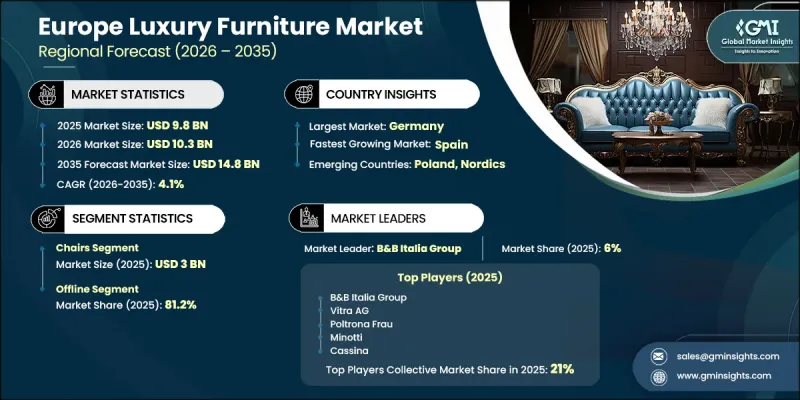
Rising concentrations of high-net-worth individuals across major European economies continue to accelerate demand for premium and ultra-luxury furniture collections. Affluent consumers increasingly seek customized, heritage-inspired, and handcrafted furnishings that reflect exclusivity, sophistication, and personal identity. Since buyers in this category place greater importance on quality, rarity, and design excellence than on price, manufacturers can maintain strong premium margins. Generational wealth transfers are also reshaping purchasing behavior, driving demand for products that merge classic luxury aesthetics with modern design preferences. As a result, luxury furniture brands are strengthening investments in bespoke production, artisanal partnerships, limited-edition collections, and personalized customer experiences to reinforce long-term brand positioning across the Europe luxury furniture market. In addition, ongoing expansion in luxury real estate developments and upscale hospitality projects continues to create stable demand for high-end furnishings. Premium hotels, branded residential projects, and mixed-use developments consistently require sophisticated furniture solutions that align with curated interior concepts and international design standards. These long-term projects provide recurring revenue opportunities while also helping furniture manufacturers strengthen collaborations with architects, developers, and interior designers to support future innovation and visibility.
| Market Scope | |
|---|---|
| Start Year | 2025 |
| Forecast Year | 2026-2035 |
| Start Value | $9.8 Billion |
| Forecast Value | $14.8 Billion |
| CAGR | 4.1% |
In 2025, the chairs segment accounted for USD 3 billion. Chairs continue to lead product demand because of their broad functionality, strong visual appeal, and shorter replacement cycles compared to larger furniture categories. Within residential, hospitality, and premium commercial environments, luxury chairs serve as both practical seating solutions and statement design pieces. Their comparatively accessible price positioning encourages consumers to explore designer collections, artistic craftsmanship, and unique material combinations. Demand for luxury chairs is also supported by their strong presence across dining spaces, lounges, office interiors, and hospitality environments. Furniture designers frequently use chairs to introduce new concepts in ergonomics, structure, sustainability, and material innovation, thereby maintaining consumer interest throughout the region.
The residential application segment represented the largest share in 2025. Strong consumer preference for elevated living environments and personalized home interiors has continued to drive demand across the region. Consumers increasingly consider luxury furniture a long-term lifestyle investment that improves comfort, enhances interior appeal, and contributes to overall property value. Higher disposable incomes across several Western European countries have further supported spending on premium sofas, custom dining furniture, luxury bedroom sets, and personalized interior solutions tailored to modern lifestyles.
Germany Luxury Furniture Market held a 22% share in 2025 and is forecast to grow at a CAGR of 3.6% during 2026-2035. The country continues to maintain a leading position due to its advanced manufacturing infrastructure, long-standing furniture design heritage, and stable domestic demand for premium furnishings. Germany hosts several internationally recognized luxury furniture manufacturers known for engineering precision, exceptional material quality, and refined functional aesthetics. Consumers across the country consistently demonstrate strong appreciation for durability, craftsmanship, and premium product standards, supporting sustained growth across both residential and commercial applications. Furthermore, Germany's established real estate sector and sophisticated hospitality industry continue to create recurring opportunities for luxury interior products. Access to highly skilled labor, technological manufacturing capabilities, and an innovation-focused design culture further strengthens the country's competitive advantage within the Europe luxury furniture industry.
Key companies operating in the Europe Luxury Furniture Market include B&B Italia, Cassina, Walter Knoll, Poltrona Frau, Vitra, Fritz Hansen, and Knoll among global participants. Prominent regional brands include COR, Flexform, Minotti, Giorgetti, Cappellini, Rolf Benz, and Kettal. Emerging companies shaping the competitive landscape include Muuto, Gubi, Ligne Roset, Hem, & Tradition, Arper, and Established & Sons. Companies operating in the Europe Luxury Furniture Market are focusing on multiple strategic initiatives to strengthen brand visibility, expand customer reach, and improve competitive positioning. Leading manufacturers are increasing investments in bespoke furniture solutions, limited-edition collections, and premium customization services to attract affluent consumers seeking exclusivity and personalization. Many brands are also collaborating with architects, interior designers, and luxury real estate developers to secure long-term commercial projects and improve brand exposure. Sustainability has become a major focus area, encouraging companies to adopt eco-friendly materials, responsible sourcing practices, and energy-efficient production methods.
Table of Contents
Chapter 1 Methodology and Scope
- 1.1 Research approach
- 1.2 Quality Commitments
- 1.2.1 GMI AI policy & data integrity commitment
- 1.2.1.1 Source consistency protocol
- 1.2.1 GMI AI policy & data integrity commitment
- 1.3 Research Trail & Confidence Scoring
- 1.3.1 Research Trail Components
- 1.3.2 Scoring Components
- 1.4 Data Collection
- 1.4.1 Partial list of primary sources
- 1.5 Data mining sources
- 1.5.1 Paid sources
- 1.5.1.1 Sources, by region
- 1.5.1 Paid sources
- 1.6 Base estimates and calculations
- 1.6.1 Base year calculation for any one approach
- 1.7 Forecast model
- 1.7.1 Quantified market impact analysis
- 1.7.1.1 Mathematical impact of growth parameters on forecast
- 1.7.1 Quantified market impact analysis
- 1.8 Research transparency addendum
- 1.8.1 Source attribution framework
- 1.8.2 Quality assurance metrics
- 1.8.3 Our commitment to trust
Chapter 2 Executive Summary
- 2.1 Industry 360° synopsis
- 2.2 Key market trends
- 2.2.1 Regional
- 2.2.2 Product type
- 2.2.3 Material
- 2.2.4 Price range
- 2.2.5 Application
- 2.2.6 Distribution channel
Chapter 3 Industry Insights
- 3.1 Industry ecosystem analysis
- 3.1.1 Supplier landscape
- 3.1.2 Manufacturer/designer tier
- 3.1.3 Distribution & retail layer
- 3.1.4 End-user segment
- 3.1.5 Profit margin analysis by value chain stage
- 3.1.6 Value addition at each stage
- 3.1.7 Factors affecting the value chain
- 3.2 Impact forces
- 3.2.1 Growth drivers
- 3.2.1.1 HNWI wealth expansion & ultra-luxury demand
- 3.2.1.2 Luxury hospitality & premium real estate growth
- 3.2.1.3 Digital & omnichannel retail expansion
- 3.2.2 Industry pitfalls & challenges
- 3.2.2.1 Macroeconomic uncertainty & recessionary risk
- 3.2.2.2 Raw material cost inflation (timber, metals, textiles)
- 3.2.3 Opportunities
- 3.2.3.1 Growing demand for customizable sustainable luxury furniture
- 3.2.3.2 Expansion through luxury hospitality and residential projects
- 3.2.1 Growth drivers
- 3.3 Technology & innovation landscape
- 3.4 Growth potential analysis
- 3.5 Regulatory framework
- 3.5.1 European furniture regulations (REACH, CLP, EN Standards)
- 3.5.2 North American regulations (CARB, TB117, TSCA)
- 3.5.3 Sustainability & circular economy directives
- 3.5.4 Import/Export compliance & tariff structures
- 3.6 Pricing analysis (driven by primary research)
- 3.6.1 Historical price trend analysis
- 3.6.2 Price elasticity of demand in luxury segment
- 3.6.3 Currency fluctuation impact on import pricing
- 3.6.4 Average pricing by product sub-segment
- 3.7 Porter's analysis
- 3.8 PESTEL analysis
- 3.9 Trade data analysis (HS Code: 9401-Seats, 9403-Furniture) (driven by paid database)
- 3.9.1 Import/export volume & value trends
- 3.9.2 Key trade corridors & tariff impact
- 3.9.3 Major exporting & importing countries
- 3.9.4 Trade flow analysis by region
- 3.9.5 Intra-European trade dynamics
- 3.10 Impact of AI & generative AI on the market
- 3.10.1 AI-driven disruption of existing business models
- 3.10.2 GenAI use cases & adoption roadmap by segment
- 3.10.3 Personalized design & customization engines
- 3.10.4 AI-powered interior design consultation
- 3.10.5 Predictive demand analytics & inventory management
- 3.10.6 Virtual showrooms & immersive shopping experiences
- 3.10.7 Risks, limitations & regulatory considerations
- 3.11 Distribution infrastructure & channel penetration landscape (driven by primary research)
- 3.11.1 Channel coverage by region & format (flagship/specialty/online)
- 3.11.2 Last-mile infrastructure gaps & emerging channel shifts
- 3.12 Consumer buying behavior analysis
- 3.12.1 Purchasing patterns
- 3.12.2 Preference analysis
- 3.12.3 Regional variations in consumer behavior
- 3.12.4 Impact of e-commerce on buying decisions
- 3.12.5 Influence of sustainability on purchase decisions
Chapter 4 Competitive Landscape, 2025
- 4.1 Introduction
- 4.2 Company market share analysis
- 4.3 Company market share analysis
- 4.4 Competitive analysis of major market players
- 4.5 Competitive positioning matrix
- 4.6 Key developments
- 4.6.1 Mergers & acquisitions
- 4.6.2 Partnerships & collaborations
- 4.6.3 New product launches
- 4.6.4 Expansion plans
Chapter 5 Market Estimates and Forecast, By Product Type, 2022 - 2035 (USD Billion) (Thousand Units)
- 5.1 Key trends
- 5.2 Tables
- 5.2.1 Dining Tables
- 5.2.2 Coffee Tables
- 5.2.3 Side & Console Tables
- 5.2.4 Desks
- 5.3 Chairs
- 5.3.1 Dining Chairs
- 5.3.2 Side Chairs
- 5.3.3 Others
- 5.4 Sofas & lounges
- 5.4.1 Sofas
- 5.4.1.1 Two-seater sofas
- 5.4.1.2 Three-seater sofas
- 5.4.1.3 Modular sofas
- 5.4.1.4 Sectional/landscape sofas
- 5.4.1.5 Sofa beds & convertibles
- 5.4.2 Lounge chairs
- 5.4.2.1 Armchairs/Lounge chairs
- 5.4.2.2 Recliners
- 5.4.2.3 Chaise longues
- 5.4.2.4 Ottomans & poufs
- 5.4.1 Sofas
- 5.5 Beds & Bedroom Furniture
- 5.5.1 Beds
- 5.5.2 Nightstands
- 5.5.3 Dressers & Wardrobes
- 5.6 Storage & Cabinets
- 5.6.1 Bookcases
- 5.6.2 Sideboards
- 5.6.3 Modular Storage Systems
- 5.7 Lighting
- 5.7.1 Pendant & Ceiling Lamps
- 5.7.2 Table & Floor Lamps
- 5.7.3 Wall Lamps
- 5.8 Others
Chapter 6 Market Estimates and Forecast, By Material, 2022 - 2035 (USD Billion) (Thousand Units)
- 6.1 Key trends
- 6.2 Wood
- 6.3 Metal
- 6.4 Upholstery
- 6.5 Glass & crystal
- 6.6 Composite & others
Chapter 7 Market Estimates and Forecast, By Price Range, 2022 - 2035 (USD Billion) (Thousand Units)
- 7.1 Key trends
- 7.2 Ultra-luxury (>$10,000 per piece)
- 7.3 Premium luxury ($5,000-$10,000 per piece)
- 7.4 Accessible luxury ($2,000-$5,000 per piece)
Chapter 8 Market Estimates and Forecast, By Application, 2022 - 2035 (USD Billion) (Thousand Units)
- 8.1 Key trends
- 8.2 Residential
- 8.3 Commercial
- 8.3.1 Hospitality
- 8.3.1.1 Hotels & resorts
- 8.3.1.2 Restaurants & cafes
- 8.3.2 Corporate offices
- 8.3.3 Healthcare & Senior Living
- 8.3.4 Airports & Public Spaces
- 8.3.5 Others
- 8.3.1 Hospitality
Chapter 9 Market Estimates and Forecast, By Distribution Channel, 2022 - 2035 (USD Billion) (Thousand Units)
- 9.1 Key trends
- 9.2 Online channels
- 9.2.1 E-commerce
- 9.2.2 Company websites
- 9.3 Offline channels
- 9.3.1 Mega retail stores & home improvement centers
- 9.3.2 Specialty stores
- 9.3.3 Others
Chapter 10 Market Estimates and Forecast, By Country, 2022 - 2035 (USD Billion) (Thousand Units)
- 10.1 Key trends
- 10.2 UK
- 10.3 Germany
- 10.4 France
- 10.5 Italy
- 10.6 Spain
- 10.7 Switzerland
- 10.8 Belgium
- 10.9 Netherlands
- 10.10 Austria
- 10.11 Nordics
- 10.12 Poland
Chapter 11 Company Profiles
- 11.1 Global Players
- 11.1.1 B&B Italia
- 11.1.2 Cassina
- 11.1.3 Vitra
- 11.1.4 Fritz Hansen
- 11.1.5 Walter Knoll
- 11.1.6 Poltrona Frau
- 11.1.7 Knoll
- 11.2 Regional Champions
- 11.2.1 COR
- 11.2.2 Minotti
- 11.2.3 Flexform
- 11.2.4 Rolf Benz
- 11.2.5 Cappellini
- 11.2.6 Giorgetti
- 11.2.7 Kettal
- 11.3 Emerging Players
- 11.3.1 Muuto
- 11.3.2 &Tradition
- 11.3.3 Hem
- 11.3.4 Gubi
- 11.3.5 Ligne Roset
- 11.3.6 Arper
- 11.3.7 Established & Sons

