PUBLISHER: Mordor Intelligence | PRODUCT CODE: 2116108

PUBLISHER: Mordor Intelligence | PRODUCT CODE: 2116108
India Luxury Furniture - Market Share Analysis, Industry Trends & Statistics, Growth Forecasts (2026 - 2031)
According to Mordor Intelligence, the India luxury furniture market size was valued at USD 1.12 billion in 2025 and estimated to grow from USD 1.21 billion in 2026 to reach USD 1.74 billion by 2031, at a CAGR of 7.62% during the forecast period (2026-2031).
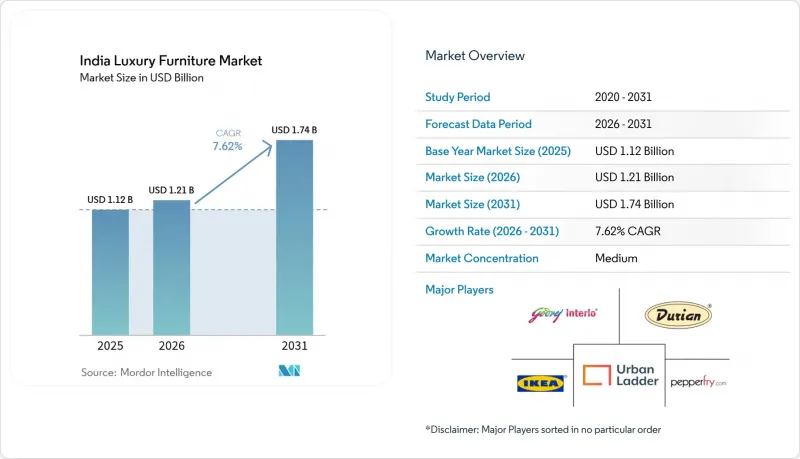
This report is Segmented by Application (Luxury Home Furniture, Luxury Office Furniture, and More), Material (Wood, Metal, Glass, Leather, Plastic and Other Synthetics, Sustainable/Green Materials), Distribution Channel (B2C/Retail, B2B/Project), and Geography (North India, South India, West India, East India, Central India, North-East India). The Market Forecasts are Provided in Terms of Value (USD).
India Luxury Furniture Market Trends and Insights
Growing Aspirational Spending among India's Upper-Middle Class
Furniture purchases have evolved from need-based outlays to lifestyle statements that communicate social status. Disposable income increased following the 2025 tax restructuring that waived income tax on salaries up to INR 1.2 million, redirecting a share of household budgets toward premium home upgrades. Shorter renovation cycles now 10-12 years reflect a craving for contemporary aesthetics that align with global design narratives, encouraging recurring spend on the India luxury furniture market. Social platforms compress style diffusion from metros to tier-2 hubs within 18-24 months, compelling brands to launch micro-collections synced with trending palettes. Luxury showrooms in Mumbai, Delhi, and Bangalore report basket sizes rising 12-15% after adopting experience-center formats where curated vignettes trigger emotional buying. Aspirational buyers increasingly request provenance certificates for materials, blending conspicuous consumption with conscious living.
Rapid Expansion of Branded Retail Chains & E-Commerce Platforms
Omnichannel strategies are redrawing shopper journeys by merging tactile store experiences with digital convenience. IKEA's compact 25,000-70,000 sq ft city stores complement 150,000 sq ft fulfillment hubs that promise 24-hour deliveries without diluting brand theater . Domestic players such as HomeLane, following its Design Cafe acquisition, integrate design consultation, manufacturing, and last-mile installation on a single tech stack, shrinking project lead times from 12 weeks to 6 weeks. Advanced 3D visualizers let customers overlay sofas or wardrobes onto room photos, boosting online conversion rates above 18% and reducing return rates through precise spatial matches. Unified inventories ensure online promotions map instantly to showroom stock, preserving price integrity. These innovations collectively democratize the India luxury furniture market by reaching affluent households in tier-3 towns without heavy real-estate outlay.
Volatile Raw-Material Prices
Soft-sawn wood averaged INR 27,500 per metric ton in April 2024, yet month-to-month gyrations exceed 15%, skewing cost forecasts for manufacturers that lock in project bids six months ahead . Imports soared from USD 630 million to USD 2.3 billion over two decades, exposing the India luxury furniture market to currency swings and freight surcharges. February 2026 BIS certification will require batch testing and factory audits, injecting compliance timetables into already tight project schedules. China's stockpiling of tropical hardwoods has pushed up CIF rates for teak and merbau, forcing Indian buyers to explore alternative species and engineered panels. Manufacturers hedge by pre-buying logs when the rupee strengthens, but holding bulky inventories strains working capital. Price pass-through to consumers lags at least one quarter, compressing gross margins during spike periods.
Other drivers and restraints analyzed in the detailed report include:
- Premiumization of Residential Interior Design Driven by Celebrity Architects
- Boom in Grade-A Office Stock & Coworking Spaces
- Highly Fragmented Unorganized Sector Limiting Price Premium
For complete list of drivers and restraints, kindly check the Table Of Contents.
Segment Analysis
Luxury hospitality furniture held a 33.57% share of the India luxury furniture market in 2025 and is poised to cross USD 610 million by 2031 at an 8.48% CAGR. Chain operators mandate ASTM E84 fire-rating, moisture-sealed edges, and elevated abrasion scores, escalating technical requirements beyond residential norms. Vendors winning Marriott or ITC contracts often secure repeat orders for pipeline properties, stabilizing capacity utilization. Home furniture retains a 53.62% share in 2025, but its expansion moderates to 6.85% as repeat purchases dominate incremental volume. Buyers in metros demand hidden charging docks, velvet performance fabrics, and convertible storage beds, blending luxury with lifestyle pragmatism.
Office applications occupy a 12.81% share in 2025, catalyzed by coworking ventures requiring adaptable layouts that integrate privacy pods and plug-and-play conferencing tables. Ergonomic benchmarks such as BIFMA X5.1 now inform even SME procurements, nudging local suppliers to upgrade testing facilities. Education and healthcare segments, albeit smaller, display double-digit growth as administrators equate furniture quality to user well-being, procuring anti-bacterial laminates and rounded-edge desks for safety compliance. BIS norms effective 2026 are expected to prune non-certified vendors from institutional tenders, consolidating demand with established brands poised to scale the India luxury furniture market size in the coming years.
Complete Report Scope:
- By Application
- Luxury Home Furniture
- Chairs and Sofas
- Tables (Side, Coffee, Dressing, etc.)
- Beds
- Wardrobes
- Dining Tables / Dining Sets
- Kitchen Cabinets
- Other Home Furniture (Bathroom, Outdoor, etc.)
- Luxury Office Furniture
- Chairs
- Tables
- Storage Cabinets
- Desks
- Sofas and Other Soft Seating
- Other Office Furniture
- Luxury Hospitality Furniture
- Other Applications (Educational Furniture, Healthcare Furniture, Retail Malls, Government Offices, etc.)
- Luxury Home Furniture
- By Material
- Wood
- Metal
- Glass
- Leather
- Plastic and Other Synthetics
- Sustainable / Green Materials
- By Distribution Channel
- B2C / Retail
- Home Centers
- Specialty Furniture Stores
- Online
- Flagship Store
- Other Distribution Channels
- B2B / Project
- B2C / Retail
- By Geography
- North India
- South India
- West India
- East India
- Central India
- North-East India
List of Companies Covered in this Report:
- Godrej Interio
- Durian
- IKEA India
- Urban Ladder
- Pepperfry
- Stanley Lifestyles
- Featherlite
- Nilkamal
- Zuari Furniture
- Evok (Hindware)
- Wipro Furniture
- Haworth India
- Herman Miller India
- B&B Italia
- HOLA International
- Spacewood
- Ashley Furniture Homestore (India)
- Hettich India
- Greenply Industries
- Amazon (Solimo)
Additional Benefits:
- The market estimate (ME) sheet in Excel format
- 3 months of analyst support
TABLE OF CONTENTS
1 Table of Contents - India Furniture Market
2 Introduction
- 2.1 Study Assumptions & Market Definition
- 2.2 Scope of the Study
3 Research Methodology
4 Executive Summary
5 Market Landscape
- 5.1 Market Overview
- 5.2 Market Drivers
- 5.2.1 Growing aspirational spending among India's upper-middle class
- 5.2.2 Rapid expansion of branded furniture retail chains & e-commerce platforms
- 5.2.3 Premiumisation of residential interior design driven by celebrity architects
- 5.2.4 Boom in Grade-A office stock & coworking spaces
- 5.2.5 Surge in branded hotel pipeline in tier-2/3 cities
- 5.2.6 ESG mandates pushing adoption of sustainable / green materials
- 5.3 Market Restraints
- 5.3.1 Volatile raw-material prices (wood, metal, leather)
- 5.3.2 Highly fragmented unorganised sector limiting price premium
- 5.3.3 Shortage of skilled carpenters & upholsterers
- 5.3.4 Lengthy building-code / fire-safety clearances for fit-outs
- 5.4 Industry Value Chain Analysis
- 5.5 Porter's Five Forces
- 5.5.1 Bargaining Power of Buyers
- 5.5.2 Bargaining Power of Suppliers
- 5.5.3 Threat of New Entrants
- 5.5.4 Threat of Substitutes
- 5.5.5 Intensity of Competitive Rivalry
- 5.6 Insights Into The Latest Trends And Innovations in the Market
- 5.7 Insights On Recent Developments (New Product Launches, Strategic Initiatives, Investments, Partnerships, JVs, Expansion, M&As, Etc.) In The Market
6 Market Size & Growth Forecasts (Value)
- 6.1 By Application
- 6.1.1 Luxury Home Furniture
- 6.1.1.1 Chairs and Sofas
- 6.1.1.2 Tables (Side, Coffee, Dressing, etc.)
- 6.1.1.3 Beds
- 6.1.1.4 Wardrobes
- 6.1.1.5 Dining Tables / Dining Sets
- 6.1.1.6 Kitchen Cabinets
- 6.1.1.7 Other Home Furniture (Bathroom, Outdoor, etc.)
- 6.1.2 Luxury Office Furniture
- 6.1.2.1 Chairs
- 6.1.2.2 Tables
- 6.1.2.3 Storage Cabinets
- 6.1.2.4 Desks
- 6.1.2.5 Sofas and Other Soft Seating
- 6.1.2.6 Other Office Furniture
- 6.1.3 Luxury Hospitality Furniture
- 6.1.4 Other Applications (Educational Furniture, Healthcare Furniture, Retail Malls, Government Offices, etc.)
- 6.1.1 Luxury Home Furniture
- 6.2 By Material
- 6.2.1 Wood
- 6.2.2 Metal
- 6.2.3 Glass
- 6.2.4 Leather
- 6.2.5 Plastic and Other Synthetics
- 6.2.6 Sustainable / Green Materials
- 6.3 By Distribution Channel
- 6.3.1 B2C / Retail
- 6.3.1.1 Home Centers
- 6.3.1.2 Specialty Furniture Stores
- 6.3.1.3 Online
- 6.3.1.4 Flagship Store
- 6.3.1.5 Other Distribution Channels
- 6.3.2 B2B / Project
- 6.3.1 B2C / Retail
- 6.4 By Geography
- 6.4.1 North India
- 6.4.2 South India
- 6.4.3 West India
- 6.4.4 East India
- 6.4.5 Central India
- 6.4.6 North-East India
7 Competitive Landscape
- 7.1 Market Concentration
- 7.2 Strategic Moves
- 7.3 Market Share Analysis
- 7.4 Company Profiles (includes Global level Overview, Market level overview, Core Segments, Financials as available, Strategic Information, Market Rank/Share for key companies, Products & Services, and Recent Developments)
- 7.4.1 Godrej Interio
- 7.4.2 Durian
- 7.4.3 IKEA India
- 7.4.4 Urban Ladder
- 7.4.5 Pepperfry
- 7.4.6 Stanley Lifestyles
- 7.4.7 Featherlite
- 7.4.8 Nilkamal
- 7.4.9 Zuari Furniture
- 7.4.10 Evok (Hindware)
- 7.4.11 Wipro Furniture
- 7.4.12 Haworth India
- 7.4.13 Herman Miller India
- 7.4.14 B&B Italia
- 7.4.15 HOLA International
- 7.4.16 Spacewood
- 7.4.17 Ashley Furniture Homestore (India)
- 7.4.18 Hettich India
- 7.4.19 Greenply Industries
- 7.4.20 Amazon (Solimo)
8 Market Opportunities & Future Outlook
- 8.1 Smart furniture enhancing connected urban living
- 8.2 Modular multifunctional designs for compact homes

