PUBLISHER: Mordor Intelligence | PRODUCT CODE: 2124613

PUBLISHER: Mordor Intelligence | PRODUCT CODE: 2124613
Europe Luxury Furniture - Market Share Analysis, Industry Trends & Statistics, Growth Forecasts (2026 - 2031)
According to Mordor Intelligence, Europe luxury furniture market size in 2026 is estimated at USD 12.54 billion, growing from 2025 value of USD 12.03 billion with 2031 projections showing USD 15.39 billion, growing at 4.2% CAGR over 2026-2031.
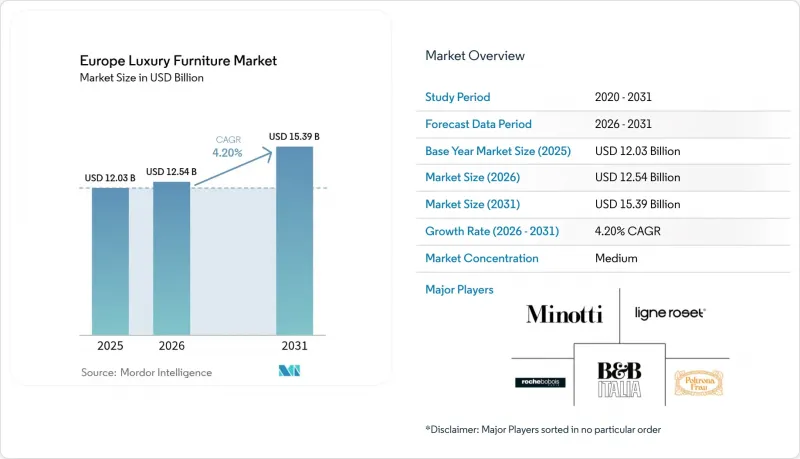
This report is Segmented by Application (Luxury Home Furniture, Luxury Office Furniture, and More), Material (Wood, Metal, Glass, and More), Distribution Channel (B2C/Retail, B2B/Project), and Geography (Germany, France, and More). The Market Forecasts are Provided in Terms of Value (USD).
Europe Luxury Furniture Market Trends and Insights
Rising Disposable Income of Affluent Millennials
Affluent Millennials are now entering the peak household-formation stage, lifting per-capita spending on premium sofas, modular tables, and bespoke cabinetry. Brands report that millennial clients allocate bigger shares of renovation budgets to sustainably sourced, design-led furniture that doubles as a lifestyle statement. Unlike previous generations, these buyers scrutinize transparency credentials-FSC labels, traceable leathers, and carbon disclosures-before committing. Social-media curation accelerates trend adoption as influencers present high-end living spaces, creating copycat demand across the Europe luxury furniture market. Retail conversion data indicate millennials drive more than one-third of omnichannel revenue, validating investments in AR-powered configurators and virtual consultations. This cohort also exhibits higher tolerance for extended lead times if craftsmanship stories resonate, offering cushion to artisans managing limited production runs.
Post-Pandemic "Home as a Sanctuary" Renovation Boom
Remote-work norms remain sticky, anchoring incremental expenditure on home offices, outdoor lounges, and wellness-focused bedroom suites. Consumers channel vacation savings into high-spec renovations, a behavior that persists even after travel restrictions are eased. European builders report that turnkey packages frequently incorporate premium Italian or Spanish furniture brands, boosting factory order backlogs. Secondary markets emerge in countryside estates and alpine chalets, widening the geographic dispersion of demand within the Europe luxury furniture market. Hospitality developers replicate residential aesthetics to justify higher ADR, funneling contract orders toward bespoke pieces. Suppliers hedge renovation-cycle risk by offering modular collections that facilitate later reconfiguration without full replacement, sustaining revenue through accessory sales.
Volatile Hardwood & Leather Input Costs
Market prices for American walnut and European oak jumped 18-24% YOY in 2024 amid supply bottlenecks and phytosanitary restrictions. Italian tanneries also faced bovine-hide shortages, intensifying cost pressure across upholstered categories. Contract pricing lags impede immediate pass-through, eroding EBIT margins by up to 300 basis points for mid-sized manufacturers. Some brands forward-purchase FSC-certified logs and store them for seasoning, but carrying costs strain balance sheets. Alternative materials, engineered veneers, lab-grown leather mitigate exposure yet require investment and consumer education. Elevated costs influence SKU rationalization, nudging makers to trim fringe colorways and focus on volume drivers within the Europe luxury furniture market.
Other drivers and restraints analyzed in the detailed report include:
- Surge in High-Net-Worth Immigration to EU Capitals
- Growing E-Commerce Adoption for High-Ticket Decor
- Luxury-Tax Expansion in Southern Europe
For complete list of drivers and restraints, kindly check the Table Of Contents.
Segment Analysis
Europe's luxury furniture market size for home application stood at USD 8.14 billion in 2025, equal to 67.70% share, driven by persistent home-improvement cycles. Living-room seating commands the highest value, buoyed by modular sectional designs that accommodate flexible layouts. Dining sets featuring extendable mechanisms satisfy hybrid entertainment preferences, while premium wardrobes integrate IoT humidity control to protect couture garments. Luxury kitchen cabinetry shows 14% YOY growth as cooking remains a lifestyle hobby among affluent households. Importantly, resale values of branded pieces sustain high upgrade frequency; auction data reveal some limited-edition sofas retain 85% of original retail after five years, strengthening perception of furniture as a capital asset inside the Europe luxury furniture market.
Hospitality furniture is projected to grow at a 5.46% CAGR, widening its 2025 base of USD 1.34 billion as RevPAR in Europe capitals rebounds and pipeline additions accelerate. Operators of boutique hotels demand residential-grade comfort, commissioning bespoke headboards, marble-clad nightstands, and sustainably sourced lounge chairs to differentiate. Procurement cycles compress as design-and-build firms rely on digital libraries for faster approval, favoring suppliers with robust BIM resources. Restoration projects, such as The Dylan Amsterdam's phased upgrade, illustrate multi-year revenue streams where suppliers refresh suites in rotations, ensuring steady order visibility. Cruise-ship refurbishment and luxury senior living complexes add adjacency opportunities, further diversifying the Europe luxury furniture market.
Complete Report Scope:
- By Application
- Luxury Home Furniture
- Chairs and Sofas
- Tables (Side, Coffee, Dressing, etc.)
- Beds
- Wardrobes
- Dining Tables / Dining Sets
- Kitchen Cabinets
- Other Home Furniture (Bathroom, Outdoor, etc.)
- Luxury Office Furniture
- Chairs
- Tables
- Storage Cabinets
- Desks
- Sofas and Other Soft Seating
- Other Office Furniture
- Luxury Hospitality Furniture
- Other Applications (Educational, Healthcare, Retail Malls, Government Offices, etc.)
- Luxury Home Furniture
- By Material
- Wood
- Metal
- Glass
- Leather
- Plastic and Other Synthetics
- Sustainable / Green Materials
- By Distribution Channel
- B2C / Retail
- Home Centers
- Specialty Furniture Stores
- Online Flagship Store
- Other Distribution Channels
- B2B / Project
- B2C / Retail
- By Geography
- Germany
- France
- United Kingdom
- Italy
- Spain
- Netherlands
- Belgium
- Switzerland
- Nordics
- Rest of Europe
List of Companies Covered in this Report:
- Roche Bobois
- Poltrona Frau
- B&B Italia
- Minotti
- Ligne Roset
- Luxury Living Group (Fendi Casa)
- Molteni&C
- Turri S.r.l.
- Eichholtz
- Duresta Upholstery
- Scavolini
- Giovanni Visentin
- Muebles Pico
- Valderamobili
- Bonaldo
- Pedrali
- Kettal
- Gloster
- Knoll (MillerKnoll)
- Herman Miller Europe
Additional Benefits:
- The market estimate (ME) sheet in Excel format
- 3 months of analyst support
TABLE OF CONTENTS
1 Introduction
- 1.1 Study Assumptions & Market Definition
- 1.2 Scope of the Study
2 Research Methodology
3 Executive Summary
4 Market Landscape
- 4.1 Market Overview
- 4.2 Market Drivers
- 4.2.1 Rising disposable income of affluent millennials
- 4.2.2 Post-pandemic "home as a sanctuary" renovation boom
- 4.2.3 Surge in high-net-worth immigration to EU capitals
- 4.2.4 Growing e-commerce adoption for high-ticket decor
- 4.2.5 Premium demand for "quiet luxury" artisanal pieces
- 4.2.6 Circular-economy certified luxury refurb programs
- 4.3 Market Restraints
- 4.3.1 Volatile hardwood & leather input costs
- 4.3.2 Counterfeit designer furniture online
- 4.3.3 Luxury-tax expansion in Southern Europe
- 4.3.4 High last-mile white-glove logistics costs
- 4.4 Industry Value Chain Analysis
- 4.5 Porter's Five Forces
- 4.5.1 Threat of New Entrants
- 4.5.2 Bargaining Power of Suppliers
- 4.5.3 Bargaining Power of Buyers
- 4.5.4 Threat of Substitutes
- 4.5.5 Competitive Rivalry
- 4.6 Insights Into The Latest Trends And Innovations in the Market
- 4.7 Insights On Recent Developments (New Product Launches, Strategic Initiatives, Investments, Partnerships, JVs, Expansion, M&As, Etc.) In The Market
5 Market Size & Growth Forecasts (Value)
- 5.1 By Application
- 5.1.1 Luxury Home Furniture
- 5.1.1.1 Chairs and Sofas
- 5.1.1.2 Tables (Side, Coffee, Dressing, etc.)
- 5.1.1.3 Beds
- 5.1.1.4 Wardrobes
- 5.1.1.5 Dining Tables / Dining Sets
- 5.1.1.6 Kitchen Cabinets
- 5.1.1.7 Other Home Furniture (Bathroom, Outdoor, etc.)
- 5.1.2 Luxury Office Furniture
- 5.1.2.1 Chairs
- 5.1.2.2 Tables
- 5.1.2.3 Storage Cabinets
- 5.1.2.4 Desks
- 5.1.2.5 Sofas and Other Soft Seating
- 5.1.2.6 Other Office Furniture
- 5.1.3 Luxury Hospitality Furniture
- 5.1.4 Other Applications (Educational, Healthcare, Retail Malls, Government Offices, etc.)
- 5.1.1 Luxury Home Furniture
- 5.2 By Material
- 5.2.1 Wood
- 5.2.2 Metal
- 5.2.3 Glass
- 5.2.4 Leather
- 5.2.5 Plastic and Other Synthetics
- 5.2.6 Sustainable / Green Materials
- 5.3 By Distribution Channel
- 5.3.1 B2C / Retail
- 5.3.1.1 Home Centers
- 5.3.1.2 Specialty Furniture Stores
- 5.3.1.3 Online Flagship Store
- 5.3.1.4 Other Distribution Channels
- 5.3.2 B2B / Project
- 5.3.1 B2C / Retail
- 5.4 By Geography
- 5.4.1 Germany
- 5.4.2 France
- 5.4.3 United Kingdom
- 5.4.4 Italy
- 5.4.5 Spain
- 5.4.6 Netherlands
- 5.4.7 Belgium
- 5.4.8 Switzerland
- 5.4.9 Nordics
- 5.4.10 Rest of Europe
6 Competitive Landscape
- 6.1 Market Concentration
- 6.2 Strategic Moves
- 6.3 Market Share Analysis
- 6.4 Company Profiles (includes Global level Overview, Market level overview, Core Segments, Financials as available, Strategic Information, Market Rank/Share for key companies, Products & Services, and Recent Developments)
- 6.4.1 Roche Bobois
- 6.4.2 Poltrona Frau
- 6.4.3 B&B Italia
- 6.4.4 Minotti
- 6.4.5 Ligne Roset
- 6.4.6 Luxury Living Group (Fendi Casa)
- 6.4.7 Molteni&C
- 6.4.8 Turri S.r.l.
- 6.4.9 Eichholtz
- 6.4.10 Duresta Upholstery
- 6.4.11 Scavolini
- 6.4.12 Giovanni Visentin
- 6.4.13 Muebles Pico
- 6.4.14 Valderamobili
- 6.4.15 Bonaldo
- 6.4.16 Pedrali
- 6.4.17 Kettal
- 6.4.18 Gloster
- 6.4.19 Knoll (MillerKnoll)
- 6.4.20 Herman Miller Europe
7 Market Opportunities & Future Outlook
- 7.1 EU Green Deal accelerating sustainable furniture innovation
- 7.2 Artisanal craftsmanship blending with modern luxury
- 7.3 Premium multifunctional urban furniture for small spaces

