PUBLISHER: Mordor Intelligence | PRODUCT CODE: 2100665

PUBLISHER: Mordor Intelligence | PRODUCT CODE: 2100665
United States Luxury Furniture - Market Share Analysis, Industry Trends & Statistics, Growth Forecasts (2026 - 2031)
According to Mordor Intelligence, the United States luxury furniture market size is projected to expand from USD 6.29 billion in 2025 and USD 6.55 billion in 2026 to USD 8.17 billion by 2031, registering a CAGR of 4.52% between 2026 to 2031.
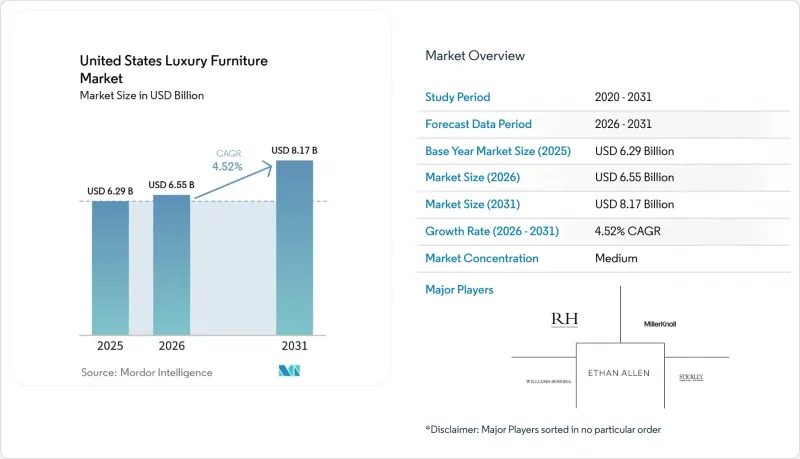
This report is Segmented by Product (Luxury Home Furniture, Luxury Office Furniture, and More), Material (Wood, Metal, and More), Distribution Channel (B2C/Retail and B2B/Project), and Geography (Northeast, South, and More). The Market Forecasts are Provided in Terms of Value (USD).
United States Luxury Furniture Market Trends and Insights
Rising population of ultra-high-net-worth households
Between 2024 and 2025, affluent families with net worths exceeding USD 30 million experienced significant growth. This increase has driven strong demand, largely unaffected by fluctuations in mortgage-rate cycles, sustaining a resilient luxury market. These buyers, concentrated in coastal technology hubs and select Sunbelt regions, frequently replace luxury items and commission bespoke pieces. They rely on interior designers, family offices, and wealth advisors to guide purchases toward brands with artisanal craftsmanship and transparent supply chains. Manufacturers failing to establish direct relationships with these influencers risk commoditization as Ultra-High-Net-Worth (UHNW) consumers prefer curated, exclusive portfolios. This trend highlights the importance of exclusivity and long-term service commitments in attracting and retaining UHNW clientele.
Increasing demand for premium outdoor living environments
In Texas, Florida, Arizona, and California, high-end furniture is becoming a key feature. Homeowners prioritize modular seating, weather-resistant hardwoods, and solution-dyed textiles for year-round functionality without compromising aesthetics. This trend aligns with the wellness movement, emphasizing outdoor spaces for entertaining and meditation as part of personal health routines. Suppliers managing longer lead times for teak, powder-coated aluminum, and marine-grade finishes achieve strong profit margins. They also educate consumers on maintenance practices to preserve colorfastness and structural integrity across multiple seasons. Outdoor spaces are increasingly viewed as extensions of indoor living, blending style with durability.
Rising vacancy rates across commercial real estate
Remote and hybrid work models have increased vacancy rates in central business districts (CBDs) to over 20%, disrupting the consistent demand for office furniture, including desks, conference tables, and modular storage. Employers now prioritize collaborative lounges over high-density cubicles, reducing seat counts even as per-seat spending rises. Contract manufacturers are shifting focus to the hospitality sector and premium home-office niches to address changing market demands. Shorter production run lengths and increased customization requirements are adding complexity to manufacturing schedules. These adjustments are necessary to remain competitive in the evolving market landscape shaped by workplace transformations.
Other drivers and restraints analyzed in the detailed report include:
- Acceleration of smart-home technology upgrades
- Greater availability of ESG-driven real-estate financing
- Persistent supply-chain delays for specialty and rare materials
For complete list of drivers and restraints, kindly check the Table Of Contents.
Segment Analysis
Luxury home furniture is projected to account for 52.74% of 2025 revenue in the United States, driven by the normalization of remote work and increased second-home ownership. Chairs and sofas have shorter replacement cycles, while beds, wardrobes, and built-in storage command higher transaction values despite longer usage. Dining tables have regained importance with the return of in-person entertaining, with extendable formats outperforming static designs. Outdoor lounges, dining sets, and cabanas now feature artisanal joinery and premium finishes, positioning outdoor spaces as year-round extensions of indoor living. Luxury hospitality furniture is recovering, supported by boutique hotel openings requiring visually appealing, durable designs that withstand commercial use without compromising aesthetics.
Office demand remains subdued in the US luxury furniture market, but executives outfitting high-end home workspaces sustain demand for ergonomic chairs and height-adjustable desks. Hospitality buyers prioritize FSC-certified timber, recycled metal frames, and CAL-117 compliant fabrics, favoring suppliers with documented compliance. Institutional segments like private education and concierge healthcare provide stable demand with long procurement cycles and low consumer sentiment sensitivity. The United States luxury furniture market diversifies its application mix, balancing cyclical residential spending with steady professional and institutional orders.
Complete Report Scope:
- By Application
- Luxury Home Furniture
- Chairs and Sofas
- Tables (Side, Coffee, Dressing, etc.)
- Beds
- Wardrobes
- Dining Tables / Dining Sets
- Kitchen Cabinets
- Other Home Furniture (Bathroom, Outdoor, etc.)
- Luxury Office Furniture
- Chairs
- Tables
- Storage Cabinets
- Desks, Sofas and Other Soft Seating
- Other Office Furniture
- Luxury Hospitality Furniture
- Other Applications (Educational Furniture, Healthcare Furniture, Retail Malls, Government Offices, etc.)
- Luxury Home Furniture
- By Material
- Wood
- Metal
- Glass
- Leather
- Plastic and Other Synthetics
- Sustainable / Green Materials
- By Distribution Channel
- B2C / Retail
- Home Centers
- Specialty Furniture Stores
- Online
- Other Distribution Channels
- B2B / Project
- B2C / Retail
- By Geography
- Northeast
- Midwest
- Southeast
- Southwest
- West
List of Companies Covered in this Report:
- RH (Restoration Hardware)
- Williams-Sonoma Inc. (Pottery Barn, West Elm)
- MillerKnoll (Herman Miller, Knoll, Design Within Reach)
- HNI Corporation
- Haworth Inc.
- L. & J.G. Stickley, Inc.
- Ethan Allen Interiors Inc.
- Roche Bobois Group
- Ligne Roset
- Bernhardt Furniture Company
- Mitchell Gold + Bob Williams
- Room & Board Inc.
- Crate & Barrel Holdings
- Baker Interiors Group
- Century Furniture LLC
- Hooker Furnishings Corporation
- B&B Italia
- Poltrona Frau
- Minotti S.p.A.
- Cassina S.p.A.
Additional Benefits:
- The market estimate (ME) sheet in Excel format
- 3 months of analyst support
TABLE OF CONTENTS
1 Introduction
- 1.1 Study Assumptions & Market Definition
- 1.2 Scope of the Study
2 Research Methodology
3 Executive Summary
4 Market Landscape
- 4.1 Market Overview
- 4.2 Market Drivers
- 4.2.1 Rising population of ultra-high-net-worth households
- 4.2.2 Increasing demand for premium outdoor living environments
- 4.2.3 Acceleration of smart-home technology upgrades
- 4.2.4 Growing influence of the "quiet luxury" aesthetic
- 4.2.5 Greater availability of ESG-driven real-estate financing
- 4.2.6 Growth of luxury e-commerce and augmented-reality shopping tools
- 4.3 Market Restraints
- 4.3.1 Rising vacancy rates across commercial real estate
- 4.3.2 Persistent supply-chain delays for specialty and rare materials
- 4.3.3 Expansion of authenticated resale marketplaces is reducing demand for new premium goods
- 4.3.4 Extended product lifecycles and superior durability limiting replacement frequency
- 4.4 Industry Value Chain Analysis
- 4.5 Porter's Five Forces Analysis
- 4.5.1 Threat of New Entrants
- 4.5.2 Bargaining Power of Suppliers
- 4.5.3 Bargaining Power of Buyers
- 4.5.4 Threat of Substitutes
- 4.5.5 Intensity of Competitive Rivalry
- 4.6 Insights Into The Latest Trends And Innovations in the Market
- 4.7 Insights On Recent Developments (New Product Launches, Strategic Initiatives, Investments, Partnerships, JVs, Expansion, M&As, Etc.) In The Market
5 Market Size & Growth Forecasts
- 5.1 By Application
- 5.1.1 Luxury Home Furniture
- 5.1.1.1 Chairs and Sofas
- 5.1.1.2 Tables (Side, Coffee, Dressing, etc.)
- 5.1.1.3 Beds
- 5.1.1.4 Wardrobes
- 5.1.1.5 Dining Tables / Dining Sets
- 5.1.1.6 Kitchen Cabinets
- 5.1.1.7 Other Home Furniture (Bathroom, Outdoor, etc.)
- 5.1.2 Luxury Office Furniture
- 5.1.2.1 Chairs
- 5.1.2.2 Tables
- 5.1.2.3 Storage Cabinets
- 5.1.2.4 Desks, Sofas and Other Soft Seating
- 5.1.2.5 Other Office Furniture
- 5.1.3 Luxury Hospitality Furniture
- 5.1.4 Other Applications (Educational Furniture, Healthcare Furniture, Retail Malls, Government Offices, etc.)
- 5.1.1 Luxury Home Furniture
- 5.2 By Material
- 5.2.1 Wood
- 5.2.2 Metal
- 5.2.3 Glass
- 5.2.4 Leather
- 5.2.5 Plastic and Other Synthetics
- 5.2.6 Sustainable / Green Materials
- 5.3 By Distribution Channel
- 5.3.1 B2C / Retail
- 5.3.1.1 Home Centers
- 5.3.1.2 Specialty Furniture Stores
- 5.3.1.3 Online
- 5.3.1.4 Other Distribution Channels
- 5.3.2 B2B / Project
- 5.3.1 B2C / Retail
- 5.4 By Geography
- 5.4.1 Northeast
- 5.4.2 Midwest
- 5.4.3 Southeast
- 5.4.4 Southwest
- 5.4.5 West
6 Competitive Landscape
- 6.1 Market Concentration
- 6.2 Strategic Moves
- 6.3 Market Share Analysis
- 6.4 Company Profiles (includes Global level Overview, Market level overview, Core Segments, Financials as available, Strategic Information, Market Rank/Share for key companies, Products & Services, and Recent Developments)
- 6.4.1 RH (Restoration Hardware)
- 6.4.2 Williams-Sonoma Inc. (Pottery Barn, West Elm)
- 6.4.3 MillerKnoll (Herman Miller, Knoll, Design Within Reach)
- 6.4.4 HNI Corporation
- 6.4.5 Haworth Inc.
- 6.4.6 L. & J.G. Stickley, Inc.
- 6.4.7 Ethan Allen Interiors Inc.
- 6.4.8 Roche Bobois Group
- 6.4.9 Ligne Roset
- 6.4.10 Bernhardt Furniture Company
- 6.4.11 Mitchell Gold + Bob Williams
- 6.4.12 Room & Board Inc.
- 6.4.13 Crate & Barrel Holdings
- 6.4.14 Baker Interiors Group
- 6.4.15 Century Furniture LLC
- 6.4.16 Hooker Furnishings Corporation
- 6.4.17 B&B Italia
- 6.4.18 Poltrona Frau
- 6.4.19 Minotti S.p.A.
- 6.4.20 Cassina S.p.A.
7 Market Opportunities & Future Outlook
- 7.1 Wellness-focused ergonomic furniture driving adoption
- 7.2 Expansion of luxury outdoor living spaces and premium lifestyle-oriented home upgrades

