
PUBLISHER: Global Market Insights Inc. | PRODUCT CODE: 2061468

PUBLISHER: Global Market Insights Inc. | PRODUCT CODE: 2061468
Prefabricated Bathroom Pods Market Opportunity, Growth Drivers, Industry Trend Analysis, and Forecast 2026 - 2035
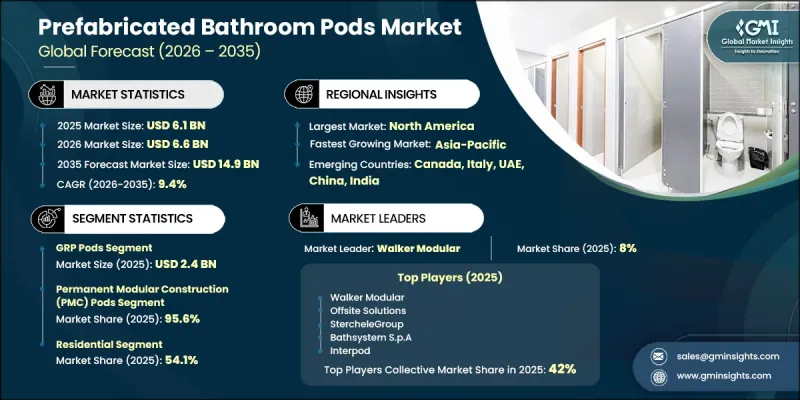
The Global Prefabricated Bathroom Pods Market was valued at USD 6.1 billion in 2025 and is estimated to grow at a CAGR of 9.4% to reach USD 14.9 billion by 2035.
The market is witnessing substantial growth as the construction industry increasingly adopts modern manufacturing and offsite construction methods to improve project efficiency and reduce overall development timelines. Prefabricated bathroom pods are gaining strong acceptance among developers and contractors because they provide consistent construction quality while minimizing on-site labor requirements. Manufactured under controlled factory conditions, these units are delivered ready for installation, allowing construction companies to streamline operations and improve project scheduling. Growing emphasis on faster project completion, cost optimization, and improved building performance is further accelerating market demand. In addition to construction efficiency, bathroom pods are widely preferred for their ability to enhance waterproofing performance, reduce installation errors, and improve long-term durability. Rising adoption across residential buildings, hospitality projects, healthcare facilities, and other large-scale developments continues to support industry expansion. Increasing compliance requirements and stricter building standards are also encouraging developers to adopt prefabricated bathroom solutions that meet established quality and regulatory expectations. Continuous advancements in modular construction technologies and growing preference for standardized building components are expected to strengthen long-term market growth.
| Market Scope | |
|---|---|
| Start Year | 2025 |
| Forecast Year | 2026-2035 |
| Start Value | $6.1 Billion |
| Forecast Value | $14.9 Billion |
| CAGR | 9.4% |
In 2025, the GRP pods segment generated USD 2.4 billion. Glass-reinforced plastic pods continue to gain widespread adoption due to their lightweight structure, strong waterproofing capabilities, and long operational lifespan. These pods are highly suitable for projects requiring durable and moisture-resistant bathroom solutions with minimal maintenance requirements. Their lightweight construction also reduces structural load demands, improving installation flexibility across different building types. Strong resistance to moisture-related damage and long-term durability continue to position GRP bathroom pods as a preferred choice for modern construction projects focused on quality and efficiency.
The PMC pods segment accounted for 95.6% share in 2025, representing the dominant application category. Permanent modular construction pods continue to lead the market due to their integration into long-term building structures where installation efficiency and construction consistency are critical priorities. These units are designed as fully completed bathroom modules with pre-installed plumbing systems, wall finishes, ceiling components, and accessories before delivery to construction sites. The ability to simplify installation processes and reduce on-site construction complexity continues to drive strong demand for PMC bathroom pods across multiple building sectors.
U.S. Prefabricated Bathroom Pods Market held an 88.4% share, generating USD 2.64 billion in 2025. Market growth in the country is being supported by increasing adoption of modular construction practices, labor shortages within the construction sector, and rising development activity across residential and commercial infrastructure projects. Developers and construction firms are increasingly utilizing prefabricated bathroom pods to improve project timelines, reduce labor dependency, and maintain construction quality standards. The U.S. market also benefits from established regulatory frameworks and inspection systems that support the integration of factory-manufactured building components into large-scale construction projects, encouraging wider adoption of prefabricated bathroom solutions.
Major companies operating in the Global Prefabricated Bathroom Pods Market include Altor Industries, Badelement A/S, Bathsystem S.p.A, BAUDET, Buildom, Castle Modular, DEBA Badsysteme, EcoReadyBath (ERB), Erawet, Eurocomponents Italia, Green Box A/S, Hellweg Badsysteme, Interpod, Nordic Offsite, Offsite Solutions, Oldcastle SurePods, PUDA Industrial, Sanika, SanMOD, StercheleGroup, and Walker Modular. Companies operating in the prefabricated bathroom pods market are implementing several strategic initiatives to strengthen their market position and improve long-term competitiveness. Leading manufacturers are focusing on advanced modular construction technologies to improve production efficiency, reduce installation time, and maintain consistent product quality. Businesses are also investing in lightweight and durable materials that enhance waterproofing performance and extend product lifespan. Strategic collaborations with construction companies, real estate developers, and infrastructure contractors help manufacturers expand market reach and secure long-term project partnerships. In addition, companies are increasing investments in automated manufacturing processes and customized bathroom pod solutions to meet evolving architectural and design requirements.
Table of Contents
Chapter 1 Research Methodology
- 1.1 Research approach
- 1.2 Quality Commitments
- 1.2.1 GMI AI policy & data integrity commitment
- 1.2.1.1 Source consistency protocol
- 1.2.1 GMI AI policy & data integrity commitment
- 1.3 Research Trail & Confidence Scoring
- 1.3.1 Research Trail Components
- 1.3.2 Scoring Components
- 1.4 Data Collection
- 1.4.1 Partial list of primary sources
- 1.5 Data mining sources
- 1.5.1 Paid sources
- 1.5.1.1 Sources, by region
- 1.5.1 Paid sources
- 1.6 Base estimates and calculations
- 1.6.1 Base year calculation for any one approach
- 1.7 Forecast model
- 1.7.1 Quantified market impact analysis
- 1.7.1.1 Mathematical impact of growth parameters on forecast
- 1.7.1 Quantified market impact analysis
- 1.8 Research transparency addendum
- 1.8.1 Source attribution framework
- 1.8.2 Quality assurance metrics
- 1.8.3 Our commitment to trust
Chapter 2 Executive Summary
- 2.1 Industry 360° synopsis, 2022 - 2035
- 2.2 Key market trends
- 2.2.1 Regional
- 2.2.2 Product type
- 2.2.3 Fixture Configuration
- 2.2.4 Application
- 2.2.5 Installation Type
Chapter 3 Industry Insights
- 3.1 Industry ecosystem analysis
- 3.1.1 Factor affecting the value chain
- 3.1.2 Profit margin analysis
- 3.1.3 Disruptions
- 3.1.4 Future outlook
- 3.1.5 Manufacturers
- 3.1.6 Distributors
- 3.2 Supplier landscape
- 3.3 Key news & initiatives
- 3.4 Technology & Innovation Landscape
- 3.4.1 Current Technological Trends
- 3.4.2 BIM Compatibility & Digital Twin Integration
- 3.4.3 Smart Plumbing & IoT-Enabled Fixtures
- 3.5 Regulatory landscape
- 3.6 Impact forces
- 3.6.1 Growth drivers
- 3.6.2 Industry pitfalls & challenges
- 3.6.3 Opportunities
- 3.7 Pricing analysis, 2025 (driven by primary research)
- 3.7.1 Historical price trend analysis (2022-2025)
- 3.7.2 Pricing strategy by player type (premium/value/cost-plus)
- 3.7.3 Regional price variation analysis
- 3.7.4 Impact of raw material costs on pricing
- 3.8 Consumer buying behavior analysis
- 3.8.1 Demographic trends
- 3.8.2 Factors affecting buying decisions
- 3.8.3 Consumer product adoption
- 3.8.4 Preferred distribution channel
- 3.9 Growth potential analysis
- 3.10 Porter's analysis
- 3.11 PESTEL analysis
- 3.12 Trade data analysis (driven by paid data base)
- 3.12.1 Import/export volume & value trends
- 3.12.2 Key trade corridors & tariff impact
- 3.12.3 Export destination analysis
- 3.12.4 Import source analysis for raw materials
- 3.13 Impact of AI & generative AI on the market
- 3.13.1 AI-driven disruption of existing business models
- 3.13.2 GenAI use cases & adoption roadmap by segment
- 3.13.3 Risks, limitations & regulatory considerations
- 3.14 Distribution infrastructure & channel penetration landscape (driven by primary research)
- 3.14.1 Channel coverage by region & format (modern vs. Traditional trade)
- 3.14.2 Last-mile infrastructure gaps & emerging channel shifts
Chapter 4 Competitive Landscape, 2025
- 4.1 Introduction
- 4.2 Company market share analysis
- 4.3 Competitive positioning matrix
- 4.4 Strategic outlook matrix
- 4.5 Competitive analysis of major market players
- 4.6 Key developments
- 4.6.1 Mergers & acquisitions
- 4.6.2 Partnerships & collaborations
- 4.6.3 New product launches
- 4.6.4 Expansion plans
Chapter 5 Market Estimates & Forecast, By Product Type, 2022-2035 (USD Billion) (Million Units)
- 5.1 Key Trends
- 5.2 Steel Frame Bathroom Pods
- 5.3 Concrete Bathroom Pods
- 5.4 GRP (Glass Reinforced Plastic) Bathroom Pods
- 5.5 Hybrid Bathroom Pods
Chapter 6 Market Estimates & Forecast, By Fixture Configuration, 2022-2035 (USD Billion) (Million Units)
- 6.1 Key Trends
- 6.2 Full Bathroom Pods
- 6.3 Half-Bath Pods
- 6.4 Shower-Only Pods
- 6.5 Wet Room Pods
Chapter 7 Market Estimates & Forecast, By Application, 2022-2035 (USD Billion) (Million Units)
- 7.1 Key Trends
- 7.2 Residential
- 7.3 Hospitality
- 7.4 Healthcare
- 7.5 Commercial
- 7.6 Industrial
Chapter 8 Market Estimates & Forecast, By Installation Type, 2022 - 2035, (USD Billion) (Million Units)
- 8.1 Key Trends
- 8.2 Permanent Modular Construction (PMC) Pods
- 8.3 Relocatable & Temporary Pods
Chapter 9 Market Estimates & Forecast, By Region, 2022 - 2035, (USD Billion) (Million Units)
- 9.1 Key trends
- 9.2 North America
- 9.2.1 U.S.
- 9.2.2 Canada
- 9.3 Europe
- 9.3.1 Germany
- 9.3.2 U.K.
- 9.3.3 France
- 9.3.4 Italy
- 9.3.5 Spain
- 9.4 Asia Pacific
- 9.4.1 China
- 9.4.2 India
- 9.4.3 Japan
- 9.4.4 South Korea
- 9.4.5 Australia
- 9.5 Latin America
- 9.5.1 Brazil
- 9.5.2 Mexico
- 9.5.3 Argentina
- 9.6 MEA
- 9.6.1 UAE
- 9.6.2 Saudi Arabia
- 9.6.3 South Africa
Chapter 10 Company Profiles (Business Overview, Financial Data, Product Landscape, Strategic Outlook, SWOT Analysis)
- 10.1 Global players
- 10.1.1 Walker Modular
- 10.1.2 Offsite Solutions
- 10.1.3 StercheleGroup
- 10.1.4 Bathsystem S.p.A
- 10.1.5 Oldcastle SurePods
- 10.1.6 Altor Industries
- 10.1.7 Badelement A/S
- 10.1.8 DEBA Badsysteme
- 10.1.9 Nordic Offsite
- 10.2 Regional players
- 10.2.1 BAUDET
- 10.2.2 Interpod
- 10.2.3 Sanika
- 10.2.4 PUDA Industrial
- 10.2.5 Green Box A/S
- 10.2.6 Eurocomponents Italia
- 10.2.7 Castle Modular
- 10.3 Emerging players
- 10.3.1 Buildom
- 10.3.2 Hellweg Badsysteme
- 10.3.3 EcoReadyBath (ERB)
- 10.3.4 Erawet
- 10.3.5 SanMOD

