
PUBLISHER: Global Market Insights Inc. | PRODUCT CODE: 2083276

PUBLISHER: Global Market Insights Inc. | PRODUCT CODE: 2083276
Asia Pacific Blue Hydrogen Market Opportunity, Growth Drivers, Industry Trend Analysis, and Forecast 2026 - 2035
Asia Pacific Blue Hydrogen Market was valued at USD 733.6 million in 2025 and is estimated to grow at a CAGR of 8.6% to reach USD 1.57 billion by 2035.
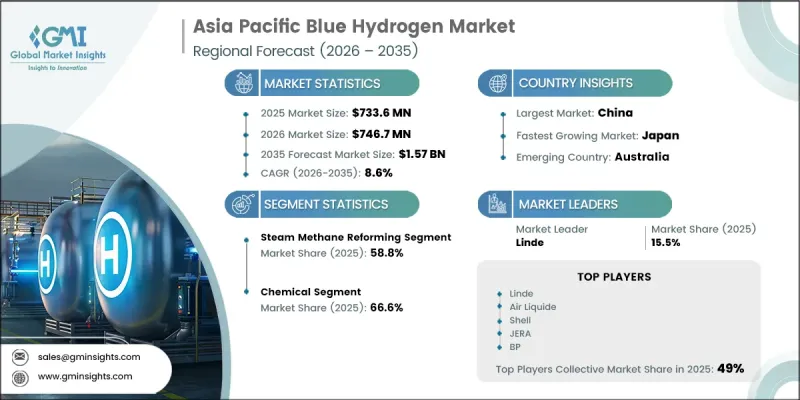
Market expansion is fueled by increasing government-led decarbonization initiatives across the Asia Pacific region, particularly in major economies that are accelerating the transition toward cleaner energy solutions. Blue hydrogen is increasingly recognized as an effective transitional fuel because it can leverage existing natural gas infrastructure while supporting industrial emissions reduction goals. Growing policy support, incentive programs, and hydrogen certification mechanisms are helping improve investment confidence and encouraging large-scale deployment throughout the region. In addition, the availability of abundant natural gas reserves and favorable carbon capture and storage (CCS) resources is enabling more efficient blue hydrogen production compared to many global markets. Established LNG infrastructure and suitable carbon storage capacity across several Asia Pacific countries are reducing operational risks and enhancing cost competitiveness. These advantages are accelerating project development, strengthening supply chains, and supporting sustained market growth. As industries continue to pursue lower-carbon production pathways, blue hydrogen is emerging as a critical component of regional energy transition strategies, creating significant opportunities for technology providers, energy companies, and industrial end users across the Asia Pacific blue hydrogen market.
| Market Scope | |
|---|---|
| Start Year | 2025 |
| Forecast Year | 2026-2035 |
| Start Value | $733.6 Million |
| Forecast Value | $1.57 Billion |
| CAGR | 8.6% |
The steam methane reforming (SMR) held a 58.8% share in 2025. Its leadership is supported by strong operational efficiency, proven commercial scalability, and widespread industrial acceptance for large-scale hydrogen generation. The growing emphasis on reducing emissions from conventional hydrogen production is accelerating the deployment of SMR technologies integrated with carbon capture and storage systems. This combination allows industrial operators to significantly reduce carbon emissions while continuing to utilize existing production infrastructure. The ability to balance environmental compliance with operational efficiency is driving increased adoption and supporting long-term business expansion across multiple industries.
The chemical segment held a 66.6% share in 2025. Rising environmental regulations across the region are encouraging chemical manufacturers to incorporate lower-emission hydrogen feedstocks into their production processes. Blue hydrogen is increasingly utilized in the manufacturing of ammonia, methanol, and specialty chemical products due to its ability to lower carbon intensity while maintaining production efficiency. Regulatory frameworks focused on carbon capture technologies are also supporting adoption by enabling chemical producers to continue utilizing natural gas-based operations while achieving emissions reduction objectives. These factors continue to strengthen demand within the chemical industry.
China Blue Hydrogen Market accounted for 57.6% share in 2025. The country's market leadership is supported by substantial energy demand, opportunities to strengthen regional energy trade networks, and ongoing investments in hydrogen development initiatives. Government-backed programs aimed at advancing clean energy technologies are encouraging greater deployment of hydrogen solutions across industrial sectors. Significant support for hydrogen innovation, research, and commercialization is accelerating market development. Furthermore, initiatives promoting hydrogen use in transportation applications are contributing to broader adoption and creating additional growth opportunities across the national market.
Key companies operating in the Asia Pacific blue hydrogen market include Woodside Energy, Air Liquide, PETRONAS, Shell, SK E&S, BP, Linde, CNOOC, Toho Gas, Santos, Korea Gas Corporation, Iwatani Corporation, Pertamina, Osaka Gas, Sinopec, JERA, Eni SpA, Johnson Matthey, INPEX Corporation, and POSCO. Companies operating in the Asia Pacific blue hydrogen market are focusing on strategic investments in carbon capture and storage infrastructure to improve production efficiency and reduce emissions. Market participants are actively forming partnerships with energy producers, industrial manufacturers, and government agencies to accelerate project development and secure long-term hydrogen supply agreements. Many companies are expanding production capacity through large-scale hydrogen facilities integrated with existing natural gas infrastructure. Investments in advanced carbon capture technologies, process optimization, and transportation networks are helping strengthen competitive positioning.
Table of Contents
Chapter 1 Methodology & Scope
- 1.1 Research design
- 1.2 Quality commitment
- 1.2.1 GMI AI policy & data integrity commitment
- 1.2.1.1 Source consistency protocol
- 1.2.1 GMI AI policy & data integrity commitment
- 1.3 Research Trail & Confidence Scoring
- 1.3.1 Research Trail Components
- 1.3.2 Scoring Components
- 1.4 Data Collection
- 1.4.1 Partial list of primary sources
- 1.5 Data mining sources
- 1.5.1 Paid sources
- 1.5.1.1 Sources, by region
- 1.5.1 Paid sources
- 1.6 Base estimates and calculations
- 1.6.1 Base year calculation for any one approach
- 1.7 Forecast model
- 1.8 Research transparency addendum
- 1.8.1 Source attribution framework
- 1.8.2 Quality assurance metrics
- 1.8.3 Our commitment to trust
- 1.9 Market definitions
Chapter 2 Executive Summary
- 2.1 Industry synopsis, 2022 - 2035
- 2.2 Business trends
- 2.3 Application trends
- 2.4 Technology trends
- 2.5 Transportation mode trends
- 2.6 Country trends
Chapter 3 Industry Insights
- 3.1 Industry ecosystem
- 3.1.1 Raw material availability & sourcing analysis
- 3.1.2 Manufacturing capacity assessment
- 3.1.3 Supply chain resilience & risk factors
- 3.1.4 Distribution network analysis
- 3.2 Regulatory landscape
- 3.2.1 China
- 3.2.2 Japan
- 3.2.3 India
- 3.2.4 Australia
- 3.3 Industry impact forces
- 3.3.1 Growth drivers
- 3.3.2 Industry pitfalls & challenges
- 3.4 Growth potential analysis
- 3.5 Porter's analysis
- 3.5.1 Bargaining power of suppliers
- 3.5.2 Bargaining power of buyers
- 3.5.3 Threat of new entrants
- 3.5.4 Threat of substitutes
- 3.6 PESTEL analysis
- 3.6.1 Political factors
- 3.6.2 Economic factors
- 3.6.3 Social factors
- 3.6.4 Technological factors
- 3.6.5 Legal factors
- 3.6.6 Environmental factors
- 3.7 Cost structure analysis of blue hydrogen
- 3.8 Price trend analysis (Driven by Primary Research)
- 3.8.1 By technology USD/Ton (Driven by Primary Research)
- 3.8.2 Pricing strategy by player type (Premium / Value / Cost-plus) (Driven by Primary Research)
- 3.9 Trade data analysis (Driven by Primary Research)
- 3.9.1 Import/export value trends (Driven by Primary Research)
- 3.9.2 Key trade corridors & tariff impact (Driven by Primary Research)
- 3.10 Production capacity & utilization (Driven by Primary Research)
- 3.10.1 Production capacity by country (Driven by Primary Research)
- 3.10.2 Utilization rates and expansion pipeline (Driven by Primary Research)
- 3.11 Impact of AI & generative AI on the market
- 3.11.1 Predictive maintenance & fault detection
- 3.11.2 Grid optimization & load forecasting
- 3.11.3 Digital twin simulation & testing
- 3.11.4 Risks, limitations & regulatory considerations
- 3.12 Emerging opportunities & trends
- 3.12.1 Digitalization & IoT integration
- 3.12.2 Emerging market penetration
- 3.13 Overall investment scenario and future outlook
Chapter 4 Competitive landscape, 2026
- 4.1 Introduction
- 4.2 Company market share analysis, by country, 2025
- 4.2.1 China
- 4.2.2 Japan
- 4.2.3 India
- 4.2.4 Australia
- 4.3 Competitive analysis of major market players
- 4.4 Competitive positioning matrix
- 4.5 Key developments
- 4.5.1 Mergers & acquisitions
- 4.5.2 Partnerships & collaborations
- 4.5.3 New product launches
- 4.5.4 Expansion plans & funding
- 4.6 Company tier benchmarking
- 4.6.1 Tier classification criteria & qualifying thresholds
- 4.6.2 Tier positioning matrix by revenue, geography & innovation
Chapter 5 Market Size and Forecast, By Technology, 2022 - 2035 (USD Million & MT)
- 5.1 Key trends
- 5.2 Steam methane reforming
- 5.3 Autothermal reforming
- 5.4 Partial oxidation
Chapter 6 Market Size and Forecast, By Application, 2022 - 2035 (USD Million & MT)
- 6.1 Key trends
- 6.2 Petroleum refinery
- 6.3 Chemicals
- 6.4 Others
Chapter 7 Market Size and Forecast, By Transportation mode, 2022 - 2035 (USD Million & MT)
- 7.1 Key trends
- 7.2 Pipeline
- 7.3 Cryogenic liquid tankers
Chapter 8 Market Size and Forecast, By Country, 2022 - 2035 (USD Million & MT)
- 8.1 Key trends
- 8.2 China
- 8.3 Japan
- 8.4 India
- 8.5 Australia
Chapter 9 Company Profiles
- 9.1 Air Liquide
- 9.2 BP
- 9.3 CNOOC
- 9.4 Eni SpA
- 9.5 INPEX Corporation
- 9.6 Iwatani Corporation
- 9.7 JERA
- 9.8 Johnson Matthey
- 9.9 Korea Gas Corporation
- 9.10 Linde
- 9.11 Osaka Gas
- 9.12 Pertamina
- 9.13 PETRONAS
- 9.14 POSCO
- 9.15 Santos
- 9.16 Shell
- 9.17 Sinopec
- 9.18 SK E&S
- 9.19 Toho Gas
- 9.20 Woodside Energy

