PUBLISHER: Global Market Insights Inc. | PRODUCT CODE: 2083385

PUBLISHER: Global Market Insights Inc. | PRODUCT CODE: 2083385
North America Electrolysis Liquid Hydrogen Market Opportunity, Growth Drivers, Industry Trend Analysis, and Forecast 2026 - 2035
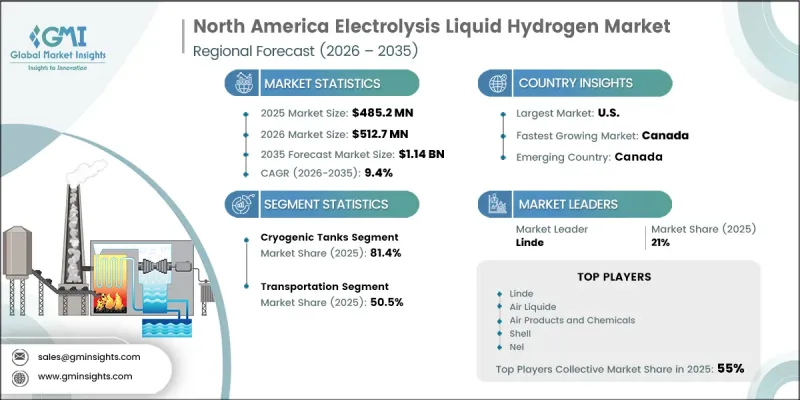
North America Electrolysis Liquid Hydrogen Market was valued at USD 485.2 million in 2025 and is estimated to grow at a CAGR of 9.4% to reach USD 1.14 billion by 2035.
Growth in the market is strongly influenced by government-backed funding mechanisms, including tax incentives, grants, and hydrogen hub development programs that are accelerating large-scale deployment of electrolysis-based hydrogen production systems. Policy frameworks such as the Infrastructure Investment and Jobs Act, along with national hydrogen initiatives, are reducing capital risk for private investors and enabling faster commercialization of hydrogen production and distribution networks. These measures are strengthening long-term demand visibility across industrial and energy sectors. In parallel, rising decarbonization commitments across heavy industries are driving the adoption of low-emission hydrogen alternatives, particularly in refining, chemicals, steel production, and other energy-intensive sectors. Electrolysis-based liquid hydrogen is increasingly viewed as a critical pathway for achieving net-zero targets due to its zero-emission characteristics and compatibility with evolving sustainability mandates. Improvements in electrolyzer efficiency and cost reductions in system deployment are also supporting wider adoption and encouraging commercialization at scale across the region.
| Market Scope | |
|---|---|
| Start Year | 2025 |
| Forecast Year | 2026-2035 |
| Start Value | $485.2 Million |
| Forecast Value | $1.14 Billion |
| CAGR | 9.4% |
The cryogenic tanks segment held 81.4% share and is projected to grow at a CAGR of 9% through 2035. The expansion of liquid hydrogen production through electrolysis is driving strong demand for advanced storage solutions capable of handling extremely low-temperature conditions. Cryogenic tanks play a crucial role in maintaining hydrogen in its liquid state while minimizing evaporation losses and ensuring safe handling during storage and transport. Their ability to support efficient large-scale distribution makes them a core component of hydrogen infrastructure development across the region.
The transportation segment held a 50.5% share and is expected to grow at a CAGR of 9.8% through 2035. Increasing adoption of hydrogen fuel cell technologies across mobility applications is significantly contributing to demand for electrolysis-derived liquid hydrogen as a clean energy source. Growing investments in hydrogen-powered transport systems by mobility and logistics operators are further strengthening infrastructure requirements, enabling efficient refueling capabilities and supporting long-distance operational performance. This shift is reinforcing hydrogen's role in decarbonizing transportation networks across North America.
U.S. Electrolysis Liquid Hydrogen Market is expected to reach USD 840 million by 2035. Expansion is being driven by the development of hydrogen production and distribution hubs under national clean energy initiatives aimed at creating integrated hydrogen ecosystems across the country. These programs emphasize large-scale production of green hydrogen, supported by renewable energy integration, which is expected to significantly enhance supply capabilities and strengthen long-term market growth.
Major companies operating in the North America electrolysis liquid hydrogen market include Siemens Energy, Air Liquide, Plug Power, Linde, Bloom Energy, Nel, Air Products and Chemicals, Thyssenkrupp, ENGIE, Ohmium, Accelera, Enapter, GreenH Electrolysis, HY2GEN, Everllence, HTEC, HORIBA, Parker US, Robert Bosch LLC, Shell, and John Cockerill. Companies operating in the North America electrolysis liquid hydrogen market are focusing on large-scale project development, technological innovation, and strategic partnerships to strengthen their market position. Continuous investment in advanced electrolyzer technologies is improving efficiency, reducing production costs, and enhancing the scalability of hydrogen production systems. Market participants are actively collaborating with governments, utilities, and industrial end users to secure long-term project agreements and strengthen supply chain integration. Expansion of hydrogen production facilities and storage infrastructure is also supporting faster commercialization across key demand centers.
Table of Contents
Chapter 1 Methodology & Scope
- 1.1 Research design
- 1.2 Quality commitment
- 1.2.1 GMI AI policy & data integrity commitment
- 1.2.1.1 Source consistency protocol
- 1.2.1 GMI AI policy & data integrity commitment
- 1.3 Research Trail & Confidence Scoring
- 1.3.1 Research Trail Components
- 1.3.2 Scoring Components
- 1.4 Data Collection
- 1.4.1 Partial list of primary sources
- 1.5 Data mining sources
- 1.5.1 Paid sources
- 1.5.1.1 Sources, by region
- 1.5.1 Paid sources
- 1.6 Base estimates and calculations
- 1.6.1 Base year calculation for any one approach
- 1.7 Forecast model
- 1.8 Research transparency addendum
- 1.8.1 Source attribution framework
- 1.8.2 Quality assurance metrics
- 1.8.3 Our commitment to trust
- 1.9 Market definitions
Chapter 2 Executive Summary
- 2.1 Industry synopsis, 2022 - 2035
- 2.2 Business trends
- 2.3 Distribution trends
- 2.4 End Use trends
- 2.5 Country trends
Chapter 3 Industry Insights
- 3.1 Industry ecosystem
- 3.1.1 Raw material availability & sourcing analysis
- 3.1.2 Manufacturing capacity assessment
- 3.1.3 Supply chain resilience & risk factors
- 3.1.4 Distribution network analysis
- 3.2 Regulatory landscape
- 3.2.1 U.S.
- 3.2.2 Canada
- 3.3 Industry impact forces
- 3.3.1 Growth drivers
- 3.3.2 Industry pitfalls & challenges
- 3.4 Growth potential analysis
- 3.5 Porter's analysis
- 3.5.1 Bargaining power of suppliers
- 3.5.2 Bargaining power of buyers
- 3.5.3 Threat of new entrants
- 3.5.4 Threat of substitutes
- 3.6 PESTEL analysis
- 3.6.1 Political factors
- 3.6.2 Economic factors
- 3.6.3 Social factors
- 3.6.4 Technological factors
- 3.6.5 Legal factors
- 3.6.6 Environmental factors
- 3.7 Cost structure analysis of electrolysis liquid hydrogen
- 3.8 Price trend analysis (Driven by Primary Research)
- 3.8.1 By end use (USD/Ton) (Driven by Primary Research)
- 3.8.2 Pricing strategy by key players (Driven by Primary Research)
- 3.9 Impact of AI & generative AI on the market
- 3.9.1 Predictive maintenance & fault detection
- 3.9.2 Grid optimization & load forecasting
- 3.9.3 Digital twin simulation & testing
- 3.9.4 Risks, limitations & regulatory considerations
- 3.10 Emerging opportunities & trends
- 3.10.1 Digitalization & IoT integration
- 3.10.2 Emerging market penetration
- 3.11 Overall investment scenario and future outlook
Chapter 4 Competitive landscape, 2026
- 4.1 Introduction
- 4.2 Company market share analysis, by country, 2025
- 4.2.1 U.S.
- 4.2.2 Canada
- 4.3 Competitive analysis of major market players
- 4.4 Competitive positioning matrix
- 4.5 Key developments
- 4.5.1 Mergers & acquisitions
- 4.5.2 Partnerships & collaborations
- 4.5.3 New product launches
- 4.5.4 Expansion plans & funding
- 4.6 Company tier benchmarking
- 4.6.1 Tier classification criteria & qualifying thresholds
- 4.6.2 Tier positioning matrix by revenue, geography & innovation
Chapter 5 Market Size and Forecast, By Distribution, 2022 - 2035 (USD Million & MT)
- 5.1 Key trends
- 5.2 Pipelines
- 5.3 Cryogenic tanks
Chapter 6 Market Size and Forecast, By End use, 2022 - 2035 (USD Million & MT)
- 6.1 Key trends
- 6.2 Transportation
- 6.3 Chemical
- 6.4 Petroleum refining
- 6.5 Aerospace & defense
- 6.6 Energy storage & power generation
- 6.7 Industrial
- 6.8 Others
Chapter 7 Market Size and Forecast, By Country, 2022 - 2035 (USD Million & MT)
- 7.1 Key trends
- 7.2 U.S.
- 7.3 Canada
Chapter 8 Company Profiles
- 8.1 Accelera
- 8.2 Air Liquide
- 8.3 Air Products and Chemicals
- 8.4 Bloom Energy
- 8.5 Enapter
- 8.6 ENGIE
- 8.7 Everllence
- 8.8 GreenH Electrolysis
- 8.9 HORIBA
- 8.10 HTEC
- 8.11 HY2GEN
- 8.12 John Cockerill
- 8.13 Linde
- 8.14 Nel
- 8.15 Ohmium
- 8.16 Parker US
- 8.17 Plug Power
- 8.18 Robert Bosch LLC
- 8.19 Shell
- 8.20 Siemens Energy
- 8.21 Thyssenkrupp
- 8.22 VERDE Hydrogen

