PUBLISHER: Global Market Insights Inc. | PRODUCT CODE: 2101990

PUBLISHER: Global Market Insights Inc. | PRODUCT CODE: 2101990
Europe Liquid Hydrogen Market Opportunity, Growth Drivers, Industry Trend Analysis, and Forecast 2026 - 2035
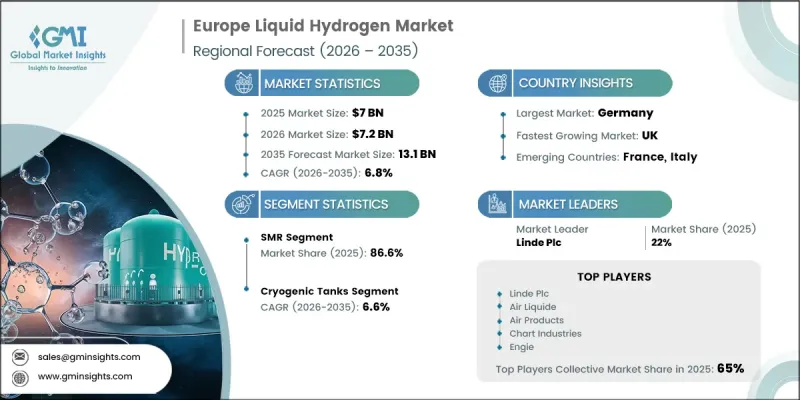
Europe Liquid Hydrogen Market was valued at USD 7 billion in 2025 and is estimated to grow at a CAGR of 6.8% to reach USD 13.1 billion by 2035.
The market is expanding as Europe intensifies its focus on deep decarbonization across hard-to-abate industries. Sectors such as steel, chemicals, refining, shipping, and long-distance transport are increasingly shifting toward low-carbon energy alternatives, supporting stronger adoption of liquid hydrogen. These industries require high-energy-density fuels that are difficult to electrify directly, making liquid hydrogen a viable solution for both energy storage and long-distance transportation. It also plays a key role in industrial feedstock substitution and fuel transition strategies aligned with Europe's net-zero commitments and regulatory frameworks. Rising investment in hydrogen infrastructure, including liquefaction facilities, storage systems, pipeline networks, ports, and cross-border corridors, is further strengthening market development. Governments and private stakeholders are actively working to build integrated hydrogen supply chains to enhance energy security and reduce dependence on fossil fuel imports. Liquid hydrogen is also gaining importance for its ability to enable efficient bulk transport between production centers and demand hubs, improving scalability and supply reliability across the region's evolving energy ecosystem.
| Market Scope | |
|---|---|
| Start Year | 2025 |
| Forecast Year | 2026-2035 |
| Start Value | $7 Billion |
| Forecast Value | $13.1 Billion |
| CAGR | 6.8% |
The SMR segment held 86.6% share in 2025 and is projected to grow at a CAGR of 6.8% through 2035. This leadership is supported by the increasing use of SMR-based hydrogen production integrated with carbon capture systems, which enables rapid scaling of supply using existing natural gas infrastructure. SMR continues to be preferred due to its reliability, high production capacity, and cost efficiency during the transition toward cleaner hydrogen systems, supporting stable market growth.
The cryogenic tanks segment accounted for 80% share in 2025 and is expected to grow at a CAGR of 6.6% from 2026 to 2035. Growth in this segment is driven by rising demand for efficient long-distance hydrogen transportation across distributed industrial zones, mobility networks, and port infrastructure. Cryogenic storage systems enable high-density hydrogen containment, reduced losses, and flexible distribution, making them essential for large-scale liquid hydrogen logistics across Europe.
Germany Liquid Hydrogen Market held 47.3% share in 2025, and is projected to generate USD 6 billion by 2035. The country's leadership is supported by rapid expansion of hydrogen infrastructure and increasing industrial demand for clean energy alternatives. Heavy industries such as steel, chemicals, and refining continue to drive strong hydrogen consumption, requiring large-scale and reliable supply systems. Liquid hydrogen supports centralized production and long-distance transport, strengthening supply chain flexibility and reinforcing Germany's broader energy transition strategy.
Major companies operating in the Europe liquid hydrogen market include Air Liquide, Air Products, Linde plc, Engie, Messer Group, Plug Power, Nel ASA, Chart Industries, Cryostar, Cummins, GenH2, H2 Energy, Hexagon Purus, INOXCVA, Iwatani Corporation, Kawasaki Heavy Industries, Cryospain, Salzburger Aluminium Group, SOL Group, and Taylor-Wharton. Companies operating in the Europe liquid hydrogen market are focusing on strengthening their market position through large-scale investments in hydrogen liquefaction and storage infrastructure. Strategic collaborations between energy companies, industrial players, and technology providers are accelerating project execution and expanding regional supply networks. Firms are actively developing advanced cryogenic storage and transport solutions to improve efficiency and reduce energy losses during distribution. Integration of renewable energy sources with hydrogen production is also becoming a key strategy to enhance sustainability credentials. Companies are expanding their presence across cross-border hydrogen corridors to support international trade and energy security objectives.
Table of Contents
Chapter 1 Methodology & Scope
- 1.1 Research design
- 1.2 Quality commitment
- 1.2.1 GMI AI policy & data integrity commitment
- 1.2.1.1 Source consistency protocol
- 1.2.1 GMI AI policy & data integrity commitment
- 1.3 Research Trail & Confidence Scoring
- 1.3.1 Research Trail Components
- 1.3.2 Scoring Components
- 1.4 Data Collection
- 1.4.1 Partial list of primary sources
- 1.5 Data mining sources
- 1.5.1 Paid sources
- 1.5.1.1 Sources, by region
- 1.5.1 Paid sources
- 1.6 Base estimates and calculations
- 1.6.1 Base year calculation for any one approach
- 1.7 Forecast model
- 1.8 Research transparency addendum
- 1.8.1 Source attribution framework
- 1.8.2 Quality assurance metrics
- 1.8.3 Our commitment to trust
- 1.9 Market definitions
Chapter 2 Executive Summary
- 2.1 Industry synopsis, 2022 – 2035
- 2.2 Business trends
- 2.3 Production trends
- 2.4 Distribution trends
- 2.5 End Use trends
- 2.6 Country trends
Chapter 3 Industry Insights
- 3.1 Industry ecosystem
- 3.1.1 Raw material availability & sourcing analysis
- 3.1.2 Manufacturing capacity assessment
- 3.1.3 Supply chain resilience & risk factors
- 3.1.4 Distribution network analysis
- 3.2 Regulatory landscape
- 3.3 Industry impact forces
- 3.3.1 Growth drivers
- 3.3.2 Industry pitfalls & challenges
- 3.4 Growth potential analysis
- 3.5 Porter's analysis
- 3.5.1 Bargaining power of suppliers
- 3.5.2 Bargaining power of buyers
- 3.5.3 Threat of new entrants
- 3.5.4 Threat of substitutes
- 3.6 PESTEL analysis
- 3.6.1 Political factors
- 3.6.2 Economic factors
- 3.6.3 Social factors
- 3.6.4 Technological factors
- 3.6.5 Legal factors
- 3.6.6 Environmental factors
- 3.7 Cost structure analysis of liquid hydrogen market
- 3.8 Price trend analysis (Driven by Primary Research)
- 3.8.1 Historical price trend analysis (Driven by Primary Research)
- 3.8.2 Liquid hydrogen pricing by production (USD/Ton) (Driven by Primary Research)
- 3.9 Trade data analysis (Driven by Primary Research)
- 3.9.1 Import/export value trends (Driven by Primary Research)
- 3.9.2 Key trade corridors & tariff impact (Driven by Primary Research)
- 3.10 Production capacity & utilization (Driven by Primary Research)
- 3.10.1 Production capacity by country (Driven by Primary Research)
- 3.10.2 Utilization rates (Driven by Primary Research)
- 3.11 Impact of AI & generative AI on the market
- 3.11.1 Predictive maintenance & fault detection
- 3.11.2 Grid optimization & load forecasting
- 3.11.3 Digital twin simulation & testing
- 3.11.4 Risks, limitations & regulatory considerations
- 3.12 Emerging opportunities & trends
- 3.12.1 Digitalization & IoT integration
- 3.12.2 Emerging market penetration
- 3.13 Overall investment scenario and future outlook
Chapter 4 Competitive landscape, 2026
- 4.1 Introduction
- 4.2 Company market share analysis, by country, 2025
- 4.2.1 Germany
- 4.2.2 UK
- 4.2.3 France
- 4.2.4 Italy
- 4.3 Competitive analysis of major market players
- 4.4 Competitive positioning matrix
- 4.5 Key developments
- 4.5.1 Mergers & acquisitions
- 4.5.2 Partnerships & collaborations
- 4.5.3 New product launches
- 4.5.4 Expansion plans & funding
- 4.6 Company tier benchmarking
- 4.6.1 Tier classification criteria & qualifying thresholds
- 4.6.2 Tier positioning matrix by revenue, geography & innovation
Chapter 5 Market Size and Forecast, By Production, 2022 – 2035 (USD Billion & MT)
- 5.1 Key trends
- 5.2 Coal gasification
- 5.3 SMR
- 5.4 Electrolysis
Chapter 6 Market Size and Forecast, By Distribution, 2022 – 2035 (USD Billion & MT)
- 6.1 Key trends
- 6.2 Pipelines
- 6.3 Cryogenic tanks
Chapter 7 Market Size and Forecast, By End use, 2022 – 2035 (USD Billion & MT)
- 7.1 Key trends
- 7.2 Transportation
- 7.2.1 Light duty vehicles (LDV)
- 7.2.2 Heavy duty vehicles (HDV)
- 7.2.3 Hydrogen ship
- 7.2.4 Rail
- 7.2.5 Port machinery
- 7.2.6 Construction machinery
- 7.3 Chemicals
- 7.4 Others
Chapter 8 Market Size and Forecast, By Country, 2022 – 2035 (USD Billion & MT)
- 8.1 Key trends
- 8.2 Germany
- 8.3 UK
- 8.4 France
- 8.5 Italy
Chapter 9 Company Profiles
- 9.1 Air Liquide
- 9.2 Air Products
- 9.3 Chart Industries
- 9.4 Cryospain
- 9.5 Cryostar
- 9.6 Cummins
- 9.7 Engie
- 9.8 GenH2
- 9.9 H2 Energy
- 9.10 Hexagon Purus
- 9.11 INOXCVA
- 9.12 Iwatani Corporation
- 9.13 Kawasaki Heavy Industries
- 9.14 Linde plc
- 9.15 Messer Group
- 9.16 Nel ASA
- 9.17 Plug Power
- 9.18 SOL Group
- 9.19 Taylor-Wharton

