PUBLISHER: Mordor Intelligence | PRODUCT CODE: 2100757

PUBLISHER: Mordor Intelligence | PRODUCT CODE: 2100757
North America Liquid Hydrogen - Market Share Analysis, Industry Trends & Statistics, Growth Forecasts (2026 - 2031)
According to Mordor Intelligence, the liquid hydrogen market in North America measured 136.79 kilotons in 2026 and is projected to reach 224.23 kilotons by 2031, growing at a 10.39% CAGR; this outlook underscores the market size potential as federal incentives and decarbonization targets widen use beyond aerospace into transport and industrial segments.
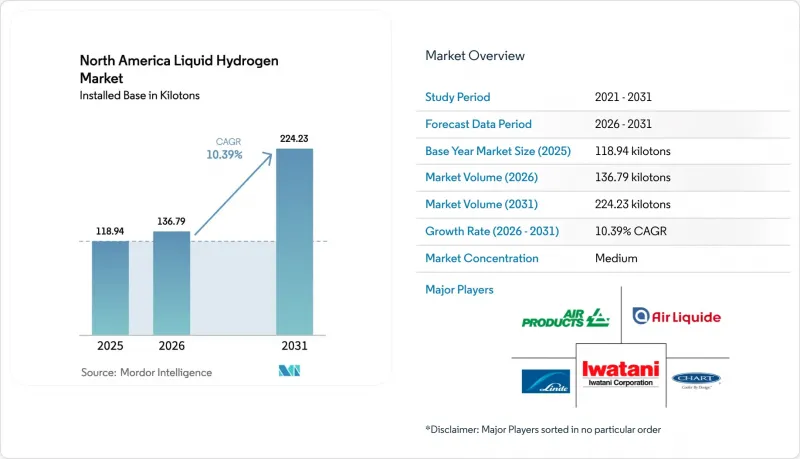
This report is Segmented by Distribution (Cryogenic Tank and High-Pressure Tube Trailers), Application (Automotive, Aerospace-Including Outer Space, Industrial, Marine, Power Generation and Energy Storage, and Other Applications), and Geography (United States, Canada, and Mexico). The Market Sizes and Forecasts are Provided in Terms of Volume (Kilo Tons).
North America Liquid Hydrogen Market Trends and Insights
DOE-Funded Hydrogen Hubs Accelerate Liquefaction Investment
Seven regional clean hydrogen hubs awarded USD 7 billion in federal grants during 2023 are underwriting 50- to 100-ton-per-day liquefaction trains that reach sub-USD 2.50-per-kilogram unit costs and crowd-in private commitments from Air Products, Air Liquide, and other project sponsors. Off-take contracts pooled across transport, industrial, and power customers de-risk utilization and enable developers to secure long-term debt, shortening project payback windows to well under ten years. Gulf Coast and California hubs have already broken ground on liquefaction blocks tied to port and pipeline infrastructure, while the Pacific Northwest hub combines renewable electrolysis with cryogenic storage for aerospace and cross-border exports. Regional specialization also aligns production pathways, blue projects where natural gas and sequestration are abundant, green projects where wind or solar is cheapest, optimizing capital allocation. The resulting infrastructure lattice is expected to anchor contiguous networks of production, storage, and distribution that lower delivered costs and accelerate adoption beyond early niches.
Scale-Up of Class-8 Fuel-Cell Truck Pilots Along I-80 & I-5 Corridors
California's Advanced Clean Fleets regulation requires new drayage trucks to be zero-emission from 2024 onward, prompting fleet operators to place multi-year orders for liquid hydrogen trucks that deliver 500- to 600-mile range without payload penalties. Hyundai, Nikola, and Volvo have collectively deployed more than 200 heavy-duty fuel-cell tractors since 2024, supported by a growing network of refueling stations dispensing cryogenic fuel that is vaporized and compressed on site. The California Energy Commission's USD 150 million grant program covers up to 50% of station capex, lowering retailer risk during utilization ramp-up. Fleet operators cite rapid fueling times and route flexibility as principal advantages over battery-electric trucks on long-haul lanes. As station density improves, original equipment manufacturers anticipate cost parity with diesel on a total-cost-of-ownership basis by 2028, catalyzing broader adoption across Western and Mountain states.
High Boil-Off Losses for below 3 t/Day Storage Systems
Small storage tanks exhibit unfavorable surface-area-to-volume ratios that raise daily venting to 1.5%-3.0%, translating into USD 150-USD 300 lost product for a 1 t/day user and imposing costly mitigation requirements such as recovery compressors or active cryocoolers. NFPA 2 spacing rules further complicate installations in dense industrial parks, as vent stacks must lie at least 25 ft from ignition sources. However, zero-boil-off pilots promise relief, their USD 0.5-1.0 million price point reserves adoption for mission-critical aerospace programs. Until costs fall, high venting erodes the business case for small-scale users, slowing penetration in fragmented industrial niches.
Other drivers and restraints analyzed in the detailed report include:
- Federal 45V/45Q Tax Credits Compress Payback Periods for CCUS-Based LH2
- Emergence of "Cold Ironing" Mandates at West-Coast Ports
- Limited Availability of Cryogenic Tanker Manufacturing Capacity
For complete list of drivers and restraints, kindly check the Table Of Contents.
Segment Analysis
Tube trailers, although smaller in payload, are scaling faster than cryogenic tankers thanks to lower capital outlay and faster permitting. The segment is projected to post an 11.6% CAGR between 2026 and 2031, narrowing delivered-cost differentials with cryogenic supply to below 15% on hauls shorter than 200 miles, aided by Type 4 composite cylinders that shave trailer tare weight by 40%. Cryogenic tanks still dominate heavy-volume lanes because a single tanker carries up to 5 t, equivalent to roughly eight tube trailer loads, and achieves better utilization over long distances, making it the backbone for aerospace and refinery customers. Logistics operators are experimenting with autonomous convoys on Interstate 10 to offset driver shortages and optimize drop-and-hook cycles, a strategy expected to extend liquid hydrogen market size leadership for cryogenic fleets.
Tube trailer adoption is resonating among fleet operators that consume only 100-300 kg per day and among electronics and food processors, where on-site vaporizers inflate upfront costs. Distributors bundle trailers with mobile pumping skids, enabling customers to avoid storage tank capex entirely. This "gas-as-a-service" model reduces switching friction and diversifies demand away from cyclical aerospace volumes. Over the forecast horizon, supply chain investments in lightweight cylinders and high-capacity compressors will further improve asset turns, lifting profitability for distributors that target the mid-volume sweet spot.
Complete Report Scope:
- By Distribution
- Cryogenic Tank
- High-pressure Tube Trailers
- By Application
- Automotive
- Aerospace (Including Outer Space)
- Industrial
- Marine
- Power Generation and Energy Storage
- Other Applications
- By Geography
- United States
- Canada
- Mexico
List of Companies Covered in this Report:
- Air Liquide S.A.
- Air Products and Chemicals, Inc.
- Linde plc
- Air Water Inc.
- Iwatani Corporation
- Messer Group GmbH
- Engie SA
- Chart Industries Inc.
- Universal Industrial Gases, Inc.
- Plug Power Inc.
- Hexagon Composites ASA
- Kawasaki Heavy Industries, Ltd.
- Cryostar SAS
- INOX India Ltd (INOXCVA)
- Taylor-Wharton
- Gardner Cryogenics
- FIBA Technologies Inc.
- Wessington Cryogenics
- VRV S.p.A.
- Hylium Industries Inc.
- CIMC ENRIC Holdings Ltd.
Additional Benefits:
- The market estimate (ME) sheet in Excel format
- 3 months of analyst support
TABLE OF CONTENTS
1 Introduction
- 1.1 Study Assumptions & Market Definition
- 1.2 Scope of the Study
2 Research Methodology
3 Executive Summary
4 Market Landscape
- 4.1 Market Overview
- 4.2 Market Drivers
- 4.2.1 DOE-funded hydrogen hubs accelerate liquefaction investment
- 4.2.2 Scale-up of Class-8 fuel-cell truck pilots along I-80 & I-5 corridors
- 4.2.3 Federal 45V/45Q tax credits compress payback periods for CCUS-based LH?
- 4.2.4 Emergence of "cold ironing" mandates at West-Coast ports
- 4.2.5 Super-insulated micro-bulk tanks enabling LH2 deliveries to SME sites
- 4.3 Market Restraints
- 4.3.1 High boil-off losses for <3-t/day storage systems
- 4.3.2 Limited availability of cryogenic tanker manufacturing capacity
- 4.3.3 County-level hazmat restrictions on LH? trucking routes
- 4.4 Supply-Chain Analysis
- 4.5 Regulatory Landscape
- 4.6 Technological Outlook
- 4.7 Porter's Five Forces
- 4.7.1 Bargaining Power of Suppliers
- 4.7.2 Bargaining Power of Consumers
- 4.7.3 Threat of New Entrants
- 4.7.4 Threat of Substitute Products & Services
- 4.7.5 Intensity of Competitive Rivalry
5 Market Size & Growth Forecasts
- 5.1 By Distribution
- 5.1.1 Cryogenic Tank
- 5.1.2 High-pressure Tube Trailers
- 5.2 By Application
- 5.2.1 Automotive
- 5.2.2 Aerospace (Including Outer Space)
- 5.2.3 Industrial
- 5.2.4 Marine
- 5.2.5 Power Generation and Energy Storage
- 5.2.6 Other Applications
- 5.3 By Geography
- 5.3.1 United States
- 5.3.2 Canada
- 5.3.3 Mexico
6 Competitive Landscape
- 6.1 Market Concentration
- 6.2 Strategic Moves
- 6.3 Market Share Analysis
- 6.4 Company Profiles (includes Global level Overview, Market level overview, Core Segments, Financials as available, Strategic Information, Market Rank/Share for key companies, Products & Services, and Recent Developments)
- 6.4.1 Air Liquide S.A.
- 6.4.2 Air Products and Chemicals, Inc.
- 6.4.3 Linde plc
- 6.4.4 Air Water Inc.
- 6.4.5 Iwatani Corporation
- 6.4.6 Messer Group GmbH
- 6.4.7 Engie SA
- 6.4.8 Chart Industries Inc.
- 6.4.9 Universal Industrial Gases, Inc.
- 6.4.10 Plug Power Inc.
- 6.4.11 Hexagon Composites ASA
- 6.4.12 Kawasaki Heavy Industries, Ltd.
- 6.4.13 Cryostar SAS
- 6.4.14 INOX India Ltd (INOXCVA)
- 6.4.15 Taylor-Wharton
- 6.4.16 Gardner Cryogenics
- 6.4.17 FIBA Technologies Inc.
- 6.4.18 Wessington Cryogenics
- 6.4.19 VRV S.p.A.
- 6.4.20 Hylium Industries Inc.
- 6.4.21 CIMC ENRIC Holdings Ltd.
7 Market Opportunities & Future Outlook
- 7.1 White-space & Unmet-Need Assessment

