PUBLISHER: Mordor Intelligence | PRODUCT CODE: 2125285

PUBLISHER: Mordor Intelligence | PRODUCT CODE: 2125285
Household Coffee Machine - Market Share Analysis, Industry Trends & Statistics, Growth Forecasts (2026 - 2031)
According to Mordor Intelligence, the household coffee machines market size was valued at USD 13.65 billion in 2025 and estimated to grow from USD 14.48 billion in 2026 to reach USD 19.4 billion by 2031, at a CAGR of 6.05% during the forecast period (2026-2031).
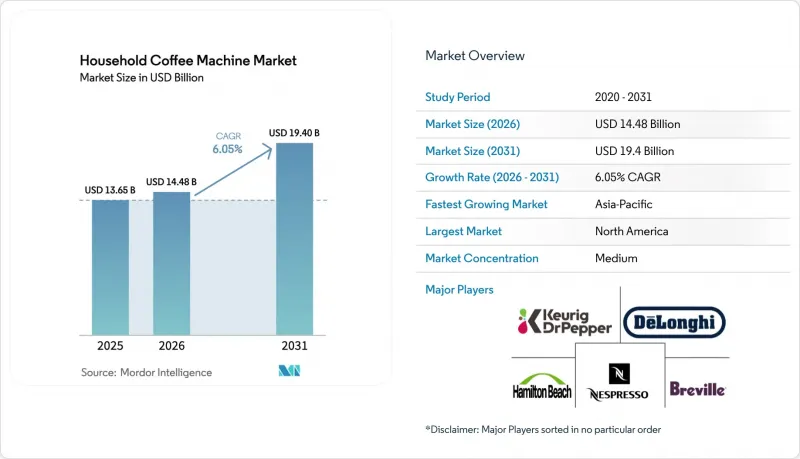
This report is Segmented by Product Type (Drip Coffee Machines, Espresso Coffee Machines, and More), by Automation Level (Manual, Semi-Automatic, and More), by Distribution Channel (Supermarkets & Hypermarkets, Specialty Stores, and More), by Geography (North America, Europe, and More). The Market Forecasts are Provided in Terms of Value (USD).
Global Household Coffee Machine Market Trends and Insights
Consumer Shift to At-Home Coffee Rituals in North America and Europe
Remote and hybrid work patterns entrenched a daily home-brewing habit across developed markets. Household penetration of single-serve and bean-to-cup appliances rose alongside inflation-driven cafe avoidance. The National Coffee Association reported that coffee would replace bottled water as the most purchased beverage by US consumers in 2025. Manufacturers responded with compact countertop designs and flavor-forward recipes that replicate cafe specials, such as pistachio lattes, boosting premium equipment sales. Seasonal flavor experimentation resonates with Gen Z buyers who favor personalization. These lifestyle shifts sustain demand beyond cyclical income changes, embedding long-term volume growth for the coffee machines market.
Convenience-Led Surge in Pod and Capsule Subscriptions
Subscription plans that bundle brewers with recurring capsule deliveries transform one-time hardware purchases into annuity streams for brand owners. Keurig Dr Pepper reported an installed base exceeding 38 million US households, demonstrating the lock-in advantage of closed systems. Nespresso's direct-to-consumer expansion in Asia couples rapid capsule replenishment with premium positioning that appeals to new urban consumers. EU circular-economy rules accelerate the shift toward aluminum and compostable capsules, and industry leaders fund in-market recycling schemes that mitigate environmental concerns. Convenience, portion control, and mess-free disposal keep pod machines central to daily routines, ensuring sustained volume momentum.
High ASPs Limiting Penetration in Price-Sensitive South America
Currency devaluation and commodity-driven inflation lift the cost of imported appliances in several Latin markets. Retail coffee prices in Brazil spiked in 2024, and additional increases are forecast for 2025, constraining discretionary spending. Entry-level machines hold their ground, yet premium espresso systems struggle for reach. Select manufacturers pivot to modular designs that allow gradual feature upgrades, improving affordability. Simultaneously, premium coffee beans enjoy double-digit growth in metropolitan Brazil, signaling distinct niches within the region. Targeted promotional finance and local assembly agreements could narrow the price gap over the medium term.
Other drivers and restraints analyzed in the detailed report include:
- Growing Espresso Culture in Tier-1 Asian Cities
- IoT-Enabled Smart Machines Elevating Replacement Demand
- Regulatory Scrutiny on Single-Use Capsules in the EU
For complete list of drivers and restraints, kindly check the Table Of Contents.
Segment Analysis
Pod and capsule machines delivered 38.86% of global revenue in 2025, reflecting the twin appeal of speed and consistency. Many households regard capsule brewers as the simplest path to espresso-quality drinks without barista skills. The subscription sales model for consumables locks in brand switching costs while generating predictable replenishment volume. Nespresso leverages this framework by offering boutique recycling hubs and loyalty rewards that anchor premium positioning. Domestic Chinese challengers such as Joyoung price aggressively, broadening entry-level access and propelling regional growth.
Bean-to-cup machines, by contrast, dominate the upper price tiers and represent the fastest-growing line with an 8.34% CAGR to 2031. This segment attracts enthusiasts seeking freshly ground beans, automatic milk texturing, and personalized profiles. Commercial variants command list prices of USD 10,000-20,000 and offer programmable recipes for cafes and offices. As connectivity improves, cloud-based telemetry aids predictive maintenance, reducing downtime and justifying inclusive service contracts. Drip coffee makers retain relevance among budget-minded users, especially in North American markets where filter taste profiles remain popular. Traditional percolators and pour-over gear occupy cultural niches but contribute little incremental revenue. The diverging paths of convenience-driven pods and experience-driven bean-to-cup units highlight a barbell structure that guides product development and marketing investments across the coffee machines market.
Complete Report Scope:
- By Product Type
- Drip Coffee Machines
- Espresso Coffee Machines
- Pod/Capsule Coffee Machines
- Bean-to-Cup (Automatic Espresso) Machines
- Percolators & Others
- By Automation Level
- Manual
- Semi-Automatic
- Fully Automatic
- Smart Connected / IoT-Enabled
- By Distribution Channel
- Supermarkets & Hypermarkets
- Specialty Stores
- Online Retail
- Direct-to-Consumer (Brand Stores & Subscriptions)
- Other Offline Channels
- By Geography
- North America
- United States
- Canada
- Mexico
- South America
- Brazil
- Peru
- Chile
- Argentina
- Rest of South America
- Asia-Pacific
- India
- China
- Japan
- Australia
- South Korea
- South-East Asia (Singapore, Malaysia, Thailand, Indonesia, Vietnam, Philippines)
- Rest of Asia-Pacific
- Europe
- United Kingdom
- Germany
- France
- Spain
- Italy
- BENELUX (Belgium, Netherlands, Luxembourg)
- NORDICS (Denmark, Finland, Iceland, Norway, Sweden)
- Rest of Europe
- Middle East & Africa
- United Arab Emirates
- Saudi Arabia
- South Africa
- Nigeria
- Rest of Middle East & Africa
- North America
Geography Analysis
North America contributed 32.88% of global revenue in 2025 and remains the largest regional market. High household penetration and a mature cafe culture form a solid baseline, yet innovation continues to unlock incremental spending. Keurig Dr Pepper shipped 10.4 million brewers in 2024, reinforcing replacement cycles and pod subscription growth. Smart-home adoption catalyzes demand for Wi-Fi and voice-controlled units, while sustainability concerns channel attention to energy ratings and recyclable materials. Canadian consumers mirror US preferences, with premium single-serve units outperforming entry-level drip models, and Mexico records steady uptake driven by urban middle-class expansion.
Asia-Pacific is the fastest-growing territory, recording a 7.41% CAGR toward 2031. The coffee machines market size for the region stood at USD 3.58 billion in 2026 and is projected to exceed USD 5.12 billion in 2031. China's branded cafe boom spills into home adoption as consumers seek to replicate familiar espresso beverages. Domestic appliance makers integrate local payment apps and social-sharing features, tailoring value propositions to tech-savvy millennials. India follows with strong demand in metropolitan pockets, while Vietnam, Indonesia, and the Philippines expand from low installed bases. Local assembly initiatives limit tariffs and customize voltage specifications, enhancing affordability and cultural fit.
Europe delivers stable growth despite strict environmental legislation. The Ecodesign Regulation compels appliance makers to redesign heating blocks, standby consumption, and material recyclability. Early adopters accept marginal price premiums for units carrying EU energy labels, reinforcing a virtuous cycle of sustainability investment. Southern Europe's espresso tradition underpins demand for semi-automatic machines, whereas Northern markets lean toward fully automatic convenience. South America's potential remains tempered by macroeconomic volatility. Retailers in Brazil introduce installment plans to mitigate currency depreciation, yet replacement cycles lengthen as consumers delay non-essential upgrades. The Middle East and Africa offer niche prospects, anchored by specialty cafe proliferation in the Gulf and rising urbanization in East Africa, although fragmented distribution and price sensitivity pose challenges.
- Keurig Dr Pepper Inc.
- De Longhi Group
- Nestle Nespresso SA
- Breville Group Ltd.
- Hamilton Beach Brands Inc.
- Jura Elektroapparate AG
- Koninklijke Philips N.V. (Philips Domestic Appliances)
- Groupe SEB (Krups, Tefal)
- BSH Hausgerate GmbH (Bosch, Siemens)
- Spectrum Brands Holdings (Black+Decker, Russell Hobbs)
- Newell Brands Inc. (Mr. Coffee)
- Conair LLC (Cuisinart)
- Melitta Group
- Lavazza Group (Gaggia, Saeco)
- Smeg S.p.A.
- Panasonic Corporation
- Electrolux AB
- Morphy Richards
- Illycaffe S.p.A.
- Wilfa AS*
Additional Benefits:
- The market estimate (ME) sheet in Excel format
- 3 months of analyst support
TABLE OF CONTENTS
1 Introduction
- 1.1 Study Assumptions & Market Definition
- 1.2 Scope of the Study
2 Research Methodology
3 Executive Summary
4 Market Landscape
- 4.1 Market Overview
- 4.2 Market Drivers
- 4.2.1 Consumer Shift to At-Home Coffee Rituals in North America & Europe
- 4.2.2 Convenience-Led Surge in Pod/Capsule Subscriptions
- 4.2.3 Growing Espresso Culture in Tier-1 Asian Cities
- 4.2.4 IoT-Enabled Smart Machines Elevating Replacement Demand
- 4.2.5 Energy-Efficient Designs Driven by EU Eco-Directives
- 4.2.6 Direct-to-Consumer Bundled Coffee-Machine Plans
- 4.3 Market Restraints
- 4.3.1 High ASPs Limiting Penetration in Price-Sensitive South America
- 4.3.2 Regulatory Scrutiny on Single-Use Capsules in the EU
- 4.3.3 Semiconductor Shortages Inflating Lead-Times
- 4.3.4 RTD Coffee Popularity Cannibalising Entry-Level Machines
- 4.4 Value / Supply-Chain Analysis
- 4.5 Technological Outlook
- 4.6 Regulatory Outlook
- 4.7 Porter's Five Forces
- 4.7.1 Threat of New Entrants
- 4.7.2 Bargaining Power of Buyers
- 4.7.3 Bargaining Power of Suppliers
- 4.7.4 Threat of Substitutes
- 4.7.5 Competitive Rivalry
5 Market Size & Growth Forecasts (Value & Volume)
- 5.1 By Product Type
- 5.1.1 Drip Coffee Machines
- 5.1.2 Espresso Coffee Machines
- 5.1.3 Pod/Capsule Coffee Machines
- 5.1.4 Bean-to-Cup (Automatic Espresso) Machines
- 5.1.5 Percolators & Others
- 5.2 By Automation Level
- 5.2.1 Manual
- 5.2.2 Semi-Automatic
- 5.2.3 Fully Automatic
- 5.2.4 Smart Connected / IoT-Enabled
- 5.3 By Distribution Channel
- 5.3.1 Supermarkets & Hypermarkets
- 5.3.2 Specialty Stores
- 5.3.3 Online Retail
- 5.3.4 Direct-to-Consumer (Brand Stores & Subscriptions)
- 5.3.5 Other Offline Channels
- 5.4 By Geography
- 5.4.1 North America
- 5.4.1.1 United States
- 5.4.1.2 Canada
- 5.4.1.3 Mexico
- 5.4.2 South America
- 5.4.2.1 Brazil
- 5.4.2.2 Peru
- 5.4.2.3 Chile
- 5.4.2.4 Argentina
- 5.4.2.5 Rest of South America
- 5.4.3 Asia-Pacific
- 5.4.3.1 India
- 5.4.3.2 China
- 5.4.3.3 Japan
- 5.4.3.4 Australia
- 5.4.3.5 South Korea
- 5.4.3.6 South-East Asia (Singapore, Malaysia, Thailand, Indonesia, Vietnam, Philippines)
- 5.4.3.7 Rest of Asia-Pacific
- 5.4.4 Europe
- 5.4.4.1 United Kingdom
- 5.4.4.2 Germany
- 5.4.4.3 France
- 5.4.4.4 Spain
- 5.4.4.5 Italy
- 5.4.4.6 BENELUX (Belgium, Netherlands, Luxembourg)
- 5.4.4.7 NORDICS (Denmark, Finland, Iceland, Norway, Sweden)
- 5.4.4.8 Rest of Europe
- 5.4.5 Middle East & Africa
- 5.4.5.1 United Arab Emirates
- 5.4.5.2 Saudi Arabia
- 5.4.5.3 South Africa
- 5.4.5.4 Nigeria
- 5.4.5.5 Rest of Middle East & Africa
- 5.4.1 North America
6 Competitive Landscape
- 6.1 Market Concentration
- 6.2 Strategic Moves
- 6.3 Market Share Analysis
- 6.4 Company Profiles (includes Global level Overview, Market level overview, Core Segments, Financials as available, Strategic Information, Market Rank/Share for key companies, Products & Services, and Recent Developments)
- 6.4.1 Keurig Dr Pepper Inc.
- 6.4.2 De Longhi Group
- 6.4.3 Nestle Nespresso SA
- 6.4.4 Breville Group Ltd.
- 6.4.5 Hamilton Beach Brands Inc.
- 6.4.6 Jura Elektroapparate AG
- 6.4.7 Koninklijke Philips N.V. (Philips Domestic Appliances)
- 6.4.8 Groupe SEB (Krups, Tefal)
- 6.4.9 BSH Hausgerate GmbH (Bosch, Siemens)
- 6.4.10 Spectrum Brands Holdings (Black+Decker, Russell Hobbs)
- 6.4.11 Newell Brands Inc. (Mr. Coffee)
- 6.4.12 Conair LLC (Cuisinart)
- 6.4.13 Melitta Group
- 6.4.14 Lavazza Group (Gaggia, Saeco)
- 6.4.15 Smeg S.p.A.
- 6.4.16 Panasonic Corporation
- 6.4.17 Electrolux AB
- 6.4.18 Morphy Richards
- 6.4.19 Illycaffe S.p.A.
- 6.4.20 Wilfa AS*
7 Market Opportunities & Future Outlook
- 7.1 White-Space & Unmet-Need Assessment

