PUBLISHER: Mordor Intelligence | PRODUCT CODE: 2116588

PUBLISHER: Mordor Intelligence | PRODUCT CODE: 2116588
US Household Coffee Machine - Market Share Analysis, Industry Trends & Statistics, Growth Forecasts (2026 - 2031)
According to Mordor Intelligence, the US household coffee machine market size is estimated at USD 3.47 billion in 2026, and is expected to reach USD 4.70 billion by 2031, at a CAGR of 6.30% during the forecast period (2026-2031).
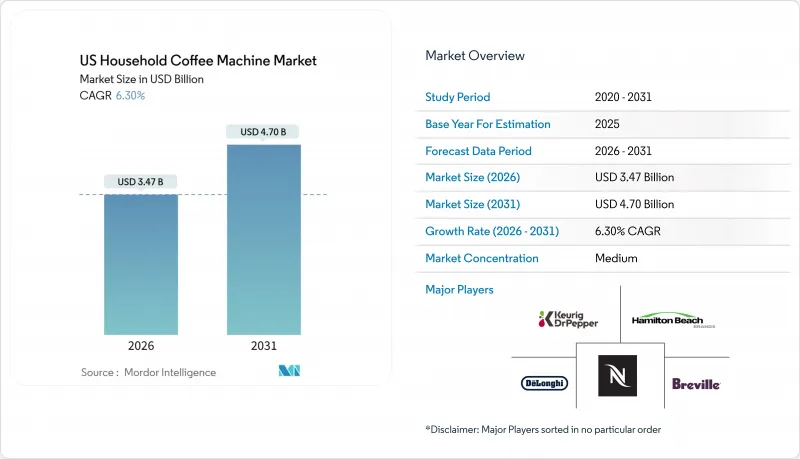
This report is Segmented by Product Type (Drip/Filter Coffee Makers, and More), Technology (Manual, and More), Capacity - Number of Cups (1 Cup, and More), Price Range (Economy, and More), Material of Housing (Plastic, and Mixed/Other), Distribution Channel (Supermarkets & Hypermarkets, and More), and Region (Northeast, and More). The Market Forecasts are Provided in Terms of Value (USD).
US Household Coffee Machine Market Trends and Insights
Increased Adoption of Single-Serve Pod Machines Due to Convenience in US Households
Keurig has seeded more than 40 million active brewers, putting single-serve capability into nearly one-third of US homes and deepening an ecosystem that delivers annuity-like pod revenue. Rival brands are answering with proprietary capsule lines that attempt to capture similar attachment rates. Convenience spans speed, portion control, and consistent quality, all of which resonate with time-pressed consumers. Hardware upgrades-such as quieter pumps and brew-strength selectors-help sustain replacement demand even as household penetration matures. Notably, Keurig's Q4 2024 brewer shipments rose 7.3% year over year, hinting at hardware stability despite soft pod volumes .
Growing Consumer Preference for Specialty Espresso-Based Beverages Fuelling At-Home Espresso Machine Sales
De'Longhi recorded 14% 2024 revenue growth, with coffee systems contributing 62% of turnover, underscoring strong consumer desire for barista-style beverages at home . Automatic tamping, precision grind sensors, and one-touch milk texturing have lowered skill barriers and widened the espresso addressable base. Breville's Barista Express Impress exemplifies premiumization, marrying Italian group-head components with North American software to command higher price points. Social media tutorials and subscription micro-roasters complete the "cafe at home" narrative, reinforcing equipment upgrades.
Environmental Concerns Over Single-Use Plastic/Aluminium Pods Leading to Regulatory Scrutiny
The USD 1.5 million settlement with the SEC regarding K-Cup recyclability claims highlights the escalating financial risks associated with sustainability-related disclosures. The growing adoption of municipal extended-producer-responsibility regulations is shifting the burden of waste management costs onto manufacturers, creating pressure to innovate and adapt. This regulatory environment is driving significant investment in research and development, particularly in sustainable packaging solutions. For instance, Keurig is set to launch K-Rounds, which are designed to be plant-based or fully compostable, aligning with evolving consumer and regulatory expectations. While these compliance-driven investments are increasing capital expenditures, companies that proactively embrace sustainability initiatives stand to gain a competitive advantage. Early movers can enhance their brand equity, appeal to the expanding base of eco-conscious consumers, and potentially mitigate future regulatory and reputational risks.
Other drivers and restraints analyzed in the detailed report include:
- Rising Penetration of Smart/IoT-Enabled Appliances Integrating with Voice Assistants in US Households
- Premiumization Trend with Stainless-Steel and Designer Coffee Makers Encouraged by Higher Disposable Incomes
- Saturation of the Drip Coffee Machine Segment Limiting Incremental Unit Growth
For complete list of drivers and restraints, kindly check the Table Of Contents.
Segment Analysis
Single-serve systems controlled 54.10% of 2025 revenue, cementing their role as the everyday solution for speed-conscious consumers. Espresso machines, though smaller in base, are forecast to rise 8.62% annually as households chase authentic cafe texture. Innovation such as De'Longhi's Bean Switch dual-hopper lets users pivot beans without purging, fusing convenience with craft. Combination brewers straddle multiple tastes within one chassis, easing counter-space friction. Drip, percolator, and French press formats persist but rely on niche artisanal enthusiasts, emphasizing manual ritual over automation.
For manufacturers, balancing pod profitability with espresso-driven premium ASPs shapes portfolio planning across the US household coffee machine market. Consumer narratives now celebrate skill progression: entry-level pod units introduce varietal exploration, while aspirational messaging guides users toward semi-automatic espresso platforms. Brands layer loyalty apps and roasting partnerships onto this ladder, ensuring repeat interaction beyond the initial sale. This ecosystem approach underpins hardware design decisions and marketing cadence across peak gifting seasons in the US household coffee machine market.
Semi-automatic machines retained a 35.10% share in 2025, confirming their appeal to hobbyists who value dosage control without full manual effort. Yet the smart cohort is scaling at 9.35% CAGR as Wi-Fi modules and firmware updates extend appliance lifecycles. Connected dashboards harvest brew-cycle analytics, guiding future feature releases and creating subscription upsell hooks. Fully automatic and super-automatic tiers address luxury seekers wanting zero-friction espresso, with voice-activated frothing now mainstream in showroom demos.
Manual pour-over stations and moka pots anchor the craft segment, but their modest growth underscores mainstream gravitation toward guided consistency. Expect firmware-driven flavour profiles-downloadable holiday blends, for instance-to differentiate next-gen releases, reinforcing software as the new value frontier in the US household coffee machine market.
Complete Report Scope:
- By Product Type
- Drip/Filter Coffee Makers
- Single-Serve Pod & Capsule Machines
- Espresso Machines
- Combination Coffee & Espresso Machines
- French Press & Manual Brewers
- Percolators & Moka Pots
- By Technology
- Manual
- Semi-Automatic
- Fully Automatic
- Super-Automatic
- Smart/Connected
- By Capacity - Number of Cups
- 1 Cup
- 2-4 Cups
- 5-10 Cups
- Above 10 Cups
- By Price Range
- Economy (<= USD 100)
- Mid-Range (USD 101-300)
- Premium (USD 301-700)
- Luxury (>= USD 701)
- By Material of Housing
- Plastic
- Stainless Steel
- Mixed/Other
- By Distribution Channel
- Supermarkets & Hypermarkets
- Specialty Appliance Retailers
- Department Stores
- Online (E-commerce)
- Brand E-Stores
- Warehouse Clubs
- By Region - United States
- Northeast
- Midwest
- South
- West
List of Companies Covered in this Report:
- Keurig Dr Pepper Inc.
- Nestle S.A. (Nespresso USA)
- Hamilton Beach Brands Holding Company
- De'Longhi Group
- Breville Group Limited
- Spectrum Brands Holdings, Inc. (Black+Decker Appliances)
- Conair Corporation (Cuisinart)
- Illycaffe S.p.A.
- JURA Elektroapparate AG
- Krups GmbH (Groupe SEB)
- Bunn-O-Matic Corporation
- Sunbeam Products Inc. (Mr. Coffee)
- Technivorm Moccamaster
- Philips Domestic Appliances (Saeco)
- Melitta USA
- KitchenAid (Whirlpool Corporation)
- OXO (Helen of Troy Ltd.)
- Smeg S.p.A.
- Gaggia Milano (Rancilio Group)
- La Marzocco USA
Additional Benefits:
- The market estimate (ME) sheet in Excel format
- 3 months of analyst support
TABLE OF CONTENTS
1 Introduction
- 1.1 Study Assumptions & Market Definition
- 1.2 Scope of the Study
2 Research Methodology
3 Executive Summary
4 Market Landscape
- 4.1 Market Overview
- 4.2 Market Drivers
- 4.2.1 Increased adoption of single-serve pod machines due to convenience in US households
- 4.2.2 Growing consumer preference for specialty espresso-based beverages fueling at-home espresso machine sales
- 4.2.3 Rising penetration of smart/IoT-enabled appliances integrating with voice assistants in US households
- 4.2.4 Premiumization trend with stainless-steel and designer coffee makers encouraged by higher disposable incomes
- 4.2.5 Home-office hybrid work culture boosting weekday home coffee consumption volumes
- 4.3 Market Restraints
- 4.3.1 Environmental concerns over single-use plastic/aluminum coffee pods leading to regulatory scrutiny
- 4.3.2 Saturation of drip coffee maker segment limiting incremental unit growth
- 4.3.3 Supply-chain volatility for electronic components increasing ASPs and inventory risk
- 4.3.4 Roasting quality perception gap versus cafe coffee limiting adoption among high-end aficionados
- 4.4 Value / Supply-Chain Analysis
- 4.5 Regulatory or Technological Outlook
- 4.6 Porter's Five Forces
- 4.6.1 Industry Rivalry
- 4.6.2 Threat of New Entrants
- 4.6.3 Bargaining Power of Suppliers
- 4.6.4 Bargaining Power of Buyers
- 4.6.5 Threat of Substitutes
5 Market Size & Growth Forecasts
- 5.1 By Product Type
- 5.1.1 Drip/Filter Coffee Makers
- 5.1.2 Single-Serve Pod & Capsule Machines
- 5.1.3 Espresso Machines
- 5.1.4 Combination Coffee & Espresso Machines
- 5.1.5 French Press & Manual Brewers
- 5.1.6 Percolators & Moka Pots
- 5.2 By Technology
- 5.2.1 Manual
- 5.2.2 Semi-Automatic
- 5.2.3 Fully Automatic
- 5.2.4 Super-Automatic
- 5.2.5 Smart/Connected
- 5.3 By Capacity - Number of Cups
- 5.3.1 1 Cup
- 5.3.2 2-4 Cups
- 5.3.3 5-10 Cups
- 5.3.4 Above 10 Cups
- 5.4 By Price Range
- 5.4.1 Economy (<= USD 100)
- 5.4.2 Mid-Range (USD 101-300)
- 5.4.3 Premium (USD 301-700)
- 5.4.4 Luxury (>= USD 701)
- 5.5 By Material of Housing
- 5.5.1 Plastic
- 5.5.2 Stainless Steel
- 5.5.3 Mixed/Other
- 5.6 By Distribution Channel
- 5.6.1 Supermarkets & Hypermarkets
- 5.6.2 Specialty Appliance Retailers
- 5.6.3 Department Stores
- 5.6.4 Online (E-commerce)
- 5.6.5 Brand E-Stores
- 5.6.6 Warehouse Clubs
- 5.7 By Region - United States
- 5.7.1 Northeast
- 5.7.2 Midwest
- 5.7.3 South
- 5.7.4 West
6 Competitive Landscape
- 6.1 Market Concentration
- 6.2 Strategic Moves
- 6.3 Market Share Analysis
- 6.4 Company Profiles (includes Global level Overview, Market level overview, Core Segments, Financials as available, Strategic Information, Market Rank/Share for key companies, Products & Services, and Recent Developments)
- 6.4.1 Keurig Dr Pepper Inc.
- 6.4.2 Nestle S.A. (Nespresso USA)
- 6.4.3 Hamilton Beach Brands Holding Company
- 6.4.4 De'Longhi Group
- 6.4.5 Breville Group Limited
- 6.4.6 Spectrum Brands Holdings, Inc. (Black+Decker Appliances)
- 6.4.7 Conair Corporation (Cuisinart)
- 6.4.8 Illycaffe S.p.A.
- 6.4.9 JURA Elektroapparate AG
- 6.4.10 Krups GmbH (Groupe SEB)
- 6.4.11 Bunn-O-Matic Corporation
- 6.4.12 Sunbeam Products Inc. (Mr. Coffee)
- 6.4.13 Technivorm Moccamaster
- 6.4.14 Philips Domestic Appliances (Saeco)
- 6.4.15 Melitta USA
- 6.4.16 KitchenAid (Whirlpool Corporation)
- 6.4.17 OXO (Helen of Troy Ltd.)
- 6.4.18 Smeg S.p.A.
- 6.4.19 Gaggia Milano (Rancilio Group)
- 6.4.20 La Marzocco USA
7 Market Opportunities & Future Outlook
- 7.1 White-space & Unmet-Need Assessment

