PUBLISHER: Mordor Intelligence | PRODUCT CODE: 2124617

PUBLISHER: Mordor Intelligence | PRODUCT CODE: 2124617
Coffee Machine - Market Share Analysis, Industry Trends & Statistics, Growth Forecasts (2026 - 2031)
According to Mordor Intelligence, the coffee machine market size was valued at USD 19.02 billion in 2025 and is estimated to grow from USD 20.03 billion in 2026 to reach USD 26.77 billion by 2031, at a CAGR of 5.60% during the forecast period (2026-2031).
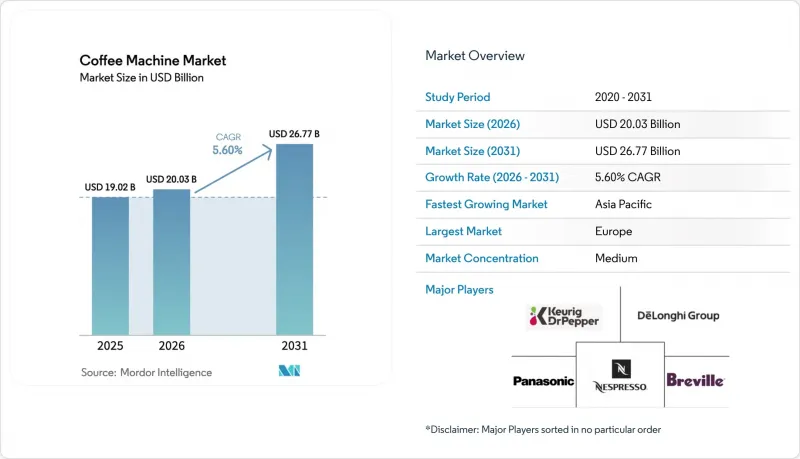
This report is Segmented by Product Type (Espresso Coffee Machines, Filter or Drip Coffee Machines, and More), by Automation Level (Semi-Automatic, Fully Automatic/ Super-Automatic), by End User (Residential, and Commercial), by Distribution Channel (B2C Channels, and B2B Channel), and by Geography (North America, South America, and More). The Market Forecasts are Provided in Terms of Value (USD).
Global Coffee Machine Market Trends and Insights
Rising Per-Capita Coffee Consumption
Global consumption increased in 2025-2026 to 173.85 million 60-kilogram bags, supported by production of 178.85 million bags and the fifth consecutive year of tightening ending stocks, which kept supply discipline in focus. In the United States, specialty-coffee participation climbed to a 14-year high in spring 2025, reaching 46% of adults on a past-day basis and signaling a deeper demand pool for cafe beverages and high-performing home machines. The same survey period showed 43% of adults consumed espresso-based beverages in the prior week, reinforcing the appeal of extraction-focused devices and integrated milk systems that deliver consistent quality. China's consumer base accelerated as De'Longhi reported double-digit revenue growth in the first half of 2025, with the market representing around 6% of group sales, which indicates rising acceptance of bean-to-cup and fully automatic ownership among urban consumers. Younger cohorts amplified the trend, as 64% of Americans aged 25 to 39 reported drinking specialty coffee in the past week in 2025, which translated into persistent upgrades of home equipment and higher-value purchases in retail and online channels. These demand signals sustained the coffee machine market as households and workplaces prioritized consistent extraction quality, faster workflows, and better energy performance in everyday use.
Shift Toward Home-Brewing Lifestyles
Home preparation remained a central habit in 2025, reflected in brewer shipments and in household penetration of key device types. Keurig Dr Pepper shipped 10.4 million brewers in 2024, a 7.3% increase year over year, even as pods were flat, illustrating that the installed base and upgrade cycles continued to expand despite price sensitivity to consumables. In January 2025, United States household penetration reached 62% for drip coffee makers, 42% for single-cup brewers, 15% for bean-to-cup machines, and 12% for espresso machines, confirming broad adoption across convenience and premium categories. Nespresso extended the at-home lifecycle focus with RELOVE refurbishment programs across 21 markets and raised progress on recycled aluminum usage and compostable capsule pilots, supporting sustainability-aligned purchases. Energy labels in Switzerland and auto-shutoff limits in the European Union continued to push residential devices toward lower annual consumption, which strengthened the value proposition for efficient machines that reduce standby losses and optimize heating cycles.
High Upfront and Lifecycle Costs of Premium Systems
Premium pricing created adoption hurdles for value-focused households, especially in markets where discretionary income remains tight. Bosch's 300 and 800 Series machines launched at USD 699 to USD 2,299, a bracket that aligns with the upper midrange to premium portion of the coffee machine market. WMF's fully automatic lines are positioned above USD 1,176 for compact commercial and high-end office use, signaling that connected features and milk systems often carry higher initial costs despite long-run efficiency gains. Breville's Oracle Jet highlighted energy-optimized heating and automated milk texturing, yet the company's fiscal 2025 disclosures acknowledged margin pressure tied to logistics and tariff dynamics, indicating that premium innovation must coexist with tight cost control. Manufacturers also face the indirect costs of safety and energy-label compliance, along with data and reporting obligations where programs like ENERGY STAR reference idle and brew energy limits for commercial brewers, which influence component selection and test cycles. Refurbishment pathways seek to widen access through certified second-life units, as seen in JURA's longstanding service model and Nespresso's RELOVE program, while Tchibo and koorvi launched a digital trade-in platform in 2025 to recapture and resell used machines.
Other drivers and restraints analyzed in the detailed report include:
- Specialty Cafe Footprint Expansion Driving Aspirational Demand
- Smart, Connected Brewer Innovation Cycle
- Regulatory and Consumer Backlash on Single-Use Capsule Waste
For complete list of drivers and restraints, kindly check the Table Of Contents.
Segment Analysis
Filter coffee machines held a 31.10% share in 2025, driven by strong household penetration and certified brewers ensuring consistent temperature and extraction standards. Capsule and pod systems are projected to grow at a 7.60% CAGR during 2026-2031, supported by compostable formats and barcode-guided brewing for repeatable outcomes. By January 2025, 62% of United States households owned drip makers, while 42% had single-cup brewers, reflecting a balance between convenience and capacity in the coffee machine market. Nespresso increased investments in Vertuo and expanded sustainability programs, enhancing capsule circularity and promoting durable machine ownership. The Specialty Coffee Association validated new home brewers in 2025, ensuring compliance with Golden Cup extraction standards.
Bean-to-cup systems reached 15% ownership in United States households by January 2025, aided by connected models integrating grinding, dosing, and milk texturing. Bosch's 800 Series introduced Home Connect features like Coffee Playlist and voice control, streamlining multiuser preferences. Environmental regulations influenced capsule development, with Keurig launching K-Rounds, free of plastic and aluminum, and expanding disposal programs under its circular packaging roadmap. Nespresso reported 100% of Original Line capsules using 80% recycled aluminum and 95% for Vertuo, alongside paper-based home-compostable capsules in 14 countries. AHAM standards provided uniform testing methods for household coffee makers, while ENERGY STAR set energy benchmarks for commercial batch brewers, guiding product labels and procurement decisions.
Fully automatic and super-automatic platforms held a 74.60% market share in 2025, with a projected 6.50% CAGR through 2031, driven by operator demand for consistency and reduced training needs in high-throughput venues. Commercial fleets prioritize modular serviceability and connectivity, enabling remote menu updates and diagnostics to reduce technician visits and downtime. At Host Milano 2025, WMF and SEB Professional showcased digital platforms offering cross-brand solutions for cafes, hospitality, offices, and retail. Franke highlighted cloud connectivity, remote updates, and energy-efficient hardware aligned with cost and sustainability goals.
The IEC 60335-2-75:2024 standard introduced hot-surface and electrode-heater provisions, ensuring advanced features meet baseline safety protections. Semi-automatic machines remain relevant in premium cafes and boutique hotels, where craft and visual theater drive demand. Platforms like WMF's espresso NEXT blend traditional workflows with automation to maintain consistency while preserving the human element. Energy-optimized systems, such as the Victoria Arduino Eagle One, reduce energy use by 35% and environmental impact by 23%, while UNIC's instant water heating minimizes limescale and extends maintenance intervals. Fully automatic machines dominate chain and self-service environments, while semi-automatics anchor craft-led formats, reflecting a clear market hierarchy.
Complete Report Scope:
- By Product Type
- Espresso Coffee Machines
- Filter/Drip Coffee Machine
- Capsule/Pod Coffee Machine
- Bean-to-Cup Coffee Machines
- Other Product Types (Moka Pot, French Press, etc.)
- By Automation Level
- Semi-Automatic
- Fully Automatic / Super-Automatic
- By End User
- Residential
- Commercial
- By Distribution Channel
- B2C Channels
- Multi-Brand Stores
- Exclusive Brand Outlets
- Online
- Other Distribution Channels
- B2B Channel (directly from the manufacturers)
- B2C Channels
- By Geography
- North America
- Canada
- United States
- Mexico
- South America
- Brazil
- Peru
- Chile
- Argentina
- Rest of South America
- Asia-Pacific
- India
- China
- Japan
- Australia
- South Korea
- South East Asia (Singapore, Malaysia, Thailand, Indonesia, Vietnam, and Philippines)
- Rest of Asia-Pacific
- Europe
- United Kingdom
- Germany
- France
- Spain
- Italy
- BENELUX (Belgium, Netherlands, and Luxembourg)
- NORDICS (Denmark, Finland, Iceland, Norway, and Sweden)
- Rest of Europe
- Middle East And Africa
- United Arab of Emirates
- Saudi Arabia
- South Africa
- Nigeria
- Rest of Middle East And Africa
- North America
Geography Analysis
Europe accounted for 38.60% of global revenue in 2025, driven by mature specialty-coffee cultures in Northern and Southern Europe and strong retail and boutique networks linking equipment to capsule ecosystems. Energy-efficiency regulations, including factory auto-shutoff limits and labeling mandates, reduced annual residential device consumption and encouraged zero-standby modes. Nespresso achieved a 35% global recycling rate for aluminum capsules in 2024, supported by broad collection coverage, while Podback and national sorting schemes expanded disposal options in key markets like the UK and Germany. De'Longhi's nine-month 2025 performance reflected strong home-coffee-machine demand, leveraging design and innovation that resonate with European consumers. Commercial machine makers like WMF and Franke focused on digitalization, remote management, and milk-system versatility, aligning with urban cafe formats in the coffee machine market.
Asia-Pacific is projected to grow at a 7.80% CAGR through 2031, with urbanization boosting specialty-coffee penetration in China, India, and Australia. Rising disposable incomes support premium automation and bean-to-cup systems. Early 2025 saw De'Longhi report double-digit revenue growth in China, highlighting demand for cafe-quality home machines. Versuni India Home Solutions (Philips Domestic Appliances) expanded its espresso category in FY 2023-2024, preparing for steady demand growth in major metros and supporting multi-price-tier placements. USDA estimates Japan's 2025-2026 coffee imports at 6.0 million bags, while Nestle expanded ready and cold-format options across APAC, including barista-style home beverages. In Australia and New Zealand, stable disposable incomes and high specialty awareness sustained the upgrade cycle for premium countertop equipment in the coffee machine market.
North America, led by the United States, recorded 23.8 million bags of coffee imports and 26.6 million bags of consumption in 2025-2026, reflecting a stable market for equipment and consumables. NCA's 2025 data showed 66% of American adults drink coffee daily, with specialty beverages and app-based ordering at record highs, complementing strong at-home usage. Keurig Dr Pepper's 2024 brewer shipments demonstrated resilience despite pod pricing elasticity. Canada expanded curbside K-Cup pod acceptance and refurbishment initiatives at Van Houtte. USDA projected Brazil at 63.0 million bags and Colombia at 13.8 million bags in 2025-2026, shaping price expectations and equipment demand across residential and foodservice channels in the coffee machine market.
- Keurig Dr Pepper
- Nestle Nespresso
- De'Longhi Group
- Panasonic
- Breville Group
- JURA Elektroapparate
- Hamilton Beach Brands
- Philips (Saeco & Gaggia)
- Electrolux AB
- Newell Brands (Mr. Coffee)
- Bosch (Home Connect)
- Melitta Group
- Morphy Richards
- La Marzocco
- Bunn-O-Matic
- FETCO
- Nuova Simonelli
- Thermoplan
- Rocket Espresso
- Behmor
- Rancilio Group
- WMF Group
- Franke Coffee Systems
- Dalla Corte
- Casadio
Additional Benefits:
- The market estimate (ME) sheet in Excel format
- 3 months of analyst support
TABLE OF CONTENTS
1 Introduction
- 1.1 Study Assumptions & Market Definition
- 1.2 Scope of the Study
2 Research Methodology
3 Executive Summary
4 Market Landscape
- 4.1 Market Overview
- 4.2 Market Drivers
- 4.2.1 Rising per-capita coffee consumption
- 4.2.2 Shift toward home-brewing lifestyles
- 4.2.3 Specialty cafe footprint expansion driving aspirational demand
- 4.2.4 Smart, connected brewer innovation cycle
- 4.2.5 Surge in single-serve convenience formats
- 4.2.6 Rising penetration of smart homes and connected appliances
- 4.3 Market Restraints
- 4.3.1 High upfront and lifecycle costs of premium systems
- 4.3.2 Regulatory and consumer backlash on single-use capsule waste
- 4.3.3 Demand plateau in saturated mature markets
- 4.3.4 Semiconductor and logistics bottlenecks limiting supply
- 4.4 Industry Value Chain Analysis
- 4.5 Porter's Five Forces Analysis
- 4.5.1 Threat of New Entrants
- 4.5.2 Bargaining Power of Suppliers
- 4.5.3 Bargaining Power of Buyers
- 4.5.4 Threat of Substitutes
- 4.5.5 Competitive Rivalry
- 4.6 Insights into the Latest Trends and Innovations in the Market
- 4.7 Insights on Recent Developments (New Product Launches, Strategic Initiatives, Investments, Partnerships, JVs, Expansion, M&As, etc.) in the Market
5 Market Size & Growth Forecasts (Value)
- 5.1 By Product Type
- 5.1.1 Espresso Coffee Machines
- 5.1.2 Filter/Drip Coffee Machine
- 5.1.3 Capsule/Pod Coffee Machine
- 5.1.4 Bean-to-Cup Coffee Machines
- 5.1.5 Other Product Types (Moka Pot, French Press, etc.)
- 5.2 By Automation Level
- 5.2.1 Semi-Automatic
- 5.2.2 Fully Automatic / Super-Automatic
- 5.3 By End User
- 5.3.1 Residential
- 5.3.2 Commercial
- 5.4 By Distribution Channel
- 5.4.1 B2C Channels
- 5.4.1.1 Multi-Brand Stores
- 5.4.1.2 Exclusive Brand Outlets
- 5.4.1.3 Online
- 5.4.1.4 Other Distribution Channels
- 5.4.2 B2B Channel (directly from the manufacturers)
- 5.4.1 B2C Channels
- 5.5 By Geography
- 5.5.1 North America
- 5.5.1.1 Canada
- 5.5.1.2 United States
- 5.5.1.3 Mexico
- 5.5.2 South America
- 5.5.2.1 Brazil
- 5.5.2.2 Peru
- 5.5.2.3 Chile
- 5.5.2.4 Argentina
- 5.5.2.5 Rest of South America
- 5.5.3 Asia-Pacific
- 5.5.3.1 India
- 5.5.3.2 China
- 5.5.3.3 Japan
- 5.5.3.4 Australia
- 5.5.3.5 South Korea
- 5.5.3.6 South East Asia (Singapore, Malaysia, Thailand, Indonesia, Vietnam, and Philippines)
- 5.5.3.7 Rest of Asia-Pacific
- 5.5.4 Europe
- 5.5.4.1 United Kingdom
- 5.5.4.2 Germany
- 5.5.4.3 France
- 5.5.4.4 Spain
- 5.5.4.5 Italy
- 5.5.4.6 BENELUX (Belgium, Netherlands, and Luxembourg)
- 5.5.4.7 NORDICS (Denmark, Finland, Iceland, Norway, and Sweden)
- 5.5.4.8 Rest of Europe
- 5.5.5 Middle East And Africa
- 5.5.5.1 United Arab of Emirates
- 5.5.5.2 Saudi Arabia
- 5.5.5.3 South Africa
- 5.5.5.4 Nigeria
- 5.5.5.5 Rest of Middle East And Africa
- 5.5.1 North America
6 Competitive Landscape
- 6.1 Market Concentration
- 6.2 Strategic Moves
- 6.3 Market Share Analysis
- 6.4 Company Profiles (includes Global level Overview, Market level overview, Core Segments, Financials as available, Strategic Information, Market Rank/Share for key companies, Products & Services, and Recent Developments)
- 6.4.1 Keurig Dr Pepper
- 6.4.2 Nestle Nespresso
- 6.4.3 De'Longhi Group
- 6.4.4 Panasonic
- 6.4.5 Breville Group
- 6.4.6 JURA Elektroapparate
- 6.4.7 Hamilton Beach Brands
- 6.4.8 Philips (Saeco & Gaggia)
- 6.4.9 Electrolux AB
- 6.4.10 Newell Brands (Mr. Coffee)
- 6.4.11 Bosch (Home Connect)
- 6.4.12 Melitta Group
- 6.4.13 Morphy Richards
- 6.4.14 La Marzocco
- 6.4.15 Bunn-O-Matic
- 6.4.16 FETCO
- 6.4.17 Nuova Simonelli
- 6.4.18 Thermoplan
- 6.4.19 Rocket Espresso
- 6.4.20 Behmor
- 6.4.21 Rancilio Group
- 6.4.22 WMF Group
- 6.4.23 Franke Coffee Systems
- 6.4.24 Dalla Corte
- 6.4.25 Casadio
7 Market Opportunities & Future Outlook
- 7.1 Rising consumer willingness to upgrade to premium and smart coffee machines
- 7.2 Sustainability-led product innovation opportunity

