PUBLISHER: Global Market Insights Inc. | PRODUCT CODE: 2101980

PUBLISHER: Global Market Insights Inc. | PRODUCT CODE: 2101980
Fintech as a Service Market Opportunity, Growth Drivers, Industry Trend Analysis, and Forecast 2026 - 2035
The Global Fintech as a Service Market was valued at USD 422.9 billion in 2025 and is estimated to grow at a CAGR of 16.1% to reach USD 1.87 trillion by 2035.
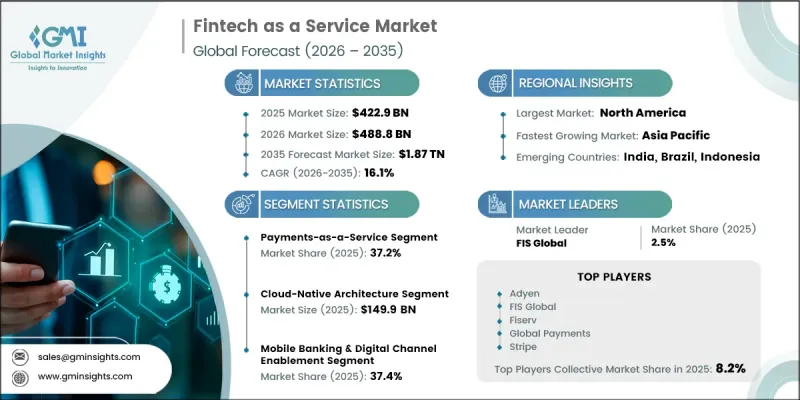
The fintech as a service market is experiencing rapid growth as financial institutions accelerate their digital transformation initiatives and seek more efficient ways to modernize financial service delivery. Traditional banks and credit unions are increasingly upgrading legacy infrastructure, adopting cloud-based technologies, and integrating advanced application programming interfaces (APIs) to improve customer experiences while lowering operational expenses. Rising competition from digital-first financial providers is encouraging organizations to adopt flexible and scalable financial solutions through third-party platforms. Financial-as-a-service providers are becoming increasingly important as businesses look for ready-to-use capabilities in areas such as payment processing, regulatory compliance, and customer engagement without developing these systems internally. The expansion of embedded finance is further strengthening demand for FaaS platforms as non-financial companies integrate financial features into their existing digital ecosystems. This shift allows businesses to offer services such as payments, lending solutions, and insurance capabilities while improving customer convenience and expanding revenue opportunities. The combination of digital banking growth, cloud adoption, and demand for integrated financial solutions is expected to drive sustained market expansion.
| Market Scope | |
|---|---|
| Start Year | 2025 |
| Forecast Year | 2026-2035 |
| Start Value | $422.9 Billion |
| Forecast Value | $1.87 Trillion |
| CAGR | 16.1% |
The cloud-native architecture segment held 35.5% share, generating USD 149.9 billion in 2025. Cloud-native solutions have become a fundamental component of the FaaS ecosystem due to their ability to provide financial organizations with scalable, flexible, and cost-efficient infrastructure. These architectures enable faster deployment of financial products, improved operational agility, and enhanced service delivery capabilities, allowing institutions to respond more effectively to changing customer requirements and evolving market conditions.
The mobile banking and digital channel segment held 37.4% share, generating USD 158.4 billion in 2025. The segment continues to expand due to the increasing global adoption of mobile devices, rising digital banking usage, and growing consumer preference for conducting financial activities through online platforms. Financial institutions are investing significantly in mobile applications, digital account onboarding solutions, electronic payment systems, and multi-channel engagement platforms to improve accessibility and deliver seamless customer experiences. Continued innovation in digital financial services is expected to further strengthen the growth of this segment.
North America Fintech as a Service Market reached USD 172.8 billion in 2025 and is expected to grow at a CAGR of 14.8% from 2026 to 2035. The region's strong market position is supported by the presence of established financial institutions, advanced digital payment ecosystems, widespread cloud adoption, and increasing implementation of banking-as-a-service and embedded finance solutions. Supportive regulatory frameworks for digital financial services, combined with continuous investments in API-driven banking technologies, are expected to sustain market growth across North America throughout the forecast period.
The leading companies operating in the global fintech as a service market include Stripe, Adyen, Finastra, FIS Global, Fiserv, Global Payments, and Nuvei. Companies operating in the fintech as a service market are strengthening their market position through continuous innovation, strategic partnerships, platform expansion, and investments in advanced financial technologies. Market participants are focusing on developing scalable cloud-based solutions, enhancing API capabilities, and expanding embedded finance offerings to address increasing demand from financial institutions and non-financial businesses. Companies are also pursuing collaborations, acquisitions, and geographic expansion strategies to increase their customer base and improve service capabilities. Investments in cybersecurity, regulatory technology, automation, and personalized financial solutions are helping organizations differentiate their offerings.
Table of Contents
Chapter 1 Methodology
- 1.1 Research approach
- 1.2 Quality Commitments
- 1.2.1 GMI AI policy & data integrity commitment
- 1.3 Research Trail & Confidence Scoring
- 1.3.1 Research Trail Components
- 1.3.2 Scoring Components
- 1.4 Data Collection
- 1.5 Data mining sources
- 1.5.1 Paid sources
- 1.6 Base estimates and calculations
- 1.6.1 Base year calculation
- 1.7 Forecast model
- 1.7.1 Quantified market impact analysis
- 1.8 Research transparency addendum
- 1.8.1 Source attribution framework
- 1.8.2 Quality assurance metrics
- 1.8.3 Our commitment to trust
Chapter 2 Executive Summary
- 2.1 Industry 360° synopsis
- 2.2 Key market trends
- 2.2.1 Regional
- 2.2.2 Service
- 2.2.3 Technology
- 2.2.4 Application
- 2.2.5 Organization Size
- 2.2.6 Deployment Model
- 2.2.7 End Use
- 2.3 TAM analysis, 2026-2035
- 2.4 CXO perspectives: Strategic imperatives
Chapter 3 Industry Insights
- 3.1 Industry ecosystem analysis
- 3.1.1 Supplier landscape
- 3.1.2 Profit margin
- 3.1.3 Cost structure
- 3.1.4 Value addition at each stage
- 3.1.5 Factor affecting the value chain
- 3.1.6 Disruptions
- 3.2 Industry impact forces
- 3.2.1 Growth drivers
- 3.2.1.1 Rise of Open Banking & API Standardization
- 3.2.1.2 Accelerating Digital Transformation in Traditional Financial Institutions
- 3.2.1.3 Surging Demand for Embedded Finance by Non-Financial Enterprises
- 3.2.1.4 Growing Adoption of Real-Time Payment Infrastructure Globally
- 3.2.2 Industry pitfalls and challenges
- 3.2.2.1 Integration Complexity with Legacy Core Banking Systems
- 3.2.2.2 Evolving & Fragmented Regulatory Compliance Requirements Across Jurisdictions
- 3.2.3 Market opportunities
- 3.2.3.1 FaaS Expansion in Underbanked Emerging Markets
- 3.2.3.2 SME-Focused FaaS Platforms Addressing Affordable Financial Infrastructure Gap
- 3.2.3.3 AI & Automation-Driven Cost Reduction Unlocking New FaaS Revenue Models
- 3.2.1 Growth drivers
- 3.3 Technology and innovation landscape
- 3.3.1 Current technological trends
- 3.3.1.1 API-Based Banking & Open Banking APIs
- 3.3.1.2 Digital Payment Gateways & Payment Orchestration
- 3.3.2 Emerging technologies
- 3.3.2.1 Generative AI for Financial Services
- 3.3.2.2 Agentic AI for Autonomous Financial Operations
- 3.3.1 Current technological trends
- 3.4 Growth potential analysis
- 3.5 Pricing Analysis (Driven by Primary Research)
- 3.5.1 Historical Price Trend Analysis
- 3.5.2 Pricing Strategy by Player Type (Premium / Value / Cost-plus)
- 3.6 Regulatory landscape
- 3.6.1 North America
- 3.6.1.1 US - Securities and Exchange Commission (SEC)
- 3.6.1.2 US - Consumer Financial Protection Bureau (CFPB)
- 3.6.2 Europe
- 3.6.2.1 UK - Financial Conduct Authority (FCA)
- 3.6.2.2 EU - European Banking Authority (EBA)
- 3.6.3 Asia Pacific
- 3.6.3.1 India - Securities and Exchange Board of India (SEBI)
- 3.6.3.2 Japan - Financial Services Agency (FSA)
- 3.6.4 LATAM
- 3.6.4.1 Brazil - Comissao de Valores Mobiliarios (CVM)
- 3.6.4.2 Mexico - Comision Nacional Bancaria y de Valores (CNBV)
- 3.6.5 MEA
- 3.6.5.1 UAE - Dubai Financial Services Authority (DFSA)
- 3.6.5.2 South Africa - Financial Sector Conduct Authority (FSCA)
- 3.6.1 North America
- 3.7 Porter's analysis
- 3.8 PESTEL analysis
- 3.9 Patent analysis (Driven by Primary Research)
- 3.10 Impact of AI & generative AI on the market
- 3.10.1 AI-driven disruption of existing business models
- 3.10.2 GenAI use cases & adoption roadmap by segment
- 3.10.3 Risks, limitations & regulatory considerations
- 3.11 Zero-Trust Architecture Adoption Trends in FaaS
- 3.12 FaaS Licensing Structures
- 3.13 Forecast assumptions & scenario analysis (Driven by Primary Research)
- 3.13.1 Base Case- Key Macro & Industry Variables Driving CAGR
- 3.13.2 Optimistic Scenarios- Favorable macro and industry tailwinds
- 3.13.3 Pessimistic Scenario - Macroeconomic slowdown or industry headwinds
Chapter 4 Competitive Landscape, 2025
- 4.1 Introduction
- 4.2 Company market share analysis
- 4.2.1 North America
- 4.2.2 Europe
- 4.2.3 Asia Pacific
- 4.2.4 LATAM
- 4.2.5 MEA
- 4.3 Competitive analysis of major market players
- 4.4 Competitive positioning matrix
- 4.5 Key developments
- 4.5.1 Mergers & acquisitions
- 4.5.2 Partnerships & collaborations
- 4.5.3 New product launches
- 4.5.4 Expansion plans and funding
- 4.6 Company tier benchmarking
- 4.6.1 Tier classification criteria & qualifying thresholds
- 4.6.2 Tier positioning matrix by revenue, geography & innovation
Chapter 5 Market Estimates and Forecast, By Service, 2022 - 2035 ($ Mn)
- 5.1 Key trends
- 5.2 Payments-as-a-Service
- 5.3 Banking-as-a-Service (BaaS)
- 5.4 Lending-as-a-Service
- 5.5 Insurance-as-a-Service (Insurtech)
- 5.6 Wealth Management-as-a-Service
- 5.7 RegTech-as-a-Service
- 5.8 Digital Assets & Cryptocurrency Services
Chapter 6 Market Estimates and Forecast, By Technology, 2022 - 2035 ($ Mn)
- 6.1 Key trends
- 6.2 Artificial Intelligence & Machine Learning
- 6.3 Blockchain & Distributed Ledger Technology (DLT)
- 6.4 Robotic Process Automation (RPA)
- 6.5 Cloud-Native Architecture
- 6.6 Big Data & Advanced Analytics
- 6.7 Others
Chapter 7 Market Estimates and Forecast, By Application, 2022 - 2035 ($ Mn)
- 7.1 Key trends
- 7.2 Mobile Banking & Digital Channel Enablement
- 7.3 P2P Lending & Marketplace Finance
- 7.4 Regulatory Compliance & Reporting
- 7.5 Risk Management & Fraud Detection
- 7.6 Others
Chapter 8 Market Estimates and Forecast, By Organization Size, 2022 - 2035 ($ Mn)
- 8.1 Key trends
- 8.2 Large Enterprises
- 8.3 SMEs
Chapter 9 Market Estimates and Forecast, By Deployment Model, 2022 - 2035 ($ Mn)
- 9.1 Key trends
- 9.2 Cloud-Based
- 9.2.1 Public Cloud
- 9.2.2 Private Cloud
- 9.3 Hybrid
- 9.4 On-Premises
Chapter 10 Market Estimates and Forecast, By End Use, 2022 - 2035 ($ Mn)
- 10.1 Key trends
- 10.2 Financial Institutions
- 10.2.1 Banks & Traditional Financial Institutions
- 10.2.2 Non-Banking Financial Companies (NBFCs)
- 10.2.3 Insurance Companies
- 10.2.4 Investment & Wealth Management Firms
- 10.3 Non-Financial Institutions
- 10.3.1 Retail & E-commerce Companies
- 10.3.2 Telecom & Technology Companies
- 10.3.3 Healthcare & Life Sciences Companies
- 10.3.4 Government & Regulatory Bodies
Chapter 11 Market Estimates & Forecast, By Region, 2022 - 2035 ($ Mn)
- 11.1 Key trends
- 11.2 North America
- 11.2.1 US
- 11.2.2 Canada
- 11.3 Europe
- 11.3.1 Germany
- 11.3.2 UK
- 11.3.3 France
- 11.3.4 Italy
- 11.3.5 Spain
- 11.3.6 Sweden
- 11.3.7 Netherlands
- 11.3.8 Switzerland
- 11.3.9 Ireland
- 11.4 Asia Pacific
- 11.4.1 China
- 11.4.2 India
- 11.4.3 Japan
- 11.4.4 South Korea
- 11.4.5 Australia
- 11.4.6 Indonesia
- 11.4.7 Malaysia
- 11.4.8 Vietnam
- 11.5 Latin America
- 11.5.1 Brazil
- 11.5.2 Mexico
- 11.5.3 Argentina
- 11.5.4 Chile
- 11.6 MEA
- 11.6.1 South Africa
- 11.6.2 Saudi Arabia
- 11.6.3 UAE
Chapter 12 Company Profiles
- 12.1 Global players
- 12.1.1 FIS Global
- 12.1.2 Fiserv
- 12.1.3 Temenos
- 12.1.4 Finastra
- 12.1.5 Mambu
- 12.1.6 Backbase
- 12.1.7 Stripe
- 12.1.8 Adyen
- 12.1.9 Checkout.com
- 12.1.10 Global Payments
- 12.1.11 Nuvei
- 12.1.12 Rapyd
- 12.2 Regional players
- 12.2.1 Solarisbank
- 12.2.2 Cross River Bank
- 12.2.3 Equals
- 12.2.4 LoanPro
- 12.2.5 ChargeAfter
- 12.3 Emerging players
- 12.3.1 Unit
- 12.3.2 Synctera
- 12.3.3 Swan

