PUBLISHER: Mordor Intelligence | PRODUCT CODE: 2123084

PUBLISHER: Mordor Intelligence | PRODUCT CODE: 2123084
Malaysia Construction - Market Share Analysis, Industry Trends & Statistics, Growth Forecasts (2026 - 2031)
According to Mordor Intelligence, the Malaysia construction market size is valued at USD 41.2 billion in 2026 and is projected to reach USD 62.4 billion by 2031, reflecting an 8.66% CAGR.
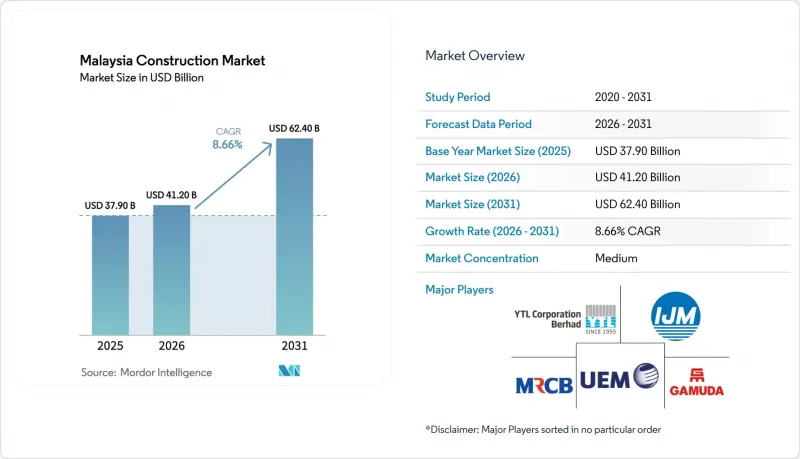
This report is Segmented by Sector (Residential, Commercial, and Infrastructure), by Construction Type (New Construction and Renovation), by Construction Method (Conventional On-Site and More), by Investment Source (Public and Private), and by Geography (Selangor, Johor, Wilayah Persekutuan, and Others). The Market Forecasts are Provided in Terms of Value (USD).
Malaysia Construction Market Trends and Insights
Government Mega-Infrastructure Pipeline (ECRL, MRT 3, Pan-Borneo, Penang LRT)
Flagship rail and highway projects underpin a multiyear civil-works surge. The 665-kilometer East Coast Rail Link targets January 2027 revenue service and already stimulates warehousing around Kuantan Port. The USD 2.9 billion to USD 3.8 billion Penang LRT, awarded in 2024, enters intensive land-acquisition phases that lock in steady subcontracting through 2030. Pan Borneo Highway, Sabah, received a fresh USD 373 million allocation, enabling accelerated earthworks on the 35-kilometer Keningau-Tambunan stretch. Collectively, these corridors shelter infrastructure workloads from cyclical residential swings and justify the segment's 9.88% CAGR.
Public-Private Partnership Funding and Budget-2025 Flood-Mitigation Allocations
Budget 2025 allocates USD 5.0 billion to flood-control structures, with early packages structured as availability-payment concessions. Private consortia bear construction and 15-year maintenance risk in return for CPI-indexed annuities, drawing in balance-sheet strength from Sunway Construction and WCT Holdings. Procurement for Klang Valley retention basins began in January 2026, and financial close is expected mid-year. Mandatory compliance with ISO 14001 and MSMA design standards raises technical thresholds, favoring incumbents and reinforcing medium-term growth signals.
Skilled-Labor Shortages and Rising Wage Floor
CIDB cites a 180,000-worker skilled-trade shortfall against project pipelines through 2028. The February 2025 wage floor moved from USD 337 to USD 382 per month, and foreign-worker levies climbed 15%. These pressures accelerate industrialized building system adoption, cutting on-site labor by 30%-40%. Gamuda's Sepang precast plant, operating at 85% utilization, demonstrates how capital-intensive off-site fabrication mitigates labor scarcity but widens capability gaps between tier-one and regional players.
Other drivers and restraints analyzed in the detailed report include:
- Affordable-Housing Push for Urban Middle-Income Households
- Surge in FDI-Led Industrial and Logistics Facilities
- Land-Acquisition and Permitting Delays
For complete list of drivers and restraints, kindly check the Table Of Contents.
Segment Analysis
Residential construction commanded 44.3% of Malaysia construction market share in 2025, reflecting sustained demand from 150,000 planned affordable apartments and private condominium launches. Its growth moderates to about 7.5% CAGR as urban affordability caps expansion. Infrastructure, while smaller, leads future momentum with a 9.88% CAGR on the back of the East Coast Rail Link, Penang LRT, and Pan Borneo Highway. Each megaproject funnels civil packages, precast demand, and specialized MEP opportunities to large contractors. Industrial-and-logistics subsegments ride the USD 73.6 billion FDI wave, accounting for roughly 40% of 2025 commercial activity. Office builds remain tepid amid 18% Kuala Lumpur vacancy, whereas retail pivots toward experiential refurbishments.
Combined, these dynamics illustrate how the Malaysia construction market remains two-speed: large-volume residential keeps laborers engaged, but infrastructure and industrial projects drive higher-margin, technology-intensive work. The interplay shapes materials sourcing-cement and steel weigh heavily in civil jobs-while encouraging contractors to spread risk across sectors. As data-center and grid-reinforcement schedules intensify from 2026 onward, infrastructure revenues will likely surpass residential by early next decade.
New builds captured 75.4% of 2025 spending in the construction industry in Malaysia, yet renovation is advancing at an 8.10% CAGR as Kuala Lumpur's average commercial building age reaches 28 years. Energy-efficiency retrofits-exemplified by Sunway Construction's USD 40 million Menara Sunway upgrade-deliver quick paybacks through energy savings and rental premiums. Suburban malls adopt similar strategies, swapping anchor tenants for dining, entertainment, and fulfillment zones. Government policy amplifies the trend: MGTC now requires Green Building Index certification for federal buildings above 10,000 square meters, offering grants that cover half of incremental retrofit costs.
The construction sector in Malaysia continues to be shaped by new construction, which still dominates because megaprojects, affordable housing, and factory builds involve greenfield civil works. However, land scarcity in urban cores and slower permitting tilt incremental value toward high-spec renovations. Contractors with MEP and facade engineering expertise, such as Kerjaya Prospek and WCT Holdings, increasingly position retrofit divisions to capture this growing slice of the Malaysia construction market.
Complete Report Scope:
- By Sector
- Residential
- Apartments / Condominiums
- Villas / Landed Houses
- Commercial
- Office
- Retail
- Industrial & Logistics
- Others
- Infrastructure
- Transportation Infrastructure
- Roadways
- Railways
- Airways
- Others
- Energy & Utilities
- Others
- Transportation Infrastructure
- Residential
- By Construction Type
- New Construction
- Renovation
- By Construction Method
- Conventional On-Site
- Modern Methods of Construction
- By Investment Source
- Public
- Private
- By Geography
- Selangor
- Johor
- Wilayah Persekutuan
- Rest of Malaysia
List of Companies Covered in this Report:
- Gamuda Berhad
- IJM Corporation Berhad
- YTL Corporation Berhad
- Malaysian Resources Corporation Berhad (MRCB)
- UEM Sunrise Berhad
- WCT Holdings Berhad
- Sunway Construction Group Berhad
- Sime Darby Property Berhad
- Mah Sing Group Berhad
- SP Setia Berhad
- Crest Builder Holdings Berhad
- Kerjaya Prospek Group Berhad
- TRC Synergy Berhad
- Hock Seng Lee Berhad
- Kimlun Corporation Berhad
- Gadang Holdings Berhad
- Econpile Holdings Berhad
- LFE Corporation Berhad
- Pentamaster Corporation Berhad (for industrial facilities)
- China Communications Construction Co. Ltd. (Malaysia unit)
Additional Benefits:
- The market estimate (ME) sheet in Excel format
- 3 months of analyst support
TABLE OF CONTENTS
1 Introduction
- 1.1 Study Assumptions & Market Definition
- 1.2 Scope of the Study
2 Research Methodology
3 Executive Summary
4 Market Insights and Dynamics
- 4.1 Market Overview
- 4.2 Market Drivers
- 4.2.1 Government mega-infrastructure pipeline (ECRL, MRT 3, Pan-Borneo, Penang LRT)
- 4.2.2 Public-private partnership funding & Budget-2025 flood-mitigation allocations
- 4.2.3 Affordable-housing push for urban middle-income households
- 4.2.4 Surge in FDI-led industrial & logistics facilities
- 4.2.5 Hyperscale data-centre & 5G infrastructure build-out
- 4.2.6 Johor-Singapore SEZ catalysing cross-border projects
- 4.3 Market Restraints
- 4.3.1 Escalating cement & steel costs
- 4.3.2 Skilled-labour shortages and rising wage floor
- 4.3.3 Land-acquisition & permitting delays
- 4.3.4 Diesel-subsidy rationalisation inflating haulage costs
- 4.4 Value / Supply-Chain Analysis
- 4.4.1 Overview
- 4.4.2 Real Estate Developers and Contractors - Key Quantitative and Qualitative Insights
- 4.4.3 Architectural and Engineering Companies - Key Quantitative and Qualitative Insights
- 4.4.4 Building Material and Equipment Companies - Key Quantitative and Qualitative Insights
- 4.5 Government Initiatives & Vision
- 4.6 Regulatory Landscape
- 4.7 Technological Outlook
- 4.8 Industry Attractiveness - Porter's Five Force Analysis
- 4.8.1 Bargaining Power of Suppliers
- 4.8.2 Bargaining Power of Consumers
- 4.8.3 Threat of New Entrants
- 4.8.4 Threat of Substitutes
- 4.8.5 Intensity of Competitive Rivalry
- 4.9 Pricing (Construction Materials) and Construction Cost (Materials, Labour, Equipment) Analysis
- 4.10 Comparison of Key Industry Metrics of Malaysia with Other Countries
- 4.11 Key Upcoming/Ongoing Projects (with a focus on Mega Projects)
5 Market Size & Growth Forecasts (Value, In USD Billion)
- 5.1 By Sector
- 5.1.1 Residential
- 5.1.1.1 Apartments / Condominiums
- 5.1.1.2 Villas / Landed Houses
- 5.1.2 Commercial
- 5.1.2.1 Office
- 5.1.2.2 Retail
- 5.1.2.3 Industrial & Logistics
- 5.1.2.4 Others
- 5.1.3 Infrastructure
- 5.1.3.1 Transportation Infrastructure
- 5.1.3.1.1 Roadways
- 5.1.3.1.2 Railways
- 5.1.3.1.3 Airways
- 5.1.3.1.4 Others
- 5.1.3.2 Energy & Utilities
- 5.1.3.3 Others
- 5.1.3.1 Transportation Infrastructure
- 5.1.1 Residential
- 5.2 By Construction Type
- 5.2.1 New Construction
- 5.2.2 Renovation
- 5.3 By Construction Method
- 5.3.1 Conventional On-Site
- 5.3.2 Modern Methods of Construction
- 5.4 By Investment Source
- 5.4.1 Public
- 5.4.2 Private
- 5.5 By Geography
- 5.5.1 Selangor
- 5.5.2 Johor
- 5.5.3 Wilayah Persekutuan
- 5.5.4 Rest of Malaysia
6 Competitive Landscape
- 6.1 Market Concentration
- 6.2 Strategic Moves
- 6.3 Market Share Analysis
- 6.4 Company Profiles (includes Global level Overview, Market level overview, Core Segments, Financials as available, Strategic Information, Market Rank/Share for key companies, Products & Services, and Recent Developments)
- 6.4.1 Gamuda Berhad
- 6.4.2 IJM Corporation Berhad
- 6.4.3 YTL Corporation Berhad
- 6.4.4 Malaysian Resources Corporation Berhad (MRCB)
- 6.4.5 UEM Sunrise Berhad
- 6.4.6 WCT Holdings Berhad
- 6.4.7 Sunway Construction Group Berhad
- 6.4.8 Sime Darby Property Berhad
- 6.4.9 Mah Sing Group Berhad
- 6.4.10 SP Setia Berhad
- 6.4.11 Crest Builder Holdings Berhad
- 6.4.12 Kerjaya Prospek Group Berhad
- 6.4.13 TRC Synergy Berhad
- 6.4.14 Hock Seng Lee Berhad
- 6.4.15 Kimlun Corporation Berhad
- 6.4.16 Gadang Holdings Berhad
- 6.4.17 Econpile Holdings Berhad
- 6.4.18 LFE Corporation Berhad
- 6.4.19 Pentamaster Corporation Berhad (for industrial facilities)
- 6.4.20 China Communications Construction Co. Ltd. (Malaysia unit)
7 Market Opportunities & Future Outlook
- 7.1 White-space & Unmet-Need Assessment

