PUBLISHER: Mordor Intelligence | PRODUCT CODE: 2114407

PUBLISHER: Mordor Intelligence | PRODUCT CODE: 2114407
India Construction - Market Share Analysis, Industry Trends & Statistics, Growth Forecasts (2026 - 2031)
According to Mordor Intelligence, the India construction market size is projected to be USD 0.74 trillion in 2025, USD 0.79 trillion in 2026, and reach USD 1.10 trillion by 2031, growing at a CAGR of 6.87% from 2026 to 2031, underpinned by front-loaded public spending and deepening private capital pools.
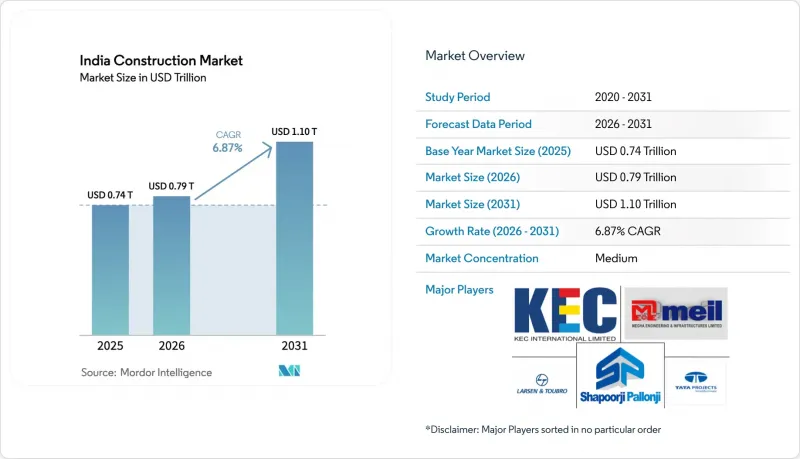
This report is Segmented by Sector (Residential, Commercial and Infrastructure), by Construction Type (New Construction and Renovation), by Construction Method (Conventional On-Site, and More), by Investment Source (Public and Private), and by Region (North India, South India, West India, East India and Central India). The Market Forecasts are Provided in Terms of Value (USD).
India Construction Market Trends and Insights
Front-Loaded FY26 Infrastructure Capex Surge
Union Budget 2025-26 earmarked USD 133.3 billion for transport, logistics, and power corridors, a 10.2% year-on-year bump that aims to complete 70% of National Infrastructure Pipeline projects by 2028. Highway awards touched 8,500 kilometers in FY 2024-25, 60% of which followed the hybrid annuity model that spreads revenue risk between public and private partners. Cement dispatches advanced 9.2% in the first nine months of FY 2025-26, mirroring the surge in site mobilizations. Dedicated Freight Corridor milestones are shaving rail transit times in half, strengthening just-in-time supply chains for auto and electronics clusters. Price-escalation clauses now appear in 85% of National Highways Authority of India contracts, buffering contractors against raw-material volatility.
500 GW Renewable-Energy Target Fueling Utility EPC Boom
India added 70 GW of solar and wind capacity in 2025, keeping the 500 GW by 2030 pledge on track. Solar Energy Corporation of India auctions cleared 40 GW at a record-low average tariff of INR 2.45/kWh, enhancing bankability for developers. Rajasthan and Gujarat claimed 45% of new solar megawatts thanks to high irradiation and land-availability policies. Offshore-wind seabed leases totaling 10 GW were awarded off Gujarat and Tamil Nadu, with construction slated for 2027. Power Grid Corporation locked in USD 2.16 billion of high-voltage transmission awards to evacuate intermittent generation, cementing grid-build as a parallel demand engine.
Volatile Imported Bitumen & Metal Prices Compressing Margins
Imported bitumen prices jumped 18% year-on-year during H1 2025 amid Middle-East supply disruptions and a weaker rupee, driving 200-300 basis-point margin squeezes for fixed-price contracts. Steel rebar swung between USD 650 and USD 735 per ton, mirroring coking-coal volatility. Legacy projects lacking escalation clauses remain exposed, although 85% of new NHAI contracts now tie payments to wholesale indices. EPC leaders are signing 12-18-month supply pacts with domestic mills, while MoRTH approved polymer-modified and recycled asphalt for 30% of new carriageways, aiming to trim import dependency. Cost turbulence is also spurring broader adoption of structural steel optimization software to cut tonnage per lane-kilometer.
Other drivers and restraints analyzed in the detailed report include:
- UIDF-Backed Tier-2/3 Urban Infrastructure Projects
- Defense-Corridor Investments Catalyzing Supplier-Park Construction
- Rising Land-Acquisition Litigation Under Bharatmala 2.0
For complete list of drivers and restraints, kindly check the Table Of Contents.
Segment Analysis
Infrastructure construction is projected to grow at a 9.49% CAGR through 2031, while residential construction held a 44.68% market share in India in 2025. Transportation corridors and renewable-energy assets together pulled in USD 25.2 billion of EPC orders during 2025, buoyed by 70 GW of fresh solar-wind capacity and 8,500 kilometers of highway awards. Defense-corridor supplier parks unlocked early-stage projects such as avionics labs and composites foundries, adding diversity to infrastructure backlogs. Private developers responded by accelerating mixed-use proposals around future expressways, a trend that feeds new townships and roadside logistics hubs. Looking ahead, the construction market size in India for infrastructure is set to benefit from continuing grid investments, offshore-wind foundations, and multimodal freight terminals that require specialized heavy-civil capabilities.
Residential starts softened in 2025 as average home-loan rates touched 9.1%, yet ready-to-move units in Tier-2 cities sold briskly thanks to USD 5.76 billion of Pradhan Mantri Awas Yojana subsidies. Apartments captured three-quarters of residential activity, reflecting land scarcity in mature metros. Villas and plotted developments remained a niche, clustered around Bengaluru's Whitefield and Pune's Hinjewadi where land is 30-40% cheaper than core CBD tracts. REIT appetite for flex workplaces and fulfillment centers is also incentivizing developers to zone excess peri-urban parcels for residential density, blurring sector boundaries. As mortgage rates stabilize, developers are expected to ramp up mid-income launches, buttressed by digital sales platforms and lower construction cycles achieved through modular techniques.
New-builds held 76.88% of the 2025 value, yet renovation is forecast to expand at a 7.96% CAGR as aging 1990s-era towers in Mumbai and Delhi chase LEED and GRIHA upgrades. The Indian Green Building Council logged 45 million ft2 of retrofit certifications in 2025, up 35% year-on-year, reflecting corporate tenants' push for lower energy bills and better air-quality metrics. Facility owners are re-cladding facades with low-emissivity glass, replacing HVAC units, and installing seismic dampers to align with revised BIS norms. Specialist contractors command a 20-25% pricing premium for live-site retrofits, creating a profitable niche that offsets slower greenfield margins. Municipal Smart-City grants worth USD 720 million are underwriting heritage precinct revamps and public-space makeovers, further enlarging the renovation pipeline.
New construction remains dominant in construction industry in India, because large-ticket highways, metro alignments, and township launches continue to rely on virgin land. NHAI steered 85% of its FY 2024-25 awards to fresh alignment builds, underscoring the state's preference for new corridors over widening projects. Developers announced 320 million ft2 of residential launches in 2025, 70% of which fell below the USD 96,000 ticket that qualifies for affordable-housing incentives. Going forward, the India construction market will likely tilt toward a balanced mix of new and retrofit work as climate-aligned refurbishment gains policy traction.
Complete Report Scope:
- By Sector
- Residential
- Apartments/Condominiums
- Villas/Landed Houses
- Commercial
- Office
- Retail
- Industrial and Logistics
- Others
- Infrastructure
- Transportation Infrastructure (Roadways, Railways, Airways, others)
- Energy & Utilities
- Others
- Residential
- By Construction Type
- New Construction
- Renovation
- By Construction Method
- Conventional On-Site
- Modern Methods of Construction (Prefabricated, Modular, etc)
- By Investment Source
- Public
- Private
- By Region
- North India
- South India
- West India
- East India
- Central India
List of Companies Covered in this Report:
- Larsen & Toubro (L&T)
- Megha Engineering & Infrastructures
- Shapoorji Pallonji
- Tata Projects
- KEC International
- Afcons Infrastructure
- Dilip Buildcon
- Hindustan Construction Company
- NCC Limited
- Lodha Group
- Sobha Ltd
- Godrej Properties
- Oberoi Realty
- Ashoka Buildcon
- IRB Infrastructure Developers
- Adani Realty
- GMR Infrastructure
- JMC Projects
- Punj Lloyd
- Essar Projects
- Reliance Infrastructure
Additional Benefits:
- The market estimate (ME) sheet in Excel format
- 3 months of analyst support
TABLE OF CONTENTS
1 Introduction
- 1.1 Study Assumptions & Market Definition
- 1.2 Scope of the Study
2 Research Methodology
3 Executive Summary
4 Market Landscape
- 4.1 Market Overview
- 4.2 Market Drivers
- 4.2.1 Front-loaded FY26 infrastructure capex surge (NIP, Gati Shakti)
- 4.2.2 UIDF-backed Tier-2/3 urban infrastructure projects
- 4.2.3 500 GW renewable-energy target fueling utility EPC boom
- 4.2.4 Defense-corridor investments catalyzing supplier-park construction
- 4.2.5 State-level data-centre incentive corridors in emerging cities
- 4.2.6 REIT-led demand for Grade-A warehousing & flex workspaces
- 4.3 Market Restraints
- 4.3.1 Rising land-acquisition litigation under Bharatmala 2.0
- 4.3.2 Volatile imported bitumen & metal prices compressing margins
- 4.3.3 Sand-mining moratoria driven by water-table depletion
- 4.3.4 ESG-linked lending compliance burden on mid-tier contractors
- 4.4 Value / Supply-Chain Analysis
- 4.4.1 Overview
- 4.4.2 Real Estate Developers and Contractors - Key Quantitative and Qualitative Insights
- 4.4.3 Architectural and Engineering Companies - Key Quantitative and Qualitative Insights
- 4.4.4 Building Material and Equipment Companies - Key Quantitative and Qualitative Insights
- 4.5 Government Initiatives & Vision
- 4.6 Regulatory Landscape
- 4.7 Technological Outlook
- 4.8 Industry Attractiveness - Porter's Five Force Analysis
- 4.8.1 Bargaining Power of Suppliers
- 4.8.2 Bargaining Power of Consumers
- 4.8.3 Threat of New Entrants
- 4.8.4 Threat of Substitutes
- 4.8.5 Intensity of Competitive Rivalry
- 4.9 Pricing (Construction Materials) and Construction Cost (Materials, Labour, Equipment) Analysis
- 4.10 Comparison of Key Industry Metrics of India with Other Countries
- 4.11 Key Upcoming/Ongoing Projects (with a focus on Mega Projects)
5 Market Size & Growth Forecasts (Value, In USD Billion)
- 5.1 By Sector
- 5.1.1 Residential
- 5.1.1.1 Apartments/Condominiums
- 5.1.1.2 Villas/Landed Houses
- 5.1.2 Commercial
- 5.1.2.1 Office
- 5.1.2.2 Retail
- 5.1.2.3 Industrial and Logistics
- 5.1.2.4 Others
- 5.1.3 Infrastructure
- 5.1.3.1 Transportation Infrastructure (Roadways, Railways, Airways, others)
- 5.1.3.2 Energy & Utilities
- 5.1.3.3 Others
- 5.1.1 Residential
- 5.2 By Construction Type
- 5.2.1 New Construction
- 5.2.2 Renovation
- 5.3 By Construction Method
- 5.3.1 Conventional On-Site
- 5.3.2 Modern Methods of Construction (Prefabricated, Modular, etc)
- 5.4 By Investment Source
- 5.4.1 Public
- 5.4.2 Private
- 5.5 By Region
- 5.5.1 North India
- 5.5.2 South India
- 5.5.3 West India
- 5.5.4 East India
- 5.5.5 Central India
6 Competitive Landscape
- 6.1 Market Concentration
- 6.2 Strategic Moves
- 6.3 Market Share Analysis
- 6.4 Company Profiles (includes Global level Overview, Market level overview, Core Segments, Financials as available, Strategic Information, Products & Services, and Recent Developments)
- 6.4.1 Larsen & Toubro (L&T)
- 6.4.2 Megha Engineering & Infrastructures
- 6.4.3 Shapoorji Pallonji
- 6.4.4 Tata Projects
- 6.4.5 KEC International
- 6.4.6 Afcons Infrastructure
- 6.4.7 Dilip Buildcon
- 6.4.8 Hindustan Construction Company
- 6.4.9 NCC Limited
- 6.4.10 Lodha Group
- 6.4.11 Sobha Ltd
- 6.4.12 Godrej Properties
- 6.4.13 Oberoi Realty
- 6.4.14 Ashoka Buildcon
- 6.4.15 IRB Infrastructure Developers
- 6.4.16 Adani Realty
- 6.4.17 GMR Infrastructure
- 6.4.18 JMC Projects
- 6.4.19 Punj Lloyd
- 6.4.20 Essar Projects
- 6.4.21 Reliance Infrastructure
7 Market Opportunities & Future Outlook
- 7.1 White-space & Unmet-need Assessment
- 7.2 Emerging Opportunities in Smart-City & Transit-Oriented Development
- 7.3 Circular-economy Construction Materials

