PUBLISHER: Mordor Intelligence | PRODUCT CODE: 2125711

PUBLISHER: Mordor Intelligence | PRODUCT CODE: 2125711
India Student Accommodation - Market Share Analysis, Industry Trends & Statistics, Growth Forecasts (2026 - 2031)
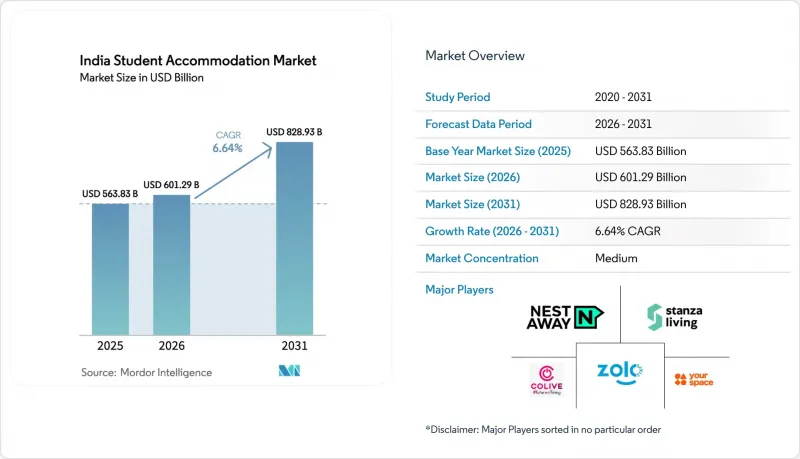
According to Mordor Intelligence, the India student accommodation market size was valued at USD 563.83 billion in 2025 and estimated to grow from USD 601.29 billion in 2026 to reach USD 828.93 billion by 2031, at a CAGR of 6.64% during the forecast period (2026-2031).
This report is Segmented by Room Type (Entire Place/Studio, Private Room, Shared Room), by Institution Type (Universities, Others), by Student Type (Domestic, International), and by Geography (Tier I Cities, Tier II Cities, Tier III & Campus Towns). The Market Forecasts are Provided in Terms of Value (USD).
India Student Accommodation Market Trends and Insights
Surging Domestic & Inbound Enrollments
Enrollment climbed to 43.3 million in 2025, and the target 50% Gross Enrollment Ratio by 2035 could add 25 million more learners. The Indian student accommodation market, therefore, faces structurally higher baseline demand. Federal outlays worth USD 603.35 million (INR 50,077.95 crore) in the 2025-26 budget fund new seats at IITs and medical colleges, creating near-term pressure on the surrounding housing supply. Tier I and emerging Tier II clusters draw most of the incremental intake because 70% of top institutions are located there, escalating competition for quality beds. India's demographic dividend, with 600 million citizens under 25 years, ensures demand persistence, while rising rural aspirations enlarge the migrant student pool beyond traditional metros. Collectively, these factors lock in a multi-year volume runway for the Indian student accommodation market.
Expansion of Higher-Education Campuses
Budget allocations rose to USD 68.52 million for NITs and USD 201.10 million for Central Universities in 2025, accelerating greenfield and brownfield projects. IIT Madras alone commissioned a 1,200-bed hostel at a cost of USD 17.68 million, featuring 4-Star GRIHA certification. Such large-scale dormitory additions stimulate adjacent private accommodation because on-campus beds rarely suffice. Private universities follow suit; REVA University, for example, now offers space for more than 3,000 residents across gender-segregated blocks. Campus development radiates into Tier II and III cities, where land is cheaper and connectivity is improving, widening the geographic footprint of the Indian student accommodation market. New skill centers and AI institutes earmarked at USD 6.02 million each intensify accommodation needs for modular, short-stay cohorts.
High Capex & Long Pay-Back Cycles
Land prices in core Tier I precincts swallow up to half of a PBSA project budget, and construction outlays average INR 2,500 - 4,000 per sq ft (USD 28.39 - 45.42) for mid-scale quality, dragging the break-even horizon to 7-10 years. Debt financing is scarce because most lenders view the sector as conventional commercial real estate, applying higher risk premiums. The India student accommodation industry is therefore tilting toward joint ventures with landowners, asset-light management agreements, and, recently, pilot REIT structures aimed at recycling capital. These mitigation strategies partly offset but do not eliminate the financial intensity that restrains the India student accommodation market over the long term.
Other drivers and restraints analyzed in the detailed report include:
- Parental Shift Toward Managed PBSA
- Government Push via Model Tenancy Act 2021
- Zoning / Development Approval Hurdles
For complete list of drivers and restraints, kindly check the Table Of Contents.
Segment Analysis
Shared rooms maintained 55.12% of the India student accommodation market share in 2025, underscoring price sensitivity among the broad middle-class student cohort. Typical monthly rents of INR 8,000-15,000 (USD 96-181) in Tier II corridors position shared layouts as the most economical choice. Within this mainstream, community living fosters peer networks and divides utility costs, aligning well with undergraduate lifestyles. The segment also sees rising technological upgrades such as app-based maintenance requests, illustrating how digital convenience can coexist with budget models.
Studios, by contrast, log the fastest 8.96% CAGR as higher disposable incomes and privacy preferences flourish among urban affluent families. Safety-oriented parents supporting daughters studying in distant metros gravitate toward this format despite its 20-30% rent premium. Feature sets now include IoT-enabled smart locks, voice-controlled lighting, and bundled high-speed Wi-Fi, enhancing perceived value against conventional PG stock. Hyderabad's 47-floor H1 tower, scheduled for 2026, epitomizes the aspirational end with women-only floors and work-from-home pods. As such, upscale offerings multiply, the studio sub-segment is poised to capture a larger slice of the Indian student accommodation market during the forecast horizon.
Complete Report Scope:
- By Room Type
- Entire Place/Studio
- Private Room
- Shared Room
- By Institution type
- Universities
- Others (Coaching Institutes, EdTech-driven, Test Prep hubs, etc.)
- By Student
- Domestic
- International
- By Geography
- Tier I Cities (Delhi, Mumbai, Bengaluru, Hyderabad, Chennai, and Kolkata)
- Tier II Cities (Pune, Ahmedabad, Jaipur, Chandigarh, Lucknow, Indore, Coimbatore, Kochi, Surat, Nagpur, Bhubaneswar, and Visakhapatnam)
- Tier III & Campus Towns (Mysuru, Madurai, Patna, Raipur, Dehradun, Guwahati, Jodhpur, Kanpur, Varanasi, Mangalore, Udaipur, Trichy, Ranchi, Kota, Manipal, Pilani, Aligarh, and Amritsar)
List of Companies Covered in this Report:
- Stanza Living
- Zolo Stays
- Your-Space
- NestAway
- Colive
- OYO Life
- CoHo
- Placio
- Tribe Stays
- AmberStudent
- UniAcco
- OxfordCaps
- HelloWorld
- StayAbode
- RentMyStay
- ZiffyHomes
- Campus Student Communities
- Weroom
- Homigo
- FF21 Hostels
Additional Benefits:
- The market estimate (ME) sheet in Excel format
- 3 months of analyst support
TABLE OF CONTENTS
1 Introduction
- 1.1 Study Assumptions & Market Definition
- 1.2 Scope of the Study
2 Research Methodology
3 Executive Summary
4 Market Landscape
- 4.1 Market Overview
- 4.2 Market Drivers
- 4.2.1 Surging domestic & inbound student enrolments
- 4.2.2 Expansion of higher-education campuses
- 4.2.3 Parental shift toward managed PBSA
- 4.2.4 Government push via Model Tenancy Act 2021
- 4.2.5 EdTech cohort courses driving short-stay demand
- 4.2.6 Internship clustering in Tier-II IT corridors
- 4.3 Market Restraints
- 4.3.1 High capex & long pay-back cycles
- 4.3.2 Zoning / development approval hurdles
- 4.3.3 Cultural bias against female migration
- 4.3.4 Hybrid & remote learning dampening demand
- 4.4 Value / Supply-Chain Analysis
- 4.5 Regulatory Landscape
- 4.6 Technological Outlook
- 4.7 Industry Attractiveness - Porter's Five Forces Analysis
- 4.7.1 Threat of New Entrants
- 4.7.2 Bargaining Power of Buyers
- 4.7.3 Bargaining Power of Suppliers
- 4.7.4 Threat of Substitutes
- 4.7.5 Intensity of Competitive Rivalry
- 4.8 Impact of Geopolitics on the Student Accommodation Market
5 Market Size & Growth Forecasts (Value, In USD Billion)
- 5.1 By Room Type
- 5.1.1 Entire Place/Studio
- 5.1.2 Private Room
- 5.1.3 Shared Room
- 5.2 By Institution type
- 5.2.1 Universities
- 5.2.2 Others (Coaching Institutes, EdTech-driven, Test Prep hubs, etc.)
- 5.3 By Student
- 5.3.1 Domestic
- 5.3.2 International
- 5.4 By Geography
- 5.4.1 Tier I Cities (Delhi, Mumbai, Bengaluru, Hyderabad, Chennai, and Kolkata)
- 5.4.2 Tier II Cities (Pune, Ahmedabad, Jaipur, Chandigarh, Lucknow, Indore, Coimbatore, Kochi, Surat, Nagpur, Bhubaneswar, and Visakhapatnam)
- 5.4.3 Tier III & Campus Towns (Mysuru, Madurai, Patna, Raipur, Dehradun, Guwahati, Jodhpur, Kanpur, Varanasi, Mangalore, Udaipur, Trichy, Ranchi, Kota, Manipal, Pilani, Aligarh, and Amritsar)
6 Competitive Landscape
- 6.1 Market Concentration
- 6.2 Strategic Moves
- 6.3 Market Share Analysis
- 6.4 Company Profiles {(includes Global level Overview, Market level overview, Core Segments, Financials as available, Strategic Information, Products & Services, and Recent Developments)}
- 6.4.1 Stanza Living
- 6.4.2 Zolo Stays
- 6.4.3 Your-Space
- 6.4.4 NestAway
- 6.4.5 Colive
- 6.4.6 OYO Life
- 6.4.7 CoHo
- 6.4.8 Placio
- 6.4.9 Tribe Stays
- 6.4.10 AmberStudent
- 6.4.11 UniAcco
- 6.4.12 OxfordCaps
- 6.4.13 HelloWorld
- 6.4.14 StayAbode
- 6.4.15 RentMyStay
- 6.4.16 ZiffyHomes
- 6.4.17 Campus Student Communities
- 6.4.18 Weroom
- 6.4.19 Homigo
- 6.4.20 FF21 Hostels
7 Market Opportunities & Future Outlook
- 7.1 White-space & Unmet-Need Assessment

