
PUBLISHER: Mordor Intelligence | PRODUCT CODE: 1906237

PUBLISHER: Mordor Intelligence | PRODUCT CODE: 1906237
Fresh Vegetables - Market Share Analysis, Industry Trends & Statistics, Growth Forecasts (2026 - 2031)
The fresh vegetables market is expected to grow from USD 734.1 billion in 2025 to USD 757.15 billion in 2026 and is forecast to reach USD 883.62 billion by 2031 at 3.14% CAGR over 2026-2031.
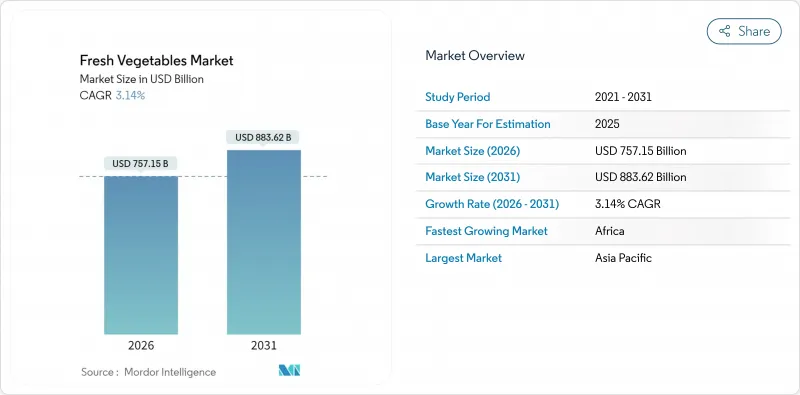
Population growth, widening middle-class purchasing power, and tightening post-pandemic food-security policies are reinforcing baseline consumption while precision agriculture and climate-resilient seed technologies stabilize farm-gate supply. Controlled-environment agriculture (CEA) investments are scaling rapidly, bringing year-round output that dampens seasonal volatility and reduces logistics emissions. At the same time, retailers and food-service operators are pushing traceability mandates that reward growers deploying digital crop-monitoring tools. These intertwined forces drive an incremental yet durable expansion of the fresh vegetable commodity market, even as production faces regulatory pressure on water use, fertilizer emissions, and labor standards in key growing hubs.
Global Fresh Vegetables Market Trends and Insights
Escalating Adoption of Climate-Resilient Seed Varieties
The first major growth lever for the fresh vegetables market is the rapid rollout of drought-tolerant, heat-resistant, and pathogen-resistant cultivars. Public breeding institutes and private seed companies now use genomic selection to compress development cycles from more than a decade to roughly five years, enabling faster alignment with changing agro-climatic zones. In Kenya and India, new tomato and pepper lines tolerate day-time temperatures above 40°C while retaining shelf life, a feature increasingly critical for exporters shipping to high-value EU supermarkets. Smallholders benefit from these traits through higher yield stability and reduced input costs, which in turn underpin steady supply for processors and retailers. Large agribusinesses lock in varietal exclusivity through contract farming, protecting premium margins. As climate variability intensifies, these seeds become indispensable for meeting national food-self-sufficiency targets, reinforcing their long-term positive pull on the fresh vegetable commodity market.
Growing Investment in Controlled-Environment Agriculture Facilities
Controlled-Environment Agriculture (CEA) projects-ranging from high-tech greenhouses to multi-tier vertical farms-are redefining productivity benchmarks. BrightFarms' 1.5 million ft2 hydroponic complex in Pennsylvania yields up to 14 harvests of lettuce per year while cutting water use by 95% compared with open-field benchmarks. Retailers value the tight delivery radii that shrink spoilage and mileage, allowing "harvest today, shelf tomorrow" propositions. Unit economics are improving as LED efficiency climbs and robotics automate transplanting and harvesting. Investors now view CEA assets as infrastructure with predictable multi-cycle cash flows, and sovereign funds in the Gulf are deploying capital to replicate the model across heat-stressed regions. These capacity additions steadily raise the ceiling for the fresh vegetable commodity market over the medium term.
Volatility in Fertilizer Prices Linked to Natural-Gas Swings
Nitrogen costs track spot natural-gas markets, exposing growers to sudden margin erosion. During the 2024 spike, urea prices more than doubled in sub-Saharan ports, prompting Kenyan and Ghanaian farmers to under-apply, curbing yields by up to 12%. Large multinationals hedge exposure through futures and pre-buy contracts, but smallholders lack credit lines, amplifying supply-chain fragility. This restraint shaves volume growth potential within the fresh vegetable commodity market in the near term.
Other drivers and restraints analyzed in the detailed report include:
- Rising Demand for Ready-to-Cook Vegetable Packs from Processors
- AI-Enabled Crop Monitoring Improving Yield Predictability
- Phytosanitary Trade Barriers on Leafy Greens
For complete list of drivers and restraints, kindly check the Table Of Contents.
Segment Analysis
The Global Fresh Vegetables Market Report is Segmented by Geography (North America, Europe, Asia-Pacific, South America, Middle East, and Africa). The Report Includes Production Analysis (Volume), Consumption Analysis (Value and Volume), Export Analysis (Value and Volume), Import Analysis (Value and Volume), and Price Trend Analysis. The Market Forecasts are Provided in Terms of Value (USD) and Volume (Metric Tons).
Geography Analysis
Asia-Pacific generated the largest regional revenue within the fresh vegetables market, with the segment accounting for 45.60% of global value in 2025. Asia-Pacific continues to tower over peers in absolute size, yet the region remains supply-constrained in winter months, prompting volume imports from temperate North Africa and South America when cold snaps curb domestic greenhouse output. The Asia-Pacific fresh vegetable market reached a leading position, yet internal logistics inefficiencies cause 7-10% value loss through spoilage, presenting opportunities for cold-chain investment. China's provincial traceability pilot, now live across 112 prefectures, allocates QR codes down to plot level, curbing counterfeit branding and empowering consumers to verify field practices at the point of sale.
Africa's production landscape is fragmented, yet cross-border initiatives under the African Continental Free Trade Area lower tariff schedules on horticulture to zero for signatories, unclogging flows from surplus zones in Kenya, Tanzania, and Morocco toward deficit urban markets like Lagos and Kinshasa. The fresh vegetables market in Africa is growing at a faster pace, registering the highest 5.13% CAGR through 2031, with regional mechanization rates ticking up from 6 to 9 tractors per 1,000 hectares over five years. Climate adaptation funds are subsidizing solar-powered cold rooms, reducing post-harvest losses of okra and leafy greens, and thereby multiplying farm-gate realization.
North America and Europe showcase mature consumption levels, but value growth remains credible as shoppers pay premiums for local, pesticide-free, and carbon-neutral claims. The United States exported USD 13.67 billion in fresh produce during 2024, aided by unified electronic phytosanitary certification that slices transit times at land borders. Europe's CEA acreage now tops 650 hectares under LED-lit vertical farms, led by the Netherlands and France. Meanwhile, the Middle East leans heavily on technology-intensive production clusters financed by sovereign funds, with Saudi Arabia's National Agricultural Development Company piloting fog-cooled greenhouses that slash summer energy bills by 18%, reinforcing year-round self-sufficiency targets.
- Market Overview
- Market Drivers
- Market Restraints
- Value/Supply-Chain Analysis
- Regulatory Landscape
- Technological Outlook
- PESTLE Analysis
- List of Key Stakeholders
Additional Benefits:
- The market estimate (ME) sheet in Excel format
- 3 months of analyst support
TABLE OF CONTENTS
1 Introduction
- 1.1 Study Assumptions and Market Definition
- 1.2 Scope of the Study
2 Research Methodology
3 Executive Summary
4 Market Landscape
- 4.1 Market Overview
- 4.2 Market Drivers
- 4.2.1 Escalating adoption of climate-resilient seed varieties
- 4.2.2 Growing investment in controlled-environment agriculture (CEA) facilities
- 4.2.3 Rising demand for ready-to-cook vegetable packs from processors
- 4.2.4 Government push for food security post-COVID stock-outs
- 4.2.5 AI-enabled crop monitoring improving yield predictability
- 4.2.6 Expansion of carbon-credit programs for regenerative vegetable farming
- 4.3 Market Restraints
- 4.3.1 Volatility in fertilizer prices linked to natural-gas swings
- 4.3.2 Mounting water-scarcity regulations in arid regions
- 4.3.3 Labor shortages driving up field-harvesting costs
- 4.3.4 Phytosanitary trade barriers on leafy greens
- 4.4 Value/Supply-Chain Analysis
- 4.5 Regulatory Landscape
- 4.6 Technological Outlook
- 4.7 PESTLE Analysis
5 Market Size and Growth Forecasts (Value and Volume)
- 5.1 By Geography (Production Analysis (Volume), Consumption Analysis (Volume and Value), Import Analysis (Volume and Value), Export Analysis (Volume and Value), and Price Trend Analysis)
- 5.1.1 North America
- 5.1.1.1 United States
- 5.1.1.2 Canada
- 5.1.2 South America
- 5.1.2.1 Brazil
- 5.1.2.2 Argentina
- 5.1.3 Europe
- 5.1.3.1 Germany
- 5.1.3.2 France
- 5.1.3.3 Italy
- 5.1.3.4 Russia
- 5.1.4 Asia-Pacific
- 5.1.4.1 China
- 5.1.4.2 India
- 5.1.4.3 Japan
- 5.1.5 Middle East
- 5.1.5.1 Saudi Arabia
- 5.1.5.2 United Arab Emirates
- 5.1.6 Africa
- 5.1.6.1 Egypt
- 5.1.6.2 Kenya
- 5.1.1 North America
6 Competitive Landscape
- 6.1 List of Key Stakeholders
7 Market Opportunities and Future Outlook

