
PUBLISHER: Mordor Intelligence | PRODUCT CODE: 2035090

PUBLISHER: Mordor Intelligence | PRODUCT CODE: 2035090
Malaysia Retail - Market Share Analysis, Industry Trends & Statistics, Growth Forecasts (2026 - 2031)
The Malaysia retail market size is USD 132.28 billion in 2026 and is projected to reach USD 159.96 billion by 2031 at a 3.87% CAGR.
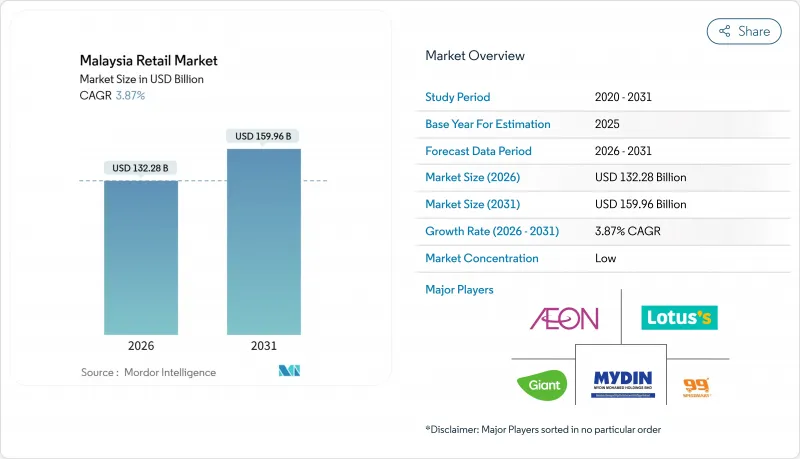
Growth reflects an active transition toward digital commerce, proximity-led formats, and policy shifts that change how consumers and retailers interact. Consumers continue to rebalance budgets toward essentials, guided by cost-of-living pressures and persistent price sensitivity across categories. Consumer inflation moderated to 1.83% in 2024, down from 2.49% in 2023, but essentials such as food, housing, utilities, and transport still account for over 23% of the Consumer Price Index (CPI) basket, keeping value-seeking behavior elevated. These dynamics have driven retailers to expand private labels, entry-price packs, and promotional intensity, particularly in grocery, personal care, and household segments. Policy adjustments around indirect taxes shape pricing and operating costs, which prompts retailers to expand value ranges and efficiency programs.
Malaysia Retail Market Trends and Insights
Rising Disposable Incomes and Middle-Class Expansion
Private consumption remains a core macro anchor and continues to contribute a large share of GDP, with policy support and labor-market stability underpinning spending in 2026. Wage measures and targeted assistance have helped support household budgets, while unemployment stabilized at low levels through late 2025. These trends support essential categories first, which is consistent with the observed resilience in food and grocery baskets during recent price cycles. Malaysia's private consumption, constituting 61% of GDP, is forecast to expand 5.0% in 2025 and 5.1% in 2026, anchored by civil servant salary adjustments under SSPA Phase 2, a minimum wage hike to USD 380.2 (MYR 1,700), and targeted assistance programs.
Government Incentives Accelerating E-Wallet Adoption
Interoperable QR payments continue to lower acceptance friction for small merchants, expanding cashless coverage across convenience formats and neighborhood stores. As of 2024-2025, Malaysia's national DuitNow QR network supports over 2.5 million merchant touchpoints nationwide, making it one of the most widely deployed interoperable QR systems in Southeast Asia. Transaction activity highlights the scale of adoption. During 2024, DuitNow QR transaction volumes expanded at double-digit quarterly growth rates, with cross-border QR usage alone rising about 50% quarter-on-quarter. In the peak December 2024 travel and shopping period, Malaysian merchants using DuitNow QR recorded approximately 6-fold year-on-year revenue growth from participating inbound wallets, reflecting higher ticket sizes and faster checkout throughput. Government digitalization initiatives have supported merchant onboarding and raised awareness of the benefits of QR acceptance for small businesses. National payment rails now handle scaled transaction volumes, which underscores the resilience and reach of the infrastructure. Providers continue to expand features such as instant payment confirmation devices and merchant dashboards, which support bookkeeping and cash management for micro and small retailers. The combined effect is broader acceptance, better visibility of sales flows, and a higher cashless share among daily-use categories.
Inflation-Driven Squeeze on Discretionary Spend
Inflationary pressure through late-2025 and into 2026 has kept household budgets tight and reinforced trade-down behavior. Malaysia's headline inflation averaged ~1.4% in 2025 and is projected to remain between 1.3% and 2.0% in 2026, indicating price stability but limited real relief for discretionary categories as essential costs absorb a large share of income. Essential baskets remain resilient, while large-ticket and lifestyle categories face slower sell-through when prices rise faster than income. In 2024, Malaysia's median monthly household income reached ~USD 1,560, while median monthly disposable income stood at ~USD 1,330, leaving limited headroom for discretionary upgrades after housing, food, utilities, and transport expenses. Company updates show traffic gains can still occur even when average unit value softens, which supports a defense-first approach to category management. Forward guidance from official sources points to stable inflation in 2026, which should support a gradual return of discretionary spending if wage gains hold.
Other drivers and restraints analyzed in the detailed report include:
- Rapid Urbanisation Fuelling Mini-Mart Penetration
- E-Commerce & Omnichannel Retail Boom
- Margin Pressure from Regional E-Commerce Giants
For complete list of drivers and restraints, kindly check the Table Of Contents.
Segment Analysis
Food, Beverage, and Tobacco accounted for 57.39% of the Malaysia retail market share in 2025, which underscores the resilience of essential spending as budgets tighten and households prioritize staples. The category continues to benefit from steady population growth and stable volume patterns, which support footfall in proximity and mass formats. Category management has focused on pack-size variety, private label, and basic first assortments that protect transaction counts. Operators with efficient sourcing and low distribution costs defend price points better and retain loyalty when discretionary wallets contract. These patterns reinforce a steady base in the Malaysia retail market across a volatile macro backdrop.
Electronic and Household Appliances are the fastest growing product category through 2031 and are projected to lead value growth as deferred upgrades return. The Malaysia retail market size for Electronic and Household Appliances is projected to expand at a 4.65% CAGR through 2031 as device cycles, connectivity upgrades, and home-improvement needs normalize. Retailers combine online discovery with in-store demo zones to address service and trust needs that matter in higher-ticket purchases. Inventory and last-mile coordination are key because shoppers expect rapid fulfillment that mirrors marketplace standards. As price sensitivity persists, warranties, financing options, and trade-in programs also support conversion and repeat purchase. The blend of online research and store engagement supports a sustainable path for value creation in this category.
The Malaysia Retail Market Report is Segmented by Product Type (Food, Beverage, and Tobacco Products; Personal Care and Household Care; Apparel, Footwear, and Accessories; and More), Retail Channel (Traditional Mom and Pop Retail; Modern Trade Retail and More), Format (Hypermarkets; Supermarkets; Convenience Stores; Department Stores; Specialty Stores and More). The Market Forecasts are Provided in Terms of Value (USD).
List of Companies Covered in this Report:
- AEON Co. Bhd
- Tesco / Lotus's Malaysia
- GCH Retail
- Mydin Mohamed Holdings
- 99 Speed Mart Retail Holdings
- KK Super Mart & Superstore
- Econsave Cash & Carry
- Jaya Grocer
- Village Grocer
- 7-Eleven Malaysia
- MR DIY Group
- Padini Holdings
- Parkson Corporation
- Watsons Malaysia
- Guardian Health & Beauty
- Lazada Malaysia
- Shopee Malaysia
- Zalora Malaysia
- Senheng New Retail
- Courts Malaysia
- Harvey Norman Malaysia
- IKEA Malaysia
Additional Benefits:
- The market estimate (ME) sheet in Excel format
- 3 months of analyst support
TABLE OF CONTENTS
1 Introduction
- 1.1 Study Assumptions & Market Definition
- 1.2 Scope of the Study
2 Research Methodology
3 Executive Summary
4 Market Landscape
- 4.1 Market Overview
- 4.2 Market Drivers
- 4.2.1 Rising disposable incomes & middle-class expansion
- 4.2.2 Government incentives accelerating e-wallet adoption
- 4.2.3 Rapid urbanisation fuelling mini-mart penetration
- 4.2.4 E-commerce & omnichannel retail boom
- 4.2.5 EPF Account 3 withdrawals boosting near-term spending
- 4.2.6 99 Speed Mart-led logistics efficiencies lowering shelf prices
- 4.3 Market Restraints
- 4.3.1 Inflation-driven squeeze on discretionary spend
- 4.3.2 Margin pressure from regional e-commerce giants
- 4.3.3 Labour shortages in brick-and-mortar operations
- 4.3.4 SST hike on non-essentials dampening demand
- 4.4 Value / Supply-Chain Analysis
- 4.5 Regulatory Landscape
- 4.6 Technological Outlook
- 4.7 Porter's Five Forces
- 4.7.1 Threat of New Entrants
- 4.7.2 Bargaining Power of Suppliers
- 4.7.3 Bargaining Power of Buyers
- 4.7.4 Threat of Substitutes
- 4.7.5 Competitive Rivalry
5 Market Size & Growth Forecasts
- 5.1 By Product Type (Value)
- 5.1.1 Food, Beverage, and Tobacco Products
- 5.1.2 Personal Care and Household Care
- 5.1.3 Apparel, Footwear, and Accessories
- 5.1.4 Furniture, Toys, and Hobby
- 5.1.5 Industrial and Automotive
- 5.1.6 Electronic and Household Appliances
- 5.1.7 Other Products
- 5.2 By Retail Channel (Value)
- 5.2.1 Traditional Mom and Pop Retail
- 5.2.2 Modern Trade Retail
- 5.2.3 E-Commerce and Others
- 5.3 By Format (Value)
- 5.3.1 Hypermarkets
- 5.3.2 Supermarkets
- 5.3.3 Convenience Stores
- 5.3.4 Department Stores
- 5.3.5 Specialty Stores
- 5.3.6 Others (Drugstore, Cash & Carry, Wholesaler)
- 5.4 By Region
- 5.4.1 Peninsular Malaysia
- 5.4.1.1 Northern Region
- 5.4.1.2 Central Region
- 5.4.1.3 Southern Region
- 5.4.1.4 East Coast Region
- 5.4.2 East Malaysia
- 5.4.2.1 Sabah
- 5.4.2.2 Sarawak
- 5.4.2.3 Labuan
- 5.4.1 Peninsular Malaysia
6 Competitive Landscape
- 6.1 Market Concentration
- 6.2 Strategic Moves
- 6.3 Market Share Analysis
- 6.4 Company Profiles (includes Global level Overview, Market level overview, Core Segments, Financials as available, Strategic Information, Market Rank/Share for key companies, Products & Services, and Recent Developments)
- 6.4.1 AEON Co. Bhd
- 6.4.2 Tesco / Lotus's Malaysia
- 6.4.3 GCH Retail
- 6.4.4 Mydin Mohamed Holdings
- 6.4.5 99 Speed Mart Retail Holdings
- 6.4.6 KK Super Mart & Superstore
- 6.4.7 Econsave Cash & Carry
- 6.4.8 Jaya Grocer
- 6.4.9 Village Grocer
- 6.4.10 7-Eleven Malaysia
- 6.4.11 MR DIY Group
- 6.4.12 Padini Holdings
- 6.4.13 Parkson Corporation
- 6.4.14 Watsons Malaysia
- 6.4.15 Guardian Health & Beauty
- 6.4.16 Lazada Malaysia
- 6.4.17 Shopee Malaysia
- 6.4.18 Zalora Malaysia
- 6.4.19 Senheng New Retail
- 6.4.20 Courts Malaysia
- 6.4.21 Harvey Norman Malaysia
- 6.4.22 IKEA Malaysia
7 Market Opportunities & Future Outlook
- 7.1 Social-commerce integration with live-stream shopping
- 7.2 Expansion of rural micro-fulfilment hubs enabling 24-hour delivery

