PUBLISHER: Mordor Intelligence | PRODUCT CODE: 2035140

PUBLISHER: Mordor Intelligence | PRODUCT CODE: 2035140
Japan Road Freight Transport - Market Share Analysis, Industry Trends & Statistics, Growth Forecasts (2026 - 2031)
Japan road freight transport market size in 2026 is estimated at USD 199.35 billion, growing from 2025 value of USD 192.39 billion with 2031 projections showing USD 238.15 billion, growing at 3.62% CAGR over 2026-2031.
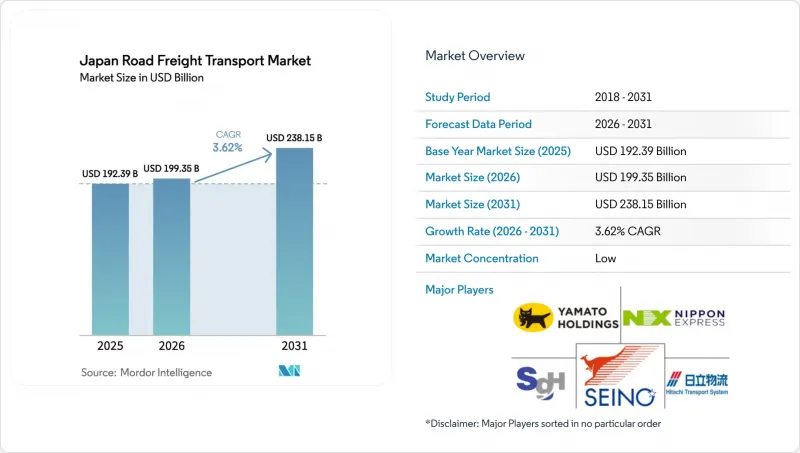
Demand momentum stems from e-commerce volume expansion, renewed wholesale and retail trade activity, and expressway upgrades that shorten transit times. At the same time, the April 2024 cap limiting each truck driver to 960 overtime hours a year reshapes fleet deployment and cost structures, compelling operators to adopt relay transport, double-trailer rigs, and automated route planning. Major carriers with diversified fleets and technology budgets convert these constraints into margin opportunities, whereas smaller firms confront higher unit costs and shrinking bargaining power. Growing cold-chain needs in pharmaceuticals and fresh food, coupled with government programs to shift bulk cargo to rail, further influence competitive strategy.
Japan Road Freight Transport Market Trends and Insights
E-Commerce Boom and Parcel Proliferation
Parcel volumes climbed from 3.9 billion in fiscal 2016 to 4.8 billion in fiscal 2021, compressing delivery windows and pushing carriers to adopt automated sortation and micro-fulfillment hubs. Smaller, more frequent shipments replace bulk orders, raising stop density and reshaping vehicle-utilization models. Major platforms invest in regional distribution centers to meet one-day commitments, while last-mile fleets integrate routing software to offset labor constraints. Capacity strain is most evident along the Tokyo-Osaka corridor where consumer demand concentrates. Fast fulfillment promises sustain the Japan road freight transport market as parcel volumes continue their upward trend.
2024 Logistics-Reform Price Transparency
The 960-hour overtime ceiling exposes true trucking costs, giving carriers leverage to renegotiate rates. Large providers swiftly passed higher labor costs to shippers, while SME operators experienced sticker-shock from shrinking overtime flexibility. Transparent pricing forces retailers and manufacturers to redesign supply chains with realistic freight budgets. Negotiation dynamics now favor carriers, allowing long-overdue margin recovery, especially for rural routes where capacity is tight.
Acute Driver Shortage Under 960 H Cap
Surveys show 81.4% of carriers cannot recruit enough drivers, with long-haul operators worst hit. Excess overtime once masked labor scarcity; legal limits now expose a deficit that may ground one-third of fleets by 2026 if unaddressed. Young workers reject trucking due to lifestyle concerns, while retirements accelerate. Regional freight could face service gaps unless collaborative delivery or autonomous solutions scale quickly.
Other drivers and restraints analyzed in the detailed report include:
- Expressway Expansion and 25 M Double-Trailer Permits
- Same-Day Delivery and Cold-Chain Growth
- Rising Diesel and Toll Costs for SMEs
For complete list of drivers and restraints, kindly check the Table Of Contents.
Segment Analysis
Wholesale and retail trade generated 46.05% of the Japan road freight transport market size in 2025 and is forecast to have a 4.05% CAGR between 2026-2031. Integrated omnichannel models merge store restocking with direct-to-consumer parcels, allowing carriers to pool volumes across fast-moving consumables and durable goods. High shipment frequency raises demand for cross-docking hubs near urban centers where real estate is scarce and expensive. Warehouses deploy robotic sorters to manage parcel surges during flash-sale events. Manufacturing traffic remains sizeable, but lean production curbs truck-kilometers per unit. Construction logistics hinges on public works spending cycles and mega-projects related to coastal protection upgrades.
Aging populations shape rural consumption trends, prompting medical supply deliveries and grocery replenishment programs run by municipal governments. Cold-chain complexity grows in fresh food and pharmaceutical wholesale, strengthening margins for specialized fleets. Meanwhile, the oil and mining sectors retain stable but low-growth demand as the energy transition moderates fossil-fuel transport volumes. The segment's scale ensures its continued dominance within the Japan road freight transport market.
The market remains 100% domestic, reflecting Japan's island geography and intricate internal trade flows. Imports and exports rely on road transport only for first and last mile moves between ports or airports and inland facilities.
Continued expressway expansion, updated tolling systems, and smart-gate technology at distribution centers sharpen domestic route efficiency and sustain the Japan road freight transport market's growth trajectory.
Full-truck-load kept 82.35% share in 2025 as it remains indispensable for bulk shipments between factories and distribution centers. Still, less-than-truck-load recorded the top growth rate at 4.02% CAGR between 2026-2031 on the back of e-commerce order fragmentation. Digital marketplaces match smaller consignments with truck space, lifting load factors and lowering cost per unit. Relay operations help FTL fleets comply with driver work-hour rules while maintaining line-haul schedules. LTL's agility meets inventory-light retail strategies, supporting continuous replenishment of micro-fulfillment sites.
Growth in LTL nudges carriers to invest in dynamic routing algorithms that cut empty mileage. Consolidation depots positioned at expressway interchanges combine different shippers' parcels into single runs, improving network density. The progress of LTL confirms a structural pivot toward flexible distribution within the Japan road freight transport industry.
The Japan Road Freight Transport Market Report is Segmented by End User Industry (Manufacturing, and More), Destination (Domestic and International), Truckload Specification (FTL and LTL), Distance (Long Haul and Short Haul), Goods Configuration (Fluid Goods and Solid Goods), Temperature Control (Non-Temperature and Temperature Controlled), and by Containerization. The Market Forecasts are Provided in Terms of Value (USD).
List of Companies Covered in this Report:
- DHL Group
- Fukuyama Transporting Co., Ltd.
- Japan Post Co., Ltd.
- K R S Corporation
- Kintetsu Group Holdings Co., Ltd.
- Konoike Group (including Konoike Transport Co., Ltd.)
- LOGISTEED, Ltd.
- Marubeni Logistics Corporation
- Mitsui-Soko Holdings Co., Ltd.
- MOL Logistics Co., Ltd.
- Nippon Express Holdings
- Nisshin Transportation Co., Ltd.
- NYK Line (Including Yusen Logistics Co., Ltd.)
- Sankyu, Inc.
- SBS Holdings, Inc.
- Seino Holdings Co., Ltd.
- Senko Group Holdings Co., Ltd.
- SG Holdings Co., Ltd.
- Trancom Co., Ltd.
- Yamato Transport Co., Ltd.
Additional Benefits:
- The market estimate (ME) sheet in Excel format
- 3 months of analyst support
TABLE OF CONTENTS
1 Introduction
- 1.1 Study Assumptions and Market Definition
- 1.2 Scope of the Study
2 Research Methodology
3 Executive Summary
4 Market Landscape
- 4.1 Market Overview
- 4.2 GDP Distribution by Economic Activity
- 4.3 GDP Growth by Economic Activity
- 4.4 Economic Performance and Profile
- 4.4.1 Trends in E-Commerce Industry
- 4.4.2 Trends in Manufacturing Industry
- 4.5 Transport and Storage Sector GDP
- 4.6 Logistics Performance
- 4.7 Length of Roads
- 4.8 Export Trends
- 4.9 Import Trends
- 4.10 Fuel Pricing Trends
- 4.11 Trucking Operational Costs
- 4.12 Trucking Fleet Size by Type
- 4.13 Major Truck Suppliers
- 4.14 Road Freight Tonnage Trends
- 4.15 Road Freight Pricing Trends
- 4.16 Modal Share
- 4.17 Inflation
- 4.18 Regulatory Framework
- 4.19 Value Chain and Distribution Channel Analysis
- 4.20 Market Drivers
- 4.20.1 E-Commerce Boom and Parcel Proliferation
- 4.20.2 2024 Logistics-Reform?Driven Price Transparency
- 4.20.3 Expressway Expansion and 25 M Double-Trailer Permits
- 4.20.4 Same-Day Delivery and Cold-Chain Growth
- 4.20.5 Dedicated Autonomous Truck Lanes Roll-Out
- 4.20.6 "Autoflow-Road" Conveyor-Belt Corridor Vision
- 4.21 Market Restraints
- 4.21.1 Acute Driver Shortage Under 960 H Cap
- 4.21.2 Rising Diesel and Toll Costs for SMEs
- 4.21.3 <35 % Load Factor and 12 % Pallet Standardization
- 4.21.4 Passenger Traffic-induced Expressway Congestion
- 4.22 Technology Innovations in the Market
- 4.23 Porter's Five Forces Analysis
- 4.23.1 Threat of New Entrants
- 4.23.2 Bargaining Power of Buyers
- 4.23.3 Bargaining Power of Suppliers
- 4.23.4 Threat of Substitutes
- 4.23.5 Competitive Rivalry
5 Market Size and Growth Forecasts (Value, USD)
- 5.1 End User Industry
- 5.1.1 Agriculture, Fishing, and Forestry
- 5.1.2 Construction
- 5.1.3 Manufacturing
- 5.1.4 Oil and Gas, Mining and Quarrying
- 5.1.5 Wholesale and Retail Trade
- 5.1.6 Others
- 5.2 Destination
- 5.2.1 Domestic
- 5.2.2 International
- 5.3 Truckload Specification
- 5.3.1 Full-Truck-Load (FTL)
- 5.3.2 Less than-Truck-Load (LTL)
- 5.4 Containerization
- 5.4.1 Containerized
- 5.4.2 Non-Containerized
- 5.5 Distance
- 5.5.1 Long Haul
- 5.5.2 Short Haul
- 5.6 Goods Configuration
- 5.6.1 Fluid Goods
- 5.6.2 Solid Goods
- 5.7 Temperature Control
- 5.7.1 Non-Temperature Controlled
- 5.7.2 Temperature Controlled
6 Competitive Landscape
- 6.1 Market Concentration
- 6.2 Key Strategic Moves
- 6.3 Market Share Analysis
- 6.4 Company Profiles (Includes Global Level Overview, Market Level Overview, Core Segments, Financials as Available, Strategic Information, Market Rank/Share for Key Companies, Products and Services, and Recent Developments)
- 6.4.1 DHL Group
- 6.4.2 Fukuyama Transporting Co., Ltd.
- 6.4.3 Japan Post Co., Ltd.
- 6.4.4 K R S Corporation
- 6.4.5 Kintetsu Group Holdings Co., Ltd.
- 6.4.6 Konoike Group (including Konoike Transport Co., Ltd.)
- 6.4.7 LOGISTEED, Ltd.
- 6.4.8 Marubeni Logistics Corporation
- 6.4.9 Mitsui-Soko Holdings Co., Ltd.
- 6.4.10 MOL Logistics Co., Ltd.
- 6.4.11 Nippon Express Holdings
- 6.4.12 Nisshin Transportation Co., Ltd.
- 6.4.13 NYK Line (Including Yusen Logistics Co., Ltd.)
- 6.4.14 Sankyu, Inc.
- 6.4.15 SBS Holdings, Inc.
- 6.4.16 Seino Holdings Co., Ltd.
- 6.4.17 Senko Group Holdings Co., Ltd.
- 6.4.18 SG Holdings Co., Ltd.
- 6.4.19 Trancom Co., Ltd.
- 6.4.20 Yamato Transport Co., Ltd.
7 Market Opportunities and Future Outlook
- 7.1 White-Space and Unmet-Need Assessment

