
PUBLISHER: Mordor Intelligence | PRODUCT CODE: 2043894

PUBLISHER: Mordor Intelligence | PRODUCT CODE: 2043894
United Kingdom Online Travel - Market Share Analysis, Industry Trends & Statistics, Growth Forecasts (2026 - 2031)
The United Kingdom Online Travel Market size market size is expected to grow from USD 29.48 billion in 2025 to USD 31.23 billion in 2026, and is projected to reach USD 41.66 billion by 2031, reflecting a 5.94% CAGR.
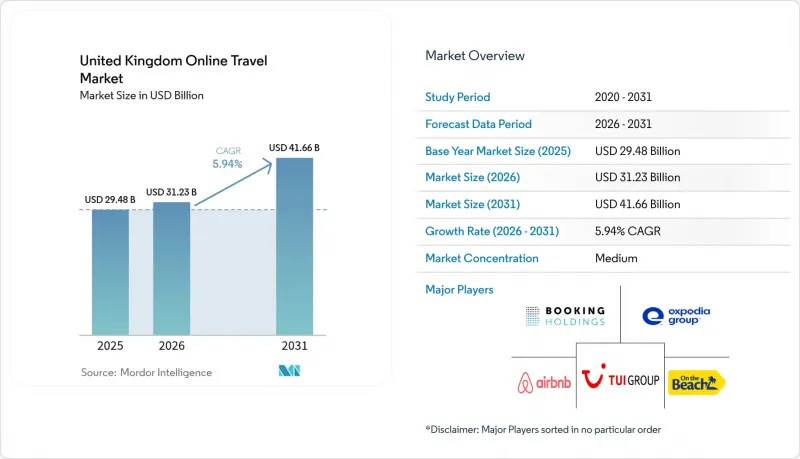
Robust inbound momentum, stronger household prioritization of travel, and a mobile-first booking shift underpin present growth, while reforms to package-travel rules and greater adoption of open banking improve conversion and margins for digital platforms. Inbound visits hit a record level in 2024 and are forecast to continue rising into 2026, reinforcing sustained demand for inventory across accommodation and transportation. Households are shifting travel spending from discretionary to essential in 2026, with surveys indicating a rising intent to increase holiday budgets and a clearer preference for packaged options that simplify decisions and control total costs. Platforms are shifting strategy toward experience bundling, mobile-native checkout, instant refunds, and loyalty-driven retention, while regulatory changes expand the addressable pool of dynamic packages at lower compliance friction. Open Banking's rapid uptake improves settlement speed and reduces fees and chargebacks, which supports reinvestment into product innovation and marketing efficiency.
United Kingdom Online Travel Market Trends and Insights
Leisure rebounds as pent-up demand surges post-pandemic
Inbound visits set a new high in 2024 and are forecast to rise further through 2026, signaling that the demand recovery has moved into a steady expansion phase rather than a short-term spike. Large consumer panels in 2025 indicated that holidays moved up the household priority list, with a rising share of Britons planning to increase spending on trips through 2026. Household data points to travel as one of the fastest-growing categories of outlay, reinforcing that leisure has become a non-negotiable line item in many budgets. This demand shows resilience in the face of currency swings, which suggests that value perception is anchored more in experience quality than in exchange-rate sensitivity. Packaged offers that deliver clarity on total cost and convenience are seeing stronger consideration, which creates room for platforms to scale dynamic combinations of flights, accommodation, and activities.
Mobile bookings and in-app payments see rapid acceleration
Mobile accounted for two-thirds of digital bookings in 2025 and is growing faster than desktop, reflecting consumer comfort with researching and completing purchases on phones. Account-to-account payments gained traction in 2025 as open banking enabled instant settlement, lower processing fees, and fewer chargebacks across large travel portfolios. These rails reduce friction at checkout, which improves conversion on mobile and frees up margin that operators can deploy into pricing, service, and loyalty initiatives. The rise of conversational discovery tools is collapsing the gap between inspiration and purchase, which shifts value toward platforms that can capture intent and close the sale within a single mobile session. As adoption of mobile-native features such as stored profiles, flexible payments, and instant refunds expands, retention improves, and cost to serve declines for well-optimized apps.
United Kingdom card issuers are raising merchant service fees
Higher card-processing costs in the United Kingdom are tightening margins for intermediaries that rely on card rails for a large portion of transactions. This pressure is accelerating the shift to open banking and account-to-account options that offer lower fees, immediate settlement, and better chargeback profiles. As more volume moves to these rails, operators can protect unit economics on price-sensitive segments while improving checkout experience on mobile. The DMCC Act increases enforcement risks around mislabeling or drip pricing, which makes transparent communication of any payment surcharges a compliance priority. Together, these dynamics create margin divergence between platforms that modernize payment stacks and those constrained by legacy arrangements.
Other drivers and restraints analyzed in the detailed report include:
- Dynamic packaging legislation raises commission caps
- "Work-from-anywhere" travel policies gain mainstream acceptance
- Airlines face a capacity crunch due to slot constraints at Heathrow
For complete list of drivers and restraints, kindly check the Table Of Contents.
Segment Analysis
Travel Accommodation held 40.88% of the United Kingdom Online Travel Market share in 2025, while Vacation Packages is forecast to scale at a 10.14% CAGR through 2031. Package consideration is rising into 2026 as travelers seek predictable total cost, streamlined planning, and protection within a single transaction. Regulatory reform scheduled for June 2026 reduces administrative friction for dynamic packaging and clarifies refund obligations, which can expand inventory variety while preserving consumer safeguards. As supply normalizes across airlines and hotels, platforms can scale multi-vertical transactions by combining air, stay, and activities under one itinerary to boost attachment and margin. Larger brands and fast-growing UK specialists are also retooling content partnerships to add cruises, experiences, and insurance, which creates more cross-sell potential across the booking journey.
Vacation Packages benefit from clearer rules around Linked Travel Arrangements, which frees organizers to suggest relevant add-ons without unintentionally assuming organizer liability when the customer assembles the trip. Transportation sub-categories, such as rail and bus, see digital growth as distribution integrates with OTA and corporate channels, while cruise gains visibility through new retailing features. Alternative lodging continues to expand within the accommodation stack, although some urban short-stay categories are navigating tighter local registration and compliance protocols. Ancillaries like tours, activities, and flexible protection products are favorable for contribution margins and can be embedded into flows via APIs. Across these booking services, the United Kingdom Online Travel Industry is prioritizing data governance, consent, and age-appropriate design in line with new data-use rules that phase in from 2025.
Mobile devices booked 67.34% of the United Kingdom Online Travel Market size in 2025 and are forecast to expand at a 9.49% CAGR through 2031. The shift is reinforced by open banking payments that settle instantly, carry lower fees, and reduce disputes, which strengthens unit economics for app transactions. Conversational discovery and assistive AI reduce the number of steps from inspiration to checkout, which gives mobile an advantage in closing intent fast. Younger cohorts continue to research and book on phones at high rates, which supports long-run share gains for mobile in the United Kingdom Online Travel Market.
Desktop and laptop remain important for complex, multi-stop itineraries, where larger screens help compare options across dates, cities, and components. Many shoppers start discovery on mobile and finish purchase on desktop for intricate trips, which means cross-device session stitching and saved carts matter for conversion. Platforms that make total pricing transparent on small screens comply with DMCC obligations while reducing unexpected fees at checkout. Social commerce features embedded into apps deepen engagement by turning trip planning into a collaborative activity rather than a single-user task. This device split allows targeted UX investment by journey type, with mobile optimized for speed and desktop optimized for comparison in the United Kingdom Online Travel Market.
The United Kingdom Online Travel Market is Segmented by Service Type (Transportation, Travel Accommodation, and More), by Booking Type (Desktop & Laptop and Mobile), by Platform Type (Online Travel Agencies, Direct Supplier Websites, and More), by Traveler Type (Leisure, Business, and More), by Region (England, Scotland, and More), and More Segments. The Market Forecasts are Provided in Terms of Value (USD).
List of Companies Covered in this Report:
- Booking Holdings Inc.
- Expedia Group Inc.
- Airbnb Inc.
- TUI Group
- On the Beach Group plc
- Lastminute.com Group
- Skyscanner Ltd.
- Loveholidays Ltd.
- et2 plc (Jet2holidays)
- easyJet plc (easyJet Holidays)
- Trainline plc
- Secret Escapes Ltd.
- Momondo A/S
- TripAdvisor LLC
- Hostelworld Group plc
- Opodo Ltd. (eDreams ODIGEO)
- British Airways Holidays
- Saga Holidays Ltd.
- Co-operative Travel (Midcounties Co-op)
- Trailfinders Ltd.
Additional Benefits:
- The market estimate (ME) sheet in Excel format
- 3 months of analyst support
TABLE OF CONTENTS
1 Introduction
- 1.1 Study Assumptions & Market Definition
- 1.2 Scope of the Study
2 Research Methodology
3 Executive Summary
4 Market Landscape
- 4.1 Market Overview
- 4.2 Market Drivers
- 4.2.1 Leisure rebounds as pent-up demand surges post-pandemic
- 4.2.2 Mobile bookings and in-app payments see rapid acceleration
- 4.2.3 Dynamic packaging legislation raises commission caps
- 4.2.4 "Work-from-anywhere" travel policies gain mainstream acceptance
- 4.2.5 Digital twins of heritage sites enhance immersive trip planning
- 4.2.6 Instant refunds via open banking bolster customer trust
- 4.3 Market Restraints
- 4.3.1 UK card issuers are raising merchant service fees
- 4.3.2 Airlines face a capacity crunch due to slot constraints at Heathrow
- 4.3.3 Data privacy regulations are tightening, especially on third-party cookie tracking
- 4.3.4 Fluctuating GBP-EUR exchange rates are compressing OTA margins
- 4.4 Value / Supply-Chain Analysis
- 4.5 Regulatory Landscape
- 4.6 Technological Outlook
- 4.7 Porter's Five Forces
- 4.7.1 Threat of New Entrants
- 4.7.2 Bargaining Power of Suppliers
- 4.7.3 Bargaining Power of Buyers
- 4.7.4 Threat of Substitutes
- 4.7.5 Competitive Rivalry
5 Market Size & Growth Forecasts
- 5.1 By Booking Service
- 5.1.1 Transportation
- 5.1.1.1 Air Travel
- 5.1.1.2 Bus & Coach Travel
- 5.1.1.3 Rail Travel
- 5.1.1.4 Car Rental
- 5.1.1.5 Cruise
- 5.1.2 Travel Accommodation
- 5.1.2.1 Hotels & Resorts
- 5.1.2.2 Alternative Lodging / Rentals
- 5.1.3 Vacation Packages
- 5.1.4 Others (Activities, Travel Insurance, Ancillary)
- 5.1.1 Transportation
- 5.2 By Device Type
- 5.2.1 Desktop & Laptop
- 5.2.2 Mobile (Smartphone & Tablet)
- 5.3 By Platform Type
- 5.3.1 Online Travel Agencies (OTAs)
- 5.3.2 Direct Supplier Websites
- 5.3.3 Meta-search Engines
- 5.4 By Traveler Type
- 5.4.1 Leisure
- 5.4.2 Business
- 5.4.3 Visiting Friends & Relatives (VFR)
- 5.5 By Age Group
- 5.5.1 Generation Z (18-24)
- 5.5.2 Millennials (25-40)
- 5.5.3 Generation X (41-56)
- 5.5.4 Baby Boomers (57-75)
- 5.6 By Region
- 5.6.1 England
- 5.6.2 Scotland
- 5.6.3 Wales
- 5.6.4 Northern Ireland
6 Competitive Landscape
- 6.1 Market Concentration
- 6.2 Strategic Moves
- 6.3 Market Share Analysis
- 6.4 Company Profiles (includes Global level Overview, Market level overview, Core Segments, Financials as available, Strategic Information, Market Rank/Share for key companies, Products & Services, and Recent Developments)
- 6.4.1 Booking Holdings Inc.
- 6.4.2 Expedia Group Inc.
- 6.4.3 Airbnb Inc.
- 6.4.4 TUI Group
- 6.4.5 On the Beach Group plc
- 6.4.6 Lastminute.com Group
- 6.4.7 Skyscanner Ltd.
- 6.4.8 Loveholidays Ltd.
- 6.4.9 et2 plc (Jet2holidays)
- 6.4.10 easyJet plc (easyJet Holidays)
- 6.4.11 Trainline plc
- 6.4.12 Secret Escapes Ltd.
- 6.4.13 Momondo A/S
- 6.4.14 TripAdvisor LLC
- 6.4.15 Hostelworld Group plc
- 6.4.16 Opodo Ltd. (eDreams ODIGEO)
- 6.4.17 British Airways Holidays
- 6.4.18 Saga Holidays Ltd.
- 6.4.19 Co-operative Travel (Midcounties Co-op)
- 6.4.20 Trailfinders Ltd.
7 Market Opportunities & Future Outlook
- 7.1 White-space & Unmet-Need Assessment

