
PUBLISHER: Mordor Intelligence | PRODUCT CODE: 2043904

PUBLISHER: Mordor Intelligence | PRODUCT CODE: 2043904
Japan Online Accommodation - Market Share Analysis, Industry Trends & Statistics, Growth Forecasts (2026 - 2031)
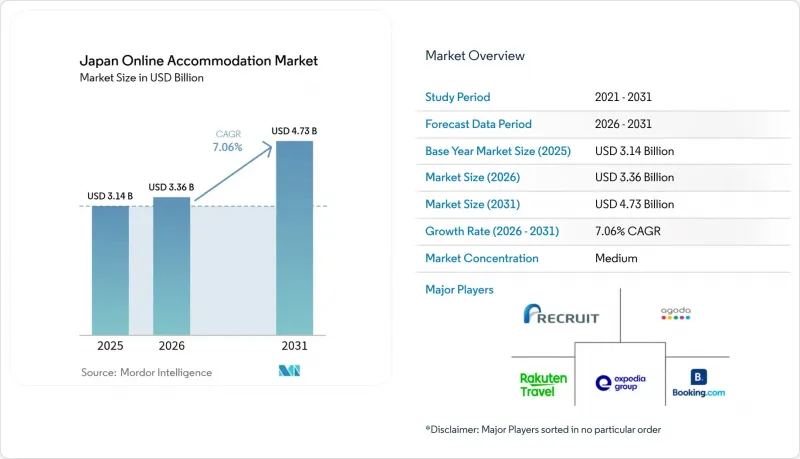
The Japan online accommodation market size was valued at USD 3.14 billion in 2025 and estimated to grow from USD 3.36 billion in 2026 to reach USD 4.73 billion by 2031, at a CAGR of 7.06% during the forecast period (2026-2031).
Growth in 2026 is led by sustained inbound recovery that brought 42.7 million international visitors in 2025, continued channel shift to mobile, and platform innovation that improves conversion and monetization across fragmented inventory. Key distribution and infrastructure factors amplify this channel realignment in 2026. Japan's 5G population coverage reached 98.4% by the end of FY2024 (March 2025), while median download speeds reported by independent measurement providers sustain high-quality visual merchandising that reduces booking friction on phones . Large-scale events and seasonal peaks continue to push major city occupancy higher, with Osaka posting elevated levels across the six-month Expo 2025, reinforcing the appeal of algorithmic revenue tools that smaller operators can now access via packaged APIs. Regional dispersion policies and targeted subsidies are in place in 2026 to spread demand away from the three largest urban areas, which strengthens prospects for faster growth in Kyushu and Okinawa relative to Kanto's larger, steadier base.
Japan Online Accommodation Market Trends and Insights
Travel Subsidies Significantly Boost Domestic Tourism Growth
Prefectural campaigns in 2026 are designed to extend stay lengths and shift bookings into under-visited areas, which supports steadier occupancy outside the three largest metros. Fukushima Prefecture offers traveler subsidies for multi-night tours through February 28, 2026, which directly targets longer-stay behavior and reinforces regional cash flows for smaller operators . These localized incentives pair well with regional transport and onsen access, which platforms can promote through targeted landing pages and app notifications to help shift demand away from peak dates. The policy emphasis on dispersal complements national overtourism measures and enables cross-selling for domestic OTAs that maintain deeper regional supplier relationships. As these programs scale, the Japan online accommodation market benefits from broader geographic conversion and reduced dependence on urban peaks that strain capacity.
Local OTAs Introduce SME-Focused Corporate Travel Bundles
A next-generation travel management platform launched in 2025 targets small and medium enterprises with integrated lodging, transport, and meeting solutions that simplify procurement and compliance. Rakuten Travel expanded its global property coverage in late 2025, allowing SMEs to consolidate domestic and outbound hotel purchases into a single loyalty stack to reduce fragmentation. Airlines and transport partners extend these bundles by exposing accommodation inventory in their apps and loyalty programs to generate ancillary revenue without building proprietary supply systems. These initiatives increase average booking values and improve repeat-purchase frequency, stabilizing seasonality for domestic platforms serving regional business corridors. As these use cases mature, the SME segment expands the addressable base for the Japan online accommodation market and strengthens platform moats via embedded rewards and reporting tools.
Stringent Regulations on Short-Term Rental Zoning and Licensing
Japan's private lodging regime combines a national baseline with municipal overlays, and heritage districts in Kyoto enforce particularly tight residential-area limits to preserve neighborhood character. Local caps and calendar restrictions create uneven availability, shifting bookings toward licensed hotels and ryokans during high season, when lodging demand is concentrated. A national system for real-time verification now improves overall compliance hygiene, but municipalities retain authority to impose stricter rules when housing or quality-of-life concerns escalate. This layered enforcement raises operational complexity and costs for smaller hosts while tilting the field toward professional managers who can navigate local compliance requirements. These constraints moderate the speed at which rentals can scale in core districts and shape how platforms curate listings in the Japan online accommodation market.
Other drivers and restraints analyzed in the detailed report include:
- AI Pricing Strategies Target Osaka Expo 2025 Demand
- Rural Incentives Extend Stays for Digital Nomads
- Hotel Capacity Constraints During Peak Events
For complete list of drivers and restraints, kindly check the Table Of Contents.
Segment Analysis
Mobile applications accounted for 67.16% of bookings by platform in 2025 and are projected to post 11.55% growth through 2031, beating the overall pace as users adopt app-first shopping and checkout flows. The Japan online accommodation market benefits from broad 5G coverage, which reduces latency and supports rich media, making mobile the default interface in both urban and regional settings. Median network speeds sustain high-resolution imagery and virtual tours, closing the experience gap that once favored in-person agents and desktop comparison. App-only promotions and wallet-linked events in the Yahoo! Travel ecosystem increase repeat usage, reinforcing app engagement loops and narrowing the role of desktop in many booking journeys. As these forces compound, mobile's lead becomes a durable feature of the Japan online accommodation market, with discovery, loyalty, and payments integrated into a single screen.
Website-based bookings remain relevant for multi-room groups and policy-heavy corporate itineraries, where larger screens and side-by-side comparisons increase confidence before purchase. AI-enabled search on domestic travel platforms improves result relevance across both the app and the web, and these features often launch first on mobile before being adapted for desktop. Property-side systems now also integrate chat and dynamic packaging tools that streamline higher-touch workflows and free up desktop space during complex negotiations. The Japan online accommodation industry, therefore, maintains a pragmatic dual-channel equilibrium as platforms align product roadmaps and promotional calendars across devices. With 5G coverage still expanding and app features compounding, the balance continues to tilt toward mobile while desktop remains critical for specific planning scenarios.
The Japan Online Accommodation Market Report is Segmented by Platform (Mobile Application, Website), Mode of Booking (Third-Party Online Portals, Direct/Captive Portals), Property Type (Hotels & Resorts, Vacation Rentals, Hostels & Budget Accommodations, Alternate Lodgings), and Geography (Kanto, Kansai, Chubu, Hokkaido & Tohoku, Chugoku & Shikoku, Kyushu & Okinawa). The Market Forecasts are Provided in Terms of Value (USD).
List of Companies Covered in this Report:
- Rakuten Travel
- Jalan (Recruit Co.)
- Booking.com B.V.
- Expedia Group Inc.
- Agoda Company Pte. Ltd.
- Airbnb Inc.
- Trip.com Group Ltd.
- Ikyu Corporation
- Hotels.com
- Travelko
- JTB Corp.
- H.I.S. Co., Ltd.
- ANA X Inc. (ANA Traveler)
- Nippon Travel Agency (Tabimado)
- Loco Partners (Relux)
- Yahoo! Travel (Yahoo Japan)
- Rurubu Travel
- KNT-CT Holdings Co., Ltd.
- Voyagin (Rakuten Group)
- Traveloka Japan
Additional Benefits:
- The market estimate (ME) sheet in Excel format
- 3 months of analyst support
TABLE OF CONTENTS
1 Introduction
- 1.1 Study Assumptions & Market Definition
- 1.2 Scope of the Study
2 Research Methodology
3 Executive Summary
4 Market Landscape
- 4.1 Market Overview
- 4.2 Market Drivers
- 4.2.1 Travel subsidies significantly boost domestic tourism growth
- 4.2.2 5G penetration drives surge in mobile travel bookings
- 4.2.3 Regulatory easing expands vacation rental market supply
- 4.2.4 Local OTAs Introduce SME-Focused Corporate Travel Bundles
- 4.2.5 AI pricing strategies target Osaka Expo 2025 demand
- 4.2.6 Rural Incentives Extend Stays for Digital Nomads
- 4.3 Market Restraints
- 4.3.1 Stringent regulations on short-term rental zoning and licensing
- 4.3.2 Low digital literacy among the aging population
- 4.3.3 Profit margins impacted by super-apps
- 4.3.4 Hotel capacity constraints during peak events
- 4.4 Value / Supply-Chain Analysis
- 4.5 Regulatory Landscape
- 4.6 Technological Outlook
- 4.7 Porter's Five Forces
- 4.7.1 Threat of New Entrants
- 4.7.2 Bargaining Power of Suppliers
- 4.7.3 Bargaining Power of Buyers
- 4.7.4 Threat of Substitutes
- 4.7.5 Intensity of Competitive Rivalry
5 Market Size & Growth Forecasts
- 5.1 By Platform
- 5.1.1 Mobile Application
- 5.1.2 Website
- 5.2 By Mode of Booking
- 5.2.1 Third-party online portals
- 5.2.2 Direct/captive portals
- 5.3 By Property Type
- 5.3.1 Hotels & Resorts
- 5.3.2 Vacation Rentals
- 5.3.3 Hostels & Budget Accommodations
- 5.3.4 Alternate Lodgings (Glamping, Farm-stays)
- 5.4 By Geography
- 5.4.1 Kanto
- 5.4.2 Kansai
- 5.4.3 Chubu
- 5.4.4 Hokkaido & Tohoku
- 5.4.5 Chugoku & Shikoku
- 5.4.6 Kyushu & Okinawa
6 Competitive Landscape
- 6.1 Market Concentration
- 6.2 Strategic Moves
- 6.3 Market Share Analysis
- 6.4 Company Profiles {(includes Global level Overview, Market level overview, Core Segments, Financials as available, Strategic Information, Market Rank/Share for key companies, Products & Services, and Recent Developments)}
- 6.4.1 Rakuten Travel
- 6.4.2 Jalan (Recruit Co.)
- 6.4.3 Booking.com B.V.
- 6.4.4 Expedia Group Inc.
- 6.4.5 Agoda Company Pte. Ltd.
- 6.4.6 Airbnb Inc.
- 6.4.7 Trip.com Group Ltd.
- 6.4.8 Ikyu Corporation
- 6.4.9 Hotels.com
- 6.4.10 Travelko
- 6.4.11 JTB Corp.
- 6.4.12 H.I.S. Co., Ltd.
- 6.4.13 ANA X Inc. (ANA Traveler)
- 6.4.14 Nippon Travel Agency (Tabimado)
- 6.4.15 Loco Partners (Relux)
- 6.4.16 Yahoo! Travel (Yahoo Japan)
- 6.4.17 Rurubu Travel
- 6.4.18 KNT-CT Holdings Co., Ltd.
- 6.4.19 Voyagin (Rakuten Group)
- 6.4.20 Traveloka Japan
7 Market Opportunities & Future Outlook
- 7.1 Integration of MaaS with lodging apps for door-to-door itineraries
- 7.2 Carbon-neutral accommodation listings attracting ESG travellers

