PUBLISHER: Mordor Intelligence | PRODUCT CODE: 2044269

PUBLISHER: Mordor Intelligence | PRODUCT CODE: 2044269
Germany Barbeque Grill - Market Share Analysis, Industry Trends & Statistics, Growth Forecasts (2026 - 2031)
The Germany barbeque grill market size reached USD 406.8 million in 2025, is expected to reach USD 418.47 million in 2026, and is forecast to achieve USD 482.06 million by 2031 at a 2.87% CAGR.
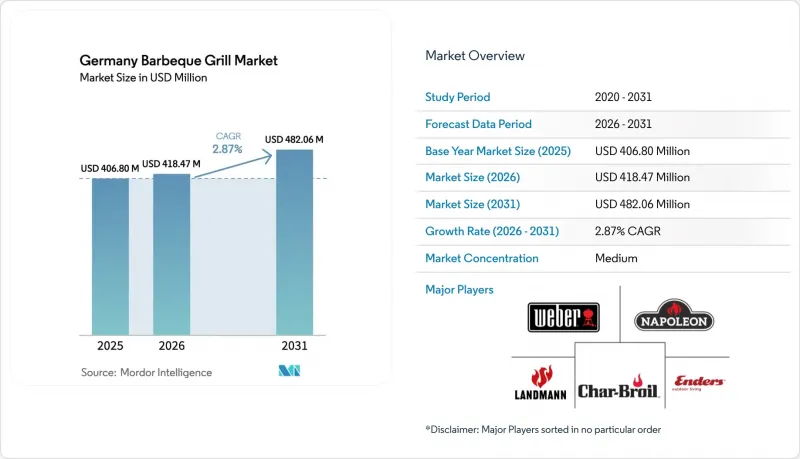
Growth now pivots toward premium feature upgrades, smart connectivity, and balcony-compliant formats that raise average selling prices across core product tiers. Fuel choices are fragmenting as gas retains convenience leadership, while urban regulations and multi-family living steer more households to electric Plug & Cook designs. Design preferences also reflect space constraints, with portable table-top models accelerating even as freestanding units still lead revenue. Technology adoption is shifting toward smart-connected variants as app control and remote monitoring move into mid-tier price bands, supporting a longer-term upgrade cycle across the Germany barbeque grill market.
Germany Barbeque Grill Market Trends and Insights
Strong Cultural Tradition of Grilling, Sustaining Steady Demand
Germany's embedded "Grillen" culture sustains baseline demand as outdoor cooking remains a core leisure activity that extends beyond summer peaks and supports repeat purchases of fuel and accessories across the Germany barbeque grill market. Replacement-driven cycles dominate detached and semi-detached homes, while urban households increasingly adopt compact formats that suit smaller spaces and stricter building rules. Premiumization offsets softer unit volumes as brands bundle accessories, connectivity, and modular side stations, which lifts perceived value and raises average selling prices. New collections use connectivity and accessory ecosystems to justify upgrades, with manufacturers positioning grills as platforms rather than stand-alone appliances. Regional preferences help shape product mixes, with South Germany favoring high-capacity freestanding units and North Germany leaning toward compact balcony-friendly solutions that comply with rental clauses and house rules.
Advances in Grill Safety Technology Are Enhancing Consumer Confidence
Safety upgrades help first-time and urban users overcome concerns around gas leaks, flare-ups, and heat exposure, making onboarding easier in dense residential settings where risk tolerance is lower. Updated GS-mark testing protocols emphasize dimensional accuracy, thermal behavior, and structural rigidity, which signals that certified products can withstand frequent use without premature degradation. Electric platforms add SafeTouch housing and thermal barriers to keep exterior surfaces cooler while delivering high internal temperatures, broadening appeal among families and multi-unit residences. Firelighter compliance under DIN EN 1860-3 pushes reformulation away from problematic compounds, with DIN CERTCO listing hundreds of valid certifications that guide assortments and support premium positioning for verified products. Retailers and installers increasingly anchor merchandising to TUV GS and DIN credentials, which standardize the evaluation of competing units and reduce buyer uncertainty at the point of sale. As these controls become expected features, differentiation migrates to build quality, ease of maintenance, and how software layers enhance safe operation across the Germany barbeque grill market.
Consumer Budget Pressure on Premium SKUs
Household caution continues to temper high-ticket purchases, which elongates replacement cycles and nudges buyers toward value bundles rather than top-of-line configurations. Promotions, accessory bundles, and mid-tier feature sets provide a bridge for families who want connectivity and performance without committing to flagship prices across the Germany barbeque grill market. Retailers respond with seasonal clearance and deferred financing that align with the spring and summer sales peaks to reduce sticker shock and keep sell-through balanced. These tools protect shelf space for premium models while ensuring that entry and mid ranges remain accessible, which helps stabilize unit volumes in a slow-growth spending environment. As real wage tailwinds gather momentum, premium intent may return, but price sensitivity remains an essential planning assumption in the near term.
Other drivers and restraints analyzed in the detailed report include:
- Increasing Smart Home Integration with Grills
- Growth in DIY Home Improvement Is Fueling Backyard Upgrades
- Product Safety and Pollutant Scrutiny Raise Costs
For complete list of drivers and restraints, kindly check the Table Of Contents.
Segment Analysis
Gas grills captured 42.12% of the Germany barbeque grill market size in 2025 on the strength of instant ignition, predictable burner control, and weeknight convenience valued by suburban households. Electric models now build momentum as balcony rules and multi-unit housing encourage 220-volt Plug & Cook usage with the added benefit of app control and quick setup times. Electric is forecast to grow at 3.12% to 2031, supported by connected features and compliance advantages that reduce friction for dense urban living. New designs that combine electric heating with wood-smoke flavor, such as AI-assisted control in consumer models, illustrate how software helps replicate charcoal outcomes without open flames. Pellet formats remain a premium niche with steady temperature holds for long cooks, while hybrid and high-heat infrared burners appeal to enthusiasts who want high-sear capability without sacrificing ease of use.
Compliance frameworks shape assortments and channel access across the Germany barbeque grill market. Conformity to DIN EN 1860 for charcoal systems and DIN EN 498 for gas systems, plus TUV GS-mark testing, remains critical for mass retail listings and reinforces consumer confidence at the point of sale. Charcoal demand still benefits from flavor and tradition, yet municipal emission rules and drought-season restrictions tilt more purchases toward electric formats that minimize particulate output . Gas retains a broad base by balancing flavor, power, and convenience, while electric gains through regulatory alignment and connected features that simplify outdoor cooking for newcomers.
Freestanding grills led revenue in 2025 with a 47.85% share as families sought full-size cooking surfaces, side burners, and rotisserie capacity for entertaining and weekend gatherings. This format remains central in suburban and exurban areas where space permits wheeled carts and larger footprints that support complete meal preparation outdoors. Portable and table-top designs are advancing fastest at a 3.03% CAGR as apartment dwellers prefer fold-flat storage and lighter builds that suit 6 m2 balconies and car trunks. Premium portable lines pack robust heating, modular grates, and easy-clean trays into compact footprints, expanding the appeal of outdoor cooking to renters and first-time buyers who grill weekly rather than daily.
Built-in systems consolidate premium intent within the Germany barbeque grill market, especially in renovation and new-build projects that integrate gas lines and modular cabinetry. ROSLE's built-in configurations showcase die-cast aluminum combustion chambers, multi-burner layouts, and high-temperature side zones that deliver restaurant-level searing within cohesive outdoor kitchens. Manufacturers increasingly offer modular components that allow staged investments and layout flexibility, reducing upfront cost barriers while preserving upgrade paths. As sustainability considerations shape purchasing choices, reusable compact charcoal systems and durable electric griddles gain share at the expense of low-end disposables, which face both environmental headwinds and retailer delisting.
The Germany Barbeque Grill Market Report is Segmented by Fuel Type (Gas Grills, Charcoal Grills, Electric Grills, and More), Product Design (Built-In, Freestanding, Portable/Table-top, and More), Technology (Conventional, Smart/Connected), End-User (Residential, Commercial), Distribution Channel (B2B/Direct, B2C/Retail), and Geography (North, South, and More). Market Forecasts are Provided in Terms of Value (USD).
List of Companies Covered in this Report:
- Weber-Stephen Products LLC
- Landmann GmbH & Co. KG
- Enders Colsman AG
- Rosle GmbH & Co. KG
- Tepro (TEST RITE tepro GmbH)
- Napoleon (Wolf Steel Ltd.)
- Char-Broil LLC
- Broil King (Onward Mfg.)
- Traeger Grills
- Pit Boss (Dansons Inc.)
- Campingaz (Newell)
- Outdoorchef
- Severin Elektrogerate
- Philips home appliances (Versuni)
- George Foreman (Spectrum Brands)
- SharkNinja Operating, LLC.
- LotusGrill GmbH
- Thuros GmbH
- Activa Grillkuche GmbH
- Schickling GmbH
Additional Benefits:
- The market estimate (ME) sheet in Excel format
- 3 months of analyst support
TABLE OF CONTENTS
1 Introduction
- 1.1 Study Assumptions & Market Definition
- 1.2 Scope of the Study
2 Research Methodology
3 Executive Summary
4 Market Landscape
- 4.1 Market Overview
- 4.2 Market Drivers
- 4.2.1 Strong cultural tradition of grilling, sustaining steady demand
- 4.2.2 Advances in grill safety technology are enhancing consumer confidence
- 4.2.3 Increasing smart home integration with grills
- 4.2.4 Expansion of specialty BBQ festivals raises awareness
- 4.2.5 Growth in DIY home improvement is fueling backyard upgrades
- 4.2.6 Development of smokeless grills complying with urban regulations
- 4.3 Market Restraints
- 4.3.1 Consumer budget pressure on premium SKUs
- 4.3.2 Fire bans in forests/parks during droughts
- 4.3.3 Product safety/pollutant scrutiny raises costs
- 4.3.4 Consumer concerns over synthetic materials in grills
- 4.4 Industry Value Chain Analysis
- 4.5 Porter's Five Forces Analysis
- 4.5.1 Threat of New Entrants
- 4.5.2 Bargaining Power of Suppliers
- 4.5.3 Bargaining Power of Buyers
- 4.5.4 Threat of Substitutes
- 4.5.5 Competitive Rivalry
- 4.6 Insights into the Latest Trends and Innovations in the Market
- 4.7 Insights on Recent Developments (New Product Launches, Strategic Initiatives, Investments, Partnerships, JVs, Expansion, M&As, etc.) in the Market
5 Market Size & Growth Forecasts
- 5.1 By Fuel Type
- 5.1.1 Gas Grills
- 5.1.2 Charcoal Grills
- 5.1.3 Electric Grills
- 5.1.4 Pellet Grills
- 5.1.5 Hybrid/Alternative Fuel
- 5.1.6 Infrared
- 5.2 By Product Design
- 5.2.1 Built-In
- 5.2.2 Freestanding
- 5.2.3 Portable / Table-top
- 5.2.4 Disposable / Single-use
- 5.3 By Technology
- 5.3.1 Conventional
- 5.3.2 Smart/Connected
- 5.4 By End-User
- 5.4.1 Residential
- 5.4.2 Commercial
- 5.5 By Distribution Channel
- 5.5.1 B2B/Direct from the Manufacturers
- 5.5.2 B2C/Retail - Specialty Stores
- 5.5.3 Home Centers & DIY Stores
- 5.5.4 Mass Merchandisers
- 5.5.5 Online
- 5.5.6 Other Distribution Channels
- 5.6 By Geography
- 5.6.1 North Germany
- 5.6.2 South Germany
- 5.6.3 East Germany
- 5.6.4 West Germany
- 5.6.5 Central Germany
6 Competitive Landscape
- 6.1 Market Concentration
- 6.2 Strategic Moves
- 6.3 Market Share Analysis
- 6.4 Company Profiles {(includes Global level Overview, Market level overview, Core Segments, Financials as available, Strategic Information, Market Rank/Share for key companies, Products & Services, and Recent Developments)}
- 6.4.1 Weber-Stephen Products LLC
- 6.4.2 Landmann GmbH & Co. KG
- 6.4.3 Enders Colsman AG
- 6.4.4 Rosle GmbH & Co. KG
- 6.4.5 Tepro (TEST RITE tepro GmbH)
- 6.4.6 Napoleon (Wolf Steel Ltd.)
- 6.4.7 Char-Broil LLC
- 6.4.8 Broil King (Onward Mfg.)
- 6.4.9 Traeger Grills
- 6.4.10 Pit Boss (Dansons Inc.)
- 6.4.11 Campingaz (Newell)
- 6.4.12 Outdoorchef
- 6.4.13 Severin Elektrogerate
- 6.4.14 Philips home appliances (Versuni)
- 6.4.15 George Foreman (Spectrum Brands)
- 6.4.16 SharkNinja Operating, LLC.
- 6.4.17 LotusGrill GmbH
- 6.4.18 Thuros GmbH
- 6.4.19 Activa Grillkuche GmbH
- 6.4.20 Schickling GmbH
7 Market Opportunities & Future Outlook
- 7.1 Balcony-legal high-heat electric searing solutions
- 7.2 Smart retrofit kits and subscription cooking guidance
- 7.3 Modular small-space outdoor kitchens for urban homes

