PUBLISHER: Mordor Intelligence | PRODUCT CODE: 2061726

PUBLISHER: Mordor Intelligence | PRODUCT CODE: 2061726
Middle East And Africa Travel Insurance - Market Share Analysis, Industry Trends & Statistics, Growth Forecasts (2026 - 2031)
According to Mordor Intelligence, the middle east and africa travel insurance market size is projected to be USD 2.83 billion in 2025, USD 3.01 billion in 2026, and reach USD 5.23 billion by 2031, growing at a CAGR of 11.68% from 2026 to 2031.
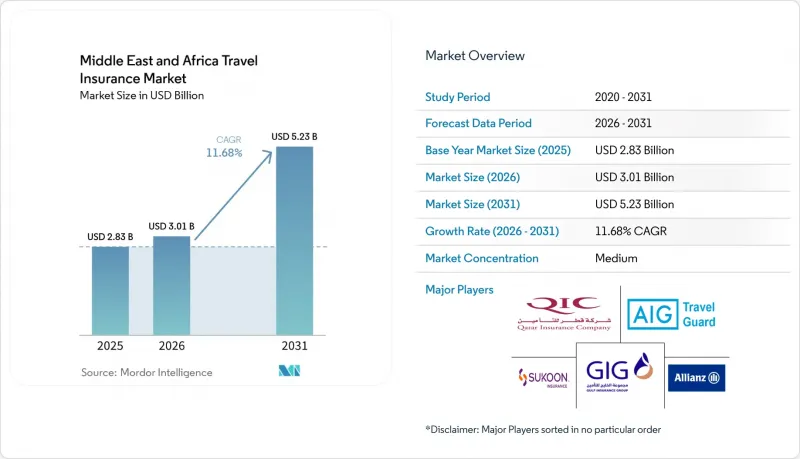
This report is Segmented by Coverage Type (Single Trip, Annual Multi-Trip, and Extended Stays and Others), End User (Senior Citizens, Education Travelers, Business Travelers, and More), Distribution Channel (Insurance Brokers and Agents, Insurance Companies, Banks, and More), and Geography. The Market Forecasts are Provided in Terms of Value (USD).
Middle East And Africa Travel Insurance Market Trends and Insights
Visa-Linked Mandatory Medical Cover in Key Corridors Catalyzing Policy Uptake
Mandatory medical cover across key entry corridors is turning mobility decisions into insured transactions. Inbound health insurance rules within the Gulf are strengthening compliance discipline for visitors and residents, which familiarizes households with health coverage structures and reduces friction when purchasing cross-border travel protection. The United Arab Emirates consolidated insurance oversight under the central bank, tightened licensing, and expanded mandatory health coverage to deepen baseline protection, which also supports a smoother path for travel medical policy adoption when residents and inbound visitors cross borders. Saudi pilgrimage travel adds consistent seasonal demand and reinforces the use of medical coverage for short-duration religious trips, which encourages families to add emergency and travel assistance riders as part of standard trip planning, especially where airlines and agencies bundle options during booking. Gulf regulators have harmonized oversight around anti-money laundering and conduct standards, which is improving policy issuance and claims governance for inbound products sold by licensed insurers. As more outbound travelers from the Middle East consider Europe and other destinations with consular coverage checks, insurers see higher take-up driven by compliance norms and digital checkout flows that reduce time-to-issue. This regulatory framing sustains premium growth in the Middle East and Africa travel insurance market as compliance pathways standardize demand into repeatable purchase behavior.
Airline/OTA Embedded Insurance Expansion Lifting Attach Rates
Embedding travel protection within airline and OTA journeys is raising conversion because coverage is offered at the moment of payment and itinerary confirmation. New card-led programs that pair rewards with built-in insurance are expanding the addressable base among frequent travelers and corporate accounts, which supports higher multi-trip adoption and faster renewals. In February 2026, Riyadh Air and Mastercard launched a global partnership that introduced digital-first cards for consumers and a B2B virtual-card program for the travel trade, with bundled insurance enhancing value for flyers and partners who want seamless settlement and cover in one flow. Insurtech distribution has matured with configurable policy engines and instant underwriting at checkout, so airlines and agencies can localize benefits by route, trip length, and destination risk without manual handling, which supports scale economics in high-volume hubs. Carriers and aggregators report that attach rates improve when coverage is visible during seat and add-on selection, which aligns with customer expectations for one-stop purchase experiences within travel super-apps. Regulatory rules in the UAE that require premiums to be paid directly to insurers are encouraging players to automate settlement through embedded rails, which further professionalize the Middle East and Africa travel insurance market distribution model.
Elevated Visa Refusal Rates Dampening Insured Trip Volumes
High visa refusal rates for some African outbound markets reduce the number of trips that convert into active policies. Travelers often purchase medical coverage and prepare full documentation as part of their application files, but rejected applicants abandon or delay trips, which lowers repeat purchase probability. Families and students are especially sensitive to sunk costs from application processes, so confidence can weaken when approvals are unpredictable. Insurers attempt to cushion this through limited visa-denial riders, but those features require careful documentation and can add complexity to underwriting. When approvals improve in specific corridors, attach rates can rise quickly because applications already include coverage steps that customers understand. Over time, smoother approvals and better transparency would help stabilize demand in the Middle East and Africa travel insurance market.
Other drivers and restraints analyzed in the detailed report include:
- Recovering Middle East Air Travel Volumes and Hub Connectivity
- Digital Aggregators and Bancassurance Widening Distribution in GCC
- FX Controls and Hard-Currency Shortages Constraining Premium Payment and Repatriation
For complete list of drivers and restraints, kindly check the Table Of Contents.
Segment Analysis
Single-trip policies accounted for 62.37% of premium volume in 2025, supported by leisure travel, family itineraries, and pilgrimage flows that align with short-duration coverage. The Middle East and Africa travel insurance market has relied on these products because they align with seasonal demand patterns for inbound and outbound trips to and from Gulf hubs. Airlines and digital platforms have made single-trip issuance fast within the booking flow, and many carriers add policy offers alongside seat selection and baggage, which keeps attach rates visible to casual travelers. Insurers have optimized benefit sets for emergency medical, trip delay, and baggage loss to short travel windows, helping manage pricing for cost-conscious customers. As consumer awareness of health insurance mechanics has improved in the UAE and neighboring markets, travelers more readily add international medical cover to protect against unexpected expenses during short holidays or visits, which sustains this segment's share in the Middle East and Africa travel insurance market. Digital journeys from leading regional insurers now enable near-instant issuance with email confirmation and mobile-wallet support, which reduces abandonment and encourages same-day purchases when visas are granted.
Annual multi-trip policies are projected to grow faster at a 6.88% CAGR through 2031 as corporate mobility normalizes, and frequent travelers seek convenience and predictable coverage. Card-linked programs from banks and airline partnerships keep annual protection always-on for cardholders, which cuts per-journey friction and improves compliance for firms with travel policies. Built-in benefits on premium cards are a key vector, and issuers in the Gulf offer digital claims and simple documentation to speed reimbursements for delays, interruptions, and medical expenses. As destinations diversify and itineraries include multiple stops each quarter, customers favor annual plans that cover cumulative trips without repetitive forms. Embedded insurance at booking also nudges frequent flyers toward upgrades that include broader medical evacuation and high-limit coverage, which makes annual products attractive from a value perspective. The Middle East and Africa travel insurance market is also expanding multi-trip features for families and small businesses, with mobile-first management and omnichannel assistance improving service standards.
List of Companies Covered in this Report:
- Allianz Partners (Allianz Travel)
- GIG Gulf (formerly AXA Gulf)
- AIG (Travel Guard)
- Qatar Insurance Company (QIC)
- Sukoon Insurance (formerly Oman Insurance)
- Abu Dhabi National Insurance Company (ADNIC)
- Orient Insurance
- Union Insurance
- Tawuniya
- RSA Middle East / Liva Insurance
- Europ Assistance (Gulf Assist)
- Qatar Islamic Insurance Company (QIIC)
- Santam
- Hollard Travel Insurance
- AXA Mansard
- Leadway Assurance
- Jubilee Insurance
- Britam
- Liberty
- Wafa Assurance
Additional Benefits:
- The market estimate (ME) sheet in Excel format
- 3 months of analyst support
TABLE OF CONTENTS
1 Introduction
- 1.1 Study Assumptions & Market Definition
- 1.2 Scope of the Study
2 Research Methodology
3 Executive Summary
4 Market Landscape
- 4.1 Market Overview
- 4.2 Market Drivers
- 4.2.1 Visa-linked mandatory medical cover in key corridors (Schengen, GCC inbound) catalyzing policy uptake
- 4.2.2 Airline/OTA embedded insurance expansion (GCC and selected African markets) lifting attach rates
- 4.2.3 Recovering ME air travel volumes and hub connectivity sustaining outbound/inbound trips
- 4.2.4 Digital aggregators and bancassurance widening distribution in GCC
- 4.2.5 Takaful-compliant offerings unlocking demand among Sharia-sensitive segments
- 4.2.6 Student and skilled-worker mobility from MEA to Europe/North America driving education-travel cover
- 4.3 Market Restraints
- 4.3.1 Elevated visa refusal rates for several African outbound markets dampening insured trip volumes
- 4.3.2 Geopolitical/security exclusions and travel advisories limiting cover and itineraries
- 4.3.3 FX controls and hard-currency shortages in parts of Africa constraining premium payment/repatriation
- 4.3.4 Low non-life insurance penetration and price sensitivity suppressing uptake in select African markets
- 4.4 Value / Supply-Chain Analysis
- 4.5 Regulatory Landscape (Middle East and Africa)
- 4.6 Technological Outlook
- 4.7 Porter's Five Forces Analysis
- 4.7.1 Threat of New Entrants
- 4.7.2 Bargaining Power of Suppliers
- 4.7.3 Bargaining Power of Buyers
- 4.7.4 Threat of Substitutes
- 4.7.5 Industry Rivalry
- 4.8 Hajj/Umrah seasonality and inbound-outbound product implications
5 Market Size & Growth Forecasts
- 5.1 By Coverage Type
- 5.1.1 Single Trip
- 5.1.2 Annual Multi-Trip
- 5.1.3 Extended-Stay and Others
- 5.2 By End User
- 5.2.1 Senior Citizens
- 5.2.2 Education Travelers
- 5.2.3 Business Travelers
- 5.2.4 Family Travelers
- 5.2.5 Other End-Users
- 5.3 By Distribution Channel
- 5.3.1 Insurance Companies
- 5.3.2 Banks
- 5.3.3 Insurance Brokers and Agents
- 5.3.4 Insurance Aggregators and Online Platforms
- 5.4 By Geography
- 5.4.1 Middle East
- 5.4.1.1 United Arab Emirates
- 5.4.1.2 Saudi Arabia
- 5.4.1.3 Qatar
- 5.4.1.4 Kuwait
- 5.4.1.5 Bahrain
- 5.4.1.6 Oman
- 5.4.1.7 Israel
- 5.4.1.8 Jordan
- 5.4.1.9 Rest of Middle East
- 5.4.2 Africa
- 5.4.2.1 South Africa
- 5.4.2.2 Nigeria
- 5.4.2.3 Kenya
- 5.4.2.4 Egypt
- 5.4.2.5 Morocco
- 5.4.2.6 Rest of Africa
- 5.4.1 Middle East
6 Competitive Landscape
- 6.1 Market Concentration
- 6.2 Strategic Moves
- 6.3 Market Share Analysis
- 6.4 Company Profiles {(includes Global level Overview, Market level overview, Core Segments, Financials as available, Strategic Information, Market Rank/Share for key companies, Products & Services, and Recent Developments)}
- 6.4.1 Allianz Partners (Allianz Travel)
- 6.4.2 GIG Gulf (formerly AXA Gulf)
- 6.4.3 AIG (Travel Guard)
- 6.4.4 Qatar Insurance Company (QIC)
- 6.4.5 Sukoon Insurance (formerly Oman Insurance)
- 6.4.6 Abu Dhabi National Insurance Company (ADNIC)
- 6.4.7 Orient Insurance
- 6.4.8 Union Insurance
- 6.4.9 Tawuniya
- 6.4.10 RSA Middle East / Liva Insurance
- 6.4.11 Europ Assistance (Gulf Assist)
- 6.4.12 Qatar Islamic Insurance Company (QIIC)
- 6.4.13 Santam
- 6.4.14 Hollard Travel Insurance
- 6.4.15 AXA Mansard
- 6.4.16 Leadway Assurance
- 6.4.17 Jubilee Insurance
- 6.4.18 Britam
- 6.4.19 Liberty
- 6.4.20 Wafa Assurance
7 Market Opportunities & Future Outlook
- 7.1 White-space & unmet-need assessment

